If you have driven down the Ahmedabad-Gandhinagar highway even once in the last five years, you already know something has changed. Fields that once grew bajra and cotton now sit next to glass towers, and "GIFT City" has become the phrase every broker in Gujarat drops into conversation, whether you asked about it or not. For anyone tracking land in Gujarat, GIFT City is no longer a side story — it has become the main reason prices in Gandhinagar and its outer villages are moving the way they are.
This piece breaks down exactly how GIFT City is reshaping the land market around it, which pockets deserve your attention right now, and what a genuinely careful buyer should check before signing anything.
Key Takeaways
- GIFT City's expansion from roughly 1,000 acres to nearly 3,430 acres has pulled five surrounding villages — Shahpur, Ratanpur, Lavarpur, Pirojpur, and Valad — directly into the growth zone.
- Land prices near GIFT City have risen sharply over the past five years, and the effect is now spilling into second-ring localities like Raysan, Kudasan, Koba, and Adalaj.
- The Ahmedabad-Gandhinagar Metro's GIFT City branch has made commute time, not just distance on a map, the new yardstick for land value.
- Agricultural land for sale in Gujarat near the extended GIFT zone carries both opportunity and regulatory homework — conversion status matters more than the sticker price.
- Digital platforms have changed how land actually gets bought and sold here, and selling property online in Gujarat is now the norm rather than the exception.
- Due diligence — title, zoning, TP scheme status, and access roads — decides whether a plot becomes a windfall or a headache.
What Exactly Is GIFT City, and Why Does It Matter for Land Prices?
GIFTCITY of Gujarat, located between Ahmedabad and Gandhinagar on the shores of Sabarmati river, has been envisioned as India’s response to Singapore and Dubai’s financial hubs. It consists of the International Financial Services Centre (IFSC) in India, which is a special economic zone and a residential-commercial core area covering a total of 880 acres of developed land, featuring underground utility pipes, district cooling, and an automatic waste disposal system.
What makes GIFT City different from every other "upcoming hub" you've heard pitched by a broker is that this one is actually functioning. Banks, fintech firms, and exchanges have moved in, employee headcount in the city has crossed 20,000, and the tax incentives attached to the IFSC status keep pulling in more. That steady inflow of working people, each needing somewhere to live, eat, and commute from, is the real engine behind rising land values in the belt around it — not just speculation.
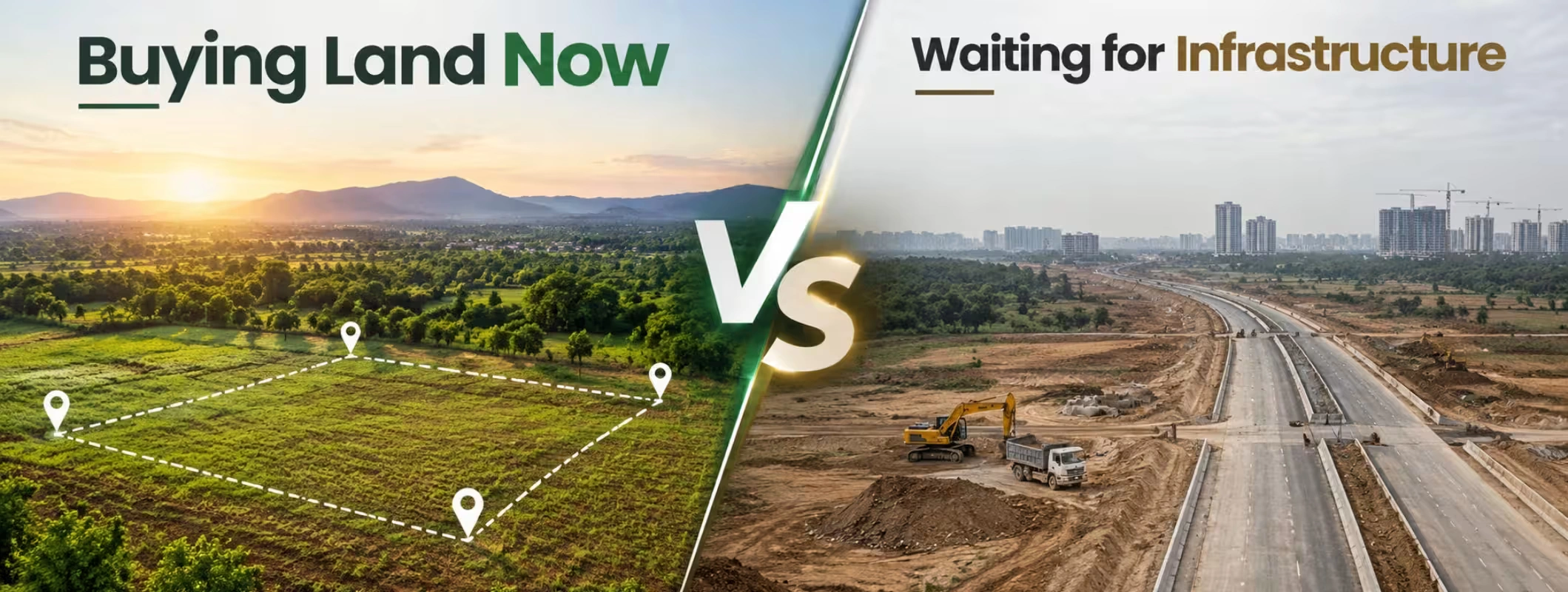
And the story is far from finished. In mid-2026, the Gujarat government unveiled a draft development plan to expand GIFT City almost threefold, from around 1,000 acres to nearly 3,430 acres, to accommodate over a million residents eventually. This "GIFT Extended Zone" will pull in close to 2,441 acres from five neighbouring villages — Shahpur, Ratanpur, Lavarpur, Pirojpur, and Valad — with the new boundary stretching up to NH-48 in the east and the Gandhinagar Bypass Road in the north. For anyone holding or eyeing land in Gujarat within this corridor, that single announcement rewrote the investment map overnight.
Also Read: Land Within 100 KM of Gujarat Border: Future Growth Corridors
How GIFT City Has Already Moved the Needle on Land Prices
Numbers tell this story better than adjectives. Land values in and around GIFT City have climbed from roughly ₹4,300 per square foot five years ago to around ₹7,500 per square foot now — a jump of nearly 74 percent. Residential rentals in the immediate vicinity have followed a similar curve, rising close to 40 percent in the same window, while commercial lease rates in the SEZ area now sit between ₹60 and ₹80 per square foot.
What's more telling is how this appreciation is bleeding outward. It's not just the core zone that's benefiting anymore. Sargasan, Kudasan, and Raysan — localities that were purely residential suburbs a decade ago — are now firmly on every serious investor's shortlist because of their proximity to GIFT City and Infocity. Kudasan, sitting along SH-71 with easy access to both Infocity and the airport, has become one of the fastest-appreciating micro-markets in the entire Gandhinagar region.
I've spoken to a few local land brokers over the past year, and the pattern they describe is consistent: buyers used to ask "how far is it from Gandhinagar city centre," but now the first question is "how far from a GIFT City metro station." That single shift in buyer psychology tells you how much the city's gravitational pull has grown.
The Metro Effect: Why Connectivity Is the New Price Driver
The Ahmedabad-Gandhinagar Metro's Phase 2 corridor, which includes a dedicated branch connecting GNLU to GIFT City, has quietly become one of the biggest value multipliers in this market. All 22 stations on this stretch, including the two on the GIFT City branch, are now operational, linking Motera to Mahatma Mandir and threading through Chandkheda, Koba, Kudasan, Raysan, and Infocity along the way.
This matters because Indian real estate has historically priced land by road distance, which is a poor proxy for how people actually live. A plot four kilometres away by road but stuck behind a level crossing is worse than a plot six kilometres away with a metro station in walking distance. Properties within one to two kilometres of an operational metro line typically see noticeably faster value growth compared to similar plots without that access — and this corridor is a textbook case of that pattern playing out in real time.
If you're mapping out where to buy next, cross-reference any shortlist against the Phase 2 metro stations — Koba Circle, Raysan, Randesan, Sector 1, and the GIFT City branch stops in particular — before you compare price tags.
Areas to Watch Around GIFT City
Here's where things get practical. Not every village near GIFT City is going to appreciate at the same pace, and treating the entire belt as one undifferentiated opportunity is where a lot of first-time investors go wrong. Based on current development plans, infrastructure rollout, and price trends, here are the pockets worth serious attention.
1. Shahpur, Ratanpur, and the GIFT Extended Zone
These are the villages now formally absorbed into the draft GIFT Extended Zone plan. Roughly 2,441 acres across Shahpur, Ratanpur, Lavarpur, Pirojpur, and Valad are earmarked for development, with a permitted Floor Space Index of 2.7 and building heights capped at 25 metres (compared to the 120-metre towers allowed in the core zone). This is a lower-rise, more residential character than the financial core, which actually makes it more relevant for individual land buyers rather than only large developers.
Land here is still priced well below the core GIFT City rates, but it sits directly inside the government's own expansion blueprint — which is about as close to a guaranteed demand trigger as land investment gets in India. The catch is that development plan notifications take time to translate into road infrastructure and utility connections, so this is patient-money territory, not a flip-in-eighteen-months play.
2. Raysan
Raysan has quietly become one of Gandhinagar's most sought-after residential belts, thanks to its green, low-density character combined with genuine proximity to GIFT City, GNLU, and the Ahmedabad-Gandhinagar corridor. Reputed schools and university campuses nearby have made it a magnet for young families and professionals working in GIFT City who don't want to live inside a construction zone. Average property prices here run noticeably below GIFT City's own core rates, which leaves room for further catch-up appreciation.
3. Kudasan
Kudasan is located at a perfect point of connectivity as one road of SH-71 exists on one side and the road of NH-147 on the other side, along with easy access to Infocity, GIFT City, and even the international airport. Kudasan is currently one of the most expensive localities beyond the core area as the market is aware of its worth, but there is scope for sustained growth.
4. Koba and Adalaj
Koba and Adalaj are slightly more distant from GIFT, but they get the advantage of being closer to the Phase 2 metro line as well as being historic sites (with the famed Rudabai Stepwell attracting visitors and development investments). Property in this area is usually less expensive by the square foot compared to that of Raysan and Kudasan, which makes them interesting options for people with an eye toward the future.
5. Sargasan
Sargasan benefits from strong existing social infrastructure — reputed schools, malls, and established corporate offices along SG Highway — combined with continued proximity to GIFT City's growing job base. Prices here remain comparatively accessible, and continued development along SG Highway should keep pushing appreciation over the medium term.
Comparison: Land Zones Around GIFT City at a Glance
Area | Distance/Access to GIFT City | Current Price Positioning | Best Suited For |
GIFT City Core & Extended Zone (Shahpur, Ratanpur) | Inside/adjacent to the notified zone | Premium core; extended zone comparatively affordable | Long-term investors, institutional-style holds |
Raysan | Very close, on metro line | Mid-range, rising steadily | Families, end-users, mid-term investors |
Kudasan | Close, dual highway access | Higher-priced, established | Buyers prioritising infrastructure over discount |
Koba / Adalaj | Slightly further, on metro corridor | Comparatively affordable | Long-horizon, value-focused buyers |
Sargasan | Moderate distance, strong social infra | Accessible pricing | First-time land buyers, budget-conscious families |
Agricultural Land and the GIFT City Ripple Effect
A large share of the plots changing hands in villages around the extended GIFT zone are still technically classified as agricultural land for sale in Gujarat, and this is exactly where inexperienced buyers get tripped up. Agricultural land in Gujarat carries restrictions on who can buy it and how it can be used until it goes through formal non-agricultural (NA) conversion. Just because a village falls inside a government-notified development zone doesn't mean every plot in it is automatically ready for residential or commercial construction.
Before you get excited about a bargain price on farm land for sale in Gujarat near Shahpur or Ratanpur, get clear answers on three things: current land-use classification in revenue records, whether the plot falls inside an approved or draft Town Planning (TP) Scheme, and whether NA conversion has been completed or is even permissible for that specific survey number. Land inside a draft TP scheme often trades at a discount precisely because of this uncertainty — which can be an opportunity if you understand the timeline, or a trap if you don't verify it and simply take a broker's word for it.
A practical example: TP schemes around Gandhinagar have historically taken years to move from draft to final stage, and land values typically jump noticeably once a scheme is finalised and roads get demarcated. Buying early, with full awareness of the risk, is how patient investors have built real gains in this belt — but it only works if you go in with eyes open rather than chasing a low per-square-yard number.
How Land Is Actually Bought and Sold Here Now
The way land transactions happen in Gujarat has changed as much as the land itself. A decade ago, buying a plot near Gandhinagar meant relying almost entirely on a local broker's word, a physical site visit, and whatever paperwork he chose to show you. That model hasn't disappeared, but it's no longer the only option, and frankly, it's no longer the safest one either.
Property listing websites have made it possible to compare plots across multiple villages, check indicative pricing trends, and shortlist options before you ever step onto the site — which saves enormous time when you're evaluating a fast-moving belt like the one around GIFT City. Sellers, too, have adapted. Selling property online in Gujarat now routinely involves listing land with verified documentation, clear photographs, and location-tagged details, rather than depending purely on word-of-mouth within a village network.
This is where a platform like 2Bigha fits naturally into the picture. Built specifically around agricultural and semi-urban land transactions in India, it lets buyers filter listings by location, size, and price, and gives sellers a structured way to reach genuine buyers instead of relying only on local touts. For a market like the GIFT City periphery, where plots are scattered across multiple villages with varying conversion statuses, having a platform that organises this information rather than making you chase it door to door is a genuine practical advantage. If you're seriously evaluating land in Gujarat around this corridor, starting your search on a dedicated platform like 2Bigha before you commit to any single broker's shortlist is a sensible first step.
That said, no listing website replaces physical verification. Treat online listings as your shortlisting tool, not your final due diligence.
Due Diligence Checklist Before You Buy Near GIFT City
Land deals in fast-appreciating corridors attract fast-talking sellers. Slow down and work through this before any advance payment changes hands.
Check | Why It Matters |
7/12 extract and mutation entries | Confirms current ownership and land-use classification |
NA (Non-Agricultural) conversion status | Determines whether the land is legally ready for construction |
TP Scheme status (draft/final) | Affects both current price and future infrastructure timeline |
Encumbrance certificate | Rules out pending loans, disputes, or liens on the plot |
Road access and width | Directly affects future construction approvals and resale value |
Distance to nearest metro station/highway | A key driver of appreciation in this specific corridor |
Local development authority approvals (GUDA/AUDA) | Confirms the plot falls within a recognised planning framework |
If even one of these checks throws up ambiguity, get it resolved in writing before you proceed — a discounted price on unclear land is rarely a genuine discount once legal costs and delays are factored in.
Should You Invest Now, or Wait?
This is the question every buyer eventually asks, and honestly, there's no single right answer — it depends on your horizon and risk appetite. If you're chasing quick appreciation, the core GIFT City zone and Kudasan have already priced in a lot of the obvious upside; you're buying maturity, not discovery, at this stage. If you have a five-to-ten-year horizon and can tolerate some regulatory uncertainty, the extended zone villages and pockets like Koba or Adalaj offer more room to run, precisely because they haven't been fully re-rated by the market yet.
What's changed structurally, though, is that GIFT City is no longer a speculative bet on a plan that might not materialise. It's an operating financial hub with real employment, real infrastructure, and a government-backed expansion plan already on paper. That reduces — though doesn't eliminate — the risk that has historically plagued "upcoming hub" land stories in India that never actually arrived.
One more practical note: if you end up owning a plot that you're not developing immediately, consider engaging a property management service to handle boundary maintenance, tax payments, and periodic site visits, especially if you don't live locally. Vacant land in a high-growth corridor can attract encroachment attempts if it's left completely unattended for long stretches.
What Buyers From Outside Gujarat Should Know
A growing share of enquiries around this corridor now come from NRIs and out-of-state investors who've heard about GIFT City's IFSC status and want a slice of the growth without necessarily relocating. If that's you, a few extra precautions are worth building into your process.
First, never finalise a purchase purely on the basis of photographs and a phone call. Land, unlike an apartment, can look identical from a listing photo whether it's a clean, road-facing plot or a landlocked parcel with disputed access. Either appoint a trusted local representative to physically verify the site and documents, or plan a dedicated visit before any token payment. Second, remember that agricultural land purchase rules in Gujarat, as in most Indian states, restrict who qualifies as an eligible buyer for certain categories of farmland — this is a separate question from NA conversion, and it's worth checking early rather than after you've already negotiated a price. Third, factor in that registration charges, stamp duty, and any pending TP scheme betterment charges can add a meaningful percentage on top of the quoted rate, so always ask for an all-in cost estimate rather than comparing bare per-square-foot figures across sellers.
None of this is meant to discourage outstation buyers — plenty of successful, long-term land investments in this belt have been made by people who live hundreds of kilometres away. It simply means the homework has to happen before the deal, not after.
A Quick Word on Timing the Market
It's tempting to try and time an entry perfectly — buy right before a TP scheme finalises, or right before a new metro station opens. In practice, that level of precision is nearly impossible to pull off consistently, and chasing it often means missing genuinely good opportunities while waiting for a "perfect" entry point that may never arrive cleanly.
A more realistic approach is to think in terms of the development stage rather than calendar dates. Land in a notified but still-draft TP scheme, in a village with confirmed metro or highway access already under construction, tends to offer the best balance of price and reduced uncertainty. You're not buying purely speculative land with no infrastructure commitment, but you're also not paying core-zone prices for land that's already fully matured. Several of the areas discussed above — particularly the newly notified extended zone villages and pockets around Koba and Adalaj — currently sit in exactly that middle stage.
Disclaimer: This article is for general informational purposes only and does not constitute financial, legal, or investment advice. Land prices, government development plans, and regulatory statuses mentioned here are subject to change; readers should verify current details with local authorities, land records offices, and a qualified legal or financial advisor before making any investment decision.