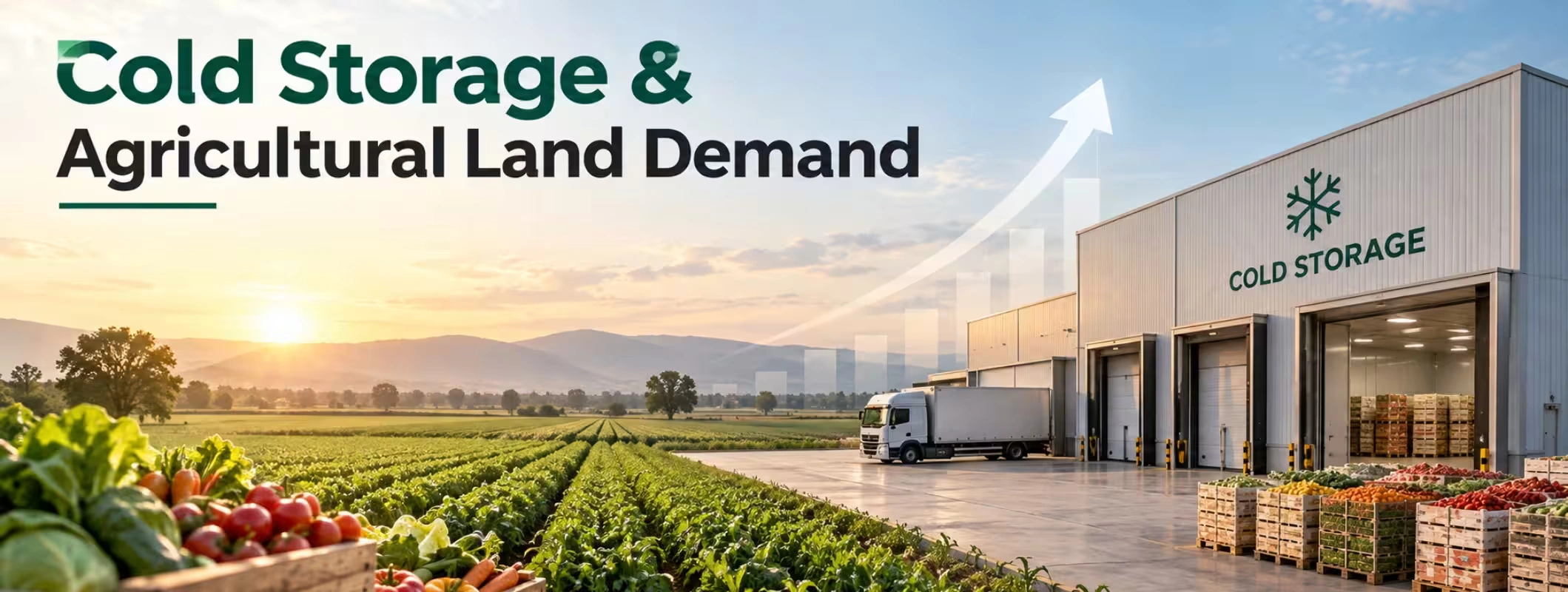
For most of India's farming history, land value came down to a handful of basics: soil quality, water access, and how close a plot sat to a market or main road. Over the last few years, a new factor has quietly worked its way into that list: distance from a cold storage facility. It sounds like a small, technical detail. In practice, it's starting to reshape which farmland sells fast and which sits unsold for years.
If you've been browsing "land for sale near me" or comparing farm land for sale near me in a produce-growing belt lately, you may have noticed something odd: plots close to a cold storage unit are often priced higher and moving faster than nearly identical land just a few kilometres further away.
Why Cold Storage Suddenly Matters So Much?
India loses a significant share of its fruits and vegetables every year simply because there's nowhere nearby to store them properly after harvest. A farmer who can't get produce into cold storage within a day or two of picking often has to sell immediately, at whatever price is on offer that day, or watch the harvest spoil.
Cold storage changes that equation completely. Farmers near a facility can hold produce, wait for better prices, and avoid distress selling. That single advantage is turning "how far is the nearest cold storage" into one of the first questions serious agricultural buyers now ask.
How This Is Playing Out on the Ground?
| Without Nearby Cold Storage | With Nearby Cold Storage |
| Must sell produce within 1-2 days of harvest | Can store and sell when prices are favourable |
| Higher risk of distress selling at low prices | Better bargaining position with buyers |
| Limited to local, immediate buyers | Can supply distant markets, even export |
| Land valued mainly on soil and water | Land valued on soil, water, and storage access |
| Lower and less consistent farmer income | More stable, often higher income |
The gap in this table is exactly why land near cold storage hubs is starting to command a premium, even when the soil quality on paper looks identical to land further away.
Which Crops Are Driving This the Most?
Not every crop benefits equally from nearby cold storage. The effect is strongest for produce that spoils fast and loses value quickly after harvest:
- Potatoes — India's single largest use case for cold storage by volume
- Onions — highly price-volatile, and storage lets farmers avoid selling during price crashes
- Fruits like grapes, mangoes, and pomegranates — especially in belts with export ambitions
- Leafy vegetables and other perishables — increasingly stored for supply to city retail chains
- Dairy and flower cultivation — smaller in scale, but growing in areas near urban demand
Land in these specific crop belts is where the cold storage effect on prices shows up most clearly.
Where Land Demand Is Shifting Because of This?
A few regions are seeing this play out in a visible way:
- Uttar Pradesh and West Bengal potato belts — some of the highest cold storage density in the country, and land prices near these clusters reflect it
- Maharashtra's grape and onion growing regions — particularly around Nashik, where export-linked cold chains have pushed land demand up
- Punjab and Haryana — government-backed cold storage expansion is starting to influence land prices in newer pockets, not just the traditional grain belts
- Himachal Pradesh's apple belt — controlled-atmosphere storage has become almost a requirement for serious apple farming, and land close to these units sees far more buyer interest
What Buyers Should Actually Check Before Buying?
If you're looking at agricultural land on sale with cold storage access as part of your decision, a few practical checks matter more than the general "the area has cold storage" claim:
- Actual distance from the plot to the nearest working facility, not just the nearest town
- Whether that facility has available capacity, or is already running full during peak season
- The type of storage available, some crops need specific temperature and humidity control that not every facility offers
- Transport connectivity between the plot and the facility, since a rough or seasonal road can cancel out the benefit
- Whether the facility is privately run, cooperative-owned, or government-supported, which affects long-term reliability
Skipping these checks is how buyers end up paying a premium for "cold storage nearby" that turns out to be an hour away on a road that floods every monsoon.
What This Means If You're Selling?
If you own land in one of these produce belts, cold storage proximity is now something worth actively highlighting rather than assuming buyers will figure out on their own.
| Do This When Listing | Avoid This |
| State the exact distance to the nearest cold storage facility | Leaving storage access unmentioned |
| Mention the crop types the facility supports | Assuming buyers already know local infrastructure |
| Note road quality between the plot and the facility | Ignoring seasonal access issues |
| Include recent yield or income data if available | Relying only on general soil quality claims |
| List on more than one platform for wider reach | Depending on a single local broker |
Owners exploring selling property online are finding that mentioning cold storage access upfront tends to draw more serious inquiries than a generic listing, simply because buyers have started specifically searching for this feature.
How Buyers Are Actually Searching for This Land?
Understanding buyer search habits helps explain why this detail matters so much for visibility:
- Broad location searches like "land for sale near me", where cold storage access becomes a filtering question once they start comparing plots
- Crop-specific searches such as "farm land for sale near me" from buyers already growing a particular produce
- Direct searches like "farm for sale" from buyers who already know they want an active or semi-active farm, not raw land
- Infrastructure-aware searches, where buyers specifically ask brokers or platforms about nearby storage and processing facilities before shortlisting anything
A listing that answers these questions directly, instead of making a buyer dig for the information, tends to close faster.
How 2Bigha Helps With This?
2Bigha verifies land records and lists relevant nearby infrastructure details, including proximity to facilities like cold storage, so buyers aren't left guessing about something that directly affects the land's practical value. Whether you're an owner considering online land selling for a plot near a growing cold chain hub, or a buyer comparing agricultural land across a few belts, 2Bigha brings the documentation and location details together in one place, rather than leaving buyers to verify everything themselves after the fact.
Disclaimer: This article is for informational purposes only and should not be considered investment, legal, financial, or property advice. Real estate regulations, infrastructure plans, market conditions, and government policies may change over time. Readers are advised to verify information with relevant authorities and consult qualified professionals before making any investment or property-related decisions.