Key Takeaways
- Gujarat’s strongest land-growth opportunities are developing around industrial clusters, expressways, freight routes, financial districts and expanding cities.
- The Ahmedabad–Gandhinagar–GIFT City belt offers a relatively mature urban and employment-led investment story.
- Sanand, Bavla and Changodar remain important manufacturing and logistics locations near Ahmedabad.
- Dholera offers a long-term, infrastructure-led opportunity but carries greater execution, location and speculation risk.
- Vadodara–Anand, Bharuch–Ankleshwar–Dahej, Surat–Hazira–Navsari and Vapi–Valsad–Umbergaon combine existing economic activity with future connectivity.
- Palanpur–Mehsana can benefit from north Gujarat’s freight, highway and industrial links.
- Rajkot–Morbi represents a manufacturing-led Saurashtra opportunity rather than a direct extension of the Ahmedabad–Mumbai corridor.
- Land beside a proposed highway does not automatically become commercial, industrial or developable.
- Buyers must verify title, tenure, permitted use, access, acquisition risk, water availability and infrastructure status before investing.
- The right corridor depends on the intended use: farming, plotted development, warehousing, industrial activity, a farmhouse or long-term appreciation.
Gujarat has one of India’s most extensive networks of ports, industrial estates, highways, freight infrastructure and manufacturing clusters. However, that does not mean every land outside Ahmedabad, Surat or Vadodara is a future real-estate hotspot.
Successful land investment requires a more disciplined approach.
The strongest locations usually sit where multiple growth drivers meet: existing employment, operational industries, legal road access, utilities, transport links, population movement and an approved development framework. A proposed road or industrial announcement can support future demand, but it cannot correct an unclear title, restricted tenure or unusable plot.
This guide examines the most relevant Gujarat growth corridors, their investment potential, suitable land types and the risks buyers should investigate before paying a token amount.
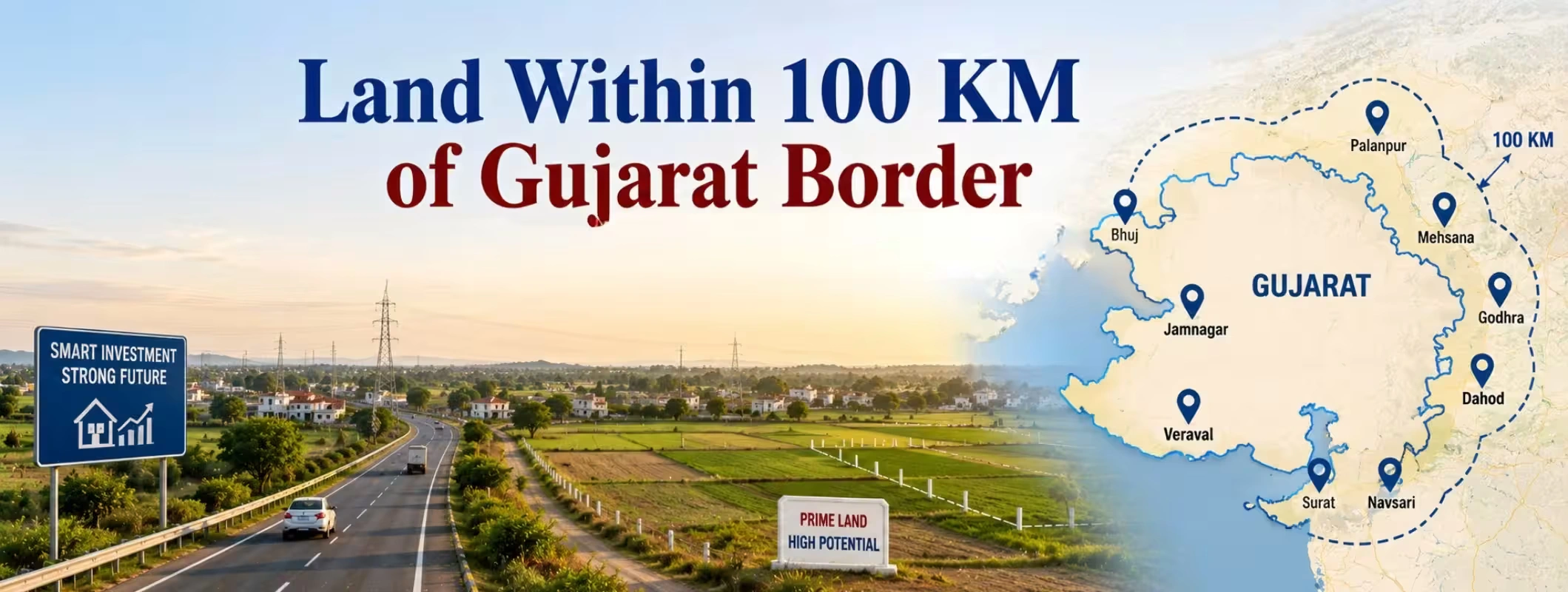
What Does Land Within 100 KM of Gujarat Mean?
Gujarat is a large state rather than a single city, so the phrase land within 100 km of Gujarat can be misleading.
For practical investment analysis, it is better to interpret it as:
Land located within an approximate 100-kilometre driving radius of Gujarat’s major economic centres, industrial nodes, transport corridors or state gateways.
The distance should be measured by the actual motorable route, not a straight line on a map. A plot may appear close to a city but still take two hours to reach because of river crossings, narrow village roads, railway lines or missing links.
This article therefore focuses on land around:
- Ahmedabad and Gandhinagar
- GIFT City
- Sanand, Bavla and Changodar
- Dholera
- Vadodara, Anand, Savli and Halol
- Bharuch, Ankleshwar and Dahej
- Surat, Hazira and Navsari
- Vapi, Valsad and Umbergaon
- Palanpur and Mehsana
- Rajkot and Morbi
These are not equal investment markets. Some already have established employment and infrastructure, while others depend heavily on long-term project execution.
Why Gujarat’s Growth Corridors Matter to Land Buyers
A genuine growth corridor is more than a road.
It develops when transport infrastructure connects employment centres, industrial estates, residential catchments, markets, ports, warehouses and public services. Land values may strengthen when a location becomes easier to reach and gains a practical economic use.
Gujarat’s corridor story is supported by several major systems:
- The Delhi–Mumbai Industrial Corridor
- The Western Dedicated Freight Corridor
- National and state highways
- The Ahmedabad–Dholera Expressway
- Industrial estates and Special Investment Regions
- GIFT City
- Ports and port-linked industrial areas
- The Mumbai–Ahmedabad High-Speed Rail corridor
- Manufacturing clusters around Sanand, Vadodara, Bharuch, Surat, Vapi, Rajkot and Morbi
Official planning identifies six Delhi–Mumbai Industrial Corridor nodes in Gujarat: Dholera–Ahmedabad, Vadodara–Ankleshwar, Palanpur–Mehsana, Bharuch–Dahej, Surat–Hazira and Valsad–Umbergaon.
That provides a useful investment framework. It does not mean land anywhere inside these broad regions will perform equally well.
Gujarat Land-Growth Corridors Compared
| Zone Type | Corridor | Main Growth Driver | Land Potentially Suited To | Market Maturity | Major Risk |
| Ahmedabad–Gandhinagar–GIFT City | Finance, IT, government, urban expansion | Finance, IT, government, urban expansion | Residential, commercial-support uses, approved plotted land | High | Expensive entry and overpricing |
| Sanand–Bavla–Changodar | Manufacturing, semiconductors, logistics | Manufacturing, semiconductors, logistics | Industrial, warehouse, worker housing, selected agricultural land | High to developing | Buying outside usable industrial influence |
| Ahmedabad–Dholera | Expressway, industrial city, planned infrastructure | Expressway, industrial city, planned infrastructure | Long-term industrial, logistics and approved plotted land | Emerging | Speculation and long holding periods |
| Vadodara–Anand–Savli–Halol | Manufacturing, engineering, education, highways | Manufacturing, engineering, education, highways | Industrial, warehouse, residential and peri-urban land | Established | Fragmented local demand |
| Bharuch–Ankleshwar–Dahej | Chemicals, manufacturing, ports and freight | Chemicals, manufacturing, ports and freight | Industrial and logistics land | Established | Pollution, buffers and environmental restrictions |
| Surat–Hazira–Navsari | Textiles, diamonds, heavy industry and urban expansion | Textiles, diamonds, heavy industry and urban expansion | Residential, warehouse, commercial-support and selected farmland | High | High prices and unapproved plotting |
| Vapi–Valsad–Umbergaon | Industry and Mumbai-region access | Industry and Mumbai-region access | Industrial, warehouse, residential and farmhouse land | Established | Flood, pollution and title issues |
| Palanpur–Mehsana | Freight movement, highways and north Gujarat industry | Freight movement, highways and north Gujarat industry | Logistics, warehousing, agriculture and highway-linked land | Developing | Thin demand away from major routes |
| Rajkot–Morbi | Engineering, ceramics and manufacturing | Engineering, ceramics and manufacturing | Industrial, warehouse and selected peri-urban plots | Established | Water, fragmented layouts and local oversupply |
1. Ahmedabad–Gandhinagar–GIFT City Corridor
The Ahmedabad–Gandhinagar region offers one of Gujarat’s clearest employment-led growth stories.
Ahmedabad provides a large urban economy, education base, industrial network and residential market. Gandhinagar adds government institutions, planned sectors and expanding social infrastructure. Between them, GIFT City has developed as a financial and technology district with domestic and international financial activity.
GIFT City’s official platform reported more than 1,000 operational entities, over 20,000 jobs and more than 29 million sq. ft. allotted by 2026.
This is why land near Gandhinagar can attract investors looking for urban spillover rather than purely speculative rural appreciation.
Where opportunity may emerge
Potential demand can develop around:
- Existing Gandhinagar sectors
- Areas with practical access to GIFT City
- Approved residential and mixed-use zones
- Corridors connected to Ahmedabad
- Locations near employment and institutional clusters
However, a village being geographically close to GIFT City is not enough. The actual journey time, development-plan zoning and approach road matter more than map distance.
Suitable investor profile
This belt may suit buyers seeking:
- A relatively mature growth market
- Residential or mixed-use demand
- Proximity to employment
- Better social infrastructure
- A medium- to long-term holding period
Main risk
The GIFT City name is frequently used to market distant plots. Buyers should verify the driving distance, jurisdiction, zoning and legal access rather than accepting phrases such as “GIFT City nearby.”
2. Sanand–Bavla–Changodar Manufacturing Belt
The Sanand side of Ahmedabad has developed into a major manufacturing and industrial ecosystem. Its economic base includes automotive, engineering, warehousing, electronics and semiconductor-linked activity.
In March 2026, the Prime Minister inaugurated the Kaynes Semicon facility at Sanand, adding another major manufacturing milestone to the corridor.
This strengthens the case for rural land near Sanand, but only where the plot has a realistic economic use.
Why this belt matters
Sanand benefits from:
- Proximity to Ahmedabad
- Established industrial activity
- Supplier and ancillary demand
- Highway access
- Workforce movement
- Warehousing and distribution needs
- Connectivity towards Bavla, Changodar and Dholera
A manufacturing facility does not increase the value of every agricultural parcel in the taluka. Demand tends to concentrate near functioning industrial estates, logistics routes, worker catchments and approved development zones.
Potential land uses
Depending on zoning and permission, this corridor may support:
- Industrial units
- Warehouses
- Ancillary manufacturing
- Worker accommodation
- Roadside support businesses
- Long-term peri-urban investment
Practical example
Consider two parcels advertised at similar prices.
One is three kilometres from an industrial estate, has a recorded public road, nearby power infrastructure and a regular shape. The other is closer in straight-line distance but has only a narrow private approach and lies behind several agricultural holdings.
The first plot may have greater practical value even if it is technically farther away.
That is the difference between location on a map and usable connectivity.
3. Ahmedabad–Dholera Growth Corridor
Dholera is Gujarat’s most discussed long-term infrastructure-led land market.
Dholera Special Investment Region spans a much larger planning area, while its Activation Area covers approximately 22.54 sq. km. NICDC states that trunk infrastructure in the Activation Area is substantially developed.
The 109-km Ahmedabad–Dholera Expressway was inaugurated on March 31, 2026, improving direct road connectivity between Ahmedabad and the Dholera region.
These developments make land near Dholera strategically interesting. They do not remove the need for detailed verification.
Why Dholera attracts investors
The investment narrative includes:
- A planned industrial city
- Expressway connectivity
- Large-scale trunk infrastructure
- Manufacturing potential
- Land-use planning under a Special Investment Region framework
- Long-term logistics and employment expectations
What investors often misunderstand
Dholera SIR, Dholera town, nearby villages and private plotted schemes are not the same thing.
A project may use “Dholera” in its marketing even when:
- It lies outside the most active development area
- It does not have approved plotting
- The approach road is weak
- Its land use remains agricultural
- Infrastructure has not reached the site
- The seller’s price assumes future development that may take years
Appropriate investment horizon
Dholera is better suited to patient investors who can tolerate:
- A long holding period
- Uneven development between zones
- Limited immediate rental income
- Regulatory complexity
- Infrastructure execution risk
- Resale liquidity risk
It is not the right place for every buyer seeking quick appreciation.
Most important check
Before considering investment plots near Dholera, identify the survey number on the official development plan. Confirm the land use, town-planning status, road reservation, ownership and applicable development authority.
A brochure map is not an official planning map.
4. Vadodara–Anand–Savli–Halol Corridor
Central Gujarat offers a more diversified and established growth environment than many speculative land markets.
Vadodara has strong engineering, chemicals, manufacturing, education and service-sector activity. Anand adds an established residential, educational and agricultural economy. Savli and Halol support industrial and manufacturing demand.
The Mumbai–Ahmedabad High-Speed Rail alignment also includes stations at Vadodara, Anand and Ahmedabad, although buyers should not assume that station proximity will benefit every surrounding village equally.
Why the corridor is attractive
The belt has:
- Existing industrial estates
- Urban employment
- Educational institutions
- Highway connectivity
- Supplier networks
- Established residential markets
- Access towards Ahmedabad, Bharuch and other parts of central Gujarat
Land near Vadodara may offer a more balanced proposition for investors who prefer an existing economy over a purely future-facing project.
Suitable opportunities
Depending on the exact location, the corridor may suit:
- Small industrial plots
- Warehousing
- Residential layouts
- Worker housing
- Farmhouses in legally suitable areas
- Agricultural holdings with reliable water and road access
Main caution
The corridor is broad. Land close to an industrial cluster can behave very differently from land in an interior village 40 kilometres away.
Investors should identify the actual demand generator before buying. “Near Vadodara” is not a sufficient investment thesis.
5. Bharuch–Ankleshwar–Dahej Industrial Corridor
Bharuch, Ankleshwar and Dahej form one of Gujarat’s strongest industrial belts.
The wider region includes chemicals, petrochemicals, manufacturing, port-linked industries and logistics activity. It also forms part of the state’s Delhi–Mumbai Industrial Corridor planning structure.
For buyers seeking industrial land for sale in Gujarat, this region may offer genuine economic demand. It also requires stricter technical and environmental due diligence than a normal residential land purchase.
What supports land demand
- Existing industries
- Port-linked activity
- Freight infrastructure
- Highway and railway access
- Supplier networks
- Warehousing requirements
- Industrial workforce
What buyers must examine
Industrial and heavy-manufacturing locations can involve:
- Pollution-control requirements
- Hazardous-industry buffers
- Coastal or environmental restrictions
- Flood risk
- Groundwater concerns
- Chemical contamination
- Restrictions on residential use
- High infrastructure costs
Land near Bharuch should not be purchased for residential or farmhouse use merely because it is affordable. The surrounding industrial activity, wind direction, water quality and future land use need practical assessment.
Strongest investment case
The best opportunities are usually parcels with:
- Approved industrial use
- Adequate road width
- Reliable power availability
- Suitable shape and frontage
- Clear environmental feasibility
- Proximity to operating industries
- No acquisition or reservation issue
6. Surat–Hazira–Navsari Corridor
Surat has a large and active urban economy supported by textiles, diamonds, trade, manufacturing, logistics and construction.
Hazira adds heavy industry and port-linked activity, while Navsari provides a southern growth direction with residential, agricultural and highway-linked opportunities.
The high-speed rail corridor includes Surat and Bilimora stations, which may improve regional connectivity when operations begin. However, no buyer should base a land purchase on an assumed opening date or speculative station influence.
Why investors examine this region
The corridor combines:
- Existing population growth
- Industrial employment
- Port access
- Urban expansion
- Established trade
- Regional transport links
- Demand for residential and commercial-support uses
Land near Surat can be expensive, so buyers often move outward in search of lower entry prices. This strategy works only when the outer location retains practical access to employment and services.
Better questions to ask
Instead of asking, “How far is it from Surat?” ask:
- How long does the trip take during working hours?
- Is the road usable throughout the year?
- Is the land inside an approved development zone?
- Are residential layouts legally permitted?
- Is waterlogging common?
- Is the plot affected by a proposed road or public reservation?
- Does actual buyer demand exist?
Major risk
Unapproved plotting is a serious concern around expanding cities. A seller may divide agricultural land on paper without obtaining the required approvals, roads or common amenities.
A small plot size does not make an agricultural parcel a legal residential plot.
7. Vapi–Valsad–Umbergaon Corridor
South Gujarat’s Vapi–Valsad–Umbergaon belt benefits from established industries and access towards the Mumbai metropolitan region, Daman and Dadra and Nagar Haveli.
The region is also identified as a Gujarat industrial node under the Delhi–Mumbai Industrial Corridor framework.
This gives rural land near Vapi a stronger economic base than many purely promotional highway markets.
Potential demand segments
- Industrial units
- Warehousing
- Employee housing
- Residential expansion
- Highway services
- Farmhouses in suitable non-industrial locations
- Logistics support
Key risks
The region requires close attention to:
- Flooding and drainage
- Industrial pollution
- Restricted or new-tenure land
- Coastal regulation where relevant
- Access-road width
- Local authority permissions
- Complicated title histories
A green-looking parcel during winter may experience severe waterlogging during the monsoon. A site visit after heavy rainfall can reveal more than several broker meetings.
8. Palanpur–Mehsana North Gujarat Corridor
The Palanpur–Mehsana region forms an important north Gujarat movement and industrial belt. Official DMIC planning identifies Palanpur–Mehsana as one of Gujarat’s industrial nodes.
The region benefits from connections towards Ahmedabad, Rajasthan and northern freight routes.
Why the corridor deserves attention
Potential drivers include:
- Freight movement
- Highway connectivity
- Agricultural trade
- Industrial estates
- Warehousing demand
- Dairy and food-linked activity
- Access to north Gujarat towns
Land near Palanpur may interest logistics and agricultural investors who prefer lower-density markets over major cities.
Suitable land types
- Warehousing near recognised transport routes
- Agricultural land with dependable irrigation
- Highway-linked commercial-support land, subject to permission
- Industrial land near established estates
- Long-term holdings near expanding town limits
Main caution
Demand can fall sharply once a plot moves away from a highway, town or industrial node. Low price alone is not proof of future potential.
9. Rajkot–Morbi Manufacturing Corridor
Rajkot and Morbi sit outside the main Ahmedabad–Mumbai industrial spine, but they remain important to Gujarat’s manufacturing economy.
Rajkot has engineering, auto-component and foundry activity. Morbi is widely associated with ceramics and related manufacturing.
This makes commercial land near Rajkot relevant for investors studying Saurashtra-based industry rather than only the DMIC.
Opportunity areas
Depending on the location and permission, possible uses include:
- Industrial facilities
- Warehousing
- Supplier units
- Worker housing
- Highway-linked services
- Residential land near expanding urban limits
Main risks
Saurashtra land decisions should pay close attention to:
- Water availability
- Industrial power requirements
- Local road quality
- Plot fragmentation
- Environmental compliance
- Genuine end-user demand
A land parcel may be located near a factory cluster yet remain unsuitable for industrial development because of access, power, shape or zoning.
Which Gujarat Corridor Is Best for Each Investment Goal?
For a relatively mature urban-growth story
Consider the Ahmedabad–Gandhinagar–GIFT City belt, selected Vadodara outskirts or established Surat expansion zones.
These areas have stronger existing demand but usually require a higher entry budget.
For manufacturing-linked demand
Sanand–Bavla, Vadodara–Savli–Halol, Bharuch–Ankleshwar–Dahej, Vapi–Umbergaon and Rajkot–Morbi deserve closer study.
The land must have appropriate industrial use or a realistic permission route.
For logistics and warehousing
Look for locations near operational highways, freight terminals, industrial estates and consumption centres.
Palanpur–Mehsana, Sanand–Changodar, Bharuch–Dahej, Surat–Hazira and Vapi may offer relevant opportunities. Highway visibility without proper entry and exit permission is not enough.
For long-term infrastructure-led appreciation
Dholera may fit a patient investor who understands planning documents and can hold through uneven development.
It carries more speculative risk than an established industrial cluster.
For agricultural use
The best agricultural land is not necessarily the closest to a future highway.
Buyers should prioritise:
- Soil quality
- Irrigation reliability
- Groundwater conditions
- Legal access
- Farm shape
- Labour availability
- Nearby markets
- Electricity
- Clear title
- Genuine agricultural eligibility
A roadside premium can reduce agricultural returns if the land is purchased mainly on development rumours.
For farmhouse or second-home use
Evaluate outer Ahmedabad, Vadodara, Surat, Valsad or other suitable peri-urban locations only after checking agricultural ownership eligibility, non-agricultural permission, approach roads, water and local development rules.
Do not assume that a farmhouse can legally be built on any agricultural parcel.
How Road and Freight Infrastructure Influence Land Value
Transport infrastructure can improve land utility in several ways:
- It reduces travel time.
- It connects manufacturers with suppliers.
- It expands the workforce catchment.
- It improves movement to ports and markets.
- It supports warehouses and distribution facilities.
- It makes outer residential locations more practical.
The Western Dedicated Freight Corridor passes through Gujarat, and the state identifies approximately 553 kilometres of the corridor within its boundaries.
The Mumbai–Ahmedabad High-Speed Rail project also includes Gujarat stations at Vapi, Bilimora, Surat, Bharuch, Vadodara, Anand, Ahmedabad and Sabarmati.
These projects can influence broad regional growth, but investors should avoid simplistic conclusions.
A railway viaduct passing near land may not provide any local access. An expressway may raise visibility while preventing direct entry. A freight corridor may benefit a logistics hub but divide agricultural access.
The question is not merely, “Is infrastructure nearby?”
The better question is:
How does this infrastructure change the legal and practical use of this exact survey number?
Infrastructure-Led Appreciation vs Speculation
Infrastructure-led land appreciation usually develops when a completed or advanced project creates measurable demand.
Positive evidence includes:
- Operational industries
- Actual employment
- Tendered or completed roads
- Utility expansion
- Approved development plans
- Growing housing demand
- Increasing commercial activity
- Real registered transactions
Speculation relies more heavily on:
- Unverified project announcements
- Broker-created maps
- Celebrity or politician claims
- Proposed airports without confirmed timelines
- “Five minutes from” descriptions
- Assumed land conversion
- Prices based on distant future projections
A good corridor may still contain a bad plot. A weak corridor may contain productive agricultural land that performs well for farming.
Investment quality depends on the parcel, not only the regional story.
Gujarat Land Due-Diligence Checklist
Before you buy land within 100 km of Gujarat’s major growth nodes, complete the following checks.
Ownership and title
- Obtain the full title chain.
- Match the seller’s name with the revenue record.
- Review the latest 7/12 extract and 8A record.
- Examine mutation entries.
- Check whether any heir, co-owner or family member has a claim.
- Search for mortgages, court cases and acquisition notices.
- Verify the seller’s identity and authority to sell.
The Gujarat AnyRoR portal provides online rural land-record information, but the portal states that online information is for reference and should not be treated as an official certified copy.
Tenure and purchase eligibility
- Check whether the property is old tenure, new tenure or restricted tenure.
- Verify whether a premium or prior permission applies.
- Confirm the buyer’s eligibility to purchase agricultural land.
- Examine region-specific tenancy and agricultural-land laws.
- Review restrictions affecting tribal or protected-category land.
- Do not rely on a general claim that “anyone can buy this land.”
Gujarat’s agricultural-land framework contains restrictions and exceptions that can vary with the land, buyer, location and intended use.
Permitted use
- Confirm whether the land is agricultural, residential, commercial or industrial.
- Check the development plan and zoning.
- Verify town-planning scheme reservations.
- Confirm whether non-agricultural permission is required.
- Review local authority and SIR regulations where applicable.
- Do not assume that highway frontage creates commercial rights.
The Revenue Department’s Collector Manual states that non-agricultural use may require permission under Section 65 and that authorities review legal occupation, tenure conditions and title disputes.
Physical and technical checks
- Conduct a licensed survey and demarcation.
- Verify the survey number and area.
- Confirm a recorded public approach road.
- Check road width and turning access.
- Inspect drainage and flood history.
- Test water availability and quality.
- Check power availability.
- Review soil and topography.
- Inspect the site during the monsoon where possible.
Infrastructure verification
- Check the official alignment.
- Identify whether the project is proposed, approved, tendered, under construction or operational.
- Verify the interchange, station, industrial gate or logistics node.
- Examine acquisition boundaries.
- Do not confuse proximity with access.
Transaction checks
- Compare the asking price with recent registered transactions.
- Calculate stamp duty, registration and permission costs.
- Avoid large cash payments.
- Link the token amount to successful legal verification.
- Use a written agreement.
- Have an independent Gujarat property lawyer review the deal.
Red Flags in Corridor-Based Land Deals
Walk away or investigate further when:
- The broker refuses to share the survey number.
- The owner’s name does not match the revenue record.
- The seller offers only an online screenshot.
- The plot has no recorded access.
- The land is marketed as residential without approval.
- The broker guarantees a fixed return.
- A proposed road is shown only on a private map.
- The asking price is far above nearby registered values.
- The land falls under a reservation or acquisition proposal.
- The seller says conversion is “automatic.”
- The investor is pressured to pay before legal review.
- The plot is sold in small pieces through an informal layout.
- The developer uses “near Dholera,” “near GIFT” or “near bullet train” without giving actual road distance.
Should You Buy Agricultural Land Near a Gujarat Growth Corridor?
Buying agricultural land around Gujarat can make sense when the land has agricultural productivity as well as long-term location value.
The agricultural case should stand independently.
Ask:
- Can the land generate farm income?
- Is irrigation dependable?
- Does the buyer legally qualify?
- Is there a public road?
- Is the soil suitable?
- Are labour and markets accessible?
- Does the parcel remain useful if development takes 15 years?
When the answer depends entirely on future conversion, the purchase is speculation rather than agricultural investment.
A sensible buyer should be comfortable holding the land in its present legal use.
Is Roadside Land Always a Better Investment?
No.
Roadside land for sale Gujarat often attracts a premium, but frontage creates value only when:
- The road is legally recorded.
- Direct access is permitted.
- The road width supports the intended use.
- The land is not affected by widening.
- Commercial or industrial use is allowed.
- The plot has sufficient depth and shape.
- Drainage and safety conditions are manageable.
Access-controlled expressways generally do not permit entry from every adjoining parcel. Land touching an expressway boundary may have less practical access than land several kilometres away near an approved interchange.
How 2Bigha Can Support a Smarter Land Search
2Bigha can help buyers explore land options across Gujarat, compare locations and connect with relevant listings before beginning detailed due diligence.
A buyer examining land investment near Gujarat growth corridors can shortlist properties by location, land type, access and intended use. The next step should always include revenue-record checks, planning verification, a physical visit and independent legal review.
Owners who live away from their land may also explore 2Bigha’s subscription plan and property management service.
Technology can simplify discovery and oversight, but it cannot convert restricted land, repair a defective title or guarantee appreciation.
Final Verdict: Which Are Gujarat’s Strongest Future Growth Corridors?
There is no single best corridor for every investor.
The Ahmedabad–Gandhinagar–GIFT City belt offers an established employment and urban-expansion story. Sanand–Bavla provides manufacturing-led demand. Vadodara–Anand offers a balanced industrial and residential market. Bharuch–Dahej and Vapi–Umbergaon suit buyers who understand industrial land. Surat–Navsari combines a strong city economy with outward expansion.
Dholera offers one of the most ambitious long-term infrastructure narratives, but it also demands the greatest patience and planning-level verification.
Palanpur–Mehsana provides a north Gujarat logistics and agricultural angle, while Rajkot–Morbi gives investors access to Saurashtra’s manufacturing ecosystem.
The best land for future appreciation near Gujarat is not simply the cheapest parcel near a future project. It is land with:
- Clear ownership
- Legal purchase eligibility
- Correct permitted use
- Reliable access
- Real infrastructure
- Practical economic demand
- A realistic purchase price
- A holding period matched to the corridor
Infrastructure can create opportunity. Proper land due diligence determines whether the buyer actually captures it.
Disclaimer: This article is for informational purposes only and should not be considered investment, legal, financial, or property advice. Real estate regulations, infrastructure plans, market conditions, and government policies may change over time. Readers are advised to verify information with relevant authorities and consult qualified professionals before making any investment or property-related decisions.