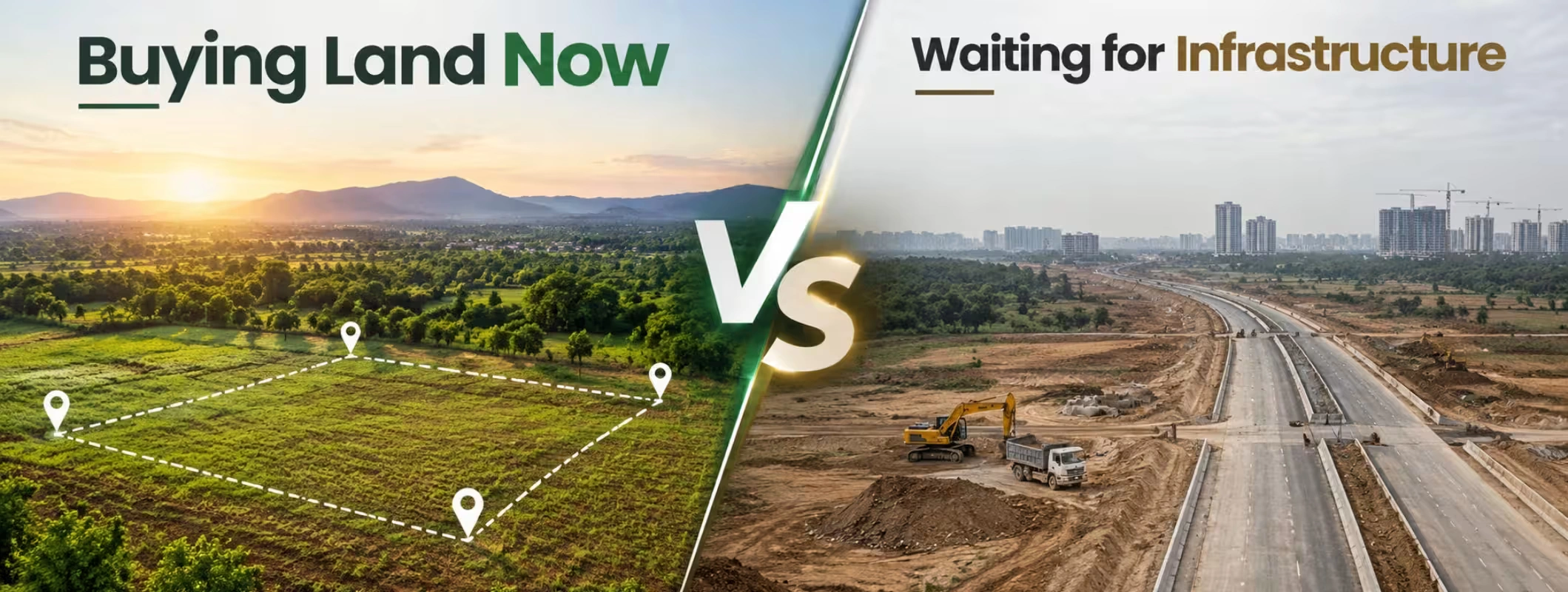
Every land buyer eventually runs into the same dilemma. You find a plot that's affordable today, in an area that's clearly on the "up-and-coming" list, a highway is planned, a metro line is proposed, or an industrial corridor has been announced. Do you buy now, while it's still cheap? Or do you wait until the road actually gets built and the risk disappears? There's no single right answer here. But there is a way to think about it clearly, instead of just guessing. If you've been scrolling through land for sale near me listings trying to decide, this is exactly the question worth slowing down on before you sign anything.
The Basic Trade-Off, in Plain Terms
Buying early and buying late aren't just two prices. They're two completely different bets.
| Details | Buy Now (Before Infrastructure) | Wait (After Infrastructure) |
| Price | Lower, sometimes significantly | Higher, often 2-3x once the project is done |
| Risk | Project could be delayed, changed, or cancelled | Almost no project risk |
| Time to see returns | Longer, often 3-7 years | Faster, but you paid more to enter |
| Documentation clarity | Sometimes messier in less-developed areas | Usually cleaner, more established market |
| Competition from other buyers | Lower | Much higher, prices already reflect the news |
| Best suited for | Patient investors with a longer horizon | Buyers who want certainty over maximum upside |
Neither column is "better." It depends entirely on how much uncertainty you're comfortable holding, and for how long.
What Infrastructure Actually Means for Land Value?
Not all infrastructure moves land prices the same way. Some projects change everything about an area. Others barely register. Roughly, here's what tends to matter most:
- Highways and expressways — usually the single biggest driver of land value, since they cut travel time to major cities
- Airports — a strong trigger, but the effect is often concentrated in a fairly narrow radius around the site
- Metro or rail lines — significant for residential and commercial land, less so for pure agricultural plots
- Industrial corridors — can transform farmland into commercial land value almost overnight, once operational
- Water and irrigation projects — matter a lot for agricultural land specifically, even if they don't get the same headlines
If you're trying to decide whether to buy land now in a particular area, the type of infrastructure being promised matters as much as the promise itself.
Why Buying Early Can Pay Off?
The math behind buying before infrastructure arrives is fairly simple. Land prices usually move in three stages:
- Before any announcement — prices are low, reflecting current use (often agricultural)
- After announcement, before completion — prices start climbing as speculation builds, sometimes years before a single road is actually laid
- After completion — prices peak, reflecting the full value of the new connectivity
Buyers who get in during stage one capture the entire price movement across all three stages. Buyers who wait for stage three are paying peak price and missing that growth entirely. This is exactly why some of the biggest land returns in India over the past two decades came from people who bought quietly years before a highway or airport was even confirmed.
Why Waiting Is Sometimes the Smarter Move?
That said, buying early isn't automatically smart. Government infrastructure timelines slip constantly; projects announced with a "2-year completion" target routinely take five or eight. Some get scaled down. A few get cancelled outright after land has already changed hands based on the promise.
Waiting removes almost all of that risk. You're paying more, but you know exactly what you're getting, because it already exists. For buyers who can't afford to have money tied up in land for a decade waiting on a project that might not happen on schedule, this is often the more sensible route.
A Simple Way to Decide
Ask yourself these questions honestly before buying early on the promise of future infrastructure:
- Is the project officially approved and funded, or still just "proposed" or "discussed"?
- Has land acquisition for the project itself actually started nearby?
- Can you afford for your money to sit for 5-10 years if the timeline slips badly?
- Is the current price low enough that even a delayed project still leaves room for profit?
- Do you have a backup plan for the land if the project never happens at all?
If most of your answers lean cautious, waiting is probably the safer path. If you can genuinely absorb the risk and the timeline uncertainty, buying early is where the bigger upside sits.
What This Looks Like for Farmland Specifically?
Agricultural land behaves a little differently from residential or commercial plots in this equation. Buyers browsing "farmlands near me" or farm lands near me near a proposed infrastructure project are often looking at land that's currently generating income from cultivation, not sitting idle. That changes the calculation.
| Agricultural Land Before Infrastructure | Agricultural Land After Infrastructure |
Still generates farming income while you wait | Often needs conversion before non-agricultural use |
Lower entry price per acre | Higher price, but conversion may already be approved |
Tenancy and conversion rules apply | Conversion process usually already completed |
Slower appreciation until project confirms | Faster appreciation, but you've missed the early gain |
This is part of why a lot of patient investors specifically target agricultural land near future infrastructure; it pays for itself through farming income even if the road takes longer than expected to arrive.
If You're on the Selling Side Instead
If you already own land in an area where infrastructure has just been announced, this same timing question applies to you, just in reverse. Selling too early means missing the price growth that's about to happen. Selling too late, after everyone already knows about the project, means competing with a flood of other sellers who had the same idea.
Owners going the land-selling route in these situations are increasingly listing through platforms rather than waiting for a broker to find the right buyer, mainly because selling property online puts the listing in front of investors actively searching for exactly this kind of opportunity, not just local buyers who happen to hear about it.
How 2Bigha Helps With This Decision?
2Bigha verifies land records and ownership details, and lists relevant nearby infrastructure information, so both buyers and sellers can make this decision with facts instead of guesswork or rumour. Whether you're comparing "land for sale near me" near a proposed highway, or you're an owner weighing whether now is the right time to sell before or after a project completes, 2Bigha gives you verified listings and documentation in one place, instead of relying on broker word-of-mouth about a project that may or may not happen on schedule.
Disclaimer: This article is for informational purposes only and should not be considered investment, legal, financial, or property advice. Real estate regulations, infrastructure plans, market conditions, and government policies may change over time. Readers are advised to verify information with relevant authorities and consult qualified professionals before making any investment or property-related decisions.