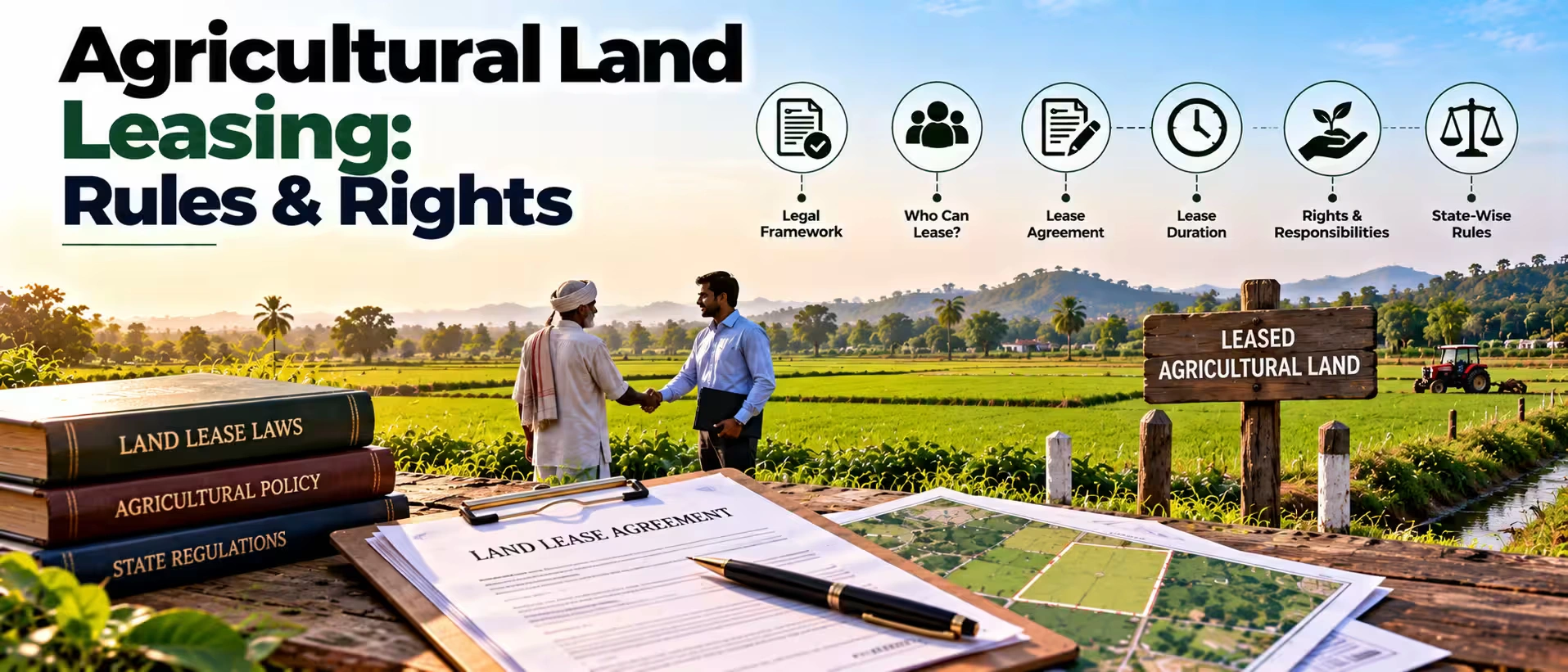
Your ability to rent out your farmland depends on the state where your farmland is located, and this one fact alone is sufficient to explain why the Indian leasing market is extensive, dynamic, and largely undocumented. There are millions of farmers cultivating land that does not belong to them, but there are no records of this anywhere. In this article, we try to understand what the law permits, what was proposed by the NITI Aayog model Act, and how to lease properly.
How Leasing Fits Into Indian Land Law?
A lease grants a person the authority to work on your land for a certain period in exchange for rent, while the name in the revenue record will remain yours. This is all there is to it, and it is not at all like a sale, a gift, or a mortgage. The problem is that post-independence, many states enacted tenancy reform legislation aimed at protecting tillers from landlords, and many of these acts have since then restricted or even banned leasing altogether. A committee of experts set up to draft a model act noted that most states have banned or restricted leasing of agricultural land.
The result is a strange gap between law and practice. Research on Bihar and Uttar Pradesh found that informal tenancy exists in almost all places despite the legal ban or restriction. Owners who live in cities hand their agriculture land to a relative or a neighbour on a verbal understanding; the tenant pays a share of the crop or a fixed sum, and nobody writes anything because writing it down could create a legal claim or break the state's rules. It works for years until a crop fails, a rent goes unpaid, or the owner wants the land back.
Where States Stand on Leasing?
Land is a state subject, so the answer changes at every border. Rather than a long list of acts, it is easier to think of states in three groups, and the groups keep shifting as new laws pass.
| Position | What it means for an owner | Examples reported |
|---|---|---|
| Restrictive tenancy law | New leases are barred or allowed only in narrow cases, so most arrangements stay informal | The Uttar Pradesh Zamindari Abolition and Land Reforms Act of 1950 restricts leasing |
| Reformed law based on the model Act | Written leases are recognised, with rules on registration and return of land | Madhya Pradesh, Maharashtra and Uttarakhand were reported to have brought in legislation along the suggested lines, with local changes |
| Reform under consideration | The law is being revisited, so rules may change soon | Odisha and Uttar Pradesh were described as considering amendments |
Treat that table as a starting point only. It reflects reporting from different years, and state laws get amended, so confirm the current rule with the local revenue office or a land lawyer before you sign anything.
What the NITI Aayog Model Act Proposes?
The rationale behind the model Act was to put informal tenancy in the limelight. The committee held that the legalization of leasing would increase the amount of cultivable land, as most of the landlords would leave their lands barren so that they do not have to lose them. Since land is a state subject, the Act remains only a model that the states can adopt completely or partially. The main features, according to the report, are as follows:
| Feature | How it works |
|---|---|
| Registration | Lease agreements are registered with the panchayat and a notary, while the revenue record keeps the owner's name. |
| Return of land | The owner gets the land back automatically when the lease ends. |
| Tenant benefits | The lessee can access insurance, compensation for crop damage, disaster relief, and bank credit. |
| Disputes | If the panchayat cannot settle a dispute, special tribunals handle it instead of burdened civil courts. |
| Rent and term | The Act leaves rent and lease period to be decided between the parties. |
In farm leasing, the automatic return of land is the feature that matters most to owners, because fear of a tenant claiming ownership is one reason many of them avoid leasing their land. A written, registered lease with a fixed end date can help protect the owner's rights and clarify when the land must be returned, subject to applicable state laws.
The tenant gains too. Someone who wants to shift to organic farmland practices usually needs several seasons to rebuild soil and earn a certificate, and nobody will invest that time on a one-season handshake deal. A multi-year registered lease makes such planning realistic, even if the law only allows what the state has actually adopted.
What Goes Wrong With Informal Leases?
Verbal leases are cheap to start and expensive to end. A tenant without paperwork cannot easily get crop insurance or a farm loan, and an owner without paperwork has little proof of the arrangement if a revenue officer or a buyer later asks who is cultivating the plot.
| Risk | Who it hurts | Why it happens |
| Tenant refuses to leave | Owner | No written end date, and a long-running cultivator may claim rights under state tenancy law |
| Rent dispute | Both | The amount or crop share was never recorded |
| No insurance or loan access | Tenant | Banks and insurers want proof of cultivation rights |
| Sale gets stuck | Owner | A buyer finds a cultivator in possession who is not named in the record |
| Wrong name in cultivator column | Both | Some state records show the cultivator separately, and entries can create later disputes |
That fourth row deserves attention. An owner who leases quietly and later decides to sell often finds that serious buyers back off the moment they discover an unexplained cultivator. If you are thinking of selling land in the near future, it is better to end the lease first, or to disclose it properly in the sale papers.
Leasing or Selling: Which Fits Your Situation?
Owners usually land on leasing when they do not want to sell but cannot farm the land themselves, and on selling when the land has stopped being useful to the family. The right choice depends on the plot and the plan.
Heading Background should be in light green and Bold only in Heading, use zebra crossing make on it : give me the complete data
Question | Leasing leans better | Selling leans better |
Do you want to keep the land for the long run? | Yes | No |
Do you need regular income without a large payout? | Yes | No |
Is the land far from your home and hard to manage? | Sometimes, with a trusted tenant | Often yes |
Is your state's leasing law unclear? | Risky | Cleaner |
Do you need a lump sum for another purchase? | No | Yes |
People who choose to sell usually begin with a simple farmland search to see what comparable land is going for in the area, and many also scroll through plots for sale near me type listings to understand how buyers describe and price plots like theirs. That research takes an evening and saves a lot of guessing about the asking price.
How to Set Up a Lease That Holds Up?
Where your state permits leasing, some practices will serve you both well. Write up the lease regardless of whether the state demands registration since paper with signatures and dates beats memory all times. Identify the plot by survey number and size so that there are no misunderstandings as to which plot is leased. Set the period starting from when and until, plus rent. Decide on the mode of paying rent: cash, crop share, or a combination of the two. Be explicit about what rights the lessee has, e.g., cutting down trees or digging a borehole or permanent structure erection.
Agree on how the land and water taxes are going to be paid plus keep a dated receipt for all payments made for rent. The lessor will need to hold onto the revenue document in his/her name. Plus, he/she should refrain from keeping any document that shows the tenant as the holder unless the state demands this. Plus, at the end of the lease agreement, get written possession back of the plot leased.
How 2Bigha Fits In?
Whether you plan to lease, sell, or buy, having the land's details sorted makes everything easier. 2Bigha is a marketplace for agricultural land and farmland across India, with verified listings and Background Verification Reports that help buyers see what they are dealing with before they commit. Buyers can also use Book a Visit to see a plot on the ground rather than judging it from photographs.
Owners who are done leasing and want to start selling property online can list on the platform with their survey details, access information, and land record ready, and a clean record with no unexplained cultivator is the kind of detail buyers look for first. For anyone ready to move forward with land selling, you can begin at 2Bigha.
Disclaimer: This article is for informational purposes only and should not be considered investment, legal, financial, or property advice. Real estate regulations, infrastructure plans, market conditions, and government policies may change over time. Readers are advised to verify information with relevant authorities and consult qualified professionals before making any investment or property-related decisions.