However, before DILRMP 3.0, the process of registering a piece of agricultural land required one to visit the office of the sub-registrar, a series of stamped documents, two witnesses, and an extended period of waiting till the transaction is recorded. Many of these processes are now going digital. Operational guidelines are being prepared by the government for DILRMP 3.0, which is a five-year scheme that will be implemented from 2026 to 2031 with an estimated budget of Rs 565.50 crore. Parcel numbers, online submission of documents, and court records are the key components. This article discusses what is currently available, what is not yet operational, and how a common person needs to adapt to the new system.
What Digital Land Registration Covers?
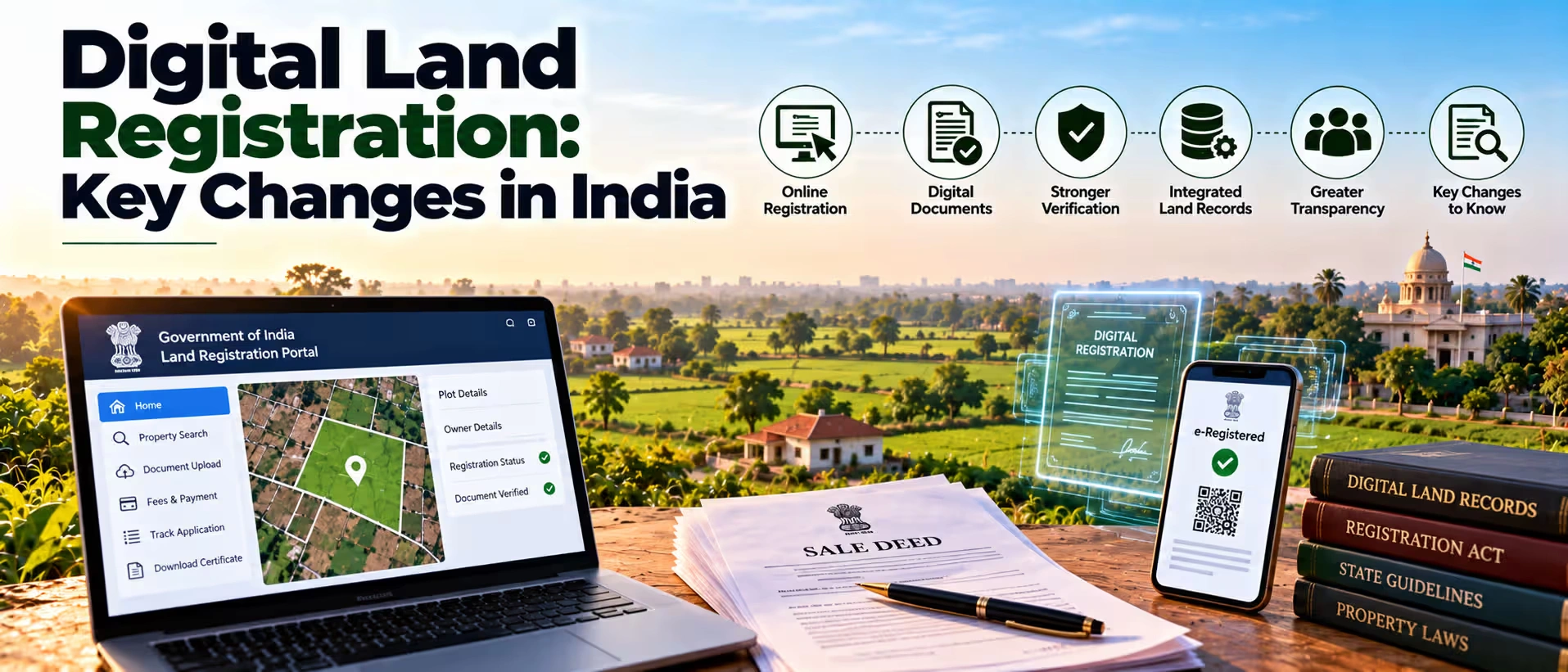
As people use the concept rather casually, it may make sense to break it down into its components. Digital land registration is not one portal. It is a combination of several systems, and each state is at a different level of development when it comes to each of those systems.
- Digital land records: Record of Rights, mutation entries, and maps of the village available online.
- Parcel identification: a 14-digit Unique Land Parcel Identification Number, known as Bhu-Aadhaar, which is generated on the basis of the coordinates of each particular parcel.
- Online registration of deeds: document submission, payment, and appointment scheduling using a website as opposed to the counter service.
- Integrated database: registration records, land records, and court records communicating with each other, thus enabling a buyer to get more from one place.
According to the Registration Act, 1908, it is required to register most property deeds. As states have the right to introduce their own registration amendments, the results of the introduction vary. Thus, Odisha is considering amendments that will enable e-appearance, will integrate registration records and unique property numbers, will limit deeds to four pages, and will equate the value of electronic signatures to paper ones.
Where Things Stand Right Now?
The numbers look strong, but they come from different sources and dates, so treat them as a rough picture and not a scorecard.
| Area | Latest reported status |
|---|---|
| Records of Rights computerised | 99.81 per cent as of 31 January 2026 |
| Cadastral maps digitised | 97.42 per cent as of the same date |
| Parcels given a Bhu-Aadhaar number | Over 40.58 crore as of August 2026, per the Department of Land Resources |
| Sub-registrar offices computerised | About 96 per cent |
| States where online document registration runs through the national system | 18 states and Union Territories |
| States where registration can trigger mutation automatically | 17 states |
| States and UTs cleared to link e-Courts with land databases | 26 |
The last two rows matter most to a buyer. When registration triggers mutation by itself, the gap between paying for land and being shown as the owner gets much smaller. And when court data is linked in, a buyer has a way to check whether the property is tied up in a case.
What Changes for Buyers?
The biggest shift is how much you can check before you hand over money. Someone looking at an agriculture plot for sale used to depend on the seller's photocopies and a local broker's word. Now the same buyer can often pull the record online, match the survey number to a map, and look up a parcel ID where one has been assigned.
The one who is trying to purchase farm land from another state gains the maximum advantage, as a significant portion of the investigation process can be completed even without visiting the site. The following is the right process:
- Download the latest Record of Rights and confirm that the name of the seller matches the Aadhaar-verified identity proof.
- Compare the survey number and area from the record and compare the same with the sale deed.
- Find the Bhu-Aadhaar number if it is issued by the state and match the same with the map.
- Go through the mutation history to know the way the land came into possession of the present owner.
- Conduct the litigation search if the state provides the same.
- Check the encumbrance record for any loans, mortgages, or pending dues.
- Even then, visit the plot physically, as the online record cannot reveal anything about the disputed boundary or access to the property.
What Digital Records Still Cannot Do?
It is all too tempting to look at these numbers and take the assumption that “digital equals safe.” This is not entirely the case. While ULPIN identifies a parcel, it does not necessarily prove ownership, and India continues to use a presumptive titling system, where the record is considered proof of ownership and not a conclusive one.
There is one paper from 2026 that refers to this situation as a digital land paradox, where records became almost fully digitized, but disputes remained. The explanation is quite clear. If there is an error in the initial record, digitizing it will make it more accessible.
| What digitisation improves | What it does not fix |
|---|---|
| Access to records from anywhere | Errors that were already in the old record |
| Speed of registration and mutation | Family disputes over inheritance |
| Ability to spot duplicate or fake documents | Missing physical boundary markers |
| Traceability of past transactions | Land with legal restrictions on sale or use |
Rights that sit outside the standard record also need care. Researchers note that land records alone may be insufficient for people with legally recognised rights, such as forest dwellers under the Forest Rights Act. A buyer in a forest or tribal belt should ask for extra proof beyond the online entry.
What Changes for Sellers?
For sellers, digital registration works like a mirror. Whatever is on your record is exactly what the buyer will see, and they will see it before they call you.
Anyone planning to sell land should start by cleaning up the record. Fix the name spellings, update the area if it changed after a partition, and clear any old loan entries. Owners who want to sell plots in smaller pieces should check the sub-division rules in their state first, because online registration systems often reject a deed if the parcel numbers do not match the approved division. A few things sellers can do early:
- After receiving inheritance or gifts, ensure that you undergo the latest mutation process so that you become the holder of the document in the registry.
- Collect all Record of Rights, taxes paid, survey maps, and old deeds in digital form.
- Request co-holders to sign the application in advance because even if one name is missing, the registration will be delayed.
- Clear any loans and get an entry from the record.
- Update your Aadhaar number and mobile number on the state portal for e-verification.
How Does a Digital Registration Deal Usually Flow?
The exact steps depend on the state, but the broad order is similar in most places.
| Step | What happens |
| 1. Record check | Buyer and seller verify the Record of Rights, map, and encumbrance details online |
| 2. Draft deed | The sale deed is prepared, in some states through the online system |
| 3. Stamp duty payment | Paid online in many states, with an e-receipt |
| 4. Appointment | Slot booked at the sub-registrar office or through the portal |
| 5. Presentation and verification | Parties appear, sometimes with biometric or e-sign verification |
| 6. Registration | Deed registered and a certificate issued |
| 7. Mutation | In states with linked systems, ownership update can follow automatically, while others still need a separate application |
Buyers should not skip the last step. Even in a state with automatic mutation, check after a few weeks that your name actually appears on the record.
How 2Bigha Helps With the Digital Shift?
Digital documents are helpful, but they don’t substitute for the inspection of the property itself. 2Bigha is a marketplace that specializes in the buying and selling of agricultural land, farmland, and other types of land in India. All transactions on the website are based on verified listings. The user can use the feature to book a Visit with knowledge of the area.
For people searching for land property for sale in a new district, that combination saves a lot of back and forth. A buyer who wants to buy farmland can compare listings, check the paperwork summary, and plan a visit in one place. Sellers can list with their record details ready, which is exactly what digital registration now rewards. You can start at 2Bigha
Disclaimer: This article is for informational purposes only and should not be considered investment, legal, financial, or property advice. Real estate regulations, infrastructure plans, market conditions, and government policies may change over time. Readers are advised to verify information with relevant authorities and consult qualified professionals before making any investment or property-related decisions.