Holding less than 2 hectares constitutes 86.2 percent of total operational holdings as reported in the Agriculture Census 2021-22. The average farming household, thus, operates multiple small parcels in the village rather than a compact area of operation. "Land Consolidation," also called "Chakbandi" here, is the longstanding policy tool to solve the above issue. On paper, it looks quite simple; however, it is nothing but an arrangement that changes cultivation patterns in the form of land transfers, and land is the most sensitive property for any family in the rural landscape. A few steps taken in 2026 have made this issue headline news again. This article covers the current happenings along with the potential change in ownership trends.
What Land Consolidation Means in India?
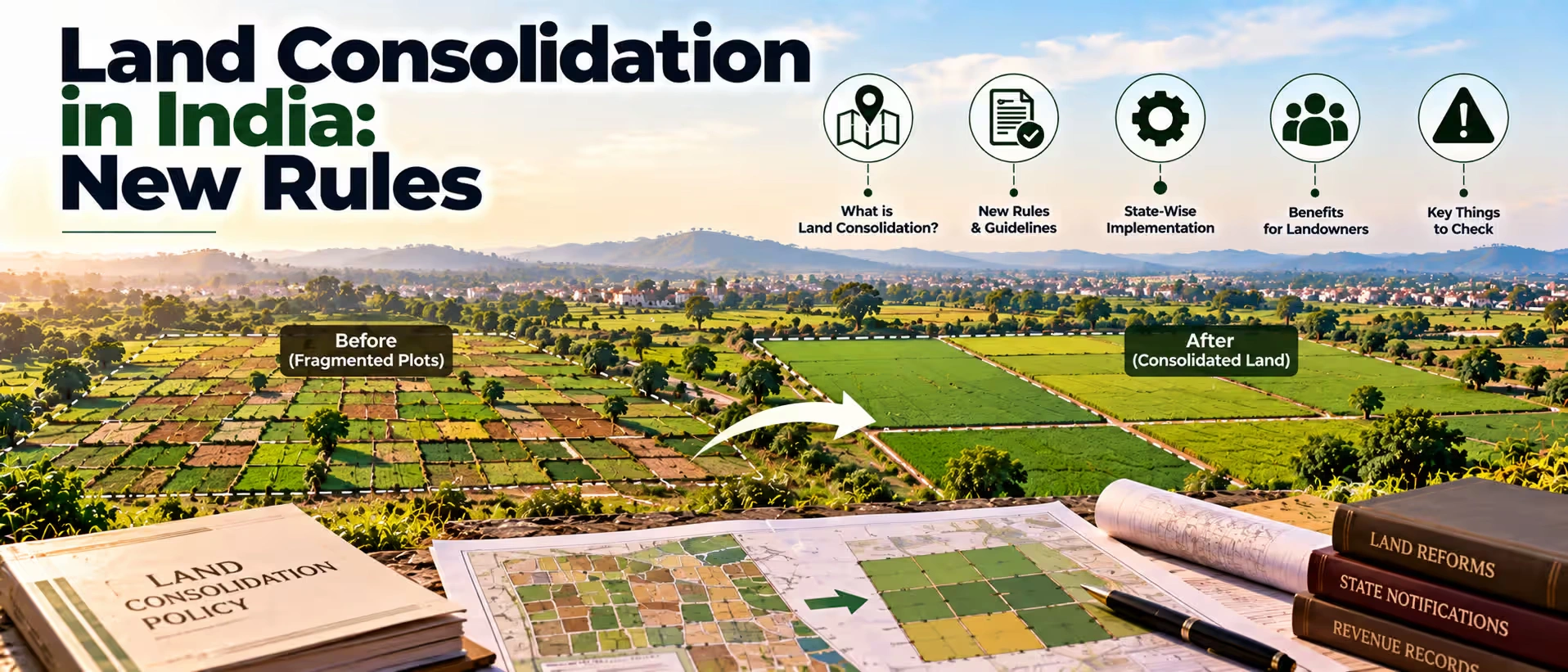
Consolidation is a planned exchange of land. Each owner gives up several scattered parcels and receives one or two contiguous blocks of roughly the same total value in return. The family keeps the same overall worth of land, only in a shape that is easier to farm. It helps to separate it from a few things it gets confused with:
- Land acquisition: the state takes land for a project and pays compensation. Consolidation does not take anything away.
- Land pooling: owners hand over land for a development scheme, usually urban, and get a developed share back.
- Land ceiling laws: these cap how much a person can hold. Consolidation does not touch the ceiling.
- Cooperative farming: owners farm jointly but keep their old plot boundaries.
Land is a state subject under the Constitution, so every state runs its own consolidation law, its own officers, and its own timeline. The Centre mostly supports through funding and digital records.
Why Fragmented Holdings Hold Back Farming and Land Markets?
A holding split into five or six pieces costs money every season. Boundary walks take time, irrigation channels cross other people's fields, and machinery cannot move easily from one piece to the next. Over generations, inheritance cuts the pieces smaller still, and the records often keep listing every heir as a co-owner long after the family has moved on.
| Problem | What it causes on the ground |
|---|---|
| Scattered parcels | Higher travel time, uneven irrigation, difficulty using tractors and harvesters |
| Tiny plot sizes | Low income per holding, little room for crop planning |
| Multiple co-owners on old records | Slow sales, disputes at the time of mutation |
| Unclear boundaries | Repeated survey requests and neighbour conflicts |
| No access road for inner plots | Lower resale value and limited bank lending |
The market effect is easy to see when someone starts looking for farmlands near me on a property portal. A good share of what shows up is a half-acre strip with a shared path, which suits very few serious buyers, and the owner of that strip often cannot sell it because three relatives still appear on the record.
Where Consolidation Has Worked and Where It Has Stalled?
Only Punjab, Haryana and Uttar Pradesh have carried out land consolidation in India, and Uttar Pradesh has continued a process that started in the 1950s. In Uttar Pradesh, it began in 1954 in Muzaffarnagar and Sultanpur districts under the 1953 Consolidation of Holdings Act.
| State | Status | Note |
|---|---|---|
| Uttar Pradesh | Ongoing | Oldest programme, running since the 1950s |
| Punjab and Haryana | Largely carried out | Plains with flatter terrain made it easier |
| Uttarakhand | Law passed, slow rollout | A 2016 law exists, but implementation stalled for years |
| Assam and Odisha | Laws on paper, work incomplete or on hold | Reported as on hold in Assam and incomplete in Odisha |
The record is not all positive. Reporting from villages in Uttar Pradesh has pointed to irregularities during the process, and in some places the bitterness left behind lasted longer than the benefits. One villager quoted in Down To Earth blamed the chakbandi in his village for a family tragedy. Any new push has to answer why the older ones left so many people unhappy.
What the 2026 Government Initiatives Add?
Three developments matter most right now.
1. Voluntary Hill Programme in Uttarakhand. In May 2026, the state government decided to undertake a voluntary consolidation programme for its hilly districts, whereby 275 villages from 11 hilly districts will be covered over five years, with five villages being addressed per annum in all 11 districts. In order to avoid conflict, villages with no land dispute are chosen, with the requirement of 10 hectares available for consolidation in any village, or the consent of at least 25 landowners for their lands. The term voluntary holds its meaning here, as there is no compulsion of any exchange.
2. Special Survey in Bihar. It has been commented that Bihar's special survey could lead to the process of consolidation through digital maps, clear valuation, and a time-bound process. Still a proposal and not law, yet it reflects the trend of the discussion: first survey, then consolidation.
3. Digital records and parcel numbers. The Digital India Land Records Modernisation Programme began in 2008, and the Unique Land Parcel Identification Number, often called Bhu-Aadhaar, is meant to give every surveyed rural parcel its own identity. The Centre has also set aside Rs 10,000 crore for state land reforms under a capital investment assistance scheme. A farm search that used to need three trips to a tehsil office can now start from a parcel number and an online record, which makes any later exchange of plots much easier to document.
One caution before reading too much into the national picture. In a reply in the Lok Sabha in February 2025, the government said it did not propose any special consolidation scheme for Uttarakhand. So the current effort is mainly driven by states, with the Centre supporting through records and funds.
Could Consolidation Change Who Owns Land?
In the strict legal sense, mostly not. Consolidation moves boundaries and not ownership. A family that owned three acres in five places owns three acres in one or two places afterward. The more realistic changes are indirect
| What may change | What stays the same |
|---|---|
| Plot shape and size of each holding | Total value owned by each family |
| Number of names on old records | The legal owner of each holding |
| Ease of selling a clean, contiguous parcel | The need for mutation after every sale |
| Access to credit against larger parcels | State control over land laws |
There is one effect that should be kept in mind. Once the holding is consolidated into one single holding with a proper record, it becomes much easier to sell, lease, or mortgage. Some families who have been struggling for decades may actually manage to sell. Others may purchase adjacent parcels of land to create a viable farm. In ten years, this may lead to consolidation into fewer and bigger parcels of land, even though no such requirement is set out by the law.
What Consolidation Means for Land Buyers?
Buyers in villages where consolidation is under way should treat the process as a due diligence item. If you are scanning land for sale near me listings in a district with an active programme, check whether the village is notified, because plots can change shape or even location after the final award. Someone looking at agriculture land for sale near me in a hill district such as those covered by Uttarakhand's programme should ask the seller directly whether the family has given consent. A short checklist helps:
- Inquire if the village is notified for consolidation and the stage reached in the process.
- Compare the plot listed with the most recent record and parcel number.
- Ascertain if the seller is a sole owner or one of the many co-owners.
- Ensure that there is legal road access to the plot as it stands.
- Get the consolidation award or exchange order if one has already been issued.
- Do not pay an advance amount before the final allotment.
What Consolidation Means for Land Sellers?
There are many advantages for the seller, provided that all documents are in order.
- One block will look better for buyers than three separate strips.
- Removing co-owner names prior to listing will save weeks down the road.
- Updating records and having a parcel number will instill confidence in out-of-state buyers.
- It may be preferable to wait for the consolidation award rather than sell a piece of land during the process.
- Save all notices and objections you have made, since the buyers and banks will request them.
How 2Bigha Fits Into a Changing Land Market?
Even as land records become clearer, most buyers have trouble handling one simple issue, that is how to be sure about whether the plot matches the description of the land available. 2Bigha is a Marketplace for agricultural land in India with verified listings. Buyers get to access Background Verification Reports before they make a choice, and they can use Book a Visit to view the plot with someone familiar with the area instead of photos alone.
Owners who plan on selling property online can list their land with the documents buyers actually ask for, such as the record number, survey details, and access information. As consolidation tidies up more villages, that kind of clean paperwork will matter even more, and land selling through a platform that checks details at the start tends to move faster than a chain of informal brokers. Buyers and sellers can start at 2Bigha.
Disclaimer: This article is for informational purposes only and should not be considered investment, legal, financial, or property advice. Real estate regulations, infrastructure plans, market conditions, and government policies may change over time. Readers are advised to verify information with relevant authorities and consult qualified professionals before making any investment or property-related decisions.