
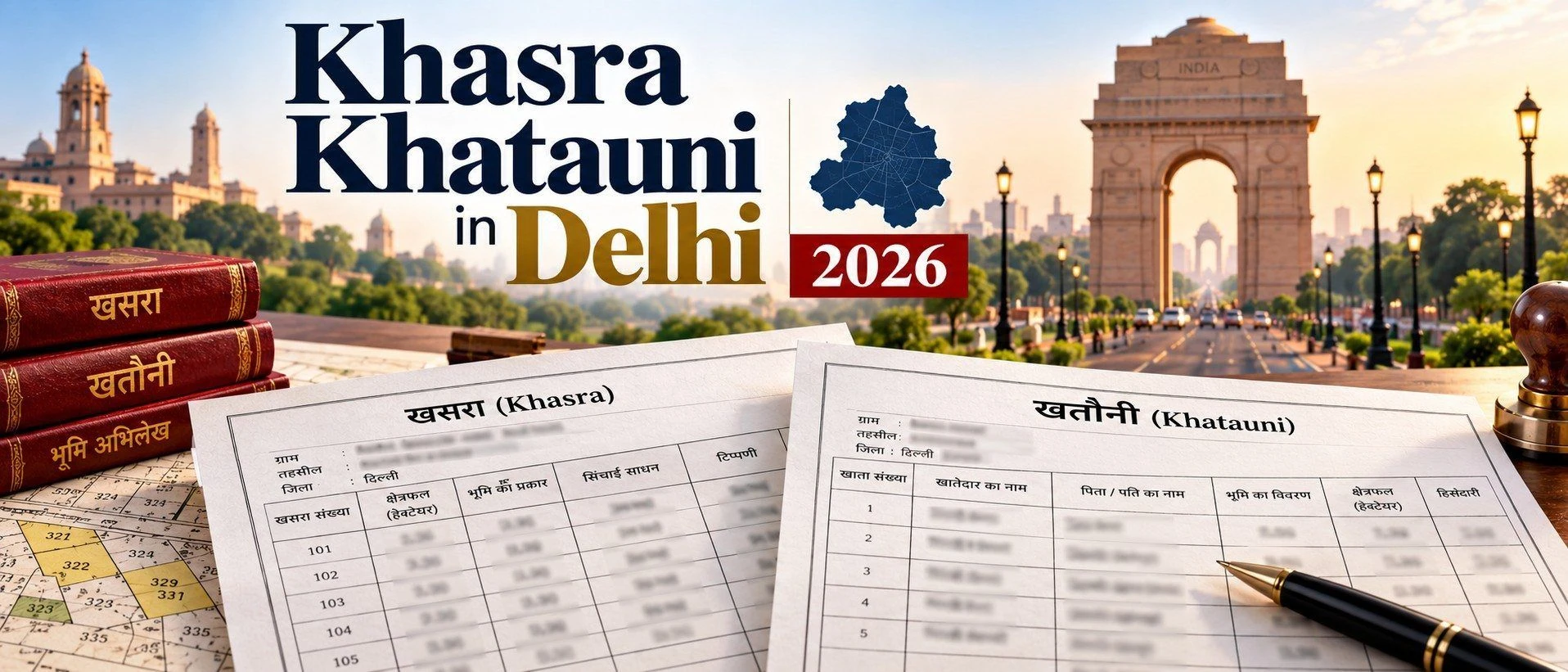
Khasra Khatauni is the combined land record from Delhi's Revenue Department that identifies a specific rural or agricultural plot (Khasra) and links it to the landholder's full account of properties (Khatauni). It exposes buyers to real risk when skipped — Delhi has far less agricultural land than most states, concentrated mainly in outer-district villages, and a plot's classification, boundaries, and recorded owner all need to be independently confirmed before any deal, since a seller's description alone isn't proof. This guide covers how to check Khasra Khatauni through Delhi's Bhulekh portal, what the record actually shows, and how it fits into a fuller title check. Whether you're evaluating a plot for sale in Delhi, looking to buy plot in Delhi for agricultural use, or working through farm land for sale Delhi, this is the record that confirms exactly which land you're dealing with.
Section 1 — What is Khasra Khatauni in Delhi?
Before checking a specific plot's record, it helps to see the surrounding area — you can browse the 2Bigha map for Delhi while you shortlist land to buy plot in Delhi.
Definition: Khasra Khatauni is Delhi's land record system linking a Khasra number — a unique identifier for one specific plot—to the Khatauni, the account listing all land parcels held by a particular owner, maintained by the Delhi Land Records Centre.
It's worth being clear on how the two pieces work together. The Khasra number pinpoints one exact parcel of land, helping locate it precisely on revenue maps for any land-related transaction. The Khatauni is essentially the ownership ledger — it lists every plot a specific person or family holds, which is why checking both together gives a fuller picture than checking either alone. This matters more in Delhi than buyers sometimes expect: unlike states where agricultural land dominates, Delhi's Khasra Khatauni system mainly covers the city's rural and revenue-estate villages, and confirming a plot's classification (agricultural vs. non-agricultural Khata type) is essential before assuming it can be used or transferred the way you expect.
State-specific note: In Delhi, land records under the DLR Act are checked separately from records updated under the PLR Act — the Bhulekh Delhi (DLRC) portal has distinct sections for "Khasra Khatauni Details" and "Jamabandi Details," and buyers sometimes miss checking both, especially for older village land that may have been updated under either framework.
Expert Tip: Don't rely solely on the textual Khasra Khatauni record — use the DLRC portal's GIS mapping feature ("See GIS Map") to visually correlate the plot's ownership data with its actual physical boundaries. Text records and boundary maps can occasionally disagree, particularly on older village land where informal subdivisions happened without a matching formal record update, and catching that mismatch before you buy is far easier than after.
Section 2 — How to Check Khasra Khatauni in Delhi?
You can search and view records online in minutes, or request a certified copy at the relevant revenue office. Compare both:
Method | Cost | Time | Legally valid for registration purposes? |
|---|---|---|---|
Online (view/download, unsigned) | Free | Instant | No — a portal printout is for reference, not certified proof |
Online (GIS map cross-check) | Free | Instant | No — supplementary visual confirmation only |
Offline (Tehsil/revenue office, certified copy) | Nominal fee, confirmed at the office | Several days | Yes, once issued as a certified copy |
Visit the official DLRC portal. Go to dlrc.delhigovt.nic.in, Delhi's official Bhulekh land records website.
Select "Khasra Khatauni Details." This option appears on the homepage alongside "Jamabandi Details."
Choose your district, subdivision, and village. Delhi's records are organized across its districts — select the specific location of the plot.
Pick your search method. Search by Khata number, Khasra number, or owner's name, whichever detail you have.
View and cross-check with the GIS map. Review the displayed record, then use the "See GIS Map" option to visually confirm boundaries against the textual details.
Visit the relevant Tehsil or revenue office covering the plot's village and subdivision.
Provide the Khasra number, Khata number, or owner details to the revenue official.
Request a certified copy of the record, specifying whether you need the Khasra Khatauni, the Jamabandi (ROR), or both.
Collect the signed and stamped copy for use in any formal transaction.
Offline processing for a certified copy typically takes several days depending on the office. Before relying on the record for a transaction, check that the Khasra number, Khata type, and owner's name are all consistent with the sale deed and any other documents the seller has provided.
Section 3 — What Does a Khasra Khatauni Record Contain?
The same verification discipline applies broadly — whether you're checking a Khasra Khatauni here or reviewing a plot sell in Delhi listed elsewhere, always confirm the plot identifiers match across every document. General land listings are also browsable at 2Bigha for context.
Field | What it means | What to check |
|---|---|---|
Khasra number | The unique identifier for the specific plot | Must match the sale deed and revenue maps exactly |
Khata number/type | The owner's account, and whether it's agricultural or non-agricultural | Confirm this matches the land's actual intended use |
Division and village name | The administrative unit and specific location | Should match the property address precisely |
Owner's name | The current recorded titleholder | Should match the seller, or show a documented inheritance chain |
Good Sign: the Khasra number is consistent across the DLRC record, the GIS map, and the sale deed; the Khata type matches the land's actual classification; and the recorded owner's name matches the seller or a clearly documented chain of transfer.
Section 4 — Common Issues & How to Fix Them
Most Khasra Khatauni issues in Delhi come down to a mismatch between the textual record, the GIS map, and the seller's paperwork. If anything looks unclear, verify it directly through the Khasra Khatauni Delhi official website rather than relying on a printed copy alone.
Khasra number mismatch with the sale deed – The number quoted by the seller doesn't match the DLRC record. Fix: get this clarified at the revenue office before any payment.
Text record and GIS map disagreement – The plot's mapped boundaries don't align with the textual Khasra details. Fix: investigate the discrepancy at the Tehsil office before relying on either source alone.
Confusing DLR Act and PLR Act records – Buyer checks only "Khasra Khatauni Details" and misses a relevant "Jamabandi Details" update. Fix: check both sections on the DLRC portal for older village land.
Owner's name not updated after a sale or inheritance – The record still shows a previous owner. Fix: confirm whether mutation has been completed, and if not, treat this as a gap to resolve before purchase.
Wrong Khata type for the intended use – Buyer assumes agricultural classification without confirming it on the record. Fix: verify the Khata type directly rather than relying on how the land is currently being used informally.
Treating the Khasra Khatauni as a full title check – Buyer skips the separate DORIS/NGDRS and MCD checks. Fix: understand this is a revenue record, not a substitute for a complete title and encumbrance search.
Section 5 — Recent Changes in 2026
The DLRC portal continues to integrate Geographic Information System (GIS) mapping with textual Khasra Khatauni records, allowing users to visually correlate ownership data with physical plot boundaries directly on the portal — a feature the Delhi government has positioned as a cornerstone of ongoing land record modernization. No major standalone policy change to the underlying Khasra Khatauni framework has been confirmed as of August 2026 — the core distinction between DLR Act and PLR Act record-keeping remains relevant for older village land, so continue checking both sections where applicable.
Section 6 — Why Khasra Khatauni Matters for Land Buyers
Confirms the exact plot's identity, area, and boundaries before you rely on a seller's description.
Reveals the land's classification (agricultural vs. non-agricultural), which affects what you can legally do with it.
Cross-checking with the GIS map catches boundary discrepancies that text records alone can miss.
Required reference for mutation, inheritance, and future resale of rural or village-area Delhi land.
Helps confirm whether the recorded owner actually matches the seller before any payment.
Complements — but doesn't replace — a full title and encumbrance search for the property.
Section 7 — Khasra Khatauni vs. Encumbrance Certificate
Khasra Khatauni | Encumbrance Certificate / Title Search | |
|---|---|---|
What it proves | The land's identity, classification, and recorded ownership | Whether the property carries a registered loan or legal claim |
Issued by | DLRC Revenue Department (Bhulekh Delhi) | Sub-Registrar's Office (via DORIS/NGDRS and certified copies) |
Needed for | Confirming the correct plot, area, and revenue classification | Confirming a clean title history for sale or loan |
They cover entirely different risks, and a buyer needs both — a clean Khasra Khatauni says nothing about hidden mortgages, and a clean title search says nothing about whether the plot's boundaries and classification actually match what's being sold. If you're planning to sell agricultural land in Delhi, having a current Khasra Khatauni that matches your title documents exactly makes a serious buyer's due diligence considerably faster — you can list verified land directly through 2Bigha's sell page.
Section 8 — Related Documents
Encumbrance Certificate Delhi — the separate title and liability check every buyer also needs
Property Document Checklist — the fuller set of papers to verify before any purchase
Sale Deed verification — confirming the specific transaction document
Mutation Process — updating ownership records after a sale or inheritance
Bhulekh Records — for comparison, how similar land record systems work in other states
