
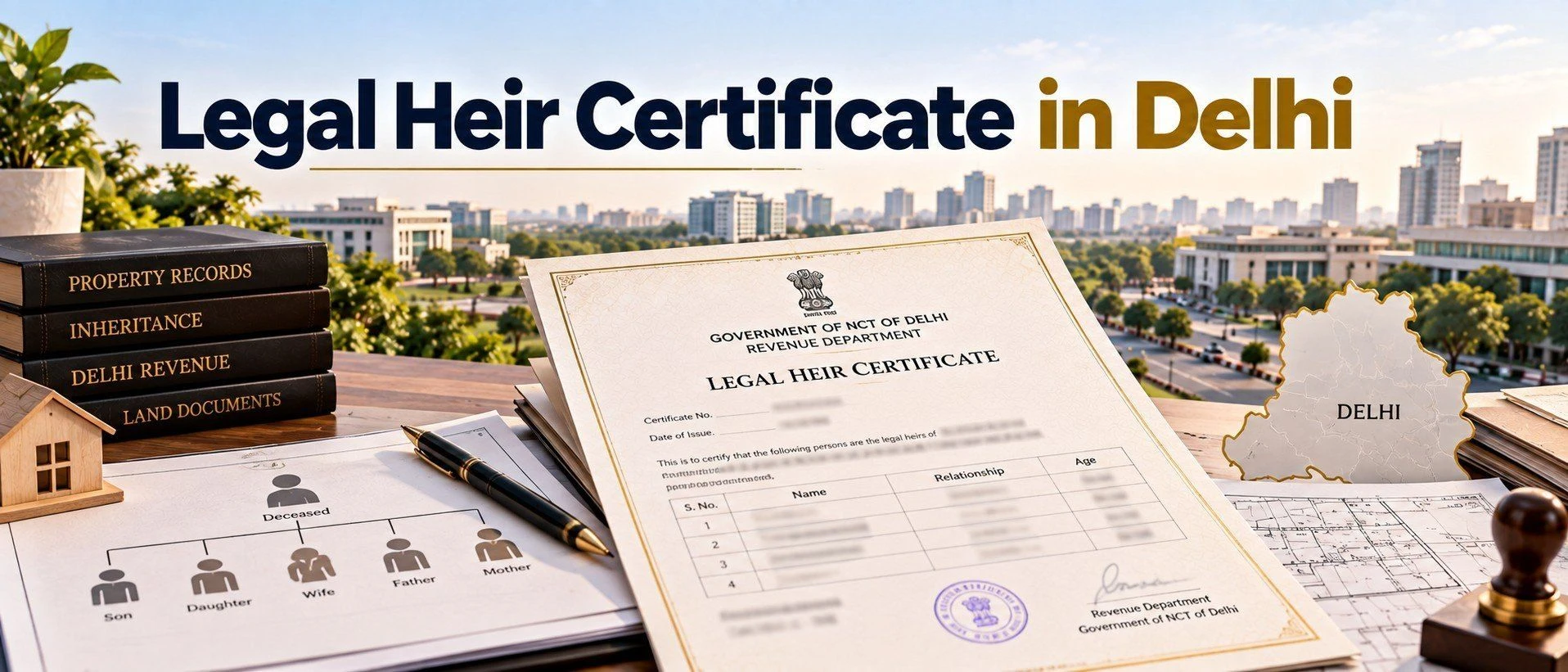
A Legal Heir Certificate, known in Delhi as a Surviving Member Certificate, is an administrative document issued by the Revenue Department that identifies the rightful heirs of a person who has died, along with their relationship to the deceased. It matters because without it, families can find themselves stuck — unable to transfer property, claim insurance, or access pension funds — precisely when they need clarity the most. This guide covers how to apply for it online and offline, what a valid certificate should contain, and how to resolve the issues that come up most often. Whether you're settling an inheritance, selling a plot for sale in Delhi that was passed down, or claiming a deceased family member's assets, this is the certificate you'll be asked for.
Section 1 — What is a Legal Heir Certificate in Delhi?
Before settling inheritance paperwork on a property, it helps to see what else is available if you're also looking to buy — browse plot for sale in Delhi on the 2Bigha map.
Definition: A Legal Heir Certificate — called a Surviving Member Certificate in Delhi — is a Revenue Department document that formally records the surviving family members of a deceased person and their relationship to them, used to establish who the rightful heirs are for administrative and inheritance purposes.
It's frequently confused with a Succession Certificate, but the two are issued by entirely different authorities for different purposes — the Legal Heir/Surviving Member Certificate is an administrative document from the Revenue Department that identifies the heirs, while a Succession Certificate is a judicial certificate issued by a civil court under the Indian Succession Act, 1925, specifically authorising someone to collect the deceased's debts, securities, and other financial assets. A buyer or family member needs the Legal Heir Certificate specifically because most administrative processes — property mutation, insurance claims, pension transfers — require it as the baseline proof of who the legitimate heirs are, even though it doesn't by itself grant authority over financial assets.
State-specific note: Delhi's application eligibility requires the applicant to be an Indian citizen and a resident of Delhi — if an NRI or overseas heir isn't a Delhi resident, they generally can't apply directly in their own name, but can authorise a trusted family member through a properly drafted Power of Attorney to handle the process on their behalf.
Expert Tip: If you're buying inherited property, don't stop at seeing the Surviving Member Certificate alone. Ask specifically whether the certificate lists every known heir and whether you have written No Objection Certificates (NOCs) from each of them — a certificate that lists fewer heirs than the family actually has, or a sale missing NOCs from co-heirs, is one of the biggest red flags in inherited-property transactions.
Section 2 — How to Get a Legal Heir Certificate in Delhi?
Comparison of routes:
Method | Cost | Time | Legally valid for registration? |
|---|---|---|---|
Online (e-District Delhi Portal) | Approx. ₹500 (stamp paper, affidavit, notarisation) | ~14 days as per Revenue Department timeline | Yes |
Offline (SDM/Tehsildar office) | Same fee structure | 3–4 weeks in practice, depending on verification | Yes |
Visit edistrict.delhigovt.nic.in and register or log in with your existing credentials.
Select "Issuance of Surviving Member Certificate" under the Department of Revenue services list.
Fill in the application form, providing details of the deceased, all known surviving family members, and their relationship to the deceased.
Upload required documents, including the death certificate, proof of relationship, and applicant ID proof.
Submit the form and download the acknowledgment receipt, then track status online; once verified and approved, download the certificate from the portal.
Visit the SDM or Tehsildar office covering the area where the deceased last resided.
Obtain and fill the application form, attaching the death certificate, relationship proof, and applicant ID.
Submit the form and pay the applicable fee, after which the Patwari conducts field verification of the family details.
Collect the certificate once the Revenue officer and Tehsildar have reviewed and signed off on the application.
The process typically takes around 14 days per the official timeline, though in practice it often runs 3 to 4 weeks once field verification and multiple sign-offs are factored in. Before collecting the certificate, check that every known heir is listed correctly with accurate names, ages, and relationships — a certificate that's incomplete or lists names inconsistently can create problems later during property transactions.
Section 3 — What Does the Legal Heir Certificate Contain?
For a broader look at verified land listings and documentation before finalising an inheritance-related transaction, visit 2Bigha.
Field | What it means | What to check |
|---|---|---|
Name and date of death of the deceased | Identifies whose estate the certificate relates to | Matches the death certificate exactly |
List of surviving heirs | All legal heirs recorded, with age and address | Complete — no known heir left off the list |
Relationship to the deceased | How each listed person is related | Accurately stated for each heir |
Issuing SDM/Tehsildar office details | Confirms authenticity | Traceable through the Revenue Department |
Date of issuance | When the certificate was granted | Recent enough to reflect the current family situation |
Good sign: A correct certificate lists every known heir accurately, with consistent names and relationships across all supporting documents, and carries a valid SDM/Tehsildar signature and office reference.
Section 4 — Common Issues & How to Fix Them?
Most delays with Legal Heir Certificates in Delhi come from incomplete family details or missing supporting documents rather than genuine disputes. Confirm your application status directly on the Legal Heir Certificate Delhi official website before assuming a delay signals a problem.
Missing or incomplete heir list – A known heir is accidentally left off the application. Fix: Apply for a fresh, corrected certificate listing every heir before proceeding with any property transaction.
Field verification delays – The Patwari's site visit and revenue officer review take longer than expected. Fix: Follow up directly with the SDM office and ensure all requested documents were submitted in full at the first visit.
Family disagreement or objection – A dispute among heirs stalls the process. Fix: Resolve disagreements directly or, if unresolved, be prepared to pursue a court-based remedy such as a succession certificate or declaratory suit.
NRI or non-resident heir unable to apply directly – Delhi's eligibility rule requires the applicant to be a Delhi resident. Fix: Authorise a resident family member through a properly drafted Power of Attorney to handle the application.
Confusing this certificate with a Succession Certificate – Buyer or heir assumes it covers financial asset claims too. Fix: Understand that debts, securities, and other financial assets require a separate, court-issued Succession Certificate.
Inconsistent names across documents – Spelling or detail mismatches between the death certificate, ID proofs, and application. Fix: Correct discrepancies before submission to avoid rejection or delay during verification.
Section 5 — Recent Changes in 2026
No major changes have been reported as of August 2026. The Delhi e-District Portal continues to process Surviving Member Certificate applications online, with the Department of Revenue's stated processing timeline remaining at approximately 14 days.
Section 6 — Why Legal Heir Certificate Matters for Land Buyers?
It's typically required before property mutation can proceed in the names of the legal heirs.
Banks and insurance companies commonly ask for it to process pension or insurance claims tied to the deceased.
Buyers of inherited property use it to confirm the seller is genuinely a recognised legal heir.
A complete heir list protects buyers from later claims by heirs who weren't part of the original transaction.
It provides the administrative foundation needed before pursuing further legal steps, such as a Succession Certificate.
It helps prevent inheritance disputes by giving the family a documented, agreed starting point.
Section 7 — Legal Heir Certificate vs. Succession Certificate
Aspect | Legal Heir (Surviving Member) Certificate | Succession Certificate |
|---|---|---|
Issued by | SDM/Tehsildar, Revenue Department | Civil Court, under the Indian Succession Act, 1925 |
What it establishes | Who the rightful heirs are | Authority to collect debts, securities, and financial assets |
Process | Administrative application | Formal judicial petition under Section 372 |
Used for | Property mutation, pension, insurance claims | Claiming bank balances, debts, and securities of the deceased |
If your inheritance documentation is in order and you're ready to sell, you can list the property to reach genuine buyers looking to buy plot in Delhi through 2Bigha.
Section 8 — Related Documents
Lal Dora Land Delhi
Encumbrance Certificate
Mutation/Fard Records
Sale Deed Verification Guides
