
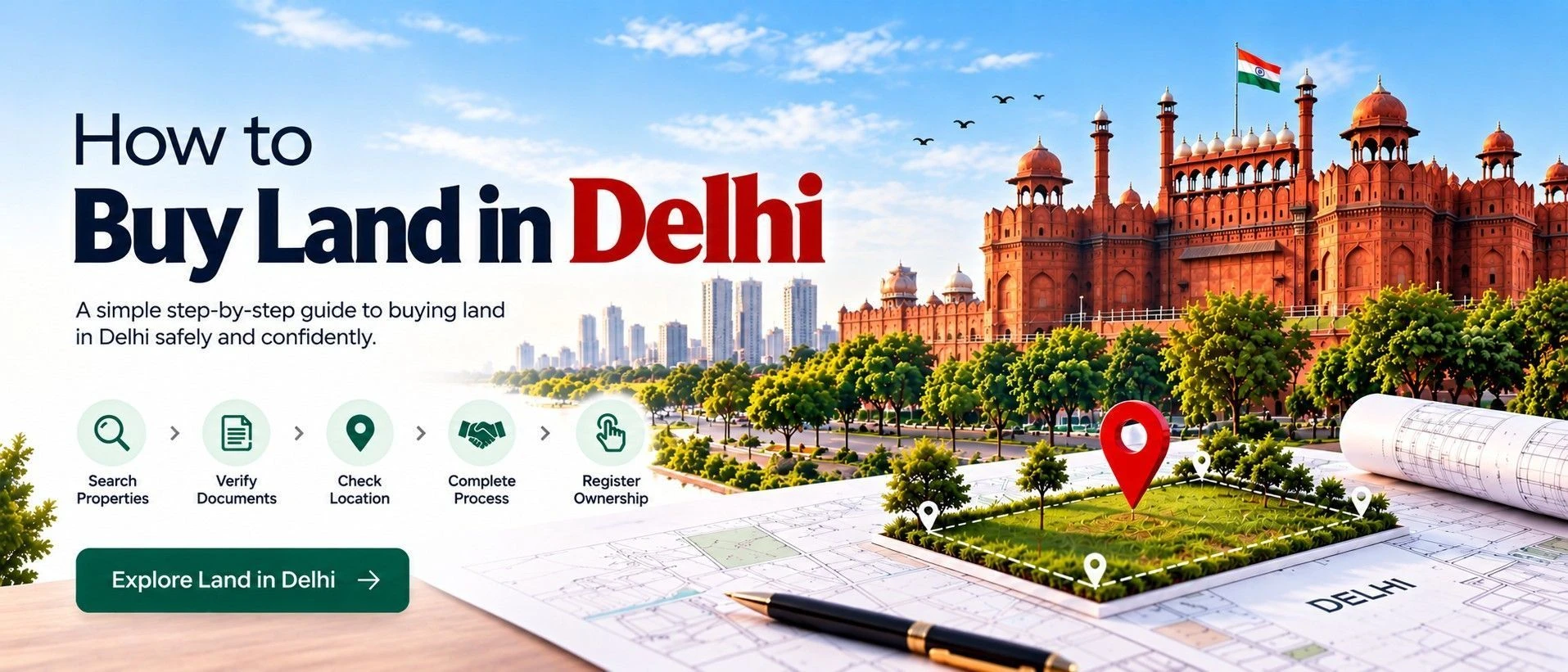
Buying land in Delhi means navigating one of India's most legally fragmented property markets, where a single city contains seven distinct property categories — freehold private land, DDA leasehold, L&DO leasehold, cooperative society allotments, unauthorized colonies, Lal Dora village land, and restricted zones like the Yamuna floodplain. It exposes buyers to serious risk when the category isn't identified correctly upfront — the wrong assumption about leasehold status, an unregistered GPA-based "sale," or overlooked MCD construction violations can leave a buyer with no real legal title despite paying full price. This guide walks through the full purchase process, the checks unique to Delhi, and the categories every buyer needs to understand before shortlisting a property. Whether you're browsing a plot for sale in Delhi, looking to buy plot in Delhi, comparing farmlands near me, or evaluating general agriculture land for sale, this is the process every serious purchase in the capital has to work through.
Section 1 — What Does Buying Land in Delhi Actually Involve?
Before shortlisting a specific property, it helps to see what's available across the city — you can browse the 2Bigha map for Delhi while comparing options to buy plot in Delhi.
Definition: Buying land in Delhi is the process of identifying a property's legal category, verifying its title and construction compliance, and completing registration through the Sub-Registrar's Office to obtain legally enforceable ownership.
The single most important thing to understand about Delhi's land market is that it isn't one market — it's seven overlapping ones, each governed by a different authority and carrying different risks. Freehold private land transfers relatively simply through a standard Sale Deed. DDA leasehold and L&DO leasehold properties involve a government lessor, meaning the "owner" actually holds a lease with its own transfer conditions and NOC requirements. Unauthorized colonies — home to a large share of Delhi's population — were historically sold through GPA arrangements that courts no longer recognize as valid ownership transfers. Lal Dora village land and restricted zones like the Yamuna floodplain carry their own distinct rules. A buyer needs to identify which category a specific property falls into before anything else, because the entire due-diligence checklist that follows depends on this one classification.
State-specific note: In Delhi, high property values mean stamp duty and registration charges represent a genuinely significant cost on top of the purchase price — budget for roughly 4–6% stamp duty (varying by land type, size, and ownership gender) plus 1% registration charges, since underestimating this can derail financing arrangements late in the process.
Expert Tip: Before falling for a property described as a "farmhouse" in outer Delhi, confirm whether it actually sits on Khadar Village Zone (KVZ) agricultural land near the Yamuna. A meaningful share of Delhi's advertised farmhouse land carries agricultural or floodplain restrictions that aren't obvious from a site visit alone, and this single check can rule out an otherwise attractive-looking property before you waste time on it.
Section 2 — How to Buy Land in Delhi Step by Step?
The process splits into due diligence, financial preparation, and registration. Compare the stages by what they establish:
Stage | Cost | Time | What it confirms |
|---|---|---|---|
Title search (DORIS/NGDRS) | Free to self-search; ₹200–₹500 for a certified copy | Days to a couple of weeks | Registered ownership history and any encumbrances |
MCD construction-status check | Free | Same day | Whether the structure is booked for unauthorized construction |
Registration (Sub-Registrar Office) | Stamp duty (4–6%) + 1% registration fee | Same day to a few days for the registered copy | Legal transfer of ownership |
Identify the property's exact category. Confirm whether it's freehold, DDA leasehold, L&DO leasehold, cooperative society, or unauthorized colony land — this single fact determines the rest of your checklist.
Run a title search. Check DORIS (through January 2024) and NGDRS (from January 2024 onward) for the property's registered transaction history and any encumbrances.
Check circle rates. Confirm the current government-notified circle rate for the locality, since stamp duty is calculated on whichever is higher—transaction value or circle rate.
Verify MCD booking status. Check mcdonline.nic.in to confirm the property isn't flagged for unauthorized construction, which can block registration entirely.
Confirm the seller's actual authority to sell. For leasehold properties, this means checking for any required NOC from DDA or L&DO before proceeding.
Book a sub-registrar appointment once your draft sale deed and supporting documents are ready.
Purchase e-stamp papers for the calculated stamp duty amount through an authorized vendor or online.
Attend execution in person. Both parties sign in the presence of two witnesses, with Aadhaar-based biometric verification completed at the office.
Collect the registered deed and file for mutation at the relevant authority (MCD, NDMC, or L&DO, depending on the property's jurisdiction) to update ownership records.
The full process, from initial title search to a fully registered and mutated property, typically takes several weeks depending on how quickly documentation comes together. Before finalizing any purchase, check that the property category was correctly identified from the start, since discovering a leasehold restriction or an unauthorized-colony status after paying an advance is a far harder problem to unwind.
Section 3 — What Should You Verify Before Buying Land in Delhi?
The same category-first discipline applies broadly — whether you're evaluating a specific plot sell in Delhi listing or browsing farm land for sale in Delhi more generally at 2Bigha, always confirm the legal category before anything else.
Field | What it means | What to check |
|---|---|---|
Property category | Freehold, DDA/L&DO leasehold, unauthorized colony, Lal Dora, or restricted zone | Confirm independently, not just from the seller's description |
Title chain | The full registered history of ownership transfers | Look for any GPA-only gap, which breaks legal enforceability |
MCD construction status | Whether the structure is flagged for unauthorized construction | Check directly at mcdonline.nic.in before paying any advance |
Agricultural/restricted classification | Whether the land is genuinely agricultural, KVZ, or floodplain | Especially relevant for "farmhouse" and outer-Delhi listings |
Good sign: the property category is clearly and independently confirmed, the title chain traces back through properly registered documents with no unresolved GPA-only transfers, MCD shows no unauthorized-construction booking, and — for agricultural-adjacent listings — the land classification is explicitly confirmed rather than assumed from appearance.
Section 4 — Common Issues & How to Fix Them
Most problems buying land in Delhi come down to skipping the category-identification step and treating every property like an ordinary freehold purchase. If anything is unclear, verify current guidance through the How to Buy Land in Delhi official website (relevant authority sites: dda.gov.in, ldo.gov.in, or mcdonline.nic.in depending on the property type) rather than relying solely on a broker's description.
Buying GPA-only "ownership" in an unauthorized colony—no registered sale deed or conveyance deed actually exists. Fix: confirm a genuine registered deed, or check whether the colony is on the PM-UDAY approved list with a defined regularization path.
Assuming leasehold can be freely converted to freehold – DDA and L&DO conversions have both been paused in recent years. Fix: confirm current conversion policy status directly with the relevant authority before assuming this option is available.
Skipping the MCD unauthorized-construction check – The Sub-Registrar can refuse to register a transfer until a booking is cleared. Fix: check mcdonline.nic.in before paying any advance, not just before registration.
Buying restricted or floodplain land as regular farmland – Some "farmhouse" listings sit on Khadar Village Zone or Yamuna floodplain land. Fix: independently confirm land classification rather than relying on how the property is marketed.
NRI buyers attempting direct agricultural land purchase – This is generally not permitted under FEMA rules except by inheritance or gift. Fix: confirm eligibility and permitted property categories before proceeding as an NRI/OCI buyer.
Underbudgeting for stamp duty and registration – Buyers focus only on the purchase price and are caught off guard by the additional 5–7% in charges. Fix: calculate stamp duty and registration costs upfront as part of your total budget, not as an afterthought.
Section 5 — Recent Changes in 2026
The PM-UDAY regularization window for eligible unauthorized colonies in Delhi opened on 24 April 2026, giving residents of the approved list of 1,511 colonies a defined path to a proper Conveyance Deed where none previously existed. DDA leasehold-to-freehold conversions have remained paused since 2025, and L&DO conversions have remained paused since December 2022, with no confirmed resumption date as of this update — buyers should not assume either conversion path is currently available. Delhi's registration infrastructure continues transitioning to NGDRS for records from January 2024 onward, running alongside the older DORIS system.
Section 6 — Why Understanding This Process Matters for Land Buyers
Delhi's seven-category property market means the "standard" due-diligence checklist from other cities can miss critical, Delhi-specific risks.
GPA-only sales remain common in unauthorized colonies but carry no legal ownership protection since 2011.
Paused DDA/L&DO conversion policies directly affect what a leasehold property can realistically become in the near term.
MCD's unauthorized-construction booking system can block registration entirely if not checked early.
High stamp duty and registration costs (5–7% combined) meaningfully affect total budget planning.
Getting the property category right at the start avoids far costlier problems discovered after an advance has been paid.
Section 7 — Buying Freehold vs. Leasehold Land in Delhi
Freehold Land | DDA/L&DO Leasehold Land | |
|---|---|---|
What you own | Full, unrestricted ownership | A long-term lease from DDA or L&DO, with transfer conditions |
Transfer process | Standard Sale Deed registration | May require an NOC from the lessor before registration |
Conversion to freehold | Not applicable — already freehold | Currently paused for both DDA and L&DO as of this update |
Knowing which category you're buying into changes the entire transaction — a leasehold purchase isn't simply "a cheaper freehold"; it comes with its own conditions and a currently frozen path to full ownership conversion. If you're planning any other category, being upfront with buyers about the exact property type from the first conversation avoids a deal collapsing once their own due diligence catches the classification. You can list verified land directly through 2Bigha's sell page.
Section 8 — Related Documents
Title Deed Delhi — the core legal document establishing ownership to sell agricultural land in Delhi orership
Encumbrance Certificate Delhi — checking for hidden mortgages or legal claims
Khasra Khatauni Delhi — verifying land classification and revenue records
Property Document Checklist — the complete set of papers to verify
Legal Checklist Before Buying Land — general due-diligence steps applicable across states
