
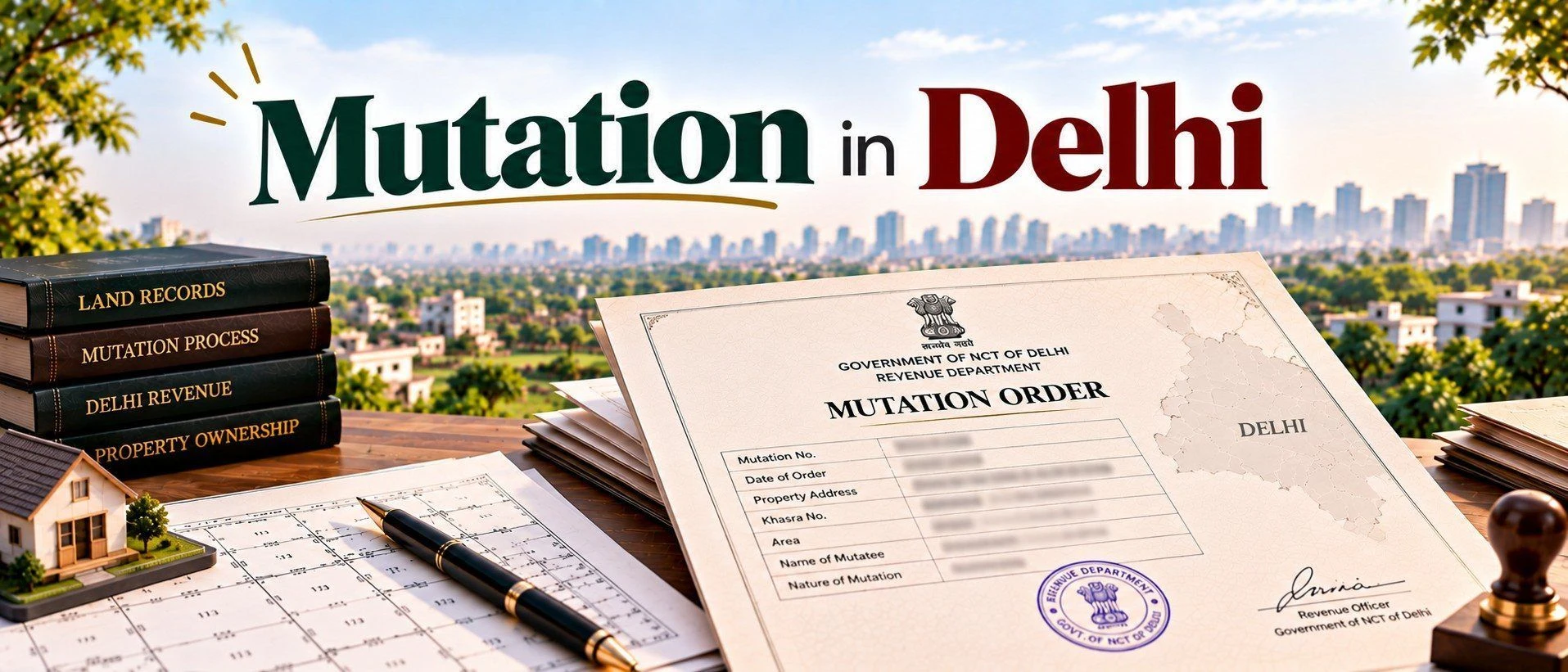
Mutation is the process of updating municipal or revenue records to reflect a change in property ownership, so the new owner's name officially replaces the previous one in government registers. It matters because without it, the property tax, electricity records, and other civic dues can keep sitting under someone else's name — a gap that can quietly complicate a future resale or loan application. This guide covers how mutation works in Delhi, what a completed mutation record should show, and how to fix the issues that most often delay one. Whether you've just bought a plot in Delhi NCR, inherited a family property, or are preparing to resell, this is the record you'll be asked for.
Section 1 — What is Mutation in Delhi?
Before initiating mutation on a newly purchased plot, it's worth comparing what else is listed — browse plots in Delhi NCR on the 2Bigha map to see location and status side by side.
Definition: Mutation is the official process of updating municipal or land revenue records to reflect a change in property ownership, so that the new owner's name is recorded in place of the previous one for the purpose of property tax and civic administration.
It's often confused with property registration, but the two are separate steps with different purposes — registration is the legal act of recording the sale deed at the Sub-Registrar's office under the Registration Act, while mutation is the follow-up step of updating the municipal or revenue department's own records so future tax bills and civic notices go to the correct, current owner. A buyer needs to complete mutation specifically because it's what allows property tax to be billed in their own name, supports future resale, and — for agricultural land — is considered mandatory to establish legal ownership rights.
State-specific note: In Delhi, mutation requirements differ by property type — for agricultural land, mutation is mandatory to establish legal ownership rights, while for non-agricultural urban properties it's technically optional but strongly recommended to avoid complications with future transfers or loan applications.
Expert Tip: If you're buying inherited property, ask specifically whether mutation was completed using Notice Form B (for ownership transfers due to inheritance) rather than Form A (used for regular sale-based transfers) — a seller who mutated an inherited property using the wrong form, or skipped the required notarised affidavit listing previous and current owners, can create a paperwork gap that surfaces later during your own resale.
Section 2 — How to Get Mutation Done in Delhi?
Method | Cost | Time | Legally valid for registration? |
|---|---|---|---|
Online (MCD e-Mutation portal) | Nominal fee, varies by property type | 15–30 working days with proper documents | Yes |
Offline (MCD zonal office) | Roughly ₹25–₹100 | 30–45 days, depending on verification speed | Yes |
Visit the MCD official portal at mcdonline.nic.in and select your specific residential or commercial zone.
Register or log in using your mobile number, creating a new profile if you're a first-time user.
Select the mutation application option, navigating to the Property Tax section and choosing "e-Change of Name" or the mutation service.
Fill in property and owner details, entering the UPIC and the details of both the previous and current owners.
Upload required documents — self-attested PDF copies of the sale deed (or Will, for inheritance cases), identity proofs, and the mandatory notarised affidavit — then submit and await approval from the Zonal Authority.
Visit the nearest MCD zonal office and collect the mutation application form.
Complete the form with all required evidence, attaching the sale deed or Will, identity proof, and the notarised affidavit (Annexure C) declaring previous and current owner details.
Pay the prescribed mutation fee and submit the completed application at the counter.
Await document verification, and in some cases a property inspection, before the mutation is recorded.
Offline processing typically takes 30 to 45 days, longer if a physical inspection is required or documents need correction. Before treating mutation as complete, check that the new owner's name appears correctly in the updated municipal records, and confirm the UPIC and property details exactly match your sale deed.
Section 3 — What Does a Mutation Record Contain?
For a broader look at verified land listings and mutation-ready properties, visit 2Bigha.
Field | What it means | What to check |
|---|---|---|
UPIC (Unique Property Identification Code) | Unique identifier for the property in MCD records | Matches your property tax and sale documents |
Current and previous owner names | Reflects the ownership transfer | New owner listed correctly, previous owner removed |
Property address and category | Location and classification for tax purposes | Matches the sale deed and site address |
Mutation reference/application number | Confirms the transaction is on record | Traceable through the MCD portal |
Date of mutation | When the change was officially recorded | Recent and consistent with your purchase date |
Good sign: A correctly completed mutation shows the new owner's name reflected accurately in MCD records, a traceable reference number, and property details matching the sale deed exactly.
Section 4 — Common Issues & How to Fix Them
Most mutation delays in Delhi come from incomplete documentation or a mismatch between the sale deed and MCD records. Confirm your application status directly on the Mutation Delhi official website before assuming a delay signals a bigger problem.
Missing or incomplete notarised affidavit – Application lacks the required affidavit (Annexure C) declaring previous and current owner names. Fix: Prepare and notarise the affidavit before submission; incomplete applications are typically returned for correction.
Wrong notice form used for inheritance cases – Using Form A (regular transfer) instead of Form B (inheritance-based transfer). Fix: Confirm which form applies to your transaction type before filing.
UPIC not generated or forgotten – Applicant can't proceed without the property's unique identification code. Fix: Retrieve the UPIC through the MCD portal using your registered mobile number, or apply for a new one if the property doesn't have one yet.
Mutation attempted via Power of Attorney – This route is considerably more difficult and often gets held up. Fix: Where possible, complete mutation directly in the name of the registered owner rather than through a POA holder.
Documents not self-attested or poorly scanned – Online submissions are rejected due to unclear or unattested copies. Fix: Re-scan documents clearly and ensure every page carries the applicant's self-attestation before re-uploading.
Zonal Authority approval delayed – Applications can sit pending beyond the standard timeframe. Fix: Track status via the MCD portal and follow up with the zonal office if it exceeds 30 days for online applications.
Section 5 — Recent Changes in 2026
No major changes have been reported as of August 2026. The MCD's online e-Mutation service continues to allow applicants to submit requests, upload documents, and track status entirely through the mcdonline.nic.in portal, alongside the traditional offline route at zonal offices.
Section 6 — Why Mutation Matters for Land Buyers?
It ensures property tax bills are correctly issued in the current owner's name.
It supports ownership proof for municipal purposes, even though it isn't a title document itself.
For agricultural land in Delhi, mutation is mandatory to establish legal ownership rights.
It's typically required before reselling or making further changes to ownership details.
Utility connections and civic services often reference mutation records for verification.
Completing mutation promptly after a purchase avoids compounding paperwork gaps for future transactions.
Section 7 — Mutation vs. Property Registration
Aspect | Mutation | Property Registration |
|---|---|---|
Governed by | MCD (municipal records) / Revenue Department (agricultural land) | Registration Act, 1908, via the Sub-Registrar's office (DORIS) |
What it does | Updates ownership in municipal/revenue records for tax and civic purposes | Legally records the transfer of title through the sale deed |
Timing | Done after registration is complete | The first, legally binding step of ownership transfer |
Proves title? | No — supports ownership proof but isn't the title itself. | Yes — the registered deed is the primary legal title document. |
If your mutation is complete and your property records are in order, you can list it to reach genuine buyers looking to sell agricultural land in Delhi through 2Bigha.
Section 8 — Related Documents
Property Tax Delhi
Legal Heir Certificate Delhi
Lal Dora Land Delhi
Encumbrance Certificate
