
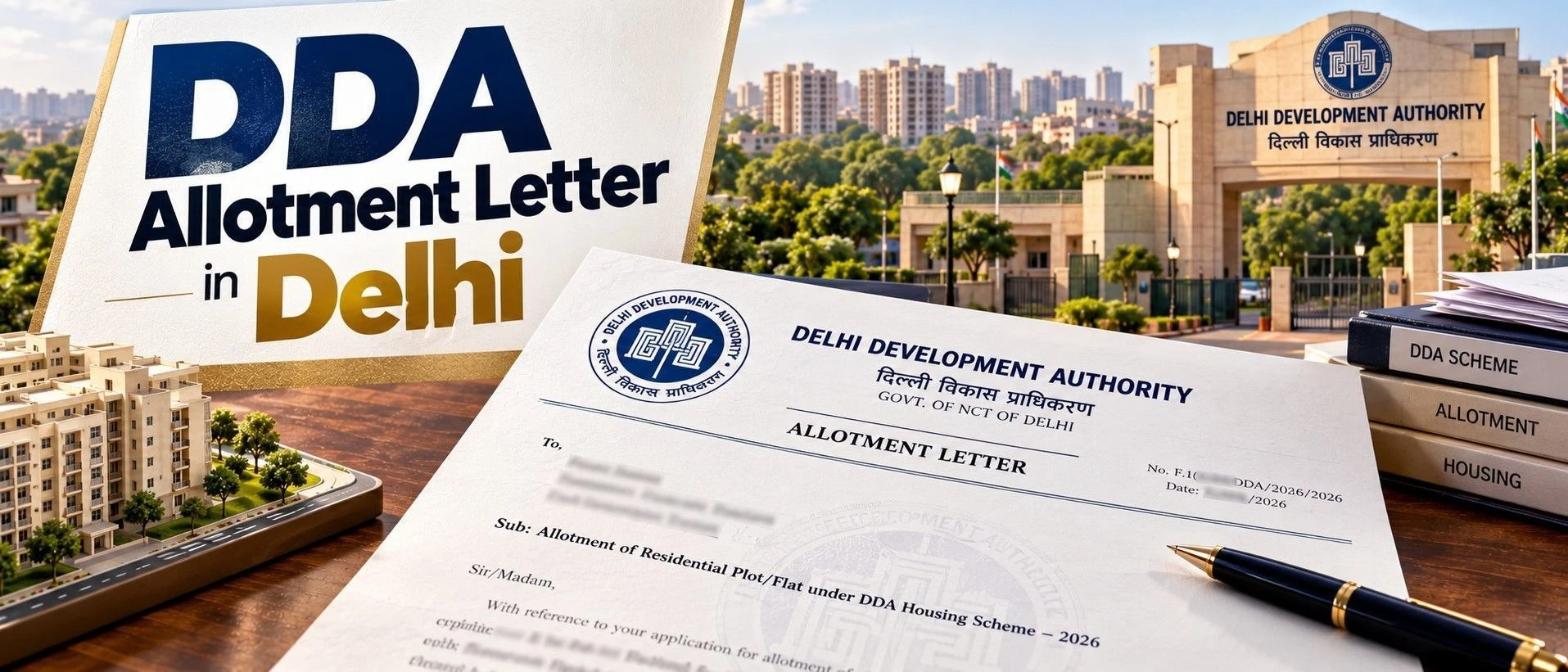
A DDA Allotment Letter is the Delhi Development Authority's formal record confirming that a specific flat or plot has been allotted to an applicant, typically issued after a lottery draw or e-auction under the DDA (Management and Disposal of Housing Estates) Regulations, 1968. It matters because this letter starts the title chain but doesn't end it — without a registered Conveyance Deed alongside it, ownership of a DDA property is legally incomplete, a gap that trips up more resale buyers in Delhi than almost any other document issue. This guide covers what the allotment letter contains, how it connects to the possession letter and Conveyance Deed, and what resale buyers must demand before paying. Whether you're a fresh DDA allottee, buying a resale DDA flat, or settling an inherited one, this is the document chain you need to understand fully.
Section 1 — What is DDA Allotment Letter in Delhi?
Before you look into buy plot in Delhi, it helps to first browse verified listings — you can see this on the 2Bigha map by opening the map, typing 'Delhi' into the search box, and using the state-level results that come up.
In simple terms, a DDA Allotment Letter is the formal notice from DDA confirming that a specific property has been allotted to an applicant following a lottery draw or e-auction, stating the property, the amount due, and the conditions the allottee must fulfil.
It differs from a Conveyance Deed, which is the registered legal document that actually transfers ownership — the allotment letter starts the process by confirming DDA's intent to allot the property to you, but full legal title only completes once the Conveyance Deed is executed and registered, something many buyers mistakenly assume happens automatically.
A buyer needs this specifically because in DDA resale transactions, sellers sometimes present the allotment and possession letters as if they were sufficient ownership proof — under the DDA Regulations, 1968, they are not; legal title requires the registered Conveyance Deed, and no explanation justifies its absence in a genuine sale.
State-specific note: In Delhi, once the allottee makes full payment and completes the required documentation, DDA issues the possession letter — typically within about 15 days — directing the allottee to report to the concerned Engineering Division to take physical possession, after which the Conveyance Deed process for full title follows separately.
Expert Tip: If you're buying a resale DDA property, don't just check whether a Conveyance Deed exists — verify it's actually registered, not merely stamped by the Collector of Stamps; a stamped-but-unregistered deed still leaves the transaction legally incomplete, which is exactly the kind of detail that a rushed resale can gloss over.
Section 2 — How to Get DDA Allotment Letter in Delhi?
There's no separate 'online vs. offline' application route for the allotment letter itself, since it's issued automatically by DDA following a scheme draw — the practical distinction for buyers is between checking scheme/status records online versus verifying the physical documents in hand. Compare below.
Method | Cost | Time | Legally valid ownership proof? |
Online (AWAAS portal record check) | Free to check | Instant | No — confirms scheme/allotment status only, not full title |
Offline (original Allotment + Possession Letter + registered Conveyance Deed) | As per scheme cost plus registration charges | Full chain can take months to years to complete | Yes, once the Conveyance Deed is registered |
Check the scheme record. Visit dda.gov.in or the AWAAS portal to review current and past housing scheme details relevant to the property.
Cross-check applicant details. Where available, match the allottee name, flat number, and scheme details shown online against the physical allotment letter.
Verify conversion status. For older properties, check whether the flat has already been converted from leasehold to freehold, which changes which document is now primary.
Note any pending dues or mutation status. Online scheme records can flag pending payments or transfer formalities worth resolving before any resale transaction.
Collect and verify the Allotment Letter. When it arrives (typically by speed post), match every property particular against DDA's own record.
Complete documentation for possession. Submit proof of payment and required identity/photograph documents to receive the possession letter.
Take physical possession. Report to the concerned Engineering Division on receiving the possession letter, and record any deficiencies in the flat at that time.
Execute and register the Conveyance Deed. Complete the Conveyance Deed process — including stamping by the Collector of Stamps and registration — to finalise legal title.
The full sequence, from allotment letter to a registered Conveyance Deed, can take anywhere from months to considerably longer depending on the scheme and whether leasehold-to-freehold conversion is involved. Before relying on any DDA document as proof of ownership, check specifically whether the Conveyance Deed has been executed and registered — not just stamped.
Section 3 — What Does the DDA Allotment Letter Contain?
Once you have the allotment letter in hand, review each field carefully — this matters whether you're a fresh allottee or evaluating a resale before you buy plot in Delhi. For a broader look at land documents across India, visit the 2Bigha homepage.
Field | What it means | What to check |
Allottee name | Person the property is allotted to | Matches the seller's identity in a resale, or your own details if fresh |
File/allotment number | DDA's internal reference for the allotment | Verifiable directly with DDA or on the AWAAS portal |
Property particulars | Flat/plot number, block, pocket, scheme details | Matches the physical property and site documents exactly |
Payment and possession status | Whether dues are cleared and possession taken | Payment receipts and possession letter both present |
Conveyance Deed status | Whether legal title has been formally transferred | Registered, not merely stamped — this is the critical check |
Good Sign: A clean DDA property file shows the allottee name matching the seller in a resale, a file number verifiable directly with DDA, payment receipts and a possession letter both present, and — critically — a registered Conveyance Deed. If all of this checks out, ownership is legally complete, not just administratively started.
Section 4 — Common Issues & How to Fix Them
These recurring issues account for most disputes in Delhi DDA resale transactions, and nearly all trace back to treating an incomplete document chain as if it were finished. For the most accurate, current procedure, always cross-check against the DDA Allotment Letter on the Delhi official website.
No Conveyance Deed alongside the letter – Seller shows the allotment and possession letters and calls it ownership proof. Fix: Under DDA Regulations 1968, this is not legal title — demand the Conveyance Deed; no explanation justifies its absence in a genuine sale.
Conveyance Deed stamped but not registered – Deed exists and is stamped by the Collector of Stamps but was never formally registered. Fix: Insist on seeing the registered deed, not just the stamped copy — an unregistered deed leaves the transfer legally incomplete.
Leasehold-to-freehold conversion not reflected – Property was converted from leasehold to freehold, but the seller's documents still only show the old allotment file. Fix: Check whether DDA still holds the allotment file at all; for converted properties, the Conveyance Deed becomes the primary document and should be verified accordingly.
Mutation not completed after inheritance – An allottee has passed away, and the property wasn't formally transferred to legal heirs. Fix: Complete DDA's mutation process for the property, which requires proof of relationship and, where applicable, NOCs from other legal heirs, within the required timeframe to avoid penalty.
Pending conversion charges or dues on the file – Outstanding payments linked to the allotment weren't cleared before resale. Fix: Get written confirmation from DDA that all dues on the specific file are cleared before finalising any purchase.
Allotment letter details not matching the physical property – Block, pocket, or flat number discrepancies between the letter and the actual site. Fix: Resolve the discrepancy directly with DDA before proceeding — do not assume it's a clerical error without written confirmation.
Section 5 — Recent Changes in 2026
DDA continues to run scheme information and status details through its official portal and the AWAAS system for housing scheme applicants, alongside the established leasehold-to-freehold conversion scheme for eligible flats. No major standalone change to the allotment letter process itself has been confirmed as of August 2026 — always verify current scheme-specific procedures directly with DDA before relying on older guidance.
Section 6 — Why DDA Allotment Letter Matters for Land Buyers
It's the first document in the title chain for any DDA property, but resale buyers often mistake it for the whole chain.
Without a registered Conveyance Deed, ownership of a DDA property remains legally incomplete regardless of possession.
Unpaid dues or unresolved mutation on the file become the new owner's problem in a resale.
Banks require the full, verified document chain — not just the allotment letter — before approving a loan against the property.
Understanding this chain protects you from a common and costly Delhi resale mistake.
It matters for inheritance too, since mutation timelines and heir documentation follow specific DDA rules with penalties for delay.
Section 7 — DDA Allotment Letter vs. Conveyance Deed
These two are the most commonly confused documents in DDA property transactions. Here's the distinction that actually matters.
Aspect | DDA Allotment Letter | Conveyance Deed |
What it is | DDA's formal notice confirming allotment | The registered legal document transferring full ownership |
When issued | After a lottery draw or e-auction, before possession | After payment, possession, and completion of formalities |
Legal weight for title | Starts the chain, not proof of ownership alone | Completes legal title once registered |
The allotment letter tells you DDA intended to give you the property; the Conveyance Deed is what actually makes it legally yours once registered — demand both, verified, before any resale purchase. If you already hold a fully title-complete DDA property and are looking to sell your land in Delhi, having the registered Conveyance Deed ready to show will meaningfully speed up buyer confidence and closing.
Section 8 — Related Documents
Building Plan Delhi — relevant if you plan any construction or alteration on a DDA plot
CLU Delhi DDA MCD — relevant if a DDA-allotted plot's use needs to be changed
