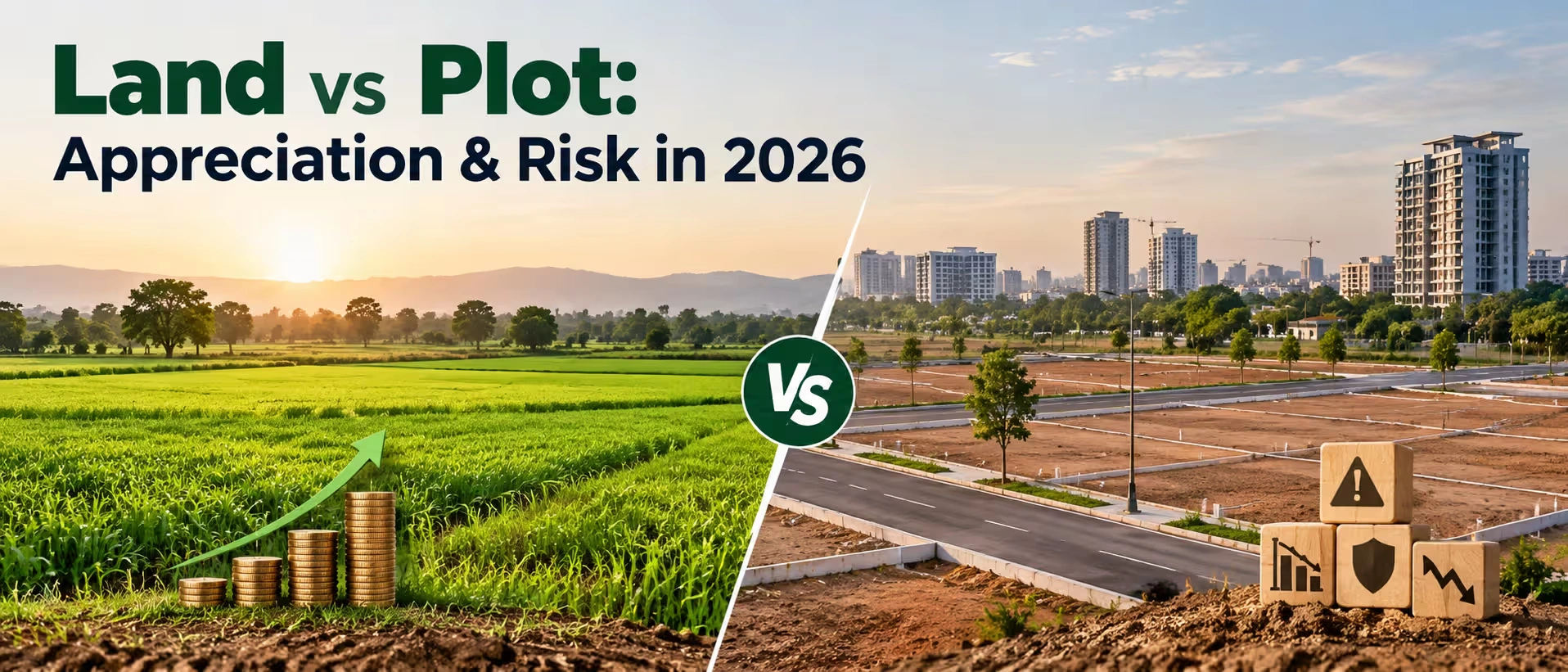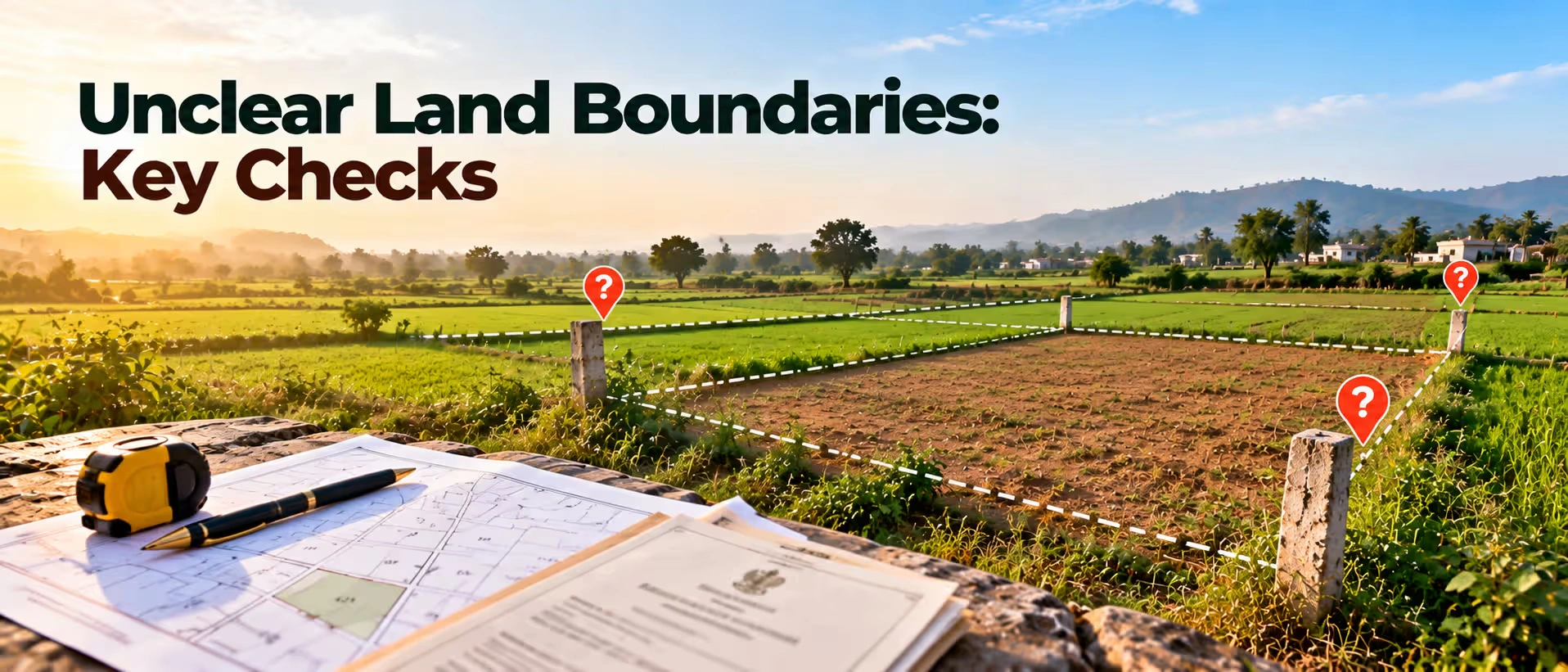
Picture this. You've found a plot you like. The price is fair, the road access is decent, and the seller is a pleasant man who offers you chai. Then you ask where the land actually begins and ends, and he points vaguely toward a neem tree and says, "Up to that side, more or less." More or less. Those two words have cost a lot of buyers a lot of money.
If you're out there searching for a plot for sale near me, you'll meet this situation sooner or later. Sometimes the seller honestly doesn't know. Sometimes he does know and would rather you didn't ask. You can't tell which one it is just by looking at him, so you need a way to find out. That's what this guide is about.
Why does the boundary matter more than the price?
People negotiate on rates per bigha and pay no attention to boundaries. This is the wrong approach. Disputes over land in India seldom begin with "I don’t have any claim to this land." Instead, they begin with "You’ve crossed my boundary." Your neighbor plows into your territory by two feet, the bund gets washed away during the monsoon, and the path that was commonly used for decades is found to be officially a village road. It is overlooked for decades.
When you buy agricultural land for sale, consider the boundary as part of the package. If the seller cannot define it, you are buying a product which you cannot define.
Ask again, but don't make it a fight
First, be nice to the man you are talking to. Nobody will explain anything properly if they are feeling that way about an accusation from someone else.
Find out what number of khasras the plot consists of. Ask about the person owning the lands beside the plot. Also, try to find out whether there has been any survey before this one and whether there is any village map for him to show you. The genuine owner of the land will know his neighbors personally, as they have been farming beside each other for almost twenty years.
Read the papers before you trust the field
It seems convincing to walk around the land. It’s sunny out, the soil seems fine, and the seller is gesturing confidently. However, it is the law that matters, which means what is on record.
You should ask for the jamabandi or Record of Rights, the khatauni, and the most recent mutation entry. You may also ask for the map of the village, the shajra or musavi in your respective state, and any previous sale deeds, since older sale deeds may include clear descriptions of the boundaries, like “road on the east, Ramphal’s field on the west.”
You can cross-check yourself. All states have made their land records available online now, so you can verify what the seller has given you against what’s on the official portal. If the area, the name, or the khasra number does not match, it is not “a small typing mistake” until the revenue office says so.
Also Read: Agricultural Land Near a Village Boundary: What Buyers Should Check?
Go there, and take someone local
Go to the land in person. It is best if you can do it twice, once during the morning and once during the evening. You will notice differences. Bring with you a local that you trust, perhaps a farmer from an adjacent land parcel, and walk along the borders slowly. Check for old bunds, boundary markers, fencing, a tube well, a drainage, and rows of trees. Does the shape in the field correspond to the shape on the map? Are there crops from your neighbour planted in an area that is supposedly yours? Is there a channel or pathway cutting across the field?
Also, talk with your neighbours. It will give you more information than talking to the seller for an hour. If a neighbour says, "Oh, that corner has been troublesome for many years," then you know what corner to excavate.
Get the land officially demarcated
This is the step that actually settles things. When a seller can't explain the boundaries, the cleanest answer is to have them marked by someone with the authority to do it. In most states,s you can apply to the local revenue office for demarcation, which people also call nishandehi. A patwari or kanungo turns up with the village map, marks the corners on the ground, and usually informs the neighbours so they can be present.
A few practical things. Apply in writing and keep the receipt. Ask for the report afterwards, with the date and the officer's name on it. Take photos and a short video of the marked corners, because memory fades and fences move.
If the plot is large, or you already suspect a dispute, you can also hire a licensed surveyor with a total station or DGPS machine. It costs extra, yes. But you get exact measurements and a proper map to attach to the sale deed, and it helps later if you ever want to sell land yourself.
Check for encroachment and hidden claims
And here comes a surprise. This boundary ambiguity has nothing to do with the seller himself; on the contrary, a piece of this land might be missing already. There’sae strip that belongs to someone nearby. There’sae canal passing through one of the corners of this land. This land might have a part that is owned by the government or is simply a pond.
There’s a local lawyer who can carry out the title search of this land for your benefit. This means that he will trace the entire history of its ownership, any loan or mortgage secured on it, as well as any litigation proceedings that might be going on about this khasra number. This procedure will cost you next to nothing.
Don't let anyone rush your money
This is where things can get really nasty. The vendor tells you that there's a buyer for tomorrow. He requires an advance immediately. He will "sort out the boundaries after registry." No. Do not do that.
If you wish to stick to the transaction, make sure the token is minimal and note that the transfer is conditional upon demarcation and clear titles being sorted out by a certain date. Otherwise, you have your token back. This will not worry a legitimate seller in the least. If he puts up a fight about it, then he's telling you something else. Once you've registered, you own the problem.
Make the sale deed say what the survey says
But if there are no errors, the documents must be as precise as the site itself. The sale document has to state the proper survey numbers, the exact area in bigha, acres, or square meters, and the boundaries of the plot with names or landmarks on all four sides. Add the report or map as an annexure.
Apply for the mutation shortly after the registration. Many do not do that, and then they regret it since the revenue record continues to show the same name of the previous owner.
And if he still can't explain anything?
Walk away. Really. If there are no documents, he refuses demarcation, and the neighbours all tell different stories, the land probably isn't worth the stress. There's other land out there. Anyone looking at farmland for sell should be able to find plots where the records are clean, and the edges are known. It may take longer, but a cheap plot you can't use is just an expensive lesson.
Quick checklist
Before you pay anything, make sure you can say yes to these:
- Khasra numbers and the neighbours can be named by the seller.
- It is true that land records confirm his information to you.
- The village map confirms the form on the ground.
- A demarcation of the land has already been carried out in writing.
- There is no encroachment, nor any dispute in the strip.
- The lawyer has verified the title of the land.
- The boundary is described in the sale deed.
- The mutation process has been planned immediately after the registration.
One last thing
Buying land is probably one of the biggest decisions your family will make. A vague boundary doesn't always mean fraud, but it always means homework, and the time to do that homework is before the money moves. Whether you're comparing farm lands near me or just exploring the wider world of land selling, take your time, ask the awkward questions, and ask for proof. On 2Bigha, you can browse listings where the details are laid out upfront, which saves a lot of guessing. A clear boundary today is one less argument tomorrow. That's worth waiting for.
Disclaimer: This article is for informational purposes only and should not be considered investment, legal, financial, or property advice. Real estate regulations, infrastructure plans, market conditions, and government policies may change over time. Readers are advised to verify information with relevant authorities and consult qualified professionals before making any investment or property-related decisions.