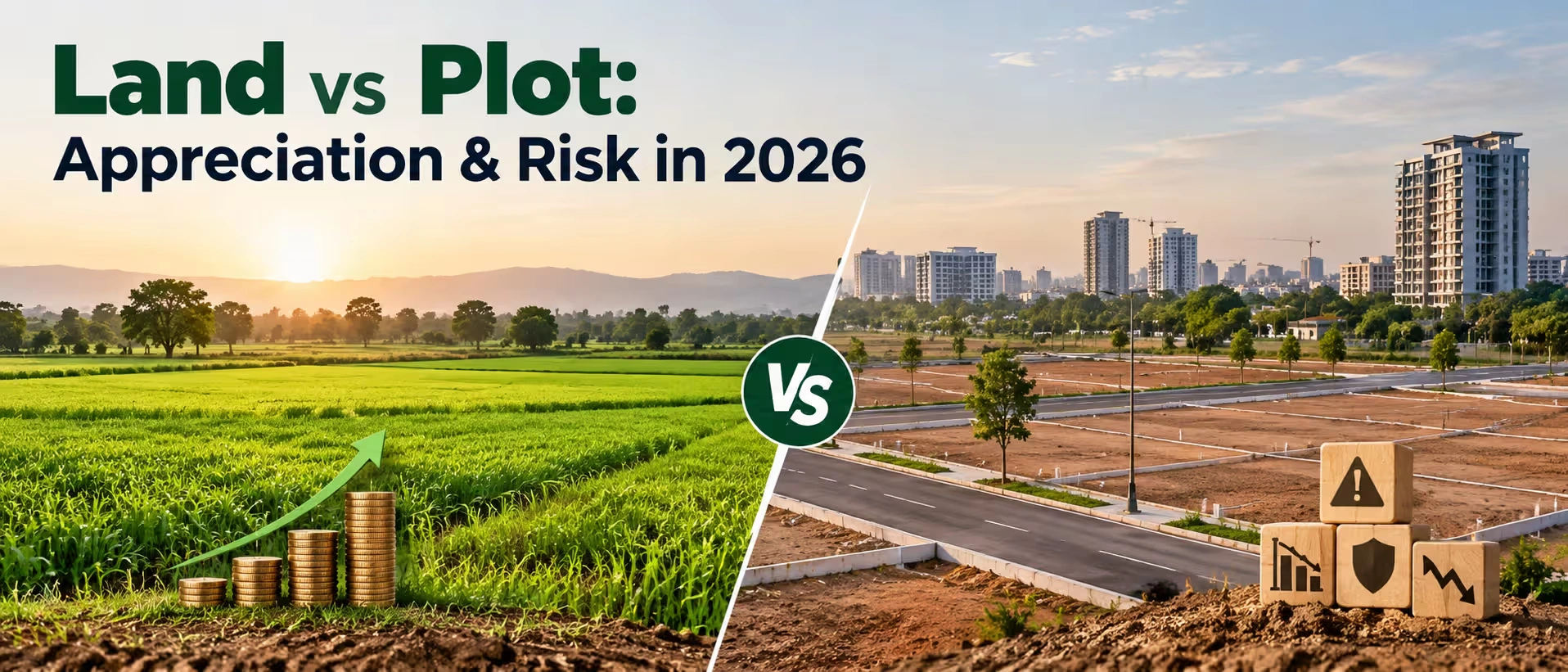
When someone asks about buying either a piece of land or a plot, he is actually wondering which one will be more profitable with less effort. The truth about India is that the right answer will depend on the location of the land or plot in question, the documents that come along with it, and how much time the owner can spare for it. Residential plots located within an approved layout function as urban properties in terms of demand and paperwork, whereas agricultural land works more as an investment in infrastructure, which may or may not be constructed according to schedule. Here is a comparison of both types based on several criteria.
Land vs Plot in India: What Is the Actual Difference?
In everyday Indian usage, a plot is a demarcated parcel inside a layout, with a plot number, internal roads, and a permitted use that is usually residential or commercial. "Land" normally means a larger parcel whose use is agricultural, or which has not yet been converted for any other purpose. Buyers who browse agriculture land for sale on listing sites are generally looking at parcels measured in bigha, acre, or guntha, while plot buyers think in square feet, square yards, or gaj.
| Feature | Plot | Agricultural Land |
| Typical size | 600 to 3,000 sq ft in most cities | 0.5 acre to several acres |
| Permitted use | Residential or commercial, as approved | Farming unless converted |
| Measured in | Sq ft, sq yard, gaj | Bigha, acre, guntha |
| Approvals | Layout approval, RERA in many cases | Revenue records, land use rules |
| Who can buy | Almost anyone | Restricted for non-farmers in some states |
| Can you build | Yes, after plan sanction | Only after land use change, with limited exceptions |
Which One Appreciates Faster?
Neither wins everywhere, and anyone who quotes you a fixed yearly return is guessing. What can be said is that the two assets gain value in different ways, and that difference matters more than any single percentage.
| Factor | Plot | Agricultural Land |
| Main price driver | Neighbourhood growth, civic services, demand for homes | Highway, airport or industrial announcements, conversion potential |
| Pattern of growth | Gradual and fairly steady | Slow for years, then sharp jumps |
| Volatility | Lower | Higher |
| Entry cost per sq ft | Higher | Much lower |
| Usual holding period | 3 to 7 years | 7 to 15 years |
| Biggest upside trigger | Nearby metro, school, hospital, or employment hub | Expressway interchange, industrial corridor, city limit expansion |
Looking at the table, investing in Plots vs Flats involves different returns and risks. Plots may offer long-term appreciation with lower maintenance costs, while agricultural land can deliver significant gains over time if infrastructure develops and land-use conversion is legally permitted.
How Do Plots Appreciate in Cities and Growing Suburbs?
The plot becomes valuable because there are people willing to live or conduct their businesses nearby. The important factors here include width of the road, availability of water and electricity supply, proximity to schools and hospitals, and also the number of job opportunities within a thirty-minute drive. One who looks for plots for sale near me and finds out three layouts within a few kilometers of distance from each other will normally notice that difference in prices will depend on something, and this factor is development level of surrounding area. A layout with tarmacked roads, street lighting, and a couple of constructed buildings is more expensive than the untouched one but also less vulnerable to market changes. Advantages making plot valuable over time:
- Government-approved layout with clear boundaries, since banks and future buyers value it higher than an informal sale deed on an unapproved subdivision.
- Corner plot or one situated on a wider road, since it always costs more when the area is being developed.
- Projects of metro, ring road, or bus corridor approved in the budget and not only announced in the news.
- A short gap between your plot and existing built-up areas, since filling that gap is the easiest source of growth
How Agricultural Land Appreciates and Why It Moves in Jumps?
Agriculture land is inexpensive because, on day one, its value lies in earning its crop. Its true worth only kicks in when there is movement towards development such as a city, a road, or an industry moving close to the plot. In such cases, it does not earn by being farmland anymore but according to the possibilities it represents. That explains why a piece of land located near a notification of a new expressway may double in value in less than five years, whereas identical land located some forty kilometres away from it will stay static in value. The following factors influence the increase:
- Proximity of planned interchange or industry as compared to proximity of nearest villages
- Whether a state allows conversion into non-agricultural usage and how quickly the process can be made possible
- Accessibility of the road to the land because lands inaccessible through roads are of no use
- Income from crops grown and possibility of irrigation in the region
Risk Comparison: Title, Conversion and Delivery
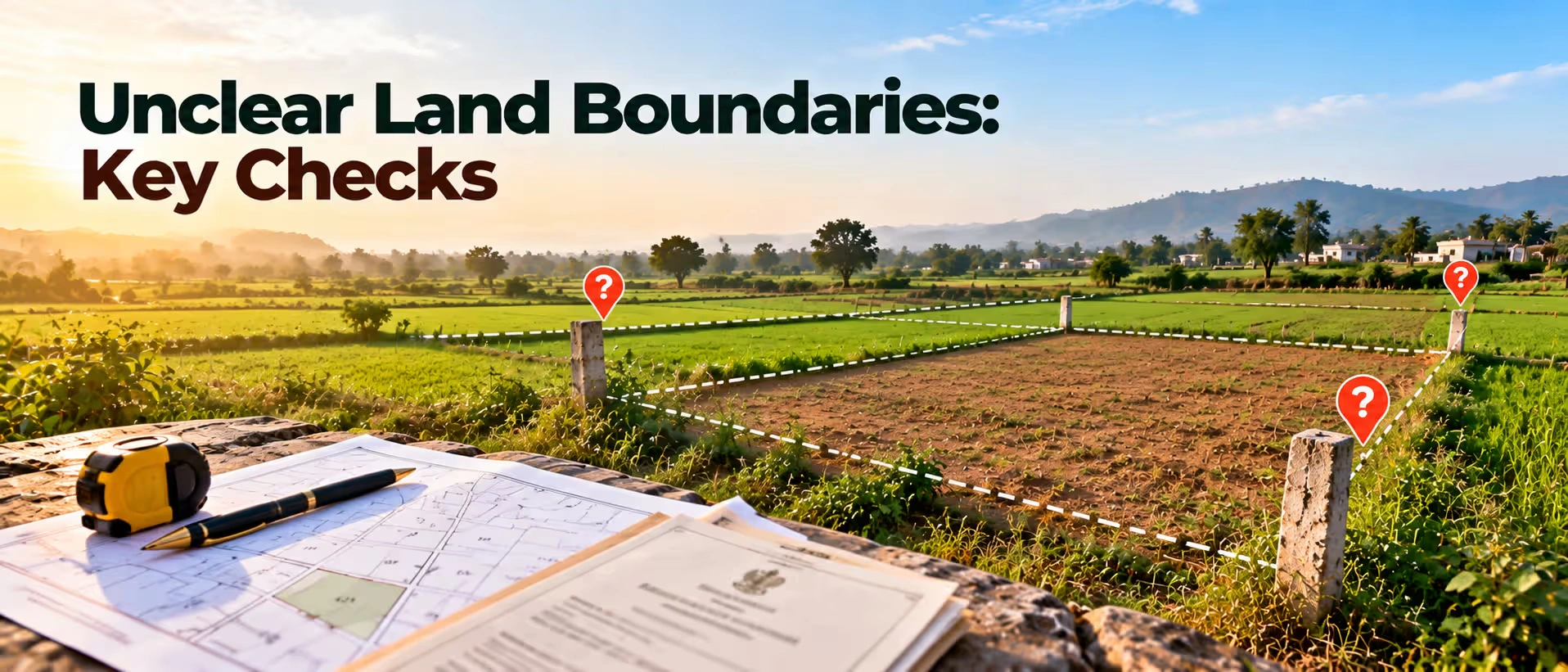
Anyone doing a farmland search should treat title checking as the very first step, since agricultural parcels often pass through several heirs, and an old inheritance dispute can surface long after the money has changed hands. Plots carry a different set of dangers, mostly connected to layouts that were sold before they were approved.
| Risk | Plot | Agricultural Land |
| Disputed or unclear title | Moderate, if layout is old | High, especially with joint family holdings |
| Unapproved layout | Common in fringe areas | Not applicable |
| Land use change refused or delayed | Low | High |
| Encroachment | Moderate | Moderate to high on large parcels |
| Government acquisition | Low | Higher near highways and project routes |
| Developer delay or abandonment | Present for new layouts | Rare |
| Buyer eligibility rules | Few | Some states, such as Maharashtra and Himachal Pradesh, restrict non-agriculturists, and rules keep changing |
On balance, plots in approved and registered layouts carry lower legal risk, and agricultural land carries more of it but costs far less to enter.
Liquidity, Loans and Resale
This is where liquidity shines through. If a plot is located in an existing layout, it sells in a matter of months, banks easily provide loans on such plots, and the buyer builds his/her house on it immediately. Agricultural land may take up to a year or even more to be sold, since the number of potential buyers is smaller and each of them wishes to check all documents, boundaries, and accessibility. Loans against such land are not easy to obtain and are often restricted to agricultural purposes.
Bear in mind that your cash flow is important. If there is the slightest possibility that you may need the funds in three to four years from now, the plot is a better choice; otherwise, agricultural land may be considered if you do not plan to touch the money in ten years.
Taxes and Costs You Should Count Before Buying
The purchase price is only part of the cost, so it helps to list every charge before you compare returns. Stamp duty and registration fees vary widely by state, and some states reduce them for women buyers. Add legal verification fees, survey charges, and, for agricultural land, any land use conversion fee that applies later.
On the sale side, land selling attracts capital gains tax, and the rules depend on the type of land and how long you held it. As of the current rules, long-term gains on land held for more than 24 months are taxed at 12.5 percent without indexation, with a transitional option available for land bought before 23 July 2024 in certain cases. Rural agricultural land that sits beyond the distance limits from municipal boundaries is generally not treated as a capital asset at all, which can make a real difference to what you keep. Reinvestment relief also exists with conditions attached. Tax law has been reorganised recently, so confirm the current provisions with a chartered accountant before you finalise a deal.
Which One Should You Choose? A Simple Decision Guide?
| Your situation | Better fit | Why |
| Want to build a home in 3 to 5 years | Plot | Approved layout, loan support, quick construction permission |
| Small budget, long horizon | Agricultural land | Low entry price, higher upside if infrastructure arrives |
| Need money back within a few years | Plot | Easier resale |
| Comfortable with legal checks and waiting | Agricultural land | Gains can be larger when conversion works out |
| First-time investor | Plot | Fewer moving parts, easier to verify |
| Want a weekend retreat or income from crops | Agricultural land | Usable immediately, even without conversion |
A split approach also works for some buyers, with a smaller plot for stability and a modest agricultural parcel near a planned corridor for the longer game.
Buying and Selling Safely Through 2Bigha
If your parcels are in different states, it is easier for you to look at authenticated listings in one place rather than going after brokers. Buyers who want farmlands close to me will be able to browse through listings according to location and budget, request Background Verification Reports regarding records and ownership, and even use the Book a Visit feature to view the land before making any payments. The listing of farms also comes with Land Assistant in beta that can answer the most basic queries on the listing. Owners who want to sell their properties will be able to put their land up for sale and connect to buyers in other states.
Common Mistakes to Avoid
- Paying a deposit without first examining the title deed for at least thirty years, which is the most common reason for future disagreements
- Buying the piece of land on the basis of pending approval, which hasn’t been granted yet
- Thinking that the process of conversion is going to be simple, even though it can take several months and is sometimes impossible
- Neglecting the issue of road access, as it’s difficult to sell any property that doesn’t have it legally
- Considering only the price per square foot and ignoring the issues of stamp duty, conversion, and time
Disclaimer: This article is for informational purposes only and should not be considered investment, legal, financial, or property advice. Real estate regulations, infrastructure plans, market conditions, and government policies may change over time. Readers are advised to verify information with relevant authorities and consult qualified professionals before making any investment or property-related decisions.