Most purchasers find the prospect of buying land near a village quite attractive. The power supply is close, a pakka road is always just a walk away, and there is a tea stall and a mechanic just a kilometre away, so it is not as isolated as the deep fields. All this is true, but the fringe of the village is also where the land records tend to become muddled, where old claims overlap and where one mistake in assuming the "agricultural" status of the land can cost you years. This guide will help you identify the things to check before buying a plot there.
What Village Boundary Actually Means on Paper?
While saying that a plot is near the boundary of the village, people actually suggest that it lies near the portion of the village that is inhabited. In revenue records, however, the inhabited portion is always known under a separate name with its own laws. For instance, in Punjab, Haryana, and Delhi, it is referred to as 'abadi deh' or 'lal dora', while in other states other names are used for the same.
So the first thing to ask is simple: is this plot inside the abadi, outside it, or touching it? Many listings of farm land for sale gloss over this, and the seller may honestly not know. A plot that looks like a field can sit partly inside the settlement limit, and that changes what you can build, how it's taxed, and how a bank treats it.
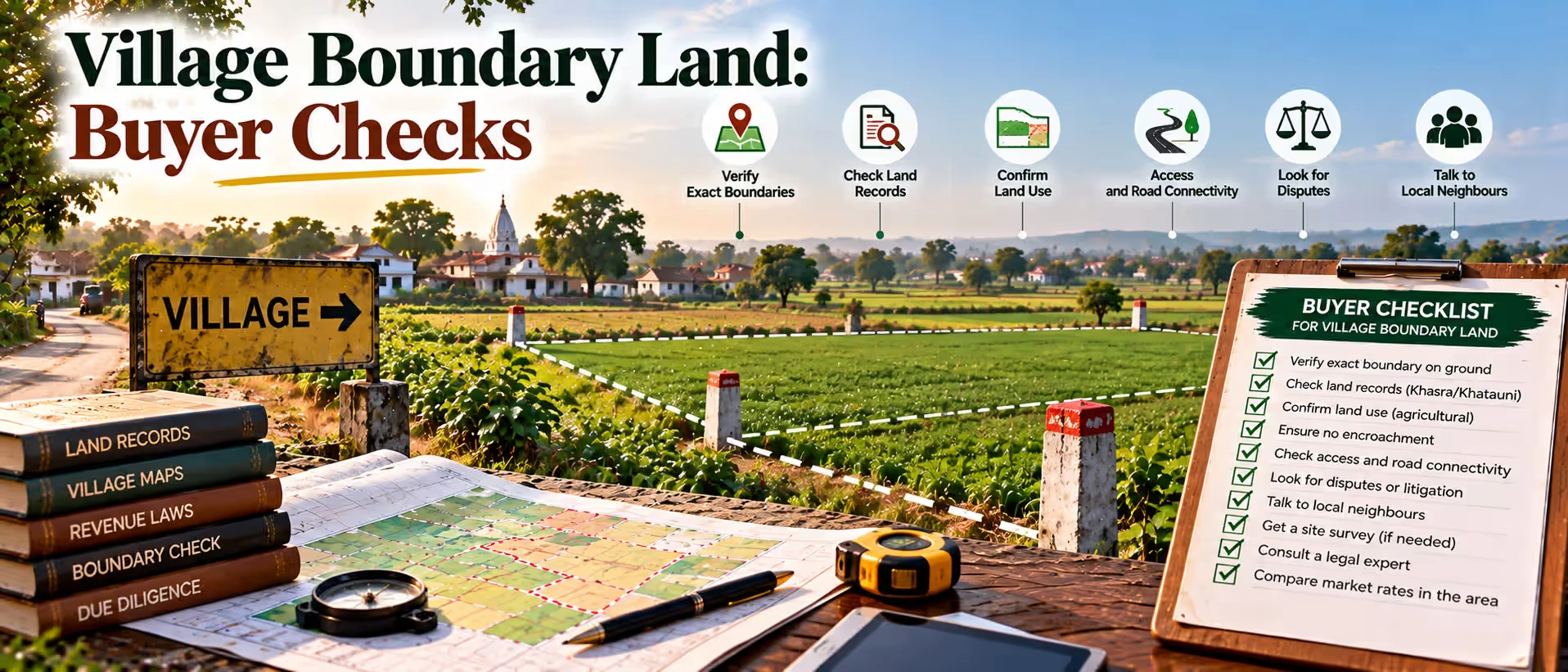
Ask the local patwari or the revenue office to show you the village map (the shajra or massavi) and point out where the abadi line runs. Then stand on the ground with that map and see if it matches what the seller is showing you.
Read the Land Category Carefully
Land close to a village is more likely to carry a category that isn't ordinary cultivable land. Common village land, grazing land, ponds, and paths often sit right at the edge of the settlement, and some of them are recorded in ways that are easy to misread.
| Category you may see | What it usually refers to | Why a buyer should care |
| Shamlat deh / common land | Land held for the whole village | Generally can't be sold by one person |
| Gochar | Grazing land | Often protected; sale may be invalid |
| Gair mumkin | Land recorded as not cultivable, such as a pond, path, or waste | Can't be treated as farm land |
| Abadi / lal dora | Inhabited village area | Different rules for building and records |
| Khatedari or private holding | Land held by a recorded owner | The one you actually want |
Names and exact meanings change from state to state, so ask the local revenue office what each entry means in your area rather than relying on the seller's explanation. If you're comparing plots of land for sale around a village, it's worth noting which ones are clearly recorded as private cultivated holdings and which ones carry a doubtful entry. The clean ones are usually fewer, but they're the ones you can resell later without a headache.
Roads, Paths and Right of Way
Plot outside the village is likely to rely on narrow lanes and field paths, and most of them are not owned by the seller. The lane that is in use for forty years might still be registered as the land of some individual, or it could even be a public lane where it cannot be closed. This should be known.
If one looks for farms for sale near me and comes across a plot that is a bit far off the village, then the road will be the item to be checked out. It is advisable to walk from the public road to the farm, identifying ownership of the path segments. Check the village map whether the path is marked, and also consult the villagers about it. In case the route crosses the land of an individual, a registered right of way should be acquired before making any payment.
The width of the lane is also important since the lane where a tractor can pass is acceptable for farming, but when one wants to build or use a truck, then width will be of concern.
Can Land at the Village Edge Turn Commercial?
This is the question that lies at the core of many purchases. People see a bustling village, a highway not too far away, and some new shops, and suddenly they begin to look for commercial lots for sale near me, hoping that the plot will be much more valuable after being converted to commercial use. This could happen, but not necessarily.
The agricultural land remains agricultural until the competent authority gives its approval of the change. Depending on the state, this procedure is known as change of land use, non-agricultural permission, or conversion, and it is always accompanied by some fee and an inspection. The authority will also review the local master plan or development plan (if there is any) to see how the area should be used. If your plot is classified as green belt, road widening zone, or agricultural zone, the conversion may be denied or restricted.
But before you pay for the potential, check three things: what the local development plan says about the area, if similar plots in the neighborhood have already been converted, and how long and expensive this procedure was for them. A seller's statement "conversion is easy" is not a document.
Boundaries, Encroachment and Neighbours
Plots located close to villages will have a higher probability of encroachment because of the greater number of persons as well as animals around the plot. A wall constructed a few yards into your plot or a neighbour who has been using your land for dumping refuse will become a problem once you purchase the plot.
Ask for demarcation from the revenue department of the plot you are interested in. This would be an official measurement in which the officers survey and mark the boundary points. It will cost a little and may take some days, but will help in determining whether what you are shown corresponds to what you buy. In addition, these should be looked out for during your inspection of the plot:
- Any structure, shed or room erected on the plot
- Tubewell, hand pump or small temple that people worship regularly
- Cattle sheds or manure piles near the boundary points
- Persons who claim to be farming the plot for a number of years without owning it.
Also talk to some of the residents rather than the seller alone. The person operating the corner store will inform you about the dispute even faster than documents will do.
Also Read: Best Villages Near Sehore to Buy Farmland in 2026
Water, Drainage and Daily Nuisances
Farming or living near a settlement will inevitably entail some of the inconveniences which the truly rural farmland lacks. Your plot of land could receive drainage from the village drainage to its low spot. Waste could be tipped just on its edge.
A stray beast could devastate a nascent growth overnight, and there may be the nuisance of sound, fume or odour coming from a poultry farm, kiln or flour mill adjoining it. It would be good if you could visit it when it is raining, if not when it has rained recently. You will be able to judge whether your plot is waterlogged, and how the local drainage acts. Also, investigate the source of water, depth of a bore well (if any), sharing, if any, etc. Settlements invariably draw groundwater faster.
Price: Why Edge Land Can Cost More or Less?
Prices near a village boundary don't follow one pattern. Some plots sell at a premium because of the road and power access, and others sell lower because of doubtful records or crowding. Anyone dealing in land selling near me should expect buyers to compare these plots against cleaner fields further out.
| Factor | Can push price up | Can push price down |
|---|---|---|
| Road and electricity | Direct, legal access | Narrow or disputed lane |
| Land category | Clear private holding | Doubtful or common land entry |
| Future use | Supportive development plan | Green belt or reserved zone |
| Surroundings | Quiet, clean edge | Drain, dumping, noisy activity |
| Water | Reliable source | Falling water table |
Get two or three recent sale rates from the sub-registrar office for the same village, since asking prices online are often higher than actual deals. Compare the quoted price with the circle rate as well. A deal far below the government rate usually means something is off, either in the paperwork or in how much of the payment will be shown in the deed.
Using 2Bigha to Shortlist and Verify
All of this will entail many visits to the tehsil office and interactions with people who may or may not be trustworthy. 2Bigha is an online platform that offers listings for farmland and agricultural land across India where you can search for lands, compare their location, and request Background Verification Reports on the land that you choose. If you want to view the property personally, you can use the Book a Visit option rather than relying on brokers.
Sellers can use the platform too. If you want to sell land online, a listing with clear location details and documents reaches buyers who are already looking for agricultural land, and it keeps your paperwork in one place instead of scattered across calls and messages. Whichever side you're on, a verified listing means fewer surprises later.
Disclaimer: This article is for informational purposes only and should not be considered investment, legal, financial, or property advice. Real estate regulations, infrastructure plans, market conditions, and government policies may change over time. Readers are advised to verify information with relevant authorities and consult qualified professionals before making any investment or property-related decisions.