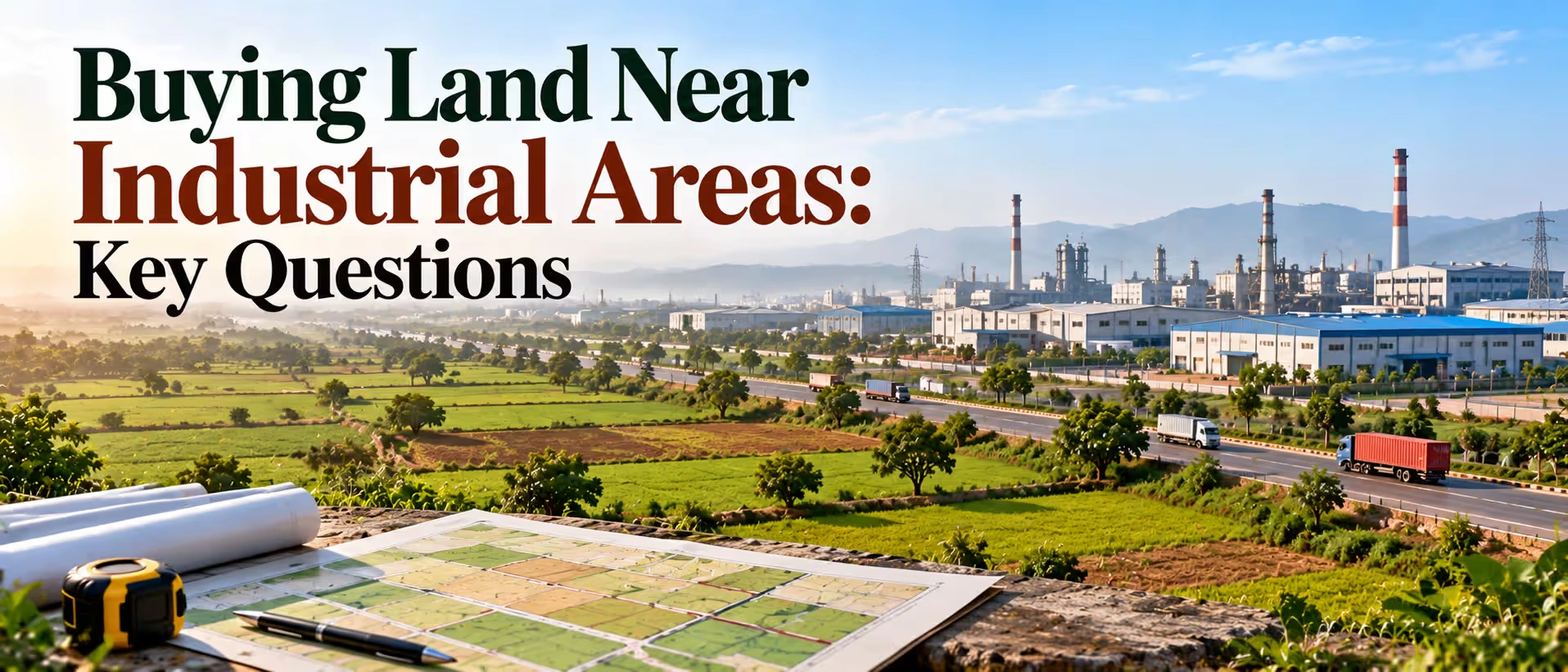
Land close to an industrial area pulls buyers in for two opposite reasons. Some see a cheap plot because the factories next door have pushed the price down, while others see a future gain because they expect the area to keep growing. Both groups can be right, and both can be badly wrong. A buyer who starts a farmland search and ends up looking at a plot beside a chemical unit or a cement plant needs a different set of checks from someone buying in a quiet village. The questions below are the ones worth asking before you hand over a token amount.
Is the Plot Likely to Be Acquired or Reserved?
Industrial areas grow, and so do their surrounding lands first. State governments’ industrial development companies often buy lands for new development zones, roads, effluent treatment plants, and rail linkages. An acre that falls in the path of all these developments may be acquired before one anticipates and with compensation lower than the actual price.
A prospective buyer interested in lands for sale near me in an industrial area needs to find out from the Revenue Office and the industrial authority whether the survey number of that land has appeared in any of the notices for acquisition, either preliminary or final. Purchase of land after a notice becomes different in terms of compensation; hence, one must do that prior to the purchase of land and not after. The seller who says “it will never be acquired” has no means of knowing.
What Does the Master Plan Say About This Land?
Use of land depends on the master plan or development plan of the area. Plans near industrial areas usually allow green belts/buffer areas, roads, and utility strips, which might exist next to the existing industrial concentration. The land that has been designated as a buffer area or green belt is permanently restricted for use as agricultural land.
Ask for the zoning of the plot in writing, along with the rules for conversion. If you are shopping for agriculture land for sale near a factory cluster in the hope of converting it later, find out how many nearby plots have actually been converted and how long it took. The plan may also allow some uses, such as warehousing or labour housing, and ban others, so the exact category matters more than the general idea that "the area is growing".
Which Industries Are Next Door?
Not all factories are alike. A garment unit and a chemical plant are neighbours on the map and strangers in every other way. The Central Pollution Control Board sorts industries into red, orange, green and white categories based on how polluting they are, and the state pollution control board publishes the consent details of each unit.
| Nearby unit type | What it can mean for your plot |
| Chemical, pharma, dye or pesticide units | Risk of air, water and soil contamination |
| Steel, cement, power or mining units | Dust, heavy trucks, ash and noise |
| Textile or leather processing | Effluent in drains and groundwater |
| Food processing | Smell, wastewater, seasonal truck traffic |
| Light assembly, packaging, warehouses | Mostly traffic, lower pollution |
Walk around and note what the neighbours actually are. Look at their chimneys, drains and waste yards, and check the pollution board's website for the consent status, past complaints and any closure notices. A unit that has been repeatedly fined for discharge is worth knowing about before you buy land downstream of it.
Is the Groundwater and Soil Safe?
This is the test that will determine whether or not the land is suitable for farming. Contamination by industrial processes often happens via the soil and water, and there could be no visible signs of this happening while the land looks green and healthy.
Should your search for farmland near me bring you close to an industrial zone, then conduct tests before buying. Take samples of the soil and water from the borehole or well and have them tested in a reputable laboratory. Request regular tests like pH, total dissolved solids, nitrates, and heavy metals, among others.
| What to test | Why it matters |
|---|---|
| Borewell or well water | Shows salinity and chemical contamination |
| Soil near the surface and deeper | Shows metals, salts and residues |
| Crop samples from neighbouring fields | Can reveal uptake of contaminants |
| Canal or stream water at the boundary | Shows what the plot receives from upstream |
Lab fees are small against the price of the land. A bad result tells you to walk away, and a clean one gives you something solid to negotiate on and to show a bank later.
Where Does the Waste and Drain Water Go?
The effluent, either treated or untreated, from industries must go somewhere, and in most cases, it is dumped into a seasonal stream, into canals, and even into an open drain. If you have a plot located near such a place, you are sure to face the dumping whenever it rains.
It is wise to take a walk around the perimeter of your plot in case it is rainy enough. Watch for the coloration of water, the foam on it, chemical smell, dying vegetation in the vicinity of the drain, and also black crust on the soil. Try to find out if there is any plant disposing of solid waste and ash close by. See if your land is at the same level as the industry, since water goes downhill.
How Bad Are the Noise, Smoke and Truck Traffic?
When preparing your questions to ask a land seller, check whether nearby industries or heavy lorry traffic cause dust, noise, smoke, or road damage. Factories operating in shifts can also create disturbances at night, affecting the land's suitability for farming or living.
Come and visit during different parts of the day, including early morning and late evening. In case you intend to construct your dwelling or farmhouse, take some time on the plot with your mind wide open. Finding out the direction of the wind for a plot upwind of the plant is entirely different from the downwind plot. See what the access road looks like for a lane used by tractors peacefully may become a road for heavy lorries once the neighboring unit expands.
What Do the People Living There Say?
Documents show what is allowed, and neighbours show what actually happens. Talk to farmers whose fields share a boundary with the industrial area, and to people who have lived in the village for years. Ask whether crop yields have changed, whether livestock have had health problems, whether wells have turned bitter or smelly, and whether there have been complaints or protests.
Pay attention to what people avoid saying as well. If everyone nearby has stopped farming or moved their cattle away from a certain stretch, there is usually a reason. Ask at the panchayat office too, since they handle many of these complaints.
Does the Price Reflect Real Value or Just Speculation?
Both underpricing and overpricing are possible in areas of industrial belts. The lands neighboring the new corridor would be costly based on the expected value. On the contrary, the lands that are near old polluting factories can be quite cheap. Compare the quoted price against recently sold lands within the village, and never believe the tales that the price would double following the project's announcement.
Anyone involved in land selling near an industrial area will also know that buyers become more careful once they discover the reason for a discount. Being open about the surroundings at the start saves time on both sides, and the land often sells faster with honest details than with a vague listing that falls apart at the first site visit.
Can You Resell or Borrow Against It Later?
Think ahead to your exit. Banks will be less likely to lend on contaminated, disputed, or uncertainly zoned land, and purchasers will be more cautious next time around. Land that has been tested, certified, and verified for land use is much easier to resell than land that relies on a promise. Keep your lab reports, zoning letters, and verification documents in good order, as they may turn out to be the most valuable pieces of paper in the file when you go to sell.
How 2Bigha Helps?
Doing all these things by yourself may take weeks. 2Bigha is an online platform for buying and selling farmlands in India, where you can compare the offers, check Background Verification Reports, and use Book a Visit to see the plot without using a broker at each step.
In case you are the seller, putting up your property on the internet through a verified listing will help you reach out to those who are looking for a farm and give them documentation and environmental facts in one document.
Disclaimer: This article is for informational purposes only and should not be considered investment, legal, financial, or property advice. Real estate regulations, infrastructure plans, market conditions, and government policies may change over time. Readers are advised to verify information with relevant authorities and consult qualified professionals before making any investment or property-related decisions.