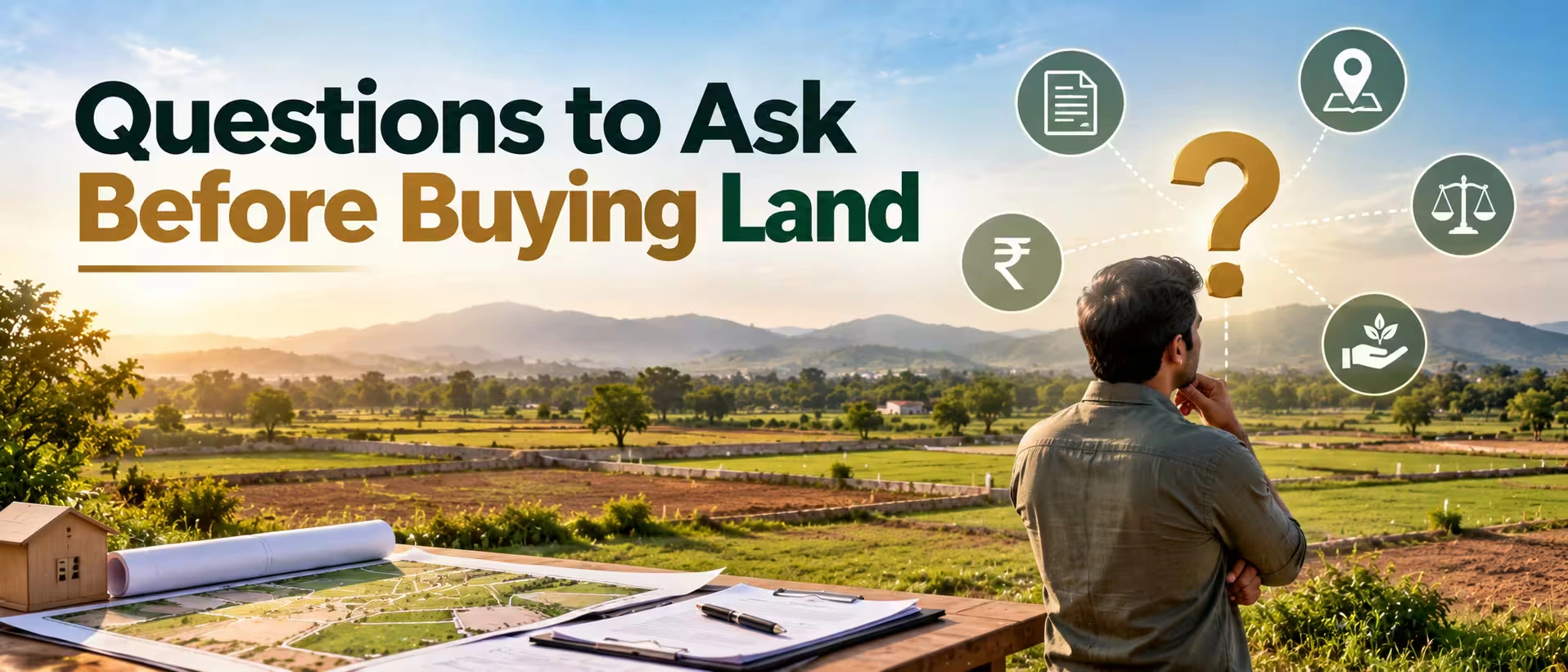
Land disputes in India seldom begin from the day of the conflict itself; they begin from the day of the transaction because the buyer failed to ask that single important question. No matter how many times you ask, the seller will always assure you that there is no problem with the land, the cost is reasonable, and the documents are in place. Good deal. You are the one making payment; therefore, you should be the one verifying the claims made by the seller.
Quick Pointers Before You Start
- Always ask every question through correspondence or by recording the discussion, provided that the owner permits this.
- Do not make any advance payments until all questions regarding ownership have been answered.
- An owner who dodges the question has answered it already.
- Request copies of documents. Do not take "I will show you later" as an answer.
- Bring along a second person knowledgeable in land records.
Why Do the Questions Matter Before Your Farmland Search Ends?
A good farmland search does not end when you like the soil or the view. It ends when the papers agree with what the seller told you. Land is not like a phone or a car. If you buy wrong, you cannot return it. You will spend years in court or lose the money. So think of these questions as a filter. Each one removes a risk. By the end, only a clean deal is left.
Step 1: Ask Who Really Owns the Land
This is the first question and the most important one. Do not move ahead until you are sure.
Questions to ask:
- Is the land in your name only, or are there other owners?
- How did you get this land? Purchase, gift, inheritance, or a partition?
- Can I see the registered sale deed or the inheritance papers?
- Are all the co-owners and legal heirs ready to sign?
Steps to check the answer:
- Ask for the seller's ID and match the name with the land record.
- Check the name in the latest record of rights (Jamabandi, Khatauni, 7/12, or the local version in your state).
- Trace the chain. Who owned it before the seller, and before that person?
- If the land came by inheritance, ask for the legal heir certificate.
| What the seller says | What it could mean | What you should do |
| "It is my ancestral land" | Many heirs may have a share | Ask for the family settlement or all heirs' consent |
| "Papers are with my brother" | Ownership may be shared or disputed | Do not proceed until you see the papers |
| "I bought it 2 years ago" | Seller may be a middleman | Ask for the earlier sale deed and check the original seller |
| "Power of attorney holder is selling" | Owner is not present | Check if the POA is valid and registered |
Step 2: Ask About Land Records and Mutation
A sale deed proves the transfer. But the government record proves who is treated as the owner. Both must match. Questions to ask:
- Is the land mutated in your name?
- Can I see the latest land record printed from the official portal?
- Does the area in the record match the area you are selling?
If you are looking through agriculture land for sale in a new state, do not assume the record system is the same as your home state. Every state uses different names and different portals. Ask the seller which record is used locally, then check it yourself online or at the tehsil office.
Step 3: Ask About Boundaries and Survey Number
Many buyers see the land, walk around once, and think they know where it starts and ends. They do not.
Questions to ask:
- What is the survey or khasra number?
- Has the land been measured recently?
- Are the boundary marks or fencing in place?
- Does any neighbour claim part of this land?
Steps to check:
- Get the village map and the survey number from the seller.
- Compare it with the official map.
- Visit the land with a surveyor and mark the corners.
- Talk to two or three neighbours. Ask them casually, no pressure.
Neighbours often tell you things a seller never will. A small talk over tea can save you lakhs.
Step 4: Ask About Loans, Disputes and Pending Dues
A land can look clean on paper and still carry a hidden burden.
| Question | Why you ask it | Document to see |
| Is there any loan on this land? | A bank may hold the original papers | Encumbrance certificate, bank NOC |
| Is there any court case? | A dispute can freeze the sale | Court case search, seller's written statement |
| Are land revenue and tax dues paid? | Dues pass to the new owner | Latest tax receipts |
| Is the land under any government acquisition? | The land can be taken later | Notification check at the local office |
| Is the land on any restricted or prohibited list? | Registration can be refused | State portal or registrar office |
Ask for an encumbrance certificate for the last 15 to 30 years. It shows if the land was mortgaged, sold twice, or tied up in any legal claim.
Read more: Water Availability Checklist for Farmland Buyers in Sri Ganganagar
Step 5: Ask About Land Use, Access and Water
The land may be legally clean and still be useless for what you want. Questions to ask:
- Is this land classified as agricultural or non-agricultural?
- Is there a proper road up to the land? Who owns that road?
- Where does the water come from? Borewell, canal, or rain only?
- Is there electricity nearby?
- What crops have been grown here in the last three years?
If you plan to build a farmhouse, check if the local rules allow it. Some zones allow only farming. Some need a conversion permit first. Also ask about the soil. Get a basic soil test before you pay anything big. It costs very little compared to the land.
Step 6: Ask About Price and Payment
Now you talk money. Keep this step calm and clear.
Questions to ask:
- What is the total price and the price per acre or bigha?
- What is the circle rate or DLC rate for this area?
- Is the payment all by bank transfer?
- What is the token amount,t and is it refundable?
- Who pays stamp duty and registration charges?
| Payment point | Safe practice | Risky practice |
| Mode | Bank transfer or cheque | Cash in hand |
| Token money | Written receipt with details | Verbal promise |
| Agreement | Registered agreement to sell | Plain paper note |
| Final payment | On the day of registration | Before papers are ready |
| Stamp duty | Paid on the full deal value | Shown lower to save money |
Never agree to show a lower price on paper. It creates a tax problem for you and a legal problem for the land.
Step 7: Ask Why They Are Selling
This one feels rude, but it is fair. A calm and honest reason is a good sign.
Common honest reasons:
- Family needs money for a wedding or a medical cost
- Moving to another city
- Inherited land that the family cannot manage
- Shifting money into another investment
Warning signs:
- The seller is in a big hurry and says the offer ends today
- The price is far below the market
- The seller refuses to meet at the registrar's office
- The story changes every time you ask
Red Flags at a Glance
Red flag | What it usually points to |
Seller will not share original papers | Title problem |
Name in record is different from the seller | Wrong owner or unsettled inheritance |
Price is too good to be true | Dispute, bad access, or fake listing |
Pressure to pay cash | Tax evasion or fraud |
No clear road to the plot | Access dispute later |
Many people claim to be "agents" | Chain of middlemen, unclear seller |
Use Verified Sources for Your Search
When you start looking for farmlands near me on random groups and social media pages, you are often talking to a middleman, not the owner. Photos get copied, prices get changed, and the same plot shows up under three names.
A better way is to search on a platform that checks listings before they go live. 2Bigha is a marketplace for agricultural land and farmland in India. You can browse verified listings, see location details, and request a visit on 2Bigha. If you want to check a specific plot, the 2Bigha Land Report helps you go through the land details before you talk money. It does not replace your own visit or a lawyer, but it gives you a strong starting point. Here is how you can use it:
- Search the location and budget you want on 2Bigha.
- Shortlist two or three listings.
- Book a visit through the platform.
- Ask the seller every question from this guide.
- Get the papers checked before signing anything.
Many people also type plots for sale near me and end up with old or fake listings. Sticking to verified listings removes most of that noise.
If You Are the Seller: Be Ready for These Questions
A smart buyer will ask everything above. If you are planning land selling, get ready before the first call.
Keep these ready:
- Registered sale deed or inheritance papers
- Latest land record and mutation proof
- Tax receipts and encumbrance certificate
- Survey map and boundary details
- Your ID and proof of address
A seller with clean papers sells faster and at a better price. Buyers trust that. They stop bargaining hard when they see nothing is hidden. Today, selling property online has also made this easier. You can list your land, share photos, and connect with genuine buyers without visiting ten brokers. The rule is simple. Give full details, be honest about problems, and keep your papers scanned and ready to share.
Final Checklist Before You Pay
If even one box stays empty, wait. A delay of a week costs nothing. A wrong purchase can cost years.
- Seller's identity matches the land record
- All co-owners and legal heirs agree to the sale
- Land is mutated in the seller's name
- Encumbrance certificate is clear
- No court case or acquisition notice exists
- Land boundaries are measured and clearly marked
- Road access and water availability are confirmed
- Payment is made through bank channels only
- Registered sale agreement is ready
Disclaimer: This article is for informational purposes only and should not be considered investment, legal, financial, or property advice. Real estate regulations, infrastructure plans, market conditions, and government policies may change over time. Readers are advised to verify information with relevant authorities and consult qualified professionals before making any investment or property-related decisions.