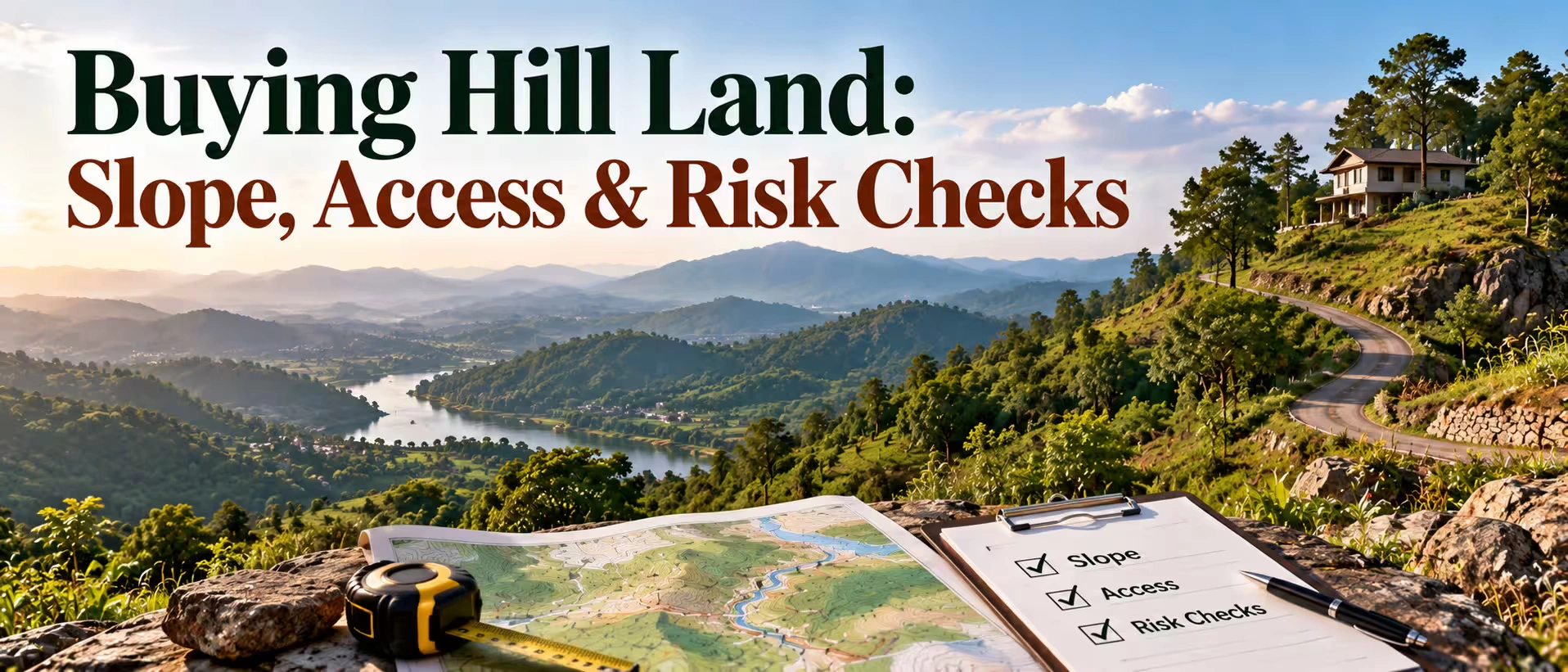
A plot with a valley view, a stream below, and pine trees along the edge is easy to fall for, and that is exactly why hill land gets bought quickly and checked slowly. The trouble is that mountains behave differently from plains. A slope that looks stable in October may slide in July, a road that works in summer may be shut for weeks in winter, and a boundary that seems clear on paper may run straight through a ravine. If you are looking at plots for sale near me in a hill district, or thinking of a homestay, orchard, or retirement cottage in the mountains, the checks below will save you far more than they cost.
Find Out Who Is Allowed to Buy?
Before considering a single slope, make sure you’re actually allowed to make the purchase. There are restrictions on the eligibility of people to make purchases of agricultural land in several hill states. In Himachal Pradesh, for instance, non-agricultural persons coming from outside the state must obtain approval of the government before buying, and in Uttarakhand, regulations for outsiders buying agricultural land have been made stringent in recent years. Sikkim, Arunachal Pradesh and the Northeast regions also have their safeguards for local inhabitants.
The advertisements for farmland for sale in hill towns do not address this aspect at all, and the broker might say it’s “just a formality”. It isn’t, however. The transaction can be declared null and void and the land confiscated by the government. Find out from the revenue department of the district what applies to you and put it in writing, and then proceed to the inspection.
Reading the Slope
Slope affects almost all aspects of the hill terrain, from what can be built, its cost, to safety considerations. There is often a big price difference for terraced land that was made by generations of farmers and the un-levelled slope in the same village. Here are the things to consider while being on site:
- How the land is located - in a terrace that was formed through farmers' effort over years or a natural one without ever being made level;
- Cracks in soil, leaning trees, and electric poles, indicating slow soil movements;
- The old retaining walls that bulge, are cracked, or have fallen;
- Its location on the slope: at the top, middle, or bottom part of the slope, where the land at the bottom accumulates soil and other stuff that comes down from above;
- Whether the land is above or under the road.
During land selling, slope and soil conditions can affect a plot's value and appeal to buyers. As a rough rule, steeper land often requires more spending on cutting, retaining walls, and drainage. For construction beyond a simple farm shed, consult a local geotechnical or structural engineer before finalising the deal.
Soil, Rock and Water Channels
Soil on the hills is very variable within short distances, with some areas resting on hard rock, while others are on loose materials from landslips long ago. Ask the locals if the hill has slid before and check for any signs of recent sliding in terms of fresh scars, exposed roots, and heaps of loose stones.
Natural drainage channels are equally important. Almost all hillsides have natural drainage channels known as nalas or gadheras that remain dry for months and then have plenty of water and stones flowing through them during rains. If your land falls within such a channel or you obstruct it with a wall, the water will surely find its way through your land. Identify the course of water from the upper slope to your own slope.
Road Access in All Seasons
Many people checking land for sale near me in the hills only test the road once, on a clear day. Do it twice if you can, once in dry weather and once during or just after rain. Hill roads are the first thing to fail when weather turns, and a plot that can't be reached for a week at a time is difficult to live on, farm, or resell.
| What to check | Why it matters |
| Width and surface of the approach road | Affects vehicle access and construction material delivery |
| Distance from the nearest motorable road | A long walk adds cost to every building task |
| Who owns the road or path | A private path can be closed or disputed |
| Landslide-prone stretches on the way | Access can be cut off for days |
| Winter snow or monsoon closures | Decides whether the plot can be used year-round |
| Distance to a hospital and market | Matters for daily life and emergencies |
If the plot depends on a path across someone else's land, get a registered right of way. A verbal promise from a neighbour won't survive a change of ownership. Check, too, whether the road is a public one maintained by the state or panchayat, or something built informally by villagers.
Disaster Risk: What to Look Up Before You Pay
Hill regions face a particular set of hazards, and most of them can be researched before you commit. The Geological Survey of India publishes landslide susceptibility information, and the National Disaster Management Authority and state disaster agencies have hazard maps and past incident records. Local panchayat officials will often know more than the maps, so talk to them as well.
| Hazard | What to look for |
|---|---|
| Landslides | History of slips on the slope, road cuttings above, loose debris |
| Flash floods and cloudbursts | Plot close to a stream bed, a narrow gorge, or a confluence |
| Earthquakes | Seismic zone of the area, soil type, nearby faults |
| Snow load and avalanche | Heavy snowfall zones, slopes above that collect snow |
| Forest fire | Pine or dry scrub next to the boundary |
| Erosion | Riverbank plots where the bank is being cut away |
It would be wise to consider whether there was any incident of a monsoon or winter in the recent past and what took place during those times. Villagers will know. If multiple people speak about a similar section of the land, the same stream or slope, you must take it seriously no matter how appealing the plot may seem to you.
The plots of land next to rivers should be avoided carefully. Even though the riverbank appears to be very sturdy, it can suddenly reduce in width by several feet within just one season.
Also read: Could AI Change the Way People Buy Land
Forest, Protected and Eco-Sensitive Land
There are large areas in hills that are classified as forest or protected areas, and this may even include those areas which seem to be a typical village field. It is illegal to sell or use any piece of land that is marked as a forest in the documents, and construction on such land can invite strict penalties. Check whether the land is under any of the following zones: reserved or protected forest, eco-sensitive zone, sanctuary buffer zone, or no construction zone.
Apart from that, find out what the local building regulations are. Normally, there are height restrictions, number of floors, and slope cutting restrictions in the hill towns. If you plan to build a homestay or small resort, then find out what permissions are needed from tourism, local authority, and fire and pollution departments.
Water, Power and Basic Services
Water in the hills is not always as straightforward as it seems. The property might depend on a spring, seasonal creek, or shared water main. Find out about the source of the water, whether it is a steady flow all year round, and whether there are other families who rely on the same supply. Some springs have dried up or lost power in some hill areas recently; therefore, "never fails" needs to be investigated during the dry season.
Electricity might be brought by long cable lines that drop during storms. Sewage has to be considered, too, since a septic tank built on an incline could infect your own spring or someone else's garden if not done properly. Mobile and internet access may differ from one ridge to the next, if working from home is important to you.
Records, Boundaries and Price
The registration system in the hill states is based on their own systems, which include jamabandi in Himachal Pradesh and khatauni in Uttarakhand. Units like nali, bigha, and biswa will differ from place to place. Convert all into square feet so that you may have a fair comparison. Check the name, survey number, and area in the document against those in the sale documents, and get mutation and an encumbrance certificate.
Boundaries in the hills will be based on natural boundaries like a ridge, a stream, or a footpath. These boundaries will not remain fixed. Get the plot surveyed and demarcated by the revenue authorities before you pay the balance.
On price, check recent sales in registered transactions in the same village and not through online asking prices. The land selling near me searches will show a variety of prices quoted. Tourist-oriented market areas will quote much higher prices for land than its productive value or than people there would be paying. Ask yourself how much it will be worth if you cannot construct anything on the plot, because that will be the lowest price that anyone would pay.
Using 2Bigha to Search and Sell
Checking a hill plot from a distance is difficult, and you can lose weeks to travel and calls. 2Bigha is a marketplace for farmland and agricultural land across India where you can browse listings, ask for Background Verification Reports, and use Book a Visit to see a plot with proper support. Buyers searching for farmlands near me can narrow down by region and then verify before they go.
For owners, selling property online through a verified listing helps you reach buyers who are already searching. A good listing for hill land should state the slope, the road condition, the water source, and any known hazard honestly, because serious buyers will ask anyway, and a seller who answers early saves everyone time.
Disclaimer: This article is for informational purposes only and should not be considered investment, legal, financial, or property advice. Real estate regulations, infrastructure plans, market conditions, and government policies may change over time. Readers are advised to verify information with relevant authorities and consult qualified professionals before making any investment or property-related decisions.