Key Takeaways
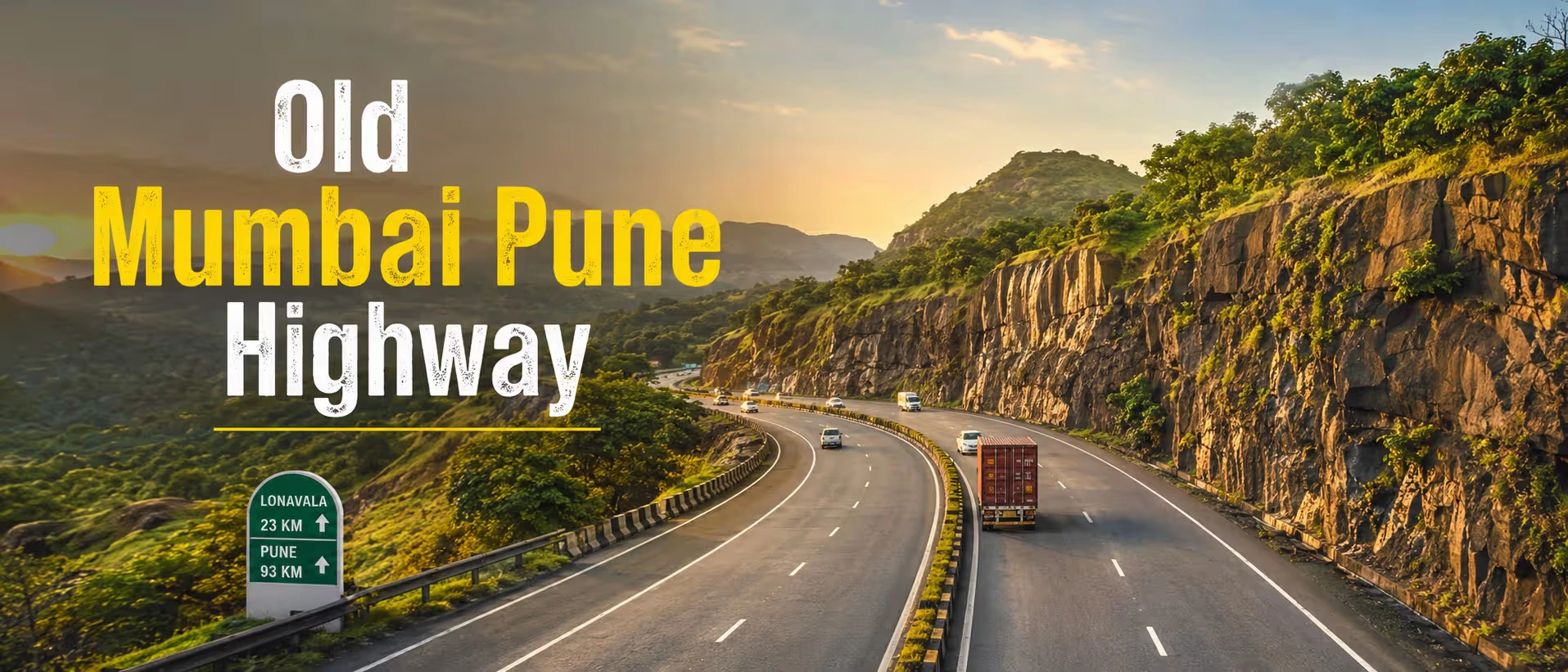
- The Old Mumbai–Pune Highway is the historic Mumbai–Pune road corridor officially referenced by MSRDC as NH-48 (Old NH-4); it should not be confused with the access-controlled Mumbai–Pune Expressway.
- Land demand does not behave uniformly across the corridor. Khopoli–Khalapur, Lonavala–Karla, Kanhe–Maval, Talegaon–Somatne and the Pune-side urban belt serve very different buyer requirements.
- Buyers should compare title, agricultural classification, legal eligibility, road access, water, terrain and actual distance from the highway before comparing price.
- Maharashtra's Section 63 places restrictions on transfers of agricultural land to non-agriculturists, so buyer eligibility must be checked before paying a substantial token amount.
- Maharashtra's official Mahabhumi system provides digital 7/12 records and facilities for checking mutation status, making digital verification an important early step in due diligence.
- Current property portals show agricultural and plotted-land inventory across Maval, Pavana Nagar, Lonavala, Karla, Kanhe and Khopoli-side locations, but individual asking prices vary too widely to treat any portal price as a corridor-wide market rate.
Why is Land Around the Old Mumbai Pune Highway Getting Attention?
The Old Mumbai–Pune Highway has something that newly created investment corridors cannot manufacture overnight: an established relationship with two of Maharashtra's most important economic regions.
For decades, the route has connected settlements, industrial areas, tourism destinations, villages and expanding suburban markets between Mumbai and Pune. Today, MSRDC identifies the old corridor as NH-48, formerly NH-4.
That history matters for land buyers.
A completely new highway may promise future connectivity, but an established corridor usually has existing villages, electricity networks, commercial activity, railway connectivity in several pockets, local markets and established movement patterns. The quality of these advantages changes from village to village, which is precisely why land must be evaluated locally rather than simply marketed as "highway property."
Interest also comes from several very different types of buyers.
One buyer may want agricultural land for active cultivation. Another may want a weekend farm within driving distance of Mumbai or Pune. A local investor may want a long holding period. A business owner may care more about industrial connectivity, while a family may be looking for a legally usable plot for a future home.
These buyers should not be shown the same property simply because every parcel happens to fall under the broader Old Mumbai–Pune corridor.
That is the first principle to understand before you buy land near old mumbai pune highway: identify why you want the land before deciding where you want it.
What Exactly Is the Old Mumbai Pune Highway?
People frequently use "Mumbai–Pune Highway," "Old Mumbai–Pune Road," "Old NH-4" and "Mumbai–Pune Expressway" interchangeably. For property research, that can create expensive confusion.
MSRDC documentation identifies the older road as National Highway 48 (Old NH-4) alongside the separate Yashwantrao Chavan Mumbai–Pune Expressway.
For a land buyer, the difference is practical.
A property advertised as "near Mumbai–Pune connectivity" may be close to the old highway but several kilometres from an expressway interchange. Another may have good village-road connectivity but no legal direct access to a major road. A third may appear close on a map while the actual driving route takes significantly longer because of railway crossings, hills, narrow approach roads or limited bridge access.
Never evaluate land using a straight-line distance from a highway.
Drive the complete approach road.
Preferably, drive it once during normal conditions and again during or immediately after the monsoon if you are considering a serious purchase.
That second visit can reveal more than dozens of polished property photographs.
Why the Old Highway Corridor Works Differently From a Typical City Property Market
Buying an apartment is usually a building-level decision followed by a neighbourhood decision.
Land works in the opposite direction.
You first need to understand the wider location, then the village, then the survey number, then the exact parcel.
Even two neighbouring plots may have very different value because one has recorded road access, while another relies on an informal route through somebody else's property.
One may have relatively flat usable land.
The next may contain a substantial slope.
One may have an operational borewell or reliable local water source.
Another may look beautifully green in August but struggle with water in April.
This is why a serious farmland search should never stop at photographs, acreage and quoted price.
Land value comes from usable characteristics.
Important Land Zones to Explore Along the Broader Corridor
There is no single "best" location. Each part of the Mumbai–Pune belt serves a different requirement.
Current property-platform inventory illustrates the spread of the market. Treat these as search zones, not interchangeable markets.
Search Zone | Typically Worth Exploring For | What Deserves Extra Attention |
Khalapur–Khopoli belt | Mumbai-side accessibility, larger parcels, long-term land holding | Terrain, village-road access, title history, distance from actual highway connection |
Lonavala–Karla belt | Weekend use, lifestyle land, tourism-linked locations | Premium expectations, slopes, construction restrictions, water and land-use classification |
Kanhe–Maval belt | Farmland, larger plots, Pune/Mumbai accessibility | Agricultural eligibility, approach roads, water, topography and regional planning |
Talegaon–Somatne side | Industrial and employment-linked demand, Pune-side growth | Land zoning, future road reservations, development authority rules |
Dehu Road–Pune urban edge | Smaller plots and urbanising land opportunities | Higher density, development rules, road widening, plot approvals and surrounding construction |
The table is intentionally missing a "price per acre" column.
That is because a corridor-wide price benchmark would create more confusion than clarity.
Current listings already demonstrate the problem: portals carry everything from agricultural acreage to residential plots and commercial parcels under broad Mumbai–Pune location labels.
A highway-facing commercially usable parcel cannot be compared with interior agricultural land merely because both measure one acre.
Is the Old Mumbai Pune Highway Good for Farmland Buyers?
It can be, but only when the parcel matches the buyer's intended use.
If you want to buy farmland near old mumbai pune highway, begin by separating genuine agricultural requirements from investment language.
Ask yourself a simple question:
Would this land still make sense if nobody promised you rapid appreciation?
If the answer is yes because the soil, water, accessibility, location and long-term utility make sense, you are evaluating the land properly.
If the entire buying decision depends on statements such as "a big project is coming," "this will become NA soon," "prices will double" or "a new road will pass from here," you are speculating on information that needs independent verification.
Highway connectivity can support land demand, but infrastructure does not automatically make every nearby parcel valuable.
2Bigha's own infrastructure-focused guidance makes a similar point: road projects can improve accessibility and influence surrounding land markets, but buyers still need to confirm land use, visit the property and examine basic site conditions.
That practical approach matters considerably along the Mumbai–Pune belt.
What Should You Check Before Buying Agricultural Land?
A beautiful view is not due diligence.
Before proceeding with agriculture land for sale in old mumbai pune highway, investigate the legal record and the physical parcel separately.
You need both.
Start With the 7/12 Extract
The 7/12 extract, commonly called Satbara Utara, is one of the primary land records used for rural and agricultural property in Maharashtra.
The Maharashtra Revenue Department operates the official Mahabhumi/Digital Satbara system for accessing digitally signed 7/12 records.
Do not simply collect a PDF from the seller and assume the work is finished.
Check whether the owner details correspond with the seller.
Review the survey or gat number.
Check the recorded area.
Examine mutation entries.
Understand whether there are multiple owners, inherited interests or pending changes.
The state's digital system also provides mutation-status checking, which can help determine whether a recent registered transaction or mutation application is still moving through the record-update process.
Then have a competent local property lawyer or land professional examine the complete title chain.
The 7/12 is important, but it is not a substitute for a full title investigation.
Can Anyone Buy Agricultural Land in Maharashtra?
This is where buyers should avoid casual advice from brokers, relatives or social media.
Section 63 of the Maharashtra Tenancy and Agricultural Lands Act contains restrictions on transfers to non-agriculturists.
There are exceptions and different legal circumstances, but you should not assume that having money to purchase agricultural land automatically makes you eligible to register it.
Your eligibility, the character of the land, its location, the proposed use and applicable exceptions need to be examined for the specific transaction.
This point becomes especially important for Mumbai and Pune professionals entering agricultural land investment for the first time.
Do not structure a deal first and ask the eligibility question later.
Ask it before paying a significant token.
A buyer searching online land in Maharastra—a commonly typed variation of Maharashtra—may see hundreds of listings, but listing availability and legal purchase eligibility are two different things.
A digital marketplace can help you discover land. Legal due diligence determines whether you should actually buy it.
A Practical 15-Point Land Buying Checklist
Use this before you move from browsing to negotiation.
| Check | What You Need to Confirm |
| Ownership | Seller's identity matches the relevant ownership records |
| Title chain | Previous transfers are documented and legally traceable |
| 7/12 extract | Area, holder details and agricultural entries are reviewed |
| Mutation records | Recent changes are updated or their status is understood |
| Survey/Gat number | The number matches the land physically shown to you |
| Physical measurement | On-ground boundaries correspond with documents |
| Access road | The parcel has legally defensible access, not merely informal access |
| Land use | Agricultural, residential, industrial or other classification is confirmed |
| Buyer eligibility | You qualify to purchase the relevant land category |
| Encumbrances | Loans, claims, disputes and restrictions are investigated |
| Water | Year-round practical availability is checked, not only monsoon appearance |
| Electricity | Connection feasibility and nearby infrastructure are examined |
| Terrain | Slope, drainage, low-lying areas and usable acreage are assessed |
| Planning impact | Reservations, widening proposals and planning restrictions are investigated |
| Registration | Stamp duty, registration requirements and transaction structure are professionally checked |
This checklist will not replace legal advice, but it will help you ask better questions before your money becomes committed.
Water Can Matter More Than Highway Distance
A common land-buying mistake is paying heavily for proximity to a major road while treating water as a secondary concern.
For actual farmland, that logic is backwards.
Suppose Parcel A lies one kilometre from the highway but has unreliable water and a poor approach road.
Parcel B lies four kilometres inside but offers a usable all-weather road, better agricultural conditions and a reliable water arrangement.
The second property may be significantly more useful for farming despite sitting farther from the highway.
This distinction matters particularly in the Maval and hill-influenced parts of the broader belt, where visual greenery during monsoon can create a very different impression from dry-season conditions.
Visit in summer if possible.
Talk to neighbouring farmers.
Ask what crops are actually grown nearby.
Ask how deep borewells run.
Find out whether tankers become necessary later in the year.
A seller can stage a property visit.
It is much harder to stage an entire village.
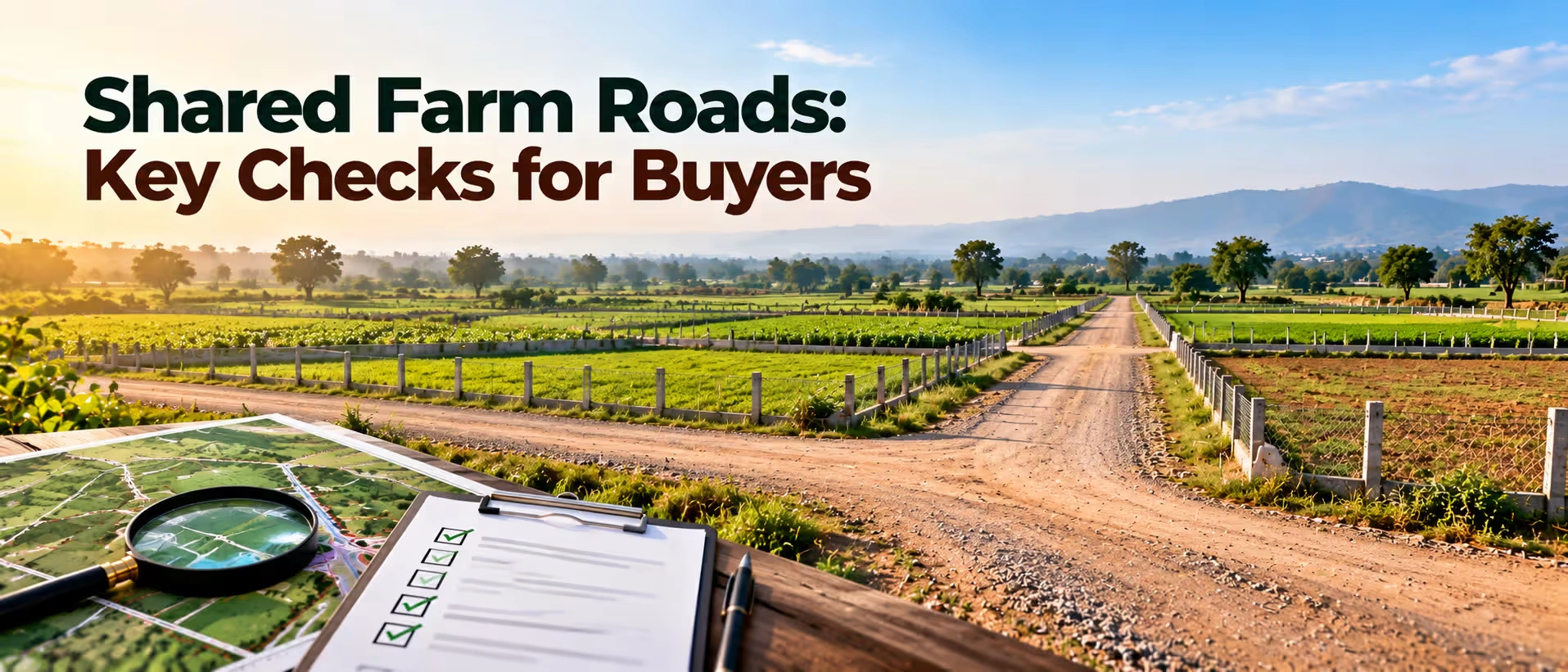
Road Access: The Detail Many Buyers Discover Too Late
"Road-touch property" is one of the most abused expressions in land marketing.
Ask exactly which road.
Is it a national highway?
A public village road?
A recorded access road?
A private internal road?
A route across another landowner's parcel?
And does the access shown on the ground correspond with official records?
For agricultural or farmhouse buyers, a good approach road can influence daily usability more than a small difference in purchase price.
Think beyond today's car.
Could a tractor reach the land?
Could construction material reach it if legally permitted?
Can two vehicles pass?
Does the road flood?
What happens during monsoon?
Does a railway crossing affect access?
Is there an unresolved right-of-way issue?
These are ordinary questions, but they separate practical land from attractive-looking land.
Why Talegaon-Side Connectivity Deserves Attention
The Pune-side portion of the corridor has another factor worth monitoring: industrial connectivity.
PMRDA currently lists a Western Bypass project connecting Pune–Nashik NH60, Chakan MIDC Phase 5 and Talegaon MIDC to the Old Mumbai–Pune Highway. The authority identifies approximately 3.2 km for this component, with land acquisition in progress.
That does not mean every nearby parcel will appreciate it.
It does mean land buyers near Talegaon and adjoining locations should study current and proposed road connections rather than evaluating the Old Highway in isolation.
Infrastructure can create opportunity, but it can also create acquisition risk, road reservations, setbacks and changes in surrounding land use.
A smart investor wants to know both sides.
Farmland vs Residential Plot: Do Not Mix the Two
A frequent search mistake occurs when a buyer starts with farmland and gradually gets shown residential or "farmhouse" plots without understanding the legal difference.
Agricultural land and approved residential plots are not simply two sizes of the same product.
The permissible use, documentation, buyer eligibility, development potential, taxation and approval framework can differ substantially.
Current property portals themselves illustrate the distinction: agricultural listings and residential plot listings are presented as different property categories even when both appear under the broader Old Mumbai Pune Highway geography.
So decide what you are buying.
- If you want agriculture, investigate agricultural utility.
- If you want to construct a residence, verify whether the land legally supports that use.
- If you want future conversion, never treat future approval as guaranteed.
The Maharashtra land-use framework has undergone recent changes, including changes to the process where planning-authority approval permits a non-agricultural use, but planning permission, applicable land use and statutory requirements still matter.
In other words, "NA process changed" does not mean "every agricultural plot can now be developed."
How to Evaluate the Price of Land Near the Old Mumbai Pune Highway
Forget the question, "What is the rate on Old Mumbai Pune Highway?"
It is too broad to produce a reliable answer.
Ask instead:
What is the rate for this type of land, in this village, with this access, this land use, this water situation and this title quality?
Those qualifiers change everything.
Online portals can help establish an asking-price range, but asking prices do not automatically equal completed transaction values.
Current listings demonstrate huge variation across agricultural land, residential plots and commercial land associated with the corridor.
Use online asking prices as leads.
Then compare recent registered transactions where available, local market evidence, ready reckoner values, neighbouring deals and parcel-specific characteristics.
Why the Cheapest Land Is Often Not the Best Deal
Suppose two five-acre parcels are available.
The cheaper one sits behind several other properties, has a difficult access road, uncertain water and a complicated title.
The costlier parcel has straightforward ownership, recorded access and better usable topography.
The second can easily be the financially safer purchase.
The purchase price is only one part of land cost.
Legal disputes, boundary problems, access creation, earthwork, fencing, water development and unusable terrain can turn "cheap land" into an expensive project.
Who Should Consider Buying Along This Corridor?
The Old Highway can suit several buyer profiles, but the right micro-location changes with the purpose.
Active Agricultural Buyers
Prioritise soil, water, usable terrain, agricultural access and nearby farming activity.
Highway proximity should improve logistics—not replace agricultural fundamentals.
Mumbai-Based Weekend Land Buyers
Khalapur, Khopoli and selected hill-side locations may enter the initial search because of their Mumbai-facing position, while Lonavala-area demand has an established lifestyle and second-home component.
Current real estate portals carry active plot inventory around Khopoli/Khalapur and Lonavala, which reflects the continued visibility of these markets.
Pune-Based Farmland Buyers
Kanhe, Maval and the wider Pune-side belt may be easier to inspect repeatedly for Pune-based owners.
That practical convenience matters.
Farmland that you can visit regularly is often more useful than a theoretically better parcel you rarely inspect.
Long-Term Land Investors
Focus on legally clear land, good accessibility, surrounding economic activity and realistic holding periods.
Do not buy solely because someone draws a proposed road on a brochure.
Sellers
Understand the buyer profile most likely to value your property.
A working farm should be presented differently from a tourism-facing parcel, highway-access land or development-oriented plot.
How to Sell Land on the Old Mumbai Pune Highway More Effectively
If your objective is to sell land on old mumbai pune highway, the biggest mistake is publishing a two-line advertisement:
"5 acre land. Prime location. Highway near. Serious buyer call."
That advertisement answers almost nothing.
A serious buyer wants clarity.
Specify the village.
Mention the survey or gat reference where appropriate and safe.
State the land area in commonly understood units.
Explain road access.
Describe the water situation.
Mention whether electricity is available nearby.
Clarify the recorded land category.
Use current photographs.
Show the actual approach.
Provide an accurate map location instead of dropping a pin several kilometres away to make the property appear closer to the highway.
Most importantly, price the land in relation to its characteristics rather than based on somebody else's frontage property.
Selling Property Online: What Makes a Land Listing Convert?
Selling property online works particularly well when the listing reduces uncertainty before the first phone call.
Apartments are relatively standardised.
Land is not.
That means good land listings need more information, not more adjectives.
"Premium," "exclusive," "investment opportunity," "future hotspot" and "best location" carry very little value without evidence.
Instead of saying: Prime farmland at an excellent location with huge future potential.
Explain: The land is approximately 3.5 km from the Old Mumbai–Pune Highway through an all-weather village road, has direct vehicle access, includes a working water source and is currently agricultural according to available records. The second version lets buyers evaluate the property. Good listings attract fewer irrelevant enquiries and more qualified ones.
Why a Land-Focused Platform Can Be More Useful Than a Generic Portal
People researching real estate sites in india will find platforms built primarily around apartments, rental homes, commercial buildings and developer projects.
Those websites can still be useful for land.
But land discovery has different information requirements.
2Bigha positions itself specifically around buying and selling agricultural land, farmland and rural plots, with map-based property exploration rather than treating land as a small subcategory of urban real estate.
That distinction matters when you are comparing rural locations.
A map-first approach helps you understand neighbouring villages, access routes and how different listings relate geographically. 2Bigha describes its map search in similar terms, allowing users to explore land according to location and surrounding connectivity.
For buyers exploring Maharashtra, the platform also carries agricultural land inventory in the state, including Pune-region listings.
For owners who want additional support around their land journey, 2Bigha also provides a subscription plan and property management service.
The important point is not to replace due diligence with a platform.
Use the platform to improve discovery.
Use official records, site inspection and professional legal verification to make the transaction decision.
Why Land for Sale Near Me Is Only the Beginning of the Search
Mobile search has made land for sale near me one of the easiest ways to begin property discovery.
It is also one of the least precise ways to finish it.
Nearby land is not automatically suitable land.
A parcel ten kilometres away may have better road access, cleaner title documentation, reliable water and stronger usability than a property only three kilometres from your current location.
For land, search radius should open the conversation.
Due diligence should close it.
Start broad.
Then filter aggressively.
How to Conduct a Smarter Online Farmland Search
Do not scroll endlessly through listings.
Build a shortlist in stages.
First, choose whether Mumbai access, Pune access or a midpoint location matters more.
Next, determine the maximum realistic driving distance from the highway.
Then define your minimum acreage.
After that, decide whether agriculture is the primary purpose or whether lifestyle use is influencing the decision.
Only then compare properties.
A map-based marketplace such as 2Bigha can make this process easier because rural land often makes more sense spatially than as a simple list of property cards.
Once you shortlist three to five serious options, stop browsing and start visiting.
Twenty extra listings rarely teach you as much as one proper site inspection.
What to Observe During a Land Visit
Do not spend the entire visit standing at the prettiest corner of the property.
Walk the boundaries.
Look at neighbouring land.
Follow the approach road back toward the main road.
Examine slopes.
Look for natural drainage.
Check whether water collects in lower areas.
Observe power lines.
Identify nearby homes.
Notice farms that appear actively cultivated.
Ask about wild-animal movement where relevant.
Check mobile connectivity if you expect to work or stay at the property.
Visit the nearest village market.
Then speak with people who are not financially connected with the sale.
A neighbour often gives you the most useful sentence of the entire visit.
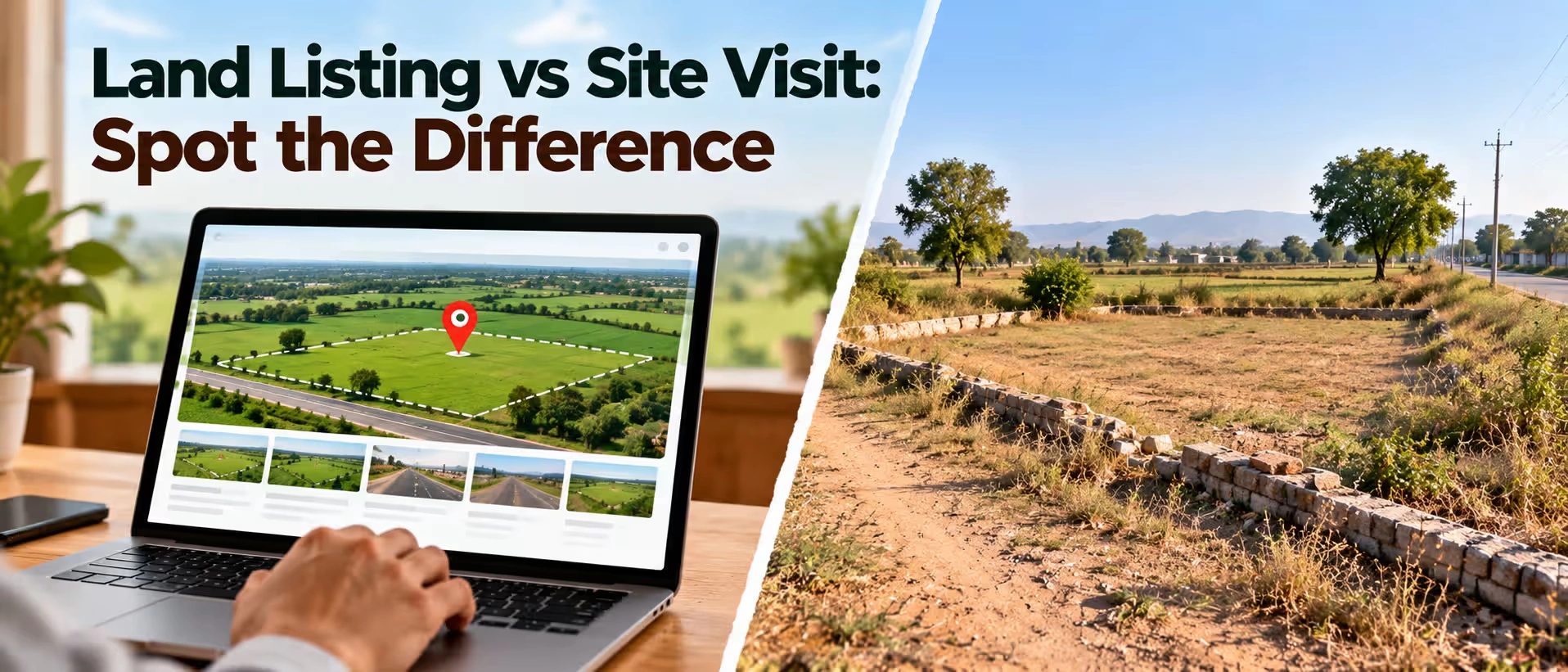
Monsoon Visits Can Be Misleading
The Mumbai–Pune belt can look spectacular during the monsoon.
Green hills, streams and cloudy weather sell an emotional idea of farmland extremely well.
But a buyer needs to imagine May, not just August.
Ask where the water comes from in late summer.
Check whether seasonal streams disappear.
Find out whether access roads deteriorate during heavy rain.
Look for waterlogging.
If a slope appears dramatic, consider how much of the advertised acreage you can realistically use.
A five-acre title does not automatically mean five acres of practically usable farmland.
Buying a Farmhouse? Verify the Use First
"Farmhouse land" is often used as a marketing description rather than a legal classification.
Never assume the label itself permits construction.
Check the actual land classification, development rules, local planning framework and permissions required for what you intend to build.
This matters particularly around scenic locations where buyers are attracted by weekend-home potential.
Buy the legal reality.
Not the brochure description.
Is Highway-Front Land Always Better?
No.
Highway-facing land can command additional attention because of visibility and access potential, but that does not automatically make it better for farming, privacy or weekend use.
- A buyer looking for commercial visibility may value frontage.
- A farmhouse buyer may prefer a quieter parcel several kilometres inside.
- A farmer may prioritise water and soil.
- A long-term investor may focus on planning and future connectivity.
- There is no universal premium feature.
- There is only a feature that matches a particular use.
What Sellers Should Prepare Before Listing
A prepared seller earns trust faster.
Before you advertise, organise your current land records, ownership documents, previous deeds, mutation information, map details and a clear understanding of what exactly you are selling.
Measure the land if boundaries are uncertain.
Resolve obvious family-ownership questions where possible.
Take real photographs.
Record a simple approach-road video.
Pin the correct location.
Prepare an honest explanation of water and access.
This is basic work, but it can dramatically improve the quality of enquiries.
A buyer who receives clear information early is more likely to invest time in a site visit.
What Not to Claim in a Land Advertisement
Avoid guarantees.
Do not promise fixed appreciation.
Do not advertise an unapproved future land use as if approval already exists.
Do not claim road frontage when the land only lies near the road.
Do not call every property "clear title" without professional verification.
Do not hide co-ownership.
Do not publish misleading map pins.
And do not quote an artificially low per-acre number when the owner will only sell a much larger parcel that pushes the total transaction far beyond the buyer's budget.
Transparency is not only an ethical advantage.
It improves conversion.
Should You Buy Now or Wait?
There is no corridor-wide answer.
A good parcel with clean documentation, appropriate use, sensible pricing and strong practical utility can deserve consideration regardless of market noise.
A weak parcel does not become attractive merely because infrastructure spending is happening somewhere nearby.
PMRDA's ongoing industrial-connectivity work around the Pune metropolitan region demonstrates that connectivity continues to evolve around the broader Old Highway ecosystem.
But infrastructure should strengthen an already sensible land purchase.
It should not be the only reason for one.
A Simple Decision Framework
Before committing, score the land mentally across five areas.
Legal strength: Can ownership, eligibility and transferability be clearly established?
Access: Can you comfortably reach the property throughout the year?
Utility: Does the parcel actually work for your intended use?
Location: Does its relationship with Mumbai, Pune or nearby employment/tourism areas make practical sense?
Price: Does the asking price reflect comparable land rather than a completely different land category?
If one category fails badly, do not let four attractive categories distract you from it.
Land problems tend to remain land problems for a long time.
Using 2Bigha for Old Mumbai Pune Highway Land Discovery
For people specifically focused on agricultural and rural property, 2Bigha provides a more land-centred starting point than a search dominated by apartments.
The platform describes itself as a marketplace for agricultural land and farmland and currently offers map-based browsing across Indian land listings.
That can be particularly useful around a corridor like Mumbai–Pune because the buying decision rarely depends on one locality name.
A buyer may begin with Maval, then compare Kanhe, Karla or nearby villages.
Another may start from Mumbai and evaluate the Khopoli–Khalapur side.
Map-based discovery makes those relationships easier to understand.
Still, treat every listing as the beginning of your investigation rather than proof that a property is suitable.
Visit.
Verify.
Compare.
Then negotiate.
Final Thoughts
The Old Mumbai–Pune Highway remains an important land-search corridor because it sits within a mature movement network between two major economic regions and passes through markets with agricultural, industrial, tourism and residential influences. MSRDC continues to reference the road as NH-48 (Old NH-4), while PMRDA's current connectivity projects demonstrate continuing infrastructure activity on the Pune side.
But the words "Old Mumbai Pune Highway" should never be enough to justify a land purchase.
The parcel matters more.
Its documents matter more.
Its approach road matters more.
Its water matters more.
Its legal use matters more.
And your reason for buying matters most of all.
Whether your objective is investment, cultivation, weekend use or a long-term land holding, shortlist properties according to actual utility rather than marketing claims.
If you are beginning your search, use a land-focused platform such as 2Bigha to explore available agricultural and farmland opportunities geographically, compare locations and narrow your shortlist before moving into site visits and legal due diligence.
The best land deal is rarely the property with the loudest appreciation promise.
It is usually the one whose location, title, access, use and price continue to make sense after the sales pitch has ended.
Disclaimer: This article is for informational purposes only and should not be considered investment, legal, financial, or property advice. Real estate regulations, infrastructure plans, market conditions, and government policies may change over time. Readers are advised to verify information with relevant authorities and consult qualified professionals before making any investment or property-related decisions.