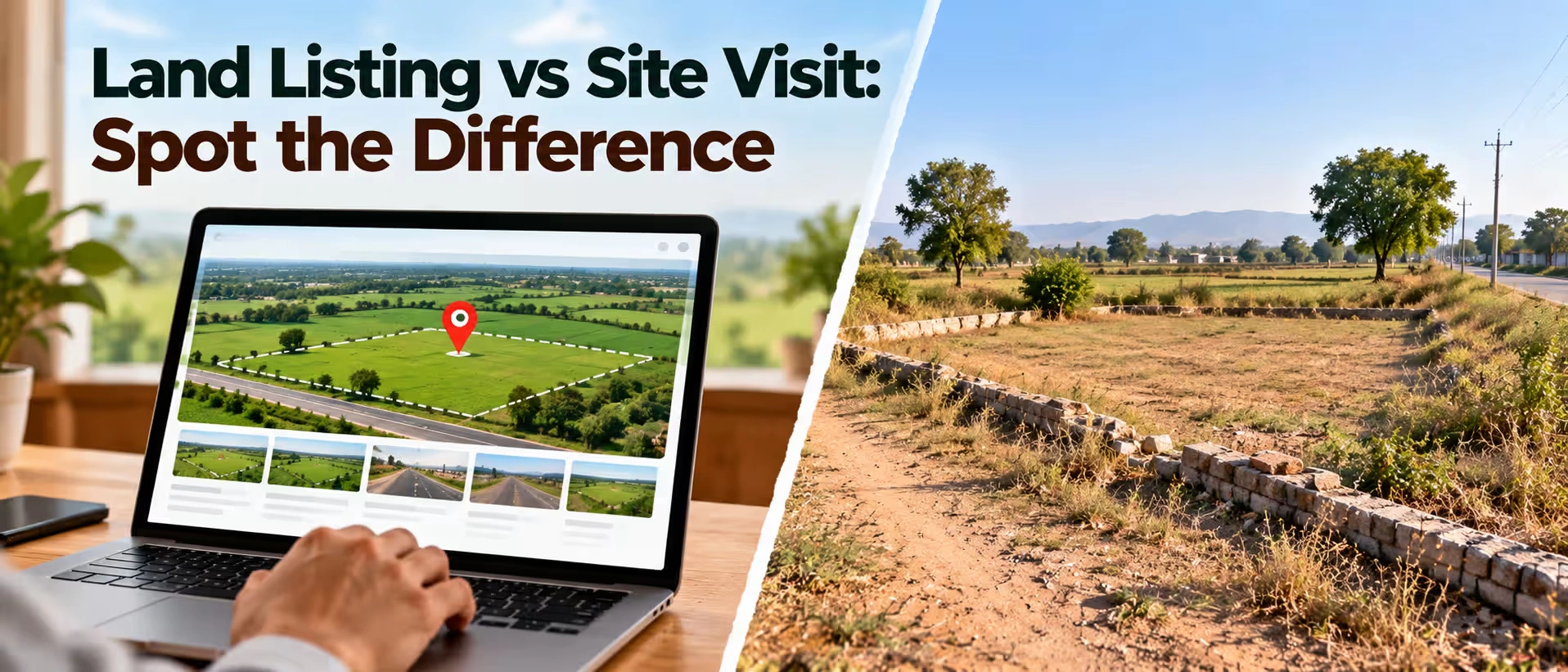
The buyer who answers an advertisement for agricultural land for sale will go out there, meet the seller or broker at the roadside, and be shown around the field which he claims is the one advertised. In most cases, that is exactly what it is. In some cases, it may not be, and the difference may range from something very minor, such as a boundary that is twenty feet off, to something quite major, such as a totally different survey number. This guide explains how the discrepancy comes about, what needs to be done when standing on the land, and how to resolve the issue with documentation before any money changes hands.
Key Takeaways
- Mismatch between the listing and the plot shown to you is a warning signal, not a cause for panic.
- Make sure you get the survey or the khasra number on the plot and match it with the listing and the land record.
- Never make a payment by token amounts merely on the assurance that the plot on the ground is the same as on paper.
- A licensed surveyor can help in marking the exact boundary lines by referring to the revenue map, and this is the best way to resolve any disputes about the plots.
- Claims about soil, water content, and organic nature have to be backed up by documentation, just like claims of ownership.
- If the seller reacts defensively to your questions, take note of it.
Why a Site Visit Can Show a Different Parcel?
Most buyers start their farmland search on a screen, which means they are judging a parcel from a map pin, a few photos, and a short description before they ever see the ground. A pin can sit on the wrong field because the owner dropped it from the nearest road, photos may come from a neighbouring plot with a better view, and the area quoted in the ad may be in local units that mean different things in different states. A bigha, for example, is not a fixed size across India, so a listing that says "5 bigha" can describe quite different areas depending on where you are.
Sometimes the cause is innocent. The seller owns two adjoining pieces and shows the better one, or the broker has never seen the survey map and points at the field he remembers. In other cases it is deliberate, and a good parcel is used to attract buyers while the one actually for sale is poorer, landlocked or in dispute. From the roadside you cannot tell which case you are in, so the right response is the same for both.
Common Ways the Land Doesn't Match the Listing
| What differs | What it usually looks like on site | Why it matters |
|---|---|---|
| Location | The field shown is next to, or across from, the recorded parcel | You may be looking at someone else's land |
| Area | Boundaries enclose less than the listed size | You pay per unit for land you won't get |
| Shape | Listing describes a regular block, ground shows a strip or L shape | Affects use, access and resale |
| Access | Listing says road-facing, but the road is a field path or crosses a neighbour's land | Legal access may not exist |
| Land type | Listing says irrigated, ground is dry or partly low-lying | Changes both use and value |
| Features | Borewell, trees, or fencing in the photos are missing | The photos may belong to another plot |
What to Do While You Are Still at the Site?
If you are looking for a plot for sale near me and the land in front of you doesn't feel like the listing, the best moment to act is before you leave, since later it becomes your word against the seller's. Start by asking the seller to name the survey or khasra number of the parcel you are standing on, and write down exactly what you are told along with the time and the names of the people present.
Photograph the boundary points, nearby road, pillars and markers, adjoining farms, and put a location pin from the center of the plot on your phone. Identify the ownership of the adjoining lands, and if possible, speak to them personally because a neighbor would reveal in no time if the land for sale belongs to them. Cross-check with the listing point-by-point; don’t rely on memory. Additionally, ask the seller in writing, via any means of communication, which plot it is that they are selling. Move on. No one will have any problem with a land that doesn’t have anything wrong with it.
How to Confirm the Right Parcel With Records and a Survey?
Once you are home, the paperwork settles most of what the visit could not. Every state keeps its own land record system under a different name, such as Bhulekh, Jamabandi, the 7/12 extract, or RTC, but they all do the same job of showing who owns which numbered parcel and how big it is.
| Step | What it tells you |
|---|---|
| Get the record of rights for the number given at the site | Recorded owner, area, and land type |
| Match it with the listing | Whether the ad describes this parcel |
| Check the village map | Shape, neighbours and road access of that number |
| Read the boundary description in the title documents | Whether the written boundaries fit what you saw |
| Hire a licensed surveyor to demarcate | Exact corners on the ground, marked from the revenue map |
| Compare surveyor's result with the seller's pointing | Whether the field he showed is the one on paper |
A demarcation by the revenue department or a licensed surveyor costs money and takes some time, but it is far cheaper than discovering after registration that you own a different field from the one you walked on.
Also Read: Satellite Images vs Site Visits: What Land Buyers Should Know?
Claims That Need Proof, Like Soil, Water and Organic Status
The discrepancy need not necessarily be in reference to limits. There are also quite a few descriptions which are difficult to determine in just one trip, and people who are looking for organic farmland get affected by this phenomenon the most, as the classification as organic influences the cost, and it is hard to verify this by just examining the crops.
Water is similar in nature. One can see very little of a bore well during the dry season, and hence ask for information such as depth, yields, power connections, etc., as well as check if the source is within the property for sale. Any information provided by the seller about the land should always come in written format.
Red Flags in How a Seller Responds?
Honest sellers exhibit differences in organizational levels too, and thus mere confusion does not point toward an issue. However, there are some responses that should be regarded differently from others.
- There are no survey numbers that could be provided at the site.
- The number he provides differs from the number that you received on the phone before visiting.
- He does not like the idea of having a surveyor visit the site, speak with neighbors, or verify any records.
- He persuades you to provide a token amount on the same day, saying that the documents will follow.
- The man at the site is actually a broker who does not have the document giving him authority to sell a property.
The price drops drastically as soon as you start to ask for some documents.
Sellers: Keeping Listings and the Ground in Agreement
Owners involved in land selling often assume the listing is a loose summary, and the real details will be sorted out at the visit, but that habit is exactly what causes disputes. A listing that names the right survey number, gives the area in a standard unit alongside the local one, and uses a map pin dropped from inside the parcel saves everyone a wasted trip.
When you intend to sell the land, walk around its boundaries before advertising it, marking them clearly and ensuring that the pictures you are using belong to your property and not the best field in the neighborhood. Have the document of rights and title deed handy for presentation to prospective buyers, informing them of any shared paths or disputes or co-owners, since any revelation by the buyer will cost you much more trust than telling them.
If You Have Already Paid a Token or Advance
At other times, the problem surfaces after funds have been transferred. Compare the agreement to the receipt and notice what is written in both the documents as this determines the claims that can be made. Send an email or use the messaging app to inform the seller about the inconsistency observed, and request him/her to send a survey number along with the documents.
Keep all the receipts, chats, and pictures until the parcel is validated, and refrain from paying anything more in the meantime. In case the seller fails to clarify or refund the token once he finds that the land is different, the services of a property lawyer in the region could be obtained for a legal notice.
How 2Bigha Helps With Verified Listings?
For those concerned about this issue specifically, an online platform that does some preliminary checks for the listing takes out a bit of the risk. 2Bigha is a real estate portal for agricultural land and farmland in India, where the listings have location information, owner information, and price information, and buyers can also request Background Verification Reports and arrange for site visits from the same portal. With the 2Bigha Land Report, one can check the details of the plot even before visiting the location.
When the owners are selling the property online, they can post their land with the survey details and photographs of their own land. This is more likely to attract buyers interested in the specific plot. People who want to sell the land quickly and easily are better off with accurate information rather than a glossy advertisement that fails on the ground.
Conclusion
A site visit is supposed to test the validity of the listing against reality, so a misrepresentation means that the process has done its work. The best strategy in such a case is for the buyer to slow down, obtain the survey number in written form, review the history of rights to the property, and have a surveyor define the true boundaries of the property prior to spending big bucks.
Disclaimer: This article is for informational purposes only and should not be considered legal, financial, or property advice. Land record systems and procedures differ by state and may change. Readers should verify details with the local revenue office and consult a qualified lawyer before making any property decision.