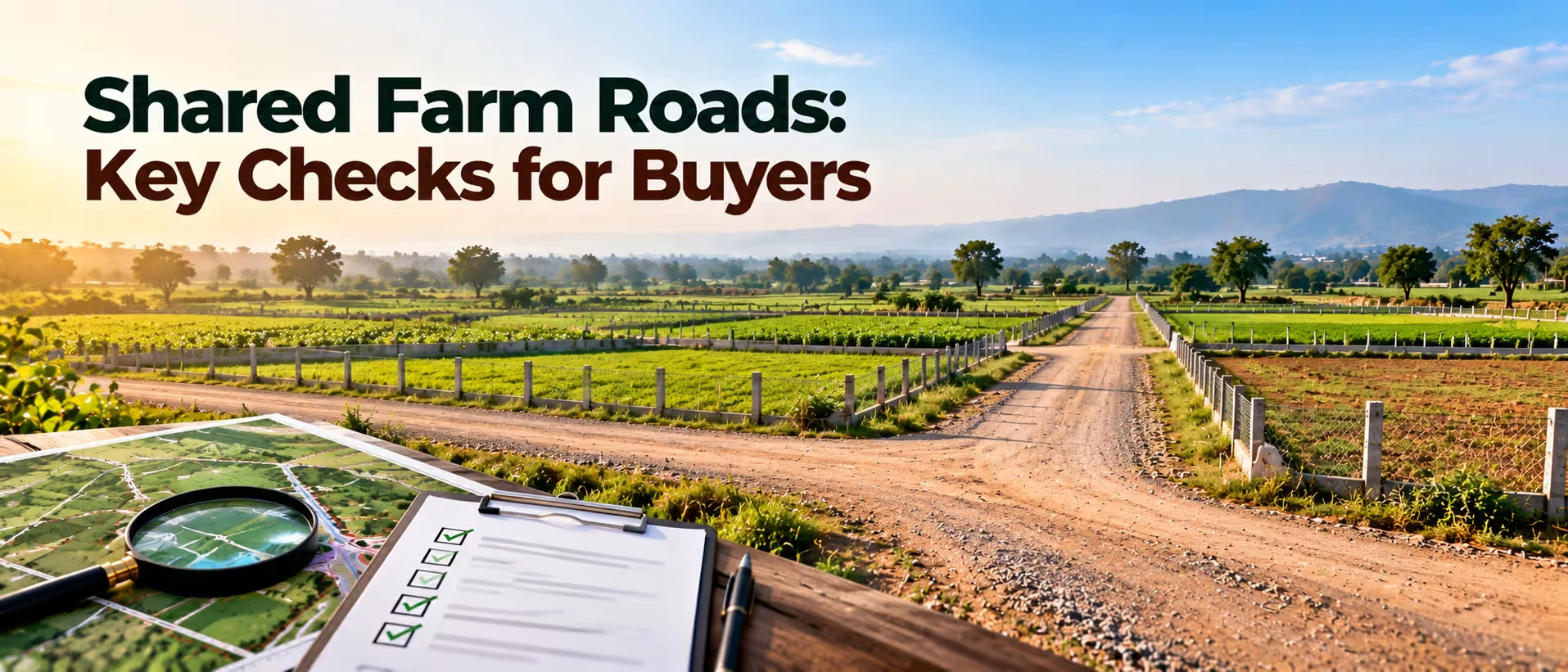
Many buyers looking at land for sale in a village find that the plot does not touch a public road at all and reaches the highway through a farm track that several families use. This is common in India, and it is not automatically a problem, but it is the kind of detail that decides whether a plot is easy to use and sell later or a source of arguments for years. The sections below explain how to find out who owns such a road, what right you will actually have to use it, and what to ask for before you pay.
Key Takeaways
- Where multiple owners have access to a road, it may be classified as being public, private, or merely existent by way of tolerance on behalf of the neighboring landowners, and in each case, you have varying degrees of protection available.
- The access itself should have a traceable origin from any of these three sources: paper, maps, and continuous use – and the seller's say-so is not sufficient.
- Look at its width and its surface compared to what your machinery will require for use.
- Take a look at it during the monsoons or consult neighbors regarding how it behaves during the rainy season, for many such roads become impassable for weeks on end.
- Ask the other users about how maintenance is shared, for disputes usually arise here.
- In the event that the seller cannot justify this access road in any way, take it up as a matter of price or walk out of the deal.
Why a Shared Farm Road Matters More Than It Looks?
People who search for farmlands near me tend to focus on price, soil, and size, and the access road gets a quick glance from the car window. That is understandable because the road looks fine on a dry day, but access is what lets you reach the land, bring in machinery, take out the harvest, and later find a buyer. A plot with a weak right of way is worth less than the same plot on a recorded road, and banks and serious buyers may refuse it.
The problem with a shared road is that no single person controls it. The owner of the strip it crosses can lock a gate, plough it up, or sell his field to someone who takes a different view, and the people who rely on it may have no paper to point to.
Who Owns the Road: Three Common Situations?
| Situation | What it means | Risk to a buyer |
|---|---|---|
| Public or government road | Shown on the village map or revenue records as a road or public path | Lowest, though encroachment and width should still be checked |
| Private strip owned by one neighbour | The road lies inside someone's recorded plot, and others use it | Higher, since your right depends on that owner's agreement or a legal right |
| Road carved out by owners together | Each owner gave up a strip, sometimes recorded and sometimes only understood | Medium, and it depends on how clearly it is written down |
It helps to know which of these you are in before you talk price, because the answer changes how much documentation you should demand.
How Access Rights Come About?
When a farm search ends up with a plot that has a common track, you need to be familiar with where the right to use that track can arise from. There are basically three sources. First is a documentary source like a registered agreement, a clause in the sale deed, or an entry on the village map. Second is the doctrine of prescription and, according to the Indian Easements Act, 1882, the right of way that has been enjoyed openly and uninterruptedly for a long time, usually twenty years, may amount to a legal right. Third is the doctrine of necessity whereby a plot is debarred from access to any road due to the manner in which the land is divided.
None of these sources is a certainty in your case, and it is the courts who consider the facts of the particular dispute. The important thing for a purchaser is that at least one of these sources should be available for his plot, preferably in writing, and he should consult a local lawyer about the application of the law in that state.
Documents and Records to Ask For
| Ask for | What it shows |
|---|---|
| Village map extract for the parcel and the road | Whether the road is marked, how wide it is, and which plots it serves |
| Record of rights for the plot and for the land the road crosses | Who is recorded as owner of the strip |
| Sale deed of the plot you are buying | Whether it mentions access, a right of way, or the road's boundaries |
| Sale deeds of neighbouring plots | Whether they refer to the same road or give a different route |
| Any registered agreement among road users | Width, use, maintenance and who can object |
| Encumbrance record and court case search | Whether the road or the plot is part of a dispute |
When verifying agricultural land road access, if the seller says paperwork is unavailable because everyone uses the road, ask for signed statements from the neighbours who use it. However, treat these as weaker evidence than legally documented access and factor the risk into the price you are willing to pay.
What to Check on the Ground?
However, there can be vast variations of access paths ranging from a hard gravel path to a rut made by two-wheelers in the field; therefore, this site visit becomes as important as document review. Follow the entire path leading from the nearest public road to your farm all the way to your field; take photographs at every turn and measure the path’s width at its narrowest place with a tape or pace it. The reason why it should be done is that a path, which is wide on its entrance side but narrow in the middle, will not hold even a tractor pulling a trailer.
Find out whether there are any gates, fences, or even crops blocking the access path, and check if these are owned by anyone who could possibly raise objections. It is worth asking the farmers around about how the road performs during rainy days, about water collecting on this road, and about whether they were prohibited from using it at some time before.
Red Flags and What to Do About Them
Co-existing roads do not always pose problems, but certain signals should be heeded.
- The seller cannot state who the land strip belongs to.
- The road is not marked on the village plan, or the plan indicates a completely different road.
- One of the neighbors states that the road use is based on permission and can be blocked.
- There is a gate or lock, and the seller does not possess a key or an agreement.
- There is a lawsuit or notification concerning the road or the surrounding plots.
- The price is notably lower than for other comparable plots, without any obvious explanation.
If you identify any of these, do not try to discuss this on the ground. Write it down and request the related document in writing, then visit a local property lawyer. If the issue can be resolved, for instance by obtaining signed agreements from the neighbors prior to the purchase, make it a requirement in your contract. If it is not possible to solve the problem, then the plot is a different purchase.
Sellers: Making a Shared Road Easier to Handle in Land Selling
Owners involved in land selling sometimes treat the road as the buyer's worry, but it is one of the first things a careful buyer will probe, and unclear access is a common reason deals fall through. If you plan to sell land that depends on a shared track, gather the village map extract, the relevant record of rights and any agreement among users before you list.
If there isn’t any written agreement, look into having the neighbors sign a plain, but registered, agreement regarding width, usage and maintenance. This could be very inexpensive in relation to the price reduction which a potential purchaser will ask for as compensation. Include the road in your description together with pictures showing it right from the entrance to the plot.
How 2Bigha Helps Buyers and Owners?
Since checking road access requires time, it will help to begin with sites where the location and the documents are presented in an organized fashion. 2Bigha is an online real estate marketplace for agricultural land and farmland in India. It features listings that include detailed information about the location, the owners, and prices. Buyers have an opportunity to ask for the Background Verification Reports as well as book a visit to the property in one place. By using the 2Bigha Land Report, you will have a chance to check all the documents before visiting a location and see whether there are any road access issues.
Conclusion
A joint property farm road does not make one overlook the purchase of a particular plot, but it should raise some further questions. You need to find out the owners of the strip, know under what conditions you acquire the right to use it, understand how wide and passable the road is, and learn about its maintenance in written form where possible. A plot that is easy to use thanks to the documented road is easy to sell as well, while a dubious road may cost more time and trouble than saved initially.
Disclaimer: This article is for informational purposes only and should not be considered legal, financial, or property advice. Property and easement rules differ by state and the facts of each case, and may change. Readers should verify details with the local revenue office and consult a qualified lawyer before making any property decision.