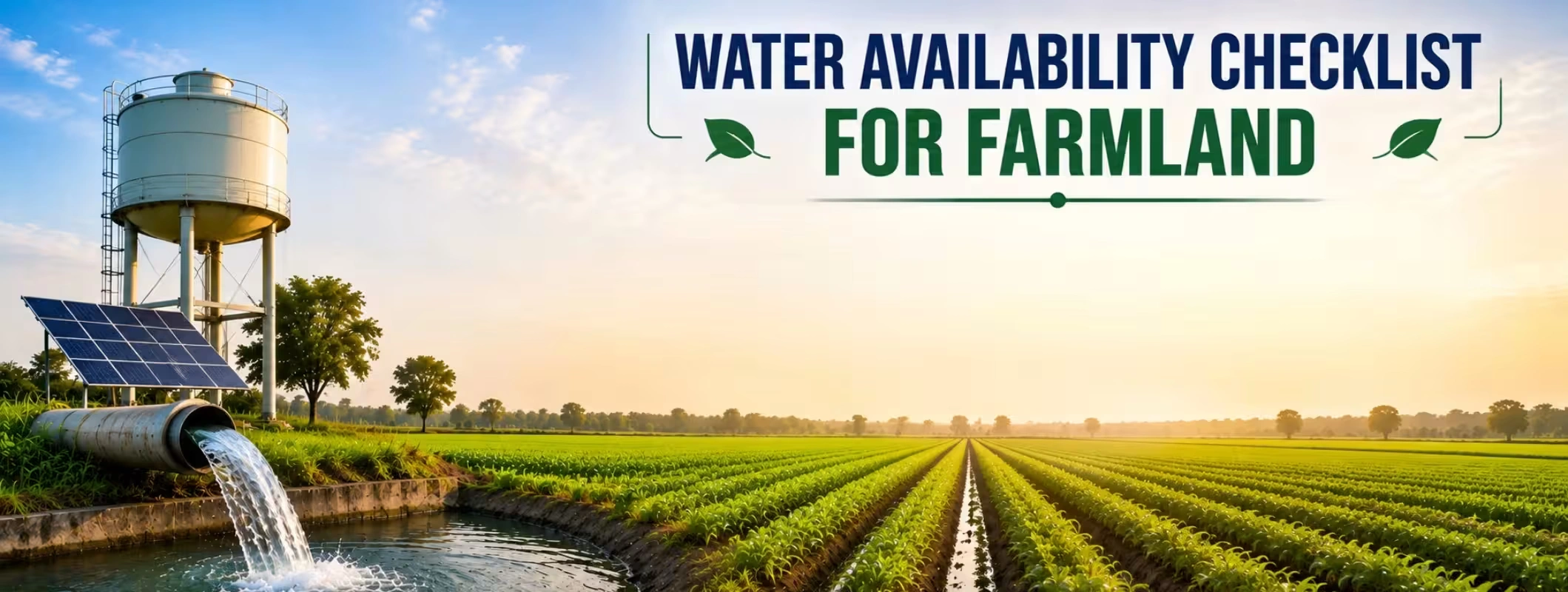
Sri Ganganagar is one of the few districts in Rajasthan where farming actually thrives despite sitting on the edge of the Thar Desert. The reason is water, specifically, canal water. But not every acre in the district gets the same access, and that single detail can make or break your investment. If you're planning to Buy Land in Sri Ganganagar, water availability should sit right at the top of your due diligence list, above soil quality, above road access, even above price. A fertile-looking plot with no reliable water source is just expensive sand. This checklist walks you through exactly what to verify before you sign anything, backed by real numbers on the district's canal and groundwater systems.
Why Does Water Availability Define Land Value Here?
Sri Ganganagar sits in an arid zone. Canal flows provide over 90% of irrigation needs in the district, which lies in the arid Thar Desert region. Groundwater exists, but it's a backup, not a primary source in most blocks. The annual mean rainfall across this canal command belt ranges between just 136 and 328 mm, nowhere near enough to sustain agriculture on its own. That's why farmland here is priced almost entirely on the strength of its irrigation access, not on rainfall or soil alone. This is also why two plots sitting a few kilometres apart can carry very different price tags. One might fall inside a canal command area with assured water; the other might depend entirely on borewells that run dry by April.
Step 1: Confirm Which Canal System Serves the Land
Sri Ganganagar draws water from three major canal networks, and each behaves differently.
| Canal System | Origin | Status in District | Key Detail |
| Gang Canal | Sutlej River, via Ferozepur Headworks, Punjab | Operational since 1927 | Rajasthan currently utilizes around 1.44 MAF of water through the Gang Canal system via the Bikaner Canal |
| Bhakra Canal | Bhakra Dam, Punjab-Rajasthan link | Supplements northern blocks | Extends coverage into command areas bordering Punjab |
| Indira Gandhi Canal (IGNP) | Harike Barrage, Punjab | Extended coverage via Suratgarh and Anupgarh branches | Suratgarh and Anupgarh branch canals extend coverage into Sri Ganganagar through gravity-fed networks |
Together, these three canal systems irrigate 747,958 hectares within the district. That's a huge command area, but it isn't uniform; some tehsils get water on a fixed rotation (called "warabandi"), while tail-end villages often face shortages during peak sowing season.
Before buying farmland for sale in Sri Ganganagar, ask the seller or local patwari:
- Which specific canal or minor/distributary feeds this survey number?
- Is the plot at the head, middle, or tail of the distributary? (Tail-enders get less water, more often.)
- What is the sanctioned warabandi schedule for this land?
Step 2: Check the Groundwater Backup Option
Canal water isn't guaranteed every single day, so groundwater matters as a fallback, especially during the kharif sowing window or canal closure periods (canals are typically shut for maintenance once a year). Here's where it gets tricky. Central Ground Water Board evaluations classify blocks like Sadulshahar and Suratgarh as moderately to critically exploited, meaning new borewells may face restrictions or simply won't yield much. Annual replenishable groundwater resources across the district were estimated at roughly 0.5 to 1 billion cubic metres as of 2020 assessments. Recent hydrological studies also flag a downward trend: groundwater levels in parts of the district have declined by 0.3 to 1.2 metres, particularly in tracts away from canal recharge zones and areas with clay-heavy soils that don't recharge easily.
What this means for you as a buyer:
- Don't assume a borewell is a reliable Plan B; check the CGWB block classification for that specific tehsil first.
- Ask for the depth of the nearest functioning borewell or tubewell and its typical yield in the dry months.
- If the land relies mainly on groundwater with no canal backup, negotiate the price accordingly.
Step 3: Watch for Waterlogging and Salinity, the Other Side of "Too Much Water"
Ironically, some parts of Sri Ganganagar don't suffer from too little water; they suffer from too much of it sitting where it shouldn't. Decades of unlined canal seepage and flood irrigation have caused water tables to rise dangerously in certain pockets. In Stage I command areas covering Sri Ganganagar and Hanumangarh, water tables rose at rates of up to 0.93 metres per year during 1952–1994, with some locations recording water just centimetres below the surface before monsoon. This raises soil salinity through capillary action, which can quietly kill long-term yields even if the land looks green today.
Checklist points for this risk:
- Visually inspect the field for white salt crusting on the topsoil, especially after irrigation.
- Ask neighbouring farmers about crop yield trends over the last 5 years; declining yields on canal-fed land often signal salinity or waterlogging.
- Check if the plot has any subsurface drainage infrastructure, particularly in low-lying zones.
Step 4: Verify Legal Water Rights, Not Just Physical Access
Physical proximity to a canal doesn't automatically mean legal entitlement to draw from it. Irrigation rights in Rajasthan are tied to land records and sanctioned "chak" numbers under the command area development framework. Before you purchase land in Sri Ganganagar, confirm:
- The plot's registered chak number and whether it's officially listed under the relevant canal division.
- Any pending disputes over water-sharing with adjoining plots.
- Whether the seller has cleared all irrigation cess (water tax) dues; unpaid dues can sometimes transfer with the land.
A local revenue lawyer or a Verified Land Listing platform can pull these records faster than a manual visit to the tehsil office.
Quick Reference: Water Availability Checklist
| # | What to Check | Why It Matters |
| 1 | Canal system and distributary name | Determines primary water source reliability |
| 2 | Head, middle, or tail position on distributary | Affects frequency and volume of water received |
| 3 | Warabandi schedule | Confirms your legal turn for water access |
| 4 | CGWB groundwater block status | Flags if borewell is a viable backup |
| 5 | Nearby borewell depth and yield | Real-world proof of groundwater reliability |
| 6 | Salinity or waterlogging signs | Protects long-term soil productivity |
| 7 | Registered chak number | Confirms legal irrigation entitlement |
| 8 | Irrigation cess dues | Avoids inherited liabilities |
How 2Bigha Helps You Buy Water-Secure Farmland?
Manually chasing canal records, chak numbers, and groundwater data across multiple tehsil offices takes weeks, and most buyers simply don't have the time or local contacts to do it properly. This is exactly the gap 2Bigha fills. As a platform built for buying and selling agricultural land and farmland across India, 2Bigha verifies listings before they go live, which means water source details, canal access, and basic legal checks are already part of the listing information rather than something you have to dig up yourself.
Whether you're looking to buy land in Sri Ganganagar with assured canal irrigation or want to compare a few plots for sale in Sri Ganganagar side by side, 2Bigha's verified listings and area conversion tools make the comparison process far simpler. And if you're on the other side, planning to sell land in Sri Ganganagar, listing on a platform that pre-verifies water and legal details tends to attract more serious, faster-closing buyers. For anyone actively hunting for Farmland for Sale in Sri Ganganagar, starting with a platform that already filters for water-secure land saves both time and future regret.
Conclusion
This is not an issue that should be taken lightly in a Sri Ganganagar land transaction because it is the very core of it. Traditionally, the livelihood of the people in the district was based around the canal water available from the Gang Canal system or from its newer incarnation – Indira Gandhi Canal. But as groundwater becomes scarce in one area and in excess in the other, one cannot afford to take anything for granted anymore. Follow the steps above in order to ensure that you are protected.
Disclaimer: This article is for informational purposes only and should not be considered investment, legal, financial, or property advice. Real estate regulations, infrastructure plans, market conditions, and government policies may change over time. Readers are advised to verify information with relevant authorities and consult qualified professionals before making any investment or property-related decisions.