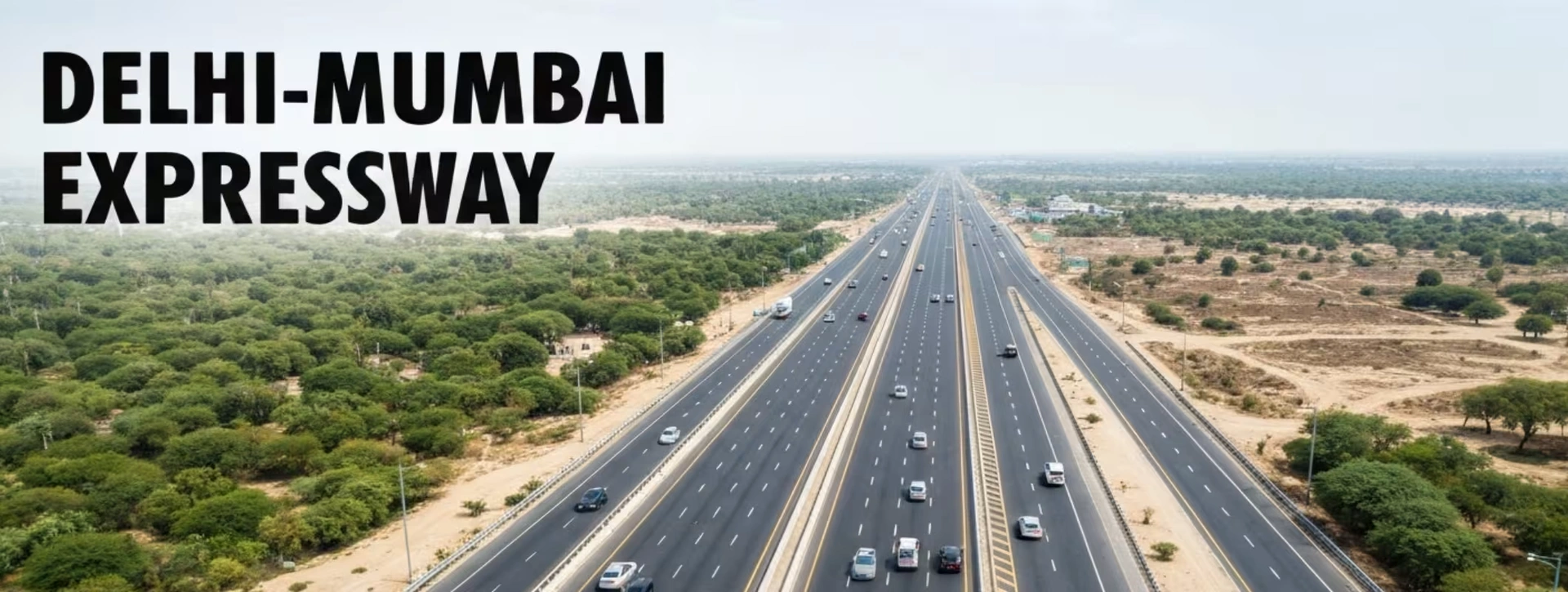
The Delhi–Mumbai Expressway is one of India’s largest infrastructure projects, designed to transform road connectivity between North and West India. Spanning multiple states, the expressway is not only reducing travel time but also reshaping land markets along its entire corridor. From semi-urban regions to rural belts, the rising demand for plots of land for sale reflects growing investor interest, improving accessibility, and changing development patterns.
This blog covers the latest updates on the Delhi–Mumbai Expressway and explains how the project is influencing land values, investment opportunities, and long-term growth potential across key locations.
Overview of the Delhi-Mumbai Expressway
The Delhi-Mumbai Expressway is a high-speed road connecting the capital of India to India's financial center. When it is complete, it'll cut the time of travel from Delhi and Mumbai by a significant amount. The expressway runs between Haryana, Rajasthan, Madhya Pradesh, Gujarat, and Maharashtra and covers hundreds of villages and towns.
The massive connectivity project has created new growth corridors in areas where demand for land is growing quickly. The areas that were once thought to be inaccessible are now being made economically viable, accessible and economically productive.
Latest Updates on the Expressway Development
A few parts that make up the Delhi-Mumbai Expressway are in operation while others are nearing their completion. Important exchanges, service routes, as well as connecting roads are currently being constructed in conjunction with the expressway's main route. The infrastructure supporting them, like logistic parks, leisure areas and industrial zones are also developing rapidly.
Each time a section is completed the nearby land markets see an increase in activity. Investors are attentive to the latest developments, since even a partial connection can cause significant changes in the land price and interest from buyers.
How the Expressway Is Transforming Land Markets?
1. Increased Demand for Land Along the Corridor
The improved road accessibility has made land close to the expressway extremely desired. Buyers are constantly looking for plots that are close to the both exit and entry points as these areas offer better visibility and the potential for future development. This demand is growing for commercial land, agricultural land, and huge land parcels that are suitable for holding over the long term.
As the demand increases the competition among buyers rises which pushes up the cost of land.
2. Strong Appreciation in Land Value
A major and noticeable consequence of the Delhi-Mumbai expressway is the rise in land prices. Areas that were previously ignored are now experiencing constant growth in value. Investors who jumped into these markets during the initial construction are already seeing positive returns.
The appreciation for land is particularly high in areas where connectivity enhancements are paired with adjacent towns, industrial areas or tourist zones.
3. Growth of Industrial and Logistics Land
The expressway is intended to facilitate freight movement along with supply chains. This is why the demand for warehouses, land as well as logistics parks and manufacturing facilities is increasing. Companies are looking for locations that provide speedier transportation and reduce expenses for fuel.
This is changing the nature of land markets and is attracting more attention to large land parcels and strategically placed parcels close to interstates.
4. Expansion of Semi-Urban and Rural Land Markets
The expressway is driving development out of the major cities. Rural belts and towns that are semi-urban along the expressway are getting more attention from investors. These areas provide land at reasonable prices while also enjoying the potential for growth in the future.
As the infrastructure gets better as infrastructure improves, these areas slowly transition from traditional land markets to zones of investment organized.
Impact on Agricultural Land
Agricultural land located along the Delhi–Mumbai Expressway has gained new importance in recent years. While farming remains the primary use in many areas, growing investor interest has increased land value significantly. Better road connectivity improves market access for farmers by reducing transportation challenges for agricultural produce. At the same time, buyers are paying close attention to Agricultural Land Laws in India, which regulate ownership, usage, and conversion of farmland.
In several regions, agricultural land is now viewed as a strong long-term asset due to its strategic location along the expressway. However, future development potential depends on compliance with state-specific agricultural land laws, land-use policies, and conversion norms, making legal awareness a key factor for investors and landowners alike.
Influence on Commercial Land Opportunities
Commercial land located near the Delhi-Mumbai Expressway is drawing interest from companies planning infrastructure along the road, tourism developments, along with service centers. Hotels, food courts, fuel stations and retail space require well-connected land, which makes parcels that are adjacent to expressways extremely desirable.
This is creating an unbreakable connection between infrastructure development and the demand for commercial land.
Land Investment Trends Along the Expressway
The focus of investors today is on the growth of infrastructure, instead of speculation on the short-term. The Delhi-Mumbai Expressway fits in this plan of action. Buyers carefully study the connectivity maps, plans for development, as well as the related economic activity prior to deciding on the property.
Long-term land investments along the expressway can be seen as a reliable option particularly for those seeking to diversify their portfolios beyond traditional urban markets.
Role of Research and Data in Land Decisions
As land markets become more competitive, making informed decisions is essential. Understanding the potential for location, price fluctuations, and other aspects of development is crucial to a successful investment. This is why platforms such as 2Bigha are useful for research.
2Bigha allows users to explore land-based perspectives, research regional trends and learn how infrastructure projects of major importance affect various locations. By providing insight into the movement of markets and growth corridors It helps in better planning and better evaluation of land development opportunities across India.
Future Outlook for Land Markets
The long-term outlook for land markets along the Delhi–Mumbai Expressway remains strong. As more stretches become operational, secondary growth is expected to pick up pace, leading to the development of residential clusters, industrial zones, and commercial hubs across the corridor. Improved connectivity is also pushing demand outward from posh localities in Delhi, as buyers and investors look for better-priced land options with future growth potential.
Land located near access points, feeder roads, and upcoming infrastructure projects is likely to see consistent demand over time. Investors who focus on strong fundamentals such as connectivity, location advantage, and planned development—rather than short-term price movements—are expected to benefit the most in the years ahead.
Key Factors Driving Land Market Growth
A variety of factors have been cited as reasons for the expansion of the land market along the expressway.
- National connectivity is improved
- Reduction in costs for travel and logistics
- Commercial and industrial activity is growing.
- Interest from long-term investors is growing
- Development of semi-urban areas to the extent that it is expanding
Together, they provide a solid base for land appreciation and an increase in the market that is steady.
Conclusion
The Delhi-Mumbai Expressway is much more than just a highway project. It is a powerful growth engine that will transform the land market across several states. From the rising demand for land and appreciation to the emergence of new commercial and industrial opportunities The impact is broad and lasting.
For landowners, investors, and other market watchers, knowing how land value is influenced by infrastructure is crucial. As the development process continues in the region, the Delhi-Mumbai Expressway will continue to be a major influence on the land investment in India.
Frequently Asked Questions (FAQs)
1. What is the Delhi–Mumbai Expressway and why is it important for land markets?
The Delhi–Mumbai Expressway is a major national highway project connecting North India to Western India. It significantly reduces travel time and improves movement of goods and people. For land markets, this improved connectivity increases accessibility to previously remote regions. As a result, land near the expressway becomes more valuable due to higher demand, better development potential, and growing economic activity.
2. How do expressway projects influence land value over time?
Expressways typically lead to gradual but steady land appreciation. During construction, investor interest begins to rise. Once sections become operational, demand increases further due to improved access. Over time, as industries, commercial projects, and townships develop, land prices continue to grow. The Delhi–Mumbai Expressway follows this same pattern, making it a strong driver of long-term land value growth.
3. Which types of land are seeing higher demand along the Delhi–Mumbai Expressway?
Land that is suitable for logistics, warehouses, industrial uses, and commercial development is in high demand. Land that is agricultural near major access points is also receiving attention because of the future expansion prospects. Large parcels of land close to the interchanges as well as feeder routes are appreciated by long-term investors as well as companies that are planning to expand.
4. How does the expressway impact agricultural land in nearby regions?
Agricultural land benefits from improved road connectivity, which makes transportation of produce faster and more cost-effective. At the same time, rising investor interest increases land value. In some areas, agricultural land is now viewed as a long-term asset because of its strategic location near the expressway and future development potential.
5. What role does industrial growth play in shaping land markets along the expressway?
The Delhi–Mumbai Expressway supports faster freight movement and supply chains, making nearby land attractive for industries. Manufacturing units, logistics hubs, and storage facilities prefer well-connected locations. This industrial demand increases competition for land, pushing prices upward and changing the overall character of land markets along the corridor.