List Your Land
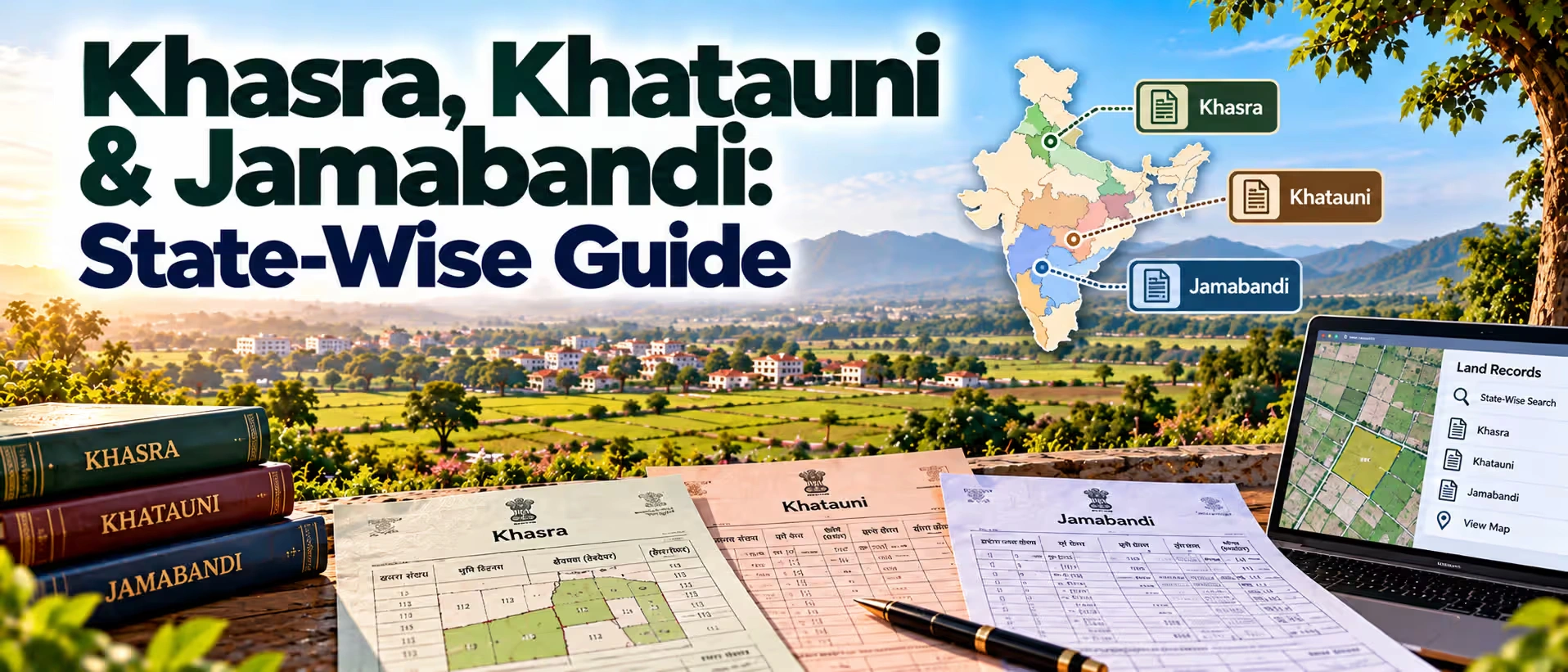
Anyone who has gone through a farmland search in India has run into these three words sooner or later. A seller says the khasra is clear, a broker asks for the khatauni, and a bank wants a fresh jamabandi nakal. They sound like one document, but they are not. And each of them gives an answer to a particular question about the land. This manual will explain to you all three documents in simple language, explain what the columns mean, and provide the official website of each major state. All these documents can be found online today.
Khasra, Khatauni and Jamabandi: The Basic Difference
In a very simple manner: the khasra is about the plot; the khatauni is about the holdings of the individual; and the jamabandi is the complete register of rights for the village.
| Record | What it tells you | Works at which level | Common in |
| Khasra (also Gata or survey number) | Plot number, area, land type, crop, boundaries | Single plot | Almost every state |
| Khatauni (Khata) | Owner name, share, and every plot that person holds in the village | Owner account | UP, Uttarakhand, MP, Bihar |
| Jamabandi | Record of rights with owners, cultivators, shares, and area | Whole village register | Haryana, Punjab, Rajasthan, Himachal, Bihar |
Names vary from state to state; this is why people get confused. In Chhattisgarh, the records that represent ownership and plots are B1 and P-II, respectively. States like Maharashtra and Gujarat use a 7/12 extract. The logic behind the entire system remains consistent; one record refers to the plot, while another refers to the owner of the plot.
What Is a Khasra?
A khasra is the number given to a plot in the village revenue map. The khasra record (called Gata in Uttar Pradesh) lists the plot's area, what kind of land it is, whether it is irrigated, and what was grown on it in recent seasons.
If you are looking at a plot for sale near me type of listing, the khasra number is the first thing to ask for. With that single number, you can pull the plot's record and later match it to the village map, so you are sure the land shown to you is the land on paper. One thing to keep in mind is that a khasra number belongs to a village, not to the whole state. The same number can exist in two different villages, so always note the village, tehsil, and district along with it.
What Is a Khatauni?
Khatauni is the record of the landowner. It consolidates all the plots owned by an individual in a village in one khata number and records the share of each co-owner. So while the khasra gives the nature of the land, the khatauni gives the identity of the landowner.
The khatauni also keeps a record of all changes. Whenever there is a sale, inheritance, or partition of the property, the record is altered through the mutation process. A khatauni that bears the name of the old landowner even after the sale means that the mutation process is not completed. In the state of Uttar Pradesh, the khatauni is the most important document of ownership, and the Bhulekh portal of the state enables you to search it by khasra number, khata number, or owner name.
What Is a Jamabandi?
A Jamabandi is an instrument that comprises all the information regarding revenue and rights. The document consists of information such as the name of the owner, name of the cultivator, area of the land, type of land, and the share of every individual holding in a village. It is the main land record in the states of Haryana and Punjab, and a copy of the same document is known as Nakal or Fard. This term is also used in Rajasthan and Himachal Pradesh.
The jamabandi is not prepared on an annual basis. It is prepared after several years, with mutations between these periods. Hence, you need to verify the latest jamabandi year instead of old printouts provided by the seller.
Digitally certified jamabandis, mutations, and Fard copies can be issued in the state of Haryana through the Revenue Haryana Portal. According to The Tribune report, the charges are Rs 100 for the first 10 pages of a jamabandi and Rs 5 for every page thereafter. The procedure for viewing your jamabandi at jamabandi.nic.in differs and is very simple.
How to Read These Records Column by Column?
Before trusting a listing, Verify Land Records Before Buying. The layout differs by state, but most records carry the same fields. Here is what to look at and what each one should tell you.
| Field | What to check |
| Khasra / Gata / survey number | Matches the number in the sale papers and the village map |
| Khata / Khewat number | Links the plot to the owner's account |
| Owner (khatedar / bhuswami) | Name and father's name match the seller's ID |
| Share | Whether land is jointly held, and each person's fraction |
| Area | Written in hectares, bigha, or kanal depending on state |
| Land type | Irrigated, unirrigated, abadi, government, tribal or forest |
| Crop / girdawari | What was actually grown, which shows who is in possession |
| Mutation / intkal | Last change of ownership and its date |
| Liabilities (bhar) | Loans, mortgages, court orders or encumbrances |
Two columns deserve extra attention. The first is land type, because it decides whether the plot can be sold or used the way the seller says. The second is the liabilities column, since a loan against the land will not disappear when ownership changes.
Where to Get These Records, State by State?
Every state runs its own portal, and the exact name of the record changes. Use the table as a starting point and always confirm that the website ends in .gov.in or .nic.in, because many lookalike sites charge money for free records.
| State | Record you will use | Official portal |
| Uttar Pradesh | Khatauni, Khasra (Gata), Bhu-Naksha | upbhulekh.gov.in |
| Uttarakhand | Khatauni, Khasra | bhulekh.uk.gov.in |
| Haryana | Jamabandi, Nakal, Fard, Shajra | jamabandi.nic.in |
| Punjab | Jamabandi, Fard | jamabandi.punjab.gov.in |
| Rajasthan | Jamabandi Nakal, Khasra | apnakhata.raj.nic.in |
| Madhya Pradesh | Khasra, B-1 Khatauni | mpbhulekh.gov.in |
| Chhattisgarh | B1, P-II, Bhu-Naksha | bhuiyan.cg.nic.in and bhunaksha.cg.nic.in |
| Bihar | Jamabandi Panji, Khesra | biharbhumi.bihar.gov.in |
| Gujarat | 7/12 and 8A extract | anyror.gujarat.gov.in |
| Maharashtra | 7/12 Satbara extract | bhulekh.mahabhumi.gov.in |
Portal addresses do change now and then, so if a link does not open, search the state revenue department's name and use the link from the department's own page.
A closer look at three states
Uttar Pradesh. In the UP Bhulekh portal, the khatauni, khasra, and the cadastral map can be accessed. You will have to enter the district, tehsil, village, and search based on Gata Number, khata number, or name of the owner. The online document is suitable for review and due diligence purposes; however, in some cases, the stamped document from tehsil may be needed.
Haryana. The portal jamabandi.nic.in, allows you to select the district, tehsil, village, and jamabandi year and then search based on khewat, khasra, or name of the owner. The portal also gives you an opportunity to find out any court case and shajra map. The land parcels are measured in traditional units such as kanal and marla; therefore, pay attention to the area column.
Chhattisgarh. For B1 and P-II, one has to use the Bhuiyan portal, whereas the Bhunaksha portal provides the plot map. The information given in P-II also classifies the land according to the government.
How to Check These Records Online: Step by Step
The process is almost the same for all portals.
- Go to the official website of your state as mentioned in the above table.
- Choose the district, tehsil, and village. In some cases, the rural and urban records may appear separately.
- Choose the method of search: khasra/Gata number, khata/khewat number, or owner’s name.
- In case of jamabandi, choose the most recent year.
- Go to the record and check the details regarding the owner’s name, area, and type of land as mentioned by the seller.
- Download/save the copy along with the date when it was downloaded.
- Go to the khasra number on the map of the village (Bhu-Naksha/shajra).
If no results appear, use the khasra number instead of the name, as spelling variations are common in revenue records.
Mistakes Buyers Make With Land Records
Most disputes start from small oversights. These are the ones that show up again and again.
- Relying on a printout from the seller. Always do the search yourself on the official portal. The paper document could be old or tampered with.
- Understanding khatauni as proof of ownership. It is a revenue document. It proves possession and rights as entered, while the sale deed proves the chain of title.
- Overlooking joint owners. If there are multiple names under the shares section, normally all co-owners need to sign.
- Neglecting to check the map. The document might be fine, but the plot on the ground may be a totally different one. Many people looking for agricultural lands around me only match the figures and never check the boundary using the map.
- Disregarding the liabilities section. Any bank lien on the property will remain on the property.
- Using an old year. In jamabandi areas, an old registry might show someone who has already sold out his/her land.
Checking Land Before You Buy or Sell on 2Bigha
The recording of data alone is just half the work. It is equally important to find out those pieces of land which are worth searching for. 2Bigha is a land market where the landowners advertise their land holdings, and the prospective buyers can browse according to their geographical location, size, and cost. If you wish to buy agriculture land for sale in any state, then you can start your search from the farm list page.
2Bigha also offers a land report that goes through the key checks on a parcel, so you do not have to chase each portal alone. For owners, a listing backed by clean, current records tends to move faster. If you are thinking about land selling, collecting your latest khatauni or jamabandi nakal before you list will save time when a serious buyer asks for proof. And if you plan to sell land that is jointly held, sort out the share details first so the process stays smooth.
Disclaimer: This article is for informational purposes only and should not be considered investment, legal, financial, or property advice. Real estate regulations, infrastructure plans, market conditions, and government policies may change over time. Readers are advised to verify information with relevant authorities and consult qualified professionals before making any investment or property-related decisions.