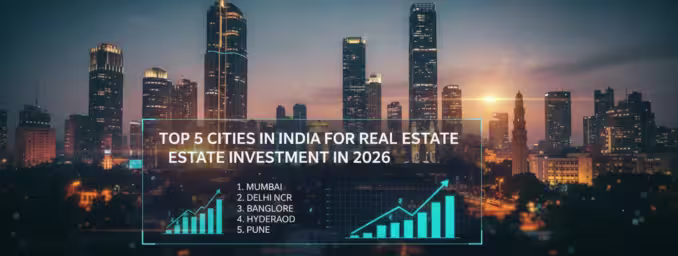
If you’re planning a property investment in 2026, don’t pick a city just because it’s “popular.” Pick it because the city has jobs + infrastructure + end-user demand + liquidity (easy resale/rental). Before you buy property, make sure the local economy supports sustained housing demand and future resale potential. 2026 is also shaping up as a year where premium housing demand stays strong, mid-segment buyers return as borrowing conditions ease, and commercial real estate remains a key driver in the biggest job hubs.
Below are 5 Indian cities/regions that tick the strongest “investment-grade” boxes for 2026—along with where to look, what to buy, and what risks to watch.
Top 5 cities at a glance (2026)
| Rank | City/Region | Best For | Why It Stands Out in 2026 |
|---|---|---|---|
| 1 | Delhi–NCR (Gurugram + Noida) | High appreciation + rental demand | Expressways, airport impact, corporate belt growth |
| 2 | Bengaluru | Rentals + long-term compounding | India’s strongest office/job engine |
| 3 | Hyderabad | Balanced entry price + new corridors | Planned growth zones, premium land appetite |
| 4 | Pune | Mid-premium homes + IT corridor bets | Metro + IT/manufacturing stability |
| 5 | Mumbai MMR (Mumbai–Thane–Navi Mumbai) | Capital preservation + infrastructure | Deep market + major connectivity upgrades |
This list aligns with recent market signals, selective price appreciation, strong end-user demand in top cities, and city-wise momentum differences seen in large broker reports.
Also Read: Punjab Land Registry Rules Changed: What It Means for Buyers in Amritsar (2026 Update)
How I picked these cities (simple, investor-first logic)
I used five filters that actually matter in India:
- Job engine (IT, GCCs, finance, manufacturing—anything that keeps rentals alive)
- Infra pipeline (metro, expressways, airports = new micro-markets)
- Price momentum with liquidity (growth without “stuck inventory” risk)
- Demand quality (end-user > pure speculation)
- Exit options (resale + rentability + multiple buyer segments)
Delhi–NCR (Gurugram + Noida): Biggest appreciation story when you choose the right corridor
Why NCR is top in 2026
- NCR has shown some of the strongest price growth among top Indian markets in recent cycles.
- Infrastructure is not “coming someday”—it’s already reshaping corridors: the Dwarka Expressway is a major decongestion + connectivity lever between Delhi and Gurugram.
- Noida/Greater Noida gets a direct catalyst from the Noida International Airport (Jewar) momentum and expected economic pull for the region.
Where investors are focusing (micro-markets)
- Gurugram: Dwarka Expressway belt, New Gurugram sectors, Golf Course Extension side (budget dependent)
- Noida: Noida Expressway, Sector belts with strong metro/access, and airport-influence zones (don’t blindly buy “near airport”; buy where infrastructure + livability is real)
What to buy in NCR (2026)
- For appreciation: under-construction with reputed developers only + infrastructure-adjacent sectors
- For rental: ready-to-move mid-premium apartments near office clusters (less vacancy pain)
Risks you must not ignore
- Some pockets have oversupply and marketing-driven pricing.
- Builder quality varies wildly, RERA checks + project funding clarity are non-negotiable.
Bengaluru: Still the most reliable rental machine, if you don’t overpay
Bengaluru stays on this list for one blunt reason: jobs keep coming, and jobs keep rentals alive.
What’s supporting Bengaluru in 2026
- Bengaluru has recorded record-high office net absorption in 2025, which is a direct signal for continued housing demand in the right catchments.
- India’s office market overall also closed 2025 strongly, which keeps Bengaluru firmly in the top demand bracket.
Best micro-markets (depending on your goal)
- Rental-first: Outer Ring Road office belt influence (but pick projects with practical access, not “Google-map-close”)
- Balanced end-use + rent: Whitefield side / East Bengaluru pockets with improving connectivity (project-by-project diligence matters)
What to buy in Bengaluru (2026)
- For rental yield: ready-to-move 2BHK/3BHK in societies with strong tenant profile
- For long-term appreciation: projects aligned with real infrastructure and established office ecosystems
Bengaluru risks
- Premium pockets can get overpriced quickly.
- Traffic/commute realities affect rentability more than brochure promises.
Hyderabad: Planned growth corridors + premium land appetite = strong 2026 momentum
Hyderabad is interesting because it offers a more balanced entry point in many pockets—while still attracting serious money.
Why Hyderabad makes sense in 2026
- ANAROCK’s city trackers show Hyderabad remains a meaningful contributor to top-city housing sales (with shifts quarter to quarter).
- Government-led planning and land monetisation in prime zones has been aggressive, HMDA auctions in premium layouts have drawn strong bids, reflecting appetite for key corridors.
Where to look
- West Hyderabad growth belt: Financial District side, Kokapet/Tellapur-type corridors (buy where social infra is catching up, not only where towers are rising)
- Emerging planned zones: track what the city is prioritising in roads, utilities, and growth plans
What to buy
- For steady demand: mid-premium apartments in strong school/office catchments
- For higher risk/reward: plotted development in credible, well-approved layouts (approvals matter here)
Hyderabad risks
- Some segments can cool if pricing runs ahead of actual end-user affordability.
- Always verify approvals, HMDA/RERA status, and approach roads/utilities.
Pune: Strong “livability + jobs” mix, plus metro-led corridor bets
Pune works well for investors who want a city that is not purely hype-driven. It’s a real end-user market with strong employment engines.
Why Pune is in the top 5
- Big IT + manufacturing base gives Pune consistent housing demand.
- The Hinjawadi–Shivajinagar Metro Line (Line 3) is a practical long-term catalyst for the IT corridor, official project timelines have been extended up to 31/03/2026 for completion work.
Where to look
- IT corridor belt: Hinjawadi–Wakad–Baner side (but don’t ignore last-mile connectivity)
- East Pune: Kharadi-type office influence areas (project selection matters more than locality name)
What to buy
- For rentals: compact, tenant-friendly configurations close to job clusters
- For appreciation: infrastructure-aligned pockets along metro/road upgrades
Pune risks
- Some parts suffer from “good location, bad commute.” That kills tenant retention.
- Don’t buy just because a corridor is famous, buy because your specific project has connectivity, approvals, and real demand.
Mumbai MMR (Mumbai–Thane–Navi Mumbai): Expensive entry, but unmatched depth and catalysts
Mumbai is not “cheap ROI.” Mumbai is capital preservation + liquidity + infrastructure-led micro-market jumps.
What makes Mumbai MMR strong in 2026
- The Navi Mumbai International Airport has commenced commercial operations, which is a major long-term demand driver for Navi Mumbai and its surrounding nodes.
- The Mumbai Trans Harbour Link (Atal Setu) is operational and has improved Mumbai–Navi Mumbai connectivity—this is exactly the kind of infra that creates new real estate gravity zones.
- Redevelopment activity remains a serious theme in the region, with large pipelines and institutional interest.
Where investors are looking
- Navi Mumbai nodes (airport influence + connectivity effects)
- Thane belt (end-user depth + better pricing than core Mumbai in many cases)
- Select redevelopment opportunities (only if you understand timelines and legal structure)
What to buy
- For stability: ready-to-move in established micro-markets
- For growth: connectivity-linked nodes (but be realistic on timelines)
Mumbai risks
- High ticket size compresses rental yield.
- Redevelopment can be slow—legal/contract clarity is everything.
Which city should you choose based on your goal?
- If you want maximum appreciation potential: Delhi–NCR (corridor-specific, not random)
- If you want rental consistency: Bengaluru (project selection is the game)
- If you want balanced entry + planned growth: Hyderabad
- If you want end-user-friendly stability: Pune
- If you want liquidity + wealth preservation: Mumbai MMR
Also Read: Noida Film City: Inside Yogi Govt’s 1,000-Acre Development Strategy
FAQs (people ask this before buying in 2026)
Which city is best for real estate investment in India in 2026?
If you want a single “best” based on appreciation + infra impact, Delhi–NCR leads. If you want rentals and long-term demand stability, Bengaluru is hard to beat.
Is 2026 a good time to invest in property in India?
For serious buyers (not quick flippers), 2026 looks supportive because demand is being driven more by end-users and premium preference, with broader market stability expected in major cities.
Should I invest in a metro city or a Tier-2 city in 2026?
Metros are safer for liquidity. Tier-2 can outperform, but only when you understand local demand drivers and exit options. If your priority is “easy resale,” metros win.
How to Approach Property Investment in 2026?
In 2026, smart property investment is less about chasing hype and more about choosing the right corridor, entry timing, and exit clarity. Before you buy properties, be clear whether your goal is appreciation, rental income, or capital preservation.
Final take (no fluff)
In 2026, the best real estate “cities” are actually the best corridors inside those cities. Pick your city from the top 5 above, then spend 80% of your effort on micro-market selection + project quality + approvals. That’s where real returns are made.