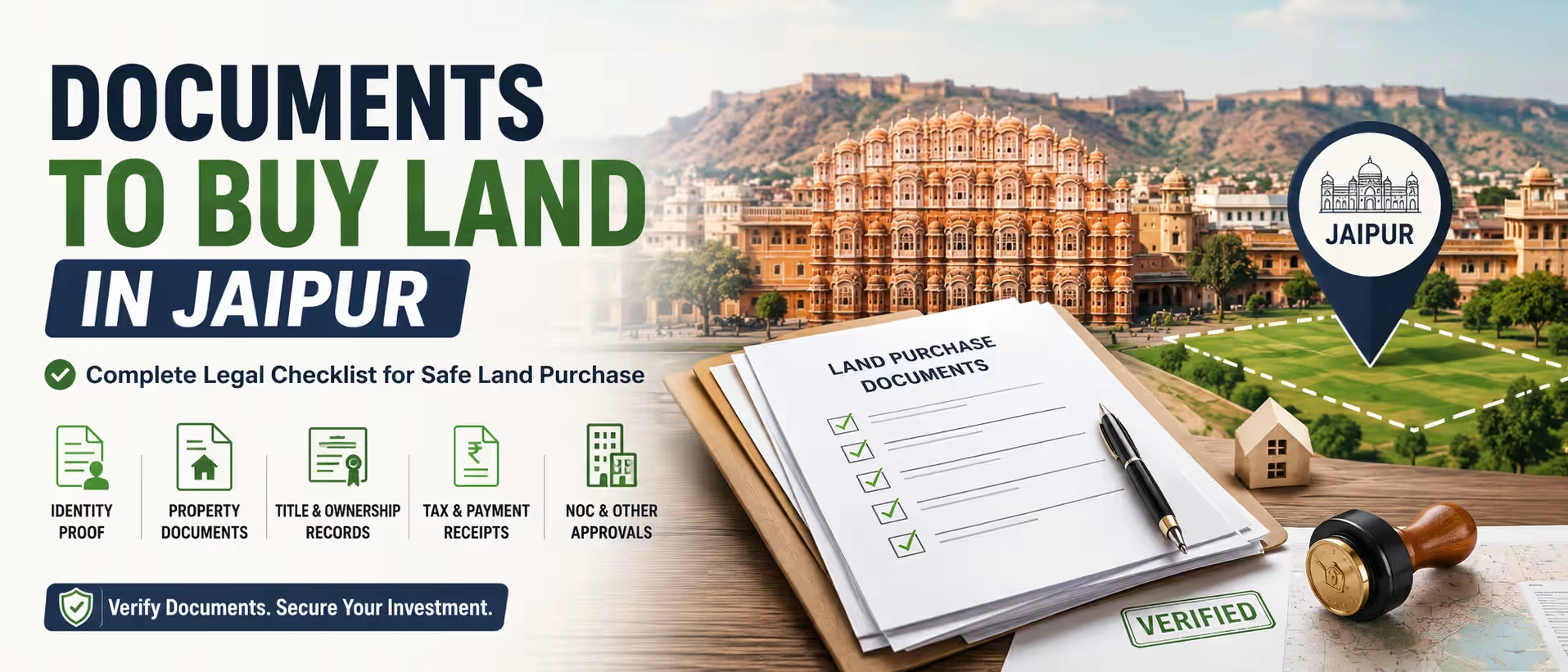
Buying land in Jaipur can be rewarding, but land transactions require far more due diligence than purchasing a ready-to-move flat. A plotted development on Ajmer Road, an agricultural parcel near Chaksu, a residential plot around Sanganer and a JDA scheme property may all follow different documentation paths.
The most important rule is simple: never judge a land deal only by its location, boundary wall, broker’s assurance or advertised approval status. Verify the ownership, land use, boundaries, access, approvals, liabilities and seller’s authority before paying a substantial token amount.
This guide explains the documents required to buy land in Jaipur, the purpose of each record, common warning signs and the steps buyers should follow before registration.
Direct Answer: The main documents required for buying land in Jaipur include the registered title deed, previous ownership chain, Jamabandi, mutation record, Khasra details, land map, encumbrance or registration search, JDA patta or allotment record where applicable, 90-A conversion order for converted land, approved layout plan, land-use confirmation, tax receipts, seller identity documents and a properly drafted sale deed.
The exact requirement depends on whether you are buying agricultural land, a JDA-approved residential plot, land in a private township, ancestral property or an independently owned urban plot.
Key Takeaways
- A registered sale deed alone does not complete land due diligence. Buyers must also verify the ownership chain, revenue entries, land use, access and physical boundaries.
- Check the Jamabandi, mutation and Khasra details through Rajasthan’s official land-record system for rural and agricultural property.
- For an urban or residential plot, verify the JDA patta, conversion order, approved layout and applicable development authority records.
- A mutation entry supports revenue administration, but buyers should not treat it as a substitute for a valid ownership document.
- Search registered records using the seller’s name, purchaser’s name, plot number, Khasra number and property address.
- For a plotted project, check its Rajasthan RERA registration and uploaded approvals rather than relying only on marketing material.
- Match every document with the actual land at the site. Area, dimensions, approach road and Khasra location must agree.
- Use an independent Jaipur property advocate and survey professional before paying the full amount.
Why Land Documentation in Jaipur Requires Extra Attention
Land records in and around Jaipur may sit across different administrative systems. Agricultural land commonly appears in revenue records, while urban plots may involve JDA documents, local-body records, lease deeds, pattas, conversion orders or private development approvals.
Rajasthan’s ePanjiyan platform links buyers to agricultural, rural and urban land-record services. The Apna Khata portal allows users to search district-wise Jamabandi records, mutation-related records and other revenue information. These online services provide a useful starting point, but buyers should obtain certified records wherever their advocate or registering authority requires them.
A practical issue often arises on Jaipur’s expanding outskirts. A property may be marketed using a popular corridor name such as “Ajmer Road,” “Tonk Road” or “near Ring Road,” while its legal identity belongs to a particular village, tehsil, Khasra number and revenue estate. The marketing location and legal location must point to the same parcel.
Jaipur Land Document Summary Table
| Document | What It Establishes | Required For |
|---|---|---|
| Registered Sale Deed / Title Deed | Confirms the seller’s recorded legal ownership of the property. | Almost every resale transaction. |
| Previous Title Documents | Shows the continuous chain of ownership over previous transactions. | All privately owned land. |
| Jamabandi Record | Verifies the recorded holder, Khasra number, land classification, and revenue details. | Agricultural and rural land. |
| Mutation Record | Confirms that ownership has been updated in the revenue records after transfer. | Agricultural and revenue land. |
| Khasra & Land Map | Identifies the exact parcel, boundaries, and physical location of the land. | Rural, agricultural, and converted land. |
| Encumbrance Certificate / Registration Search | Reveals registered mortgages, sales, liens, or legal claims on the property. | All land purchases. |
| JDA Patta, Lease Deed, or Allotment Letter | Establishes rights created by the Jaipur Development Authority or another competent authority. | JDA schemes and regulated urban plots. |
| 90-A Conversion Order | Confirms legal conversion from agricultural land to permitted non-agricultural use. | Converted residential or commercial land. |
| Approved Layout Plan | Shows approval of roads, plots, open spaces, and colony layout. | Private plotted developments. |
| Land-Use Confirmation | Verifies the property's permitted use under applicable planning regulations. | Residential, commercial, and institutional land. |
| Rajasthan RERA Project Record | Confirms project registration status and uploaded statutory approvals. | Applicable plotted developments. |
| Tax & No-Dues Receipts | Confirms there are no outstanding municipal or authority dues. | Urban and authority-controlled plots. |
| Identity & Authority Documents | Verifies the seller’s identity and legal authority to execute the sale. | Every property transaction. |
| Survey / Demarcation Record | Confirms the property's actual area and on-ground boundary position. | Especially important for open land. |
| Draft Sale Deed | Contains the agreed terms and conditions before final registration. | Registration stage. |
1. Registered Sale Deed or Title Deed
The seller’s registered sale deed is usually the first document a buyer should request. It explains how the current owner acquired the property and ordinarily includes information such as:
- Seller and purchaser names
- Plot or Khasra number
- Land area
- Property location
- Boundaries
- Sale consideration
- Registration details
- Nature of ownership
- Rights transferred
Do not accept a photocopy without comparing it against registration records or a certified copy. Spelling differences, altered plot numbers, missing pages or inconsistent boundary descriptions need investigation.
For authority-allotted properties, the ownership record may begin with an allotment letter, lease deed, patta or conveyance document rather than a conventional private sale deed. The buyer must understand whether the seller has freehold ownership, leasehold rights or only an allotment interest.
2. Previous Ownership Documents and Title Chain
A seller may possess the latest sale deed but still lack a clean and continuous title. Ask for previous sale deeds, gift deeds, partition deeds, release deeds, inheritance documents or allotment records that show how ownership moved from one person to another.
This process is called property title verification.
A property advocate should check whether:
- Every transfer was properly executed and registered
- The seller’s predecessor legally owned the land
- All legal heirs participated where necessary
- The land area remained consistent across documents
- No part of the property was sold earlier
- Plot and Khasra descriptions remained traceable
- Any old mortgage or agreement was properly closed
- Names, shares and boundaries match throughout the chain
Many buyers focus only on the current deed. That is risky. A defect from an earlier transfer can affect the present seller’s right to sell.
Practical Example
Suppose the seller acquired a plot through a family partition. The latest document may show the seller’s name, but the underlying property could still face a dispute if the partition was incomplete, unregistered where registration was required, or challenged by another heir.
The correct question is not merely, “Is the seller’s name written on one document?” It is, “Can the seller prove a legally continuous and transferable title?”
3. Jamabandi Record
A Jamabandi record is one of the most important revenue records for agricultural and rural land in Rajasthan. It may show details such as the recorded landholder, Khasra number, area, classification and nature of rights.
Rajasthan’s Apna Khata system allows users to select a district and access Jamabandi-related information. It also provides access to mutation applications, demarcation services and Girdawari-related information.
When checking Jamabandi, compare:
- Seller’s name
- Father’s or spouse’s name
- Khasra number
- Total land area
- Seller’s recorded share
- Land category
- Village and tehsil
- Any remarks or restrictions
- Names of co-sharers
Do not ignore fractional ownership
A seller may own only a share in a larger Khasra rather than a separately demarcated parcel. For example, the seller may claim to sell “one bigha” from a jointly held ten-bigha Khasra without a registered partition or clear demarcation.
In such a case, the buyer may receive an undivided share rather than exclusive ownership of the exact portion shown at the site.
4. Mutation Record or Namantaran
A mutation certificate or mutation entry records a change in the revenue records after a sale, inheritance, gift, partition or other transfer.
Check whether the property was mutated in the present seller’s name after the previous transaction. If the seller’s sale deed is registered but the revenue entry still reflects an older owner, investigate the reason and complete the required correction before proceeding.
However, buyers must understand the role of mutation correctly. Mutation primarily updates government revenue records. It supports the ownership trail, but it should be read with the registered title documents rather than treated as independent proof of a flawless title.
Check the mutation number, date, basis of mutation, recorded share and current status.
5. Khasra Number, Girdawari and Revenue Map
The Khasra number identifies a specific parcel in the revenue records. The Rajasthan land records should connect the Khasra number with the seller, village, land area and physical location.
Depending on the property, request:
- Khasra details
- Girdawari record
- Revenue map or Shajra
- Trace map
- Site plan
- Demarcation report
- Survey sketch
The land shown by the broker must be the same land described in the title and revenue records.
Why this check matters in Jaipur
On undeveloped land, physical features can be misleading. A fence, stone marker, plantation line or temporary road does not necessarily represent the legally recorded boundary.
Engage a qualified survey professional or seek official demarcation where appropriate. Confirm all four sides, total area, access road and neighbouring Khasra numbers.
6. Encumbrance Certificate or Registration Search
An encumbrance certificate or equivalent registration search helps identify registered transactions affecting the land. Depending on the available procedure and period searched, it may disclose registered sale deeds, mortgages, gifts, leases, releases or other recorded documents.
Rajasthan’s e-archival Registration and Stamps guest-search facility allows searches using fields such as:
- Registration number
- Date of registration
- Seller name
- Purchaser name
- Plot or Khasra number
- Property address
- Identity details
- Book and volume information
Do not search using only one field. Names may have spelling variations, and older records may use a village or Khasra description rather than a modern colony address.
A property lawyer should also conduct an independent title and litigation search. An online registration search may not reveal every unregistered claim, family dispute, possession issue or pending court case.
7. JDA Patta, Lease Deed, Allotment Letter or Conveyance Document
For a property developed, allotted, regularised or governed by Jaipur Development Authority, request the relevant JDA documents.
Depending on the property, these may include:
- Original allotment letter
- JDA patta
- Registered lease deed
- Conveyance deed
- Possession letter
- Site plan
- Transfer permission
- Regularisation order
- Lease payment receipt
- No-dues certificate
- Name-transfer record
JDA provides online citizen services, scheme and allottee information, lease-due details, online verification and separate calculators for different categories of lease deed or patta matters. Its portal also publishes planning information, approved plans and unauthorised-colony notices.
What buyers should verify
Confirm that:
- The patta or lease document belongs to the same plot.
- The seller is the lawful allottee, transferee or current recorded holder.
- The plot size and dimensions match the site.
- Transfer conditions have been fulfilled.
- Lease dues or authority charges are cleared.
- The property is not affected by cancellation, resumption or an adverse notice.
- Construction restrictions and land use are understood.
A property described as “JDA-approved” should not be accepted on verbal assurance. Ask what exactly is approved—the individual plot, the colony layout, a building plan, a regularisation case or only a nearby scheme.
8. Land Conversion Order Under Section 90-A
Agricultural land cannot automatically be treated as residential or commercial land merely because roads, houses or boundary walls have appeared nearby.
Where agricultural land has been converted for a non-agricultural purpose, ask for the relevant conversion order, commonly discussed in Jaipur transactions as the 90-A order.
The document should identify:
- Original Khasra numbers
- Converted area
- Approved use
- Applicant or landholder
- Conditions of conversion
- Layout or scheme details
- Roads and facility areas
- Competent authority
- Date and order number
The JDA portal lists 90-A-related citizen services and multiple patta or lease categories, which reflects the importance of identifying the precise legal route through which a parcel entered urban use.
A photocopied conversion order is not enough. Ensure that the buyer’s plot actually falls within the converted Khasra and approved layout.
9. Approved Layout Plan
For a plot in a private colony, township or plotted development, ask for the sanctioned layout.
An approved layout plan should show:
- Plot numbers
- Plot dimensions
- Internal roads
- Road widths
- Parks and open spaces
- Facility areas
- Entry and exit
- Total scheme boundary
- Relevant Khasra numbers
- Approval authority and reference number
Compare the plot offered for sale with the approved plan. A seller may show a private marketing map that differs from the sanctioned layout.
Watch for plots carved out of:
- A proposed road
- Park or open space
- Facility land
- Public utility area
- Green area
- Setback
- Drainage route
- Land excluded from approval
JDA publishes planning resources including master plans, zonal development plans, sector plans, approved building-plan information and notices concerning unauthorised colonies. Buyers should use these records as part of the verification process.
10. Land-Use and Planning Verification
A plot can have a sale deed and still face restrictions on construction or commercial use.
Check the applicable:
- Master plan
- Zonal plan
- Sector plan
- Land-use category
- Road-widening proposal
- Green or ecological restriction
- Public-purpose reservation
- Heritage control
- Infrastructure corridor
- Development-control rules
Do not assume that “near a residential colony” means “residential land.”
This distinction becomes especially important on Jaipur’s outer development corridors, where agricultural parcels, converted schemes, industrial uses and proposed infrastructure may exist within a relatively small area.
JDA’s planning portal currently provides access to master-development plans, zonal and sector information, road-network plans and special-area land-use resources.
11. Rajasthan RERA Project Details
For a plotted development that falls within the scope of the Real Estate (Regulation and Development) framework, check the project on the Rajasthan RERA portal.
The portal provides searches for registered, lapsed, suspended and revoked projects, along with project and promoter information. Individual project records may also contain location, plot or Khasra details and uploaded approval documents.
Verify:
- RERA registration number
- Promoter’s legal name
- Project status
- Approved project area
- Khasra numbers
- Layout approval
- Completion schedule
- Encumbrance declarations
- Uploaded permissions
- Litigation disclosures
- Changes made after registration
RERA registration does not eliminate the need for independent title verification. It adds a useful regulatory layer, particularly when buying directly from a developer.
12. Property Tax Receipts, Lease Dues and No-Dues Records
Ask for the latest applicable receipts and statements, including:
- Property tax receipt
- Urban development charges
- Lease-money receipt
- Betterment or conversion charges
- Maintenance dues
- Society dues
- Local-body charges
- Electricity or water dues, where relevant
- Authority no-dues certificate
A property tax receipt is useful for checking occupancy or municipal records, but it does not by itself prove ownership.
Similarly, electricity bills, water bills and address documents show use or possession. They do not replace a registered title.
13. Seller’s Identity and Legal Capacity
The seller must be the same person named in the title documents, subject to any lawful transfer, inheritance or authorised representation.
Request and verify:
- Aadhaar or accepted identity proof
- PAN
- Current address proof
- Passport-size photographs, where required
- Name-change record, if applicable
- Marriage-related name record, where relevant
- Entity documents, if the seller is a company, partnership, trust or society
- Board resolution or authorisation
- Co-owner consent
- Guardian or court permission where legally required
Match the seller’s name, parentage, signature and address across the title, revenue and identity records.
Jointly owned land
Every co-owner whose interest is being transferred should sign the sale deed or grant valid authority. One co-owner cannot ordinarily transfer the shares of other co-owners without lawful authority.
14. Power of Attorney
A Power of Attorney requires careful scrutiny because property fraud frequently involves outdated, revoked, limited or improperly executed authority documents.
When a representative sells the land, check:
- Whether the Power of Attorney is registered where required
- Its execution date
- The principal’s identity
- The exact powers granted
- Property description
- Whether it permits sale and receipt of consideration
- Whether it remains valid
- Whether it was revoked
- Whether the principal is alive
- Whether the attorney is acting within the stated authority
The final conveyance should be a properly registered sale deed. Do not treat a general authority document as an automatic substitute for registered ownership transfer.
15. Inherited or Ancestral Land Documents
Inherited land needs additional documentation because the recorded seller may not be the only person with rights.
Request, as applicable:
- Death certificate of the previous owner
- Will
- Probate or court order, where applicable
- Legal-heir or succession-related documents
- Family settlement
- Partition deed
- Release or relinquishment deeds
- Mutation based on inheritance
- Consent of all relevant heirs
- Genealogical details
Do not rely on an affidavit stating that no other heirs exist. Ask the advocate to verify the family tree, succession route and participation of every necessary party.
16. Loan Closure and Bank Release Documents
If the land was mortgaged, ask for:
- Loan-closure letter
- Bank no-dues certificate
- Release or reconveyance document
- Return of original title documents
- Satisfaction of registered charge
- Written confirmation from the lender
A seller may say the loan will be closed after receiving the buyer’s payment. Structure such transactions through proper bank and legal documentation rather than transferring unsecured money to the seller.
17. Agreement to Sell
The agreement to sell records the commercial terms before the final registration.
It should clearly state:
- Property description
- Khasra or plot number
- Total area
- Boundaries
- Agreed price
- Token and instalment details
- Registration deadline
- Documents to be produced
- Seller’s representations
- Existing liabilities
- Possession terms
- Default consequences
- Refund conditions
- Responsibility for dues
- Conditions subject to legal verification
Do not pay a large non-refundable token before document review. Make the transaction conditional on a satisfactory title search, authority verification, site measurement and land-use confirmation.
18. Draft Sale Deed
The sale deed registration document must accurately reflect the actual transaction.
Before signing, verify:
- Names and identity details
- Ownership share
- Plot or Khasra number
- Area and measurement unit
- Village, tehsil and district
- Boundaries
- Land classification
- Sale consideration
- Payment method
- Possession
- Existing encumbrances
- Indemnity clauses
- Original-document handover
- Applicable rights of access
- Seller’s declaration of title
- Correct stamp and registration treatment
Avoid copying a generic format without adapting it to the land. Agricultural land, leasehold plots, jointly owned land and authority-allotted plots need different clauses.
Documents the Buyer May Need for Registration
The exact documents needed for plot registration in Jaipur should be confirmed with the concerned Sub-Registrar and the buyer’s advocate. Common buyer-side requirements include:
- Aadhaar or accepted identity proof
- PAN or prescribed alternative, where applicable
- Address proof
- Photographs
- Payment records
- Applicable tax-compliance documents
- Loan-sanction and disbursement records, where financed
- Power of Attorney, if represented
- Identity documents of witnesses
- Executed sale deed
- Stamp-duty and registration-fee payment records
Rajasthan’s ePanjiyan system provides services related to property evaluation, location-wise DLC rates, document fees and available rebates. Buyers should check current values and charges at the time of execution rather than relying on an old quotation or broker calculation.
Documents by Type of Land
| Type of Property | Most Important Additional Documents |
|---|---|
| Agricultural Land | Jamabandi, Mutation Record, Khasra, Girdawari, Revenue Map, Survey/Demarcation Record, and buyer eligibility or land-ceiling documents. |
| Converted Residential Land | Agricultural title chain, 90-A Conversion Order, Approved Layout Plan, Land-Use Confirmation, and Patta-related records. |
| JDA Scheme Plot | Allotment Letter, JDA Patta or Lease Deed, Possession Letter, Transfer Record, and Lease-Dues Statement. |
| Private Colony Plot | Developer's Title Documents, Conversion Order, Sanctioned Layout Plan, Statutory Approvals, and Rajasthan RERA registration (where applicable). |
| Ancestral Land | Previous Title Documents, Death Certificates, Succession Certificate or Legal Heir Documents, Partition Deed, Release Deed, and consent of all legal heirs. |
| Mortgaged Land | Bank No Objection Certificate (NOC), Loan Closure Certificate, Release of Charge, and original title documents returned by the lender. |
| Company-Owned Land | Certificate of Incorporation, Board Resolution approving the sale, Authorised Signatory documents, and charge search from the relevant authority. |
| Power of Attorney (POA) Sale | Original Registered Power of Attorney, Registration Details, Validity Check, Scope of Authority, and verification of the Principal (property owner). |
Step-by-Step Land Purchase Process in Jaipur
The safest land purchase process in Jaipur follows a sequence. Do not jump directly from site visit to token payment.
Step 1: Identify the legal property
Collect the exact village, tehsil, Khasra number, plot number, authority jurisdiction, area and boundaries.
Step 2: Request the complete document set
Ask for title deeds, revenue records, approvals, tax receipts, layout plans, identity documents and the seller’s acquisition records.
Step 3: Conduct title verification
Engage an independent advocate to examine the ownership chain, registrations, heirs, mortgages, litigation and transferability.
Step 4: Verify revenue records
Match the Jamabandi, mutation, Khasra, area and recorded share with the seller’s documents.
Step 5: Check planning and land use
Confirm whether the proposed residential, commercial, agricultural or institutional use is legally permitted.
Step 6: Verify JDA or relevant authority records
Check the patta, lease, allotment, scheme, conversion, approval and dues, wherever applicable.
Step 7: Check Rajasthan RERA
For an applicable plotted project, verify the project status, promoter and uploaded approvals.
Step 8: Inspect and measure the site
Confirm physical possession, boundaries, access, encroachments, road width, topography and actual dimensions.
Step 9: Negotiate subject to legal clearance
Record that the transaction remains subject to satisfactory legal, technical and physical verification.
Step 10: Sign the agreement to sell
Define payment stages, seller obligations, registration date, default provisions and refund rights.
Step 11: Prepare and register the sale deed
Use the correct property description, valuation, stamp treatment, witnesses and registration process.
Step 12: Complete post-registration mutation
Apply for mutation or name transfer in the relevant revenue, authority or municipal record after registration.
Jaipur Land Purchase Checklist
Use this land purchase checklist Jaipur buyers can follow before releasing the final payment:
Ownership
- Seller’s registered title document checked
- Previous ownership chain reviewed
- Seller’s identity matched
- All co-owners identified
- Legal heirs verified
- Seller has legal capacity to sell
Revenue records
- Jamabandi checked
- Mutation record checked
- Khasra number matched
- Land area and share confirmed
- Girdawari reviewed where relevant
- Revenue map obtained
Approvals and land use
- JDA or relevant authority jurisdiction confirmed
- Patta or lease deed verified
- Conversion order verified
- Approved layout matched
- Permitted land use confirmed
- Road or public reservation checked
- RERA status checked where applicable
Liability and disputes
- Registration or encumbrance search completed
- Bank mortgage checked
- Court litigation searched
- Acquisition notices checked
- Tax and lease dues checked
- Encroachment risk assessed
Site verification
- Physical possession verified
- Boundaries measured
- Approach road legally confirmed
- Plot dimensions matched
- Neighbouring Khasra numbers confirmed
- No visible encroachment found
Transaction
- Agreement reviewed by advocate
- Payment trail recorded
- Sale deed legally drafted
- Original documents scheduled for handover
- Registration completed
- Mutation application planned
Common Red Flags When Buying Land in Jaipur
“The patta will come later”
Do not assume an approval or patta will automatically be issued after purchase. Verify the current legal status and understand what remains pending.
“Everyone has built houses here”
Existing construction does not prove lawful conversion, approved land use or colony approval.
“The seller has possession for many years”
Long possession is not a substitute for a transferable title.
“Only the Jamabandi is needed”
Jamabandi is important for revenue land, but it does not replace the title deed, ownership chain, registration search, land-use verification and physical survey.
“The plot is JDA-approved”
Ask for the approval number and document. Determine whether the claim relates to a colony, layout, patta, building map or nearby development.
“The road is shown on the broker’s map”
Confirm whether the access road exists in official records and reaches the plot without crossing private land.
“The price is lower because registration will happen later”
A deep discount often reflects a legal, access, conversion, title or approval issue. Investigate the reason before considering the opportunity.
“The original papers are with a relative”
Do not complete the transaction without understanding where the originals are and whether they are deposited with a bank or another claimant.
How 2Bigha Can Help Jaipur Land Buyers and Sellers
Finding suitable land is often the first major difficulty. Buyers may receive scattered listings through brokers, WhatsApp groups and local references, making it hard to compare location, area, price and land type.
2Bigha gives buyers a more organised way to explore agricultural land, farmland, rural plots and other land opportunities through location-based search. Its Jaipur page currently allows users to compare available listings by area, property type and location.
For someone searching to buy land in Jaipur, the platform can make the discovery and shortlisting stage more structured. Buyers can examine property information, compare alternatives and decide which sites deserve a physical visit.
Sellers can also use 2Bigha to present land to people specifically searching for plots and agricultural property rather than depending only on local enquiries.
However, a listing—on 2Bigha or any other real estate platform—should begin your investigation, not replace legal due diligence. Buyers must independently verify title, revenue records, approvals, access, measurement and registration details.
After purchase, owners who live outside Jaipur or cannot visit regularly may also explore 2Bigha’s subscription plan and property management service. The platform describes services involving on-ground visits, document-related support and property-condition reporting.
Final Advice Before Buying Land in Jaipur
The safest land transaction is not necessarily the one with the most papers. It is the one in which every important document tells the same story.
The owner’s name should match across the sale deed, revenue record and identity documents. The Khasra number should match the map and physical site. The area should match the survey. The proposed use should match the conversion and planning records. The plot should match the approved layout. The payment should match the sale deed.
When these details do not align, pause the transaction.
Whether you are exploring agricultural land for sale in Jaipur, a private residential plot or a JDA property, spend money on independent legal review and site measurement before spending money on the land itself. Proper due diligence may delay the purchase by a few days, but it can prevent years of litigation, blocked construction, access disputes or ownership problems.
Legal Note: Land requirements can vary according to property type, ownership history, location, transaction value and authority jurisdiction. Government procedures, fees and rules may change. Buyers should verify current requirements with the relevant Sub-Registrar, revenue office, JDA or local authority and an independent Rajasthan property advocate before completing a transaction.