Key Takeaways
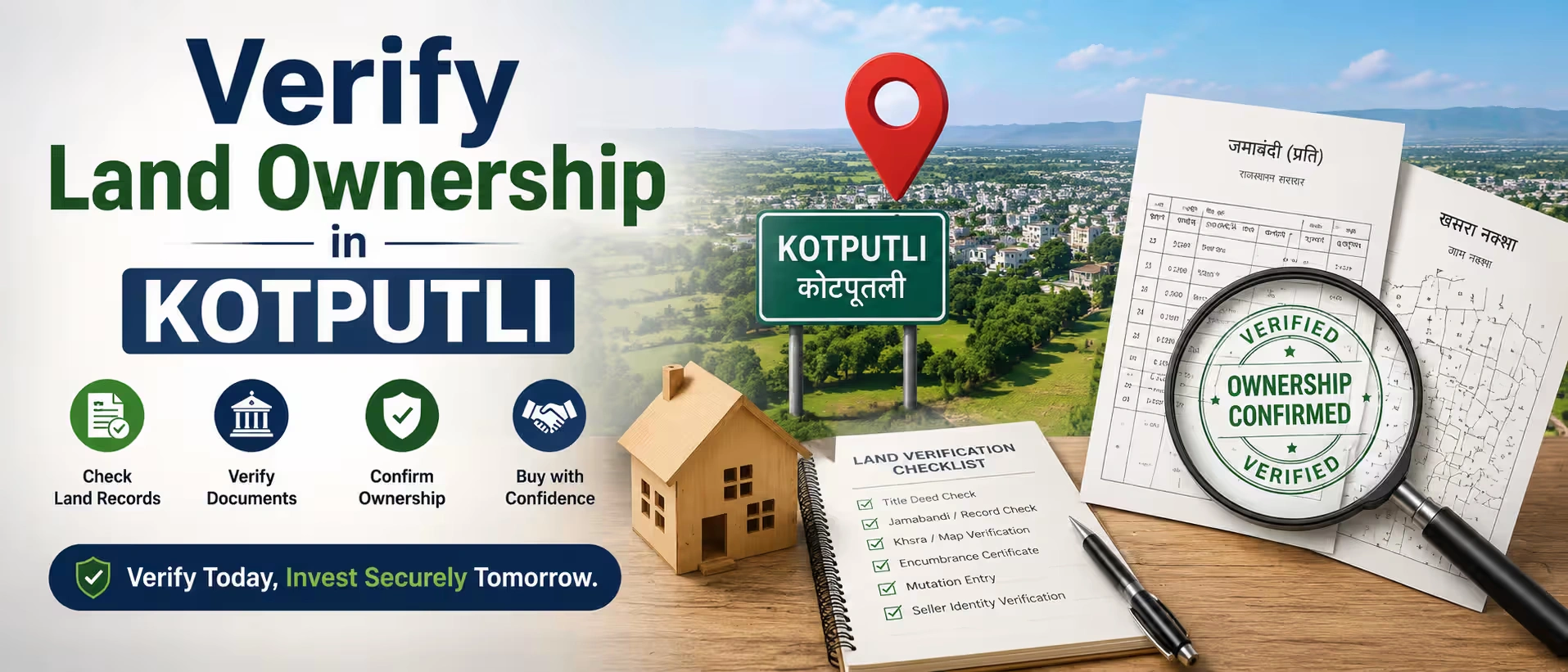
- Check land ownership in Kotputli through Jamabandi, Khasra number, and mutation before making any payment.
- Apna Khata (e-Dharti) by the state of Rajasthan will help you to check land records free of cost online.
- Now, Kotputli comes under the newly created district of Kotputli-Behror. Therefore, verify which tehsil office has the updated record of your land.
- Cross-check the use type of land (whether agricultural, residential, or industrial) before buying the land in Kotputli. This will help you to know about the laws related to the conversion of land.
Introduction
Kotputli is emerging rapidly as one of the fastest-growing real estate hubs in the state of Rajasthan. Located on the Delhi-Jaipur corridor via NH-48 and now serving as the capital of its very own district, Kotputli appeals to buyers of residential properties, farmhouse, and plots who seek proximity to the National Capital Region. However, increased demand inevitably creates new risks, namely land disputes, fraudulent registrations, and confusion regarding land-use. Therefore, gaining knowledge of how to check land ownership in Kotputli prior to purchase is no longer a luxury but a necessity. Herein lies a guide for doing exactly that.
Why Land Verification Matters in a Growing Market Like Kotputli
Kotputli's location advantage is real. It lies almost equidistant between Jaipur and Delhi, along the Delhi-Mumbai Industrial Corridor (DMIC) influence zone, and close to established industrial hubs like Neemrana and Bhiwadi. This has pushed up interest in farmhouse land, agricultural land for sale, and residential plots across the region.
However, rapid demand often outpaces regulatory clarity. In many parts of Rajasthan, land parcels have:
- Multiple claimants due to unresolved inheritance
- Disputed boundaries between adjoining khasra numbers
- Agricultural land sold without proper conversion for residential or commercial use
- Old registries that were never updated in the government's mutation records
A buyer who skips verification can end up with a plot that is legally unusable, tied up in court, or worth far less than what was paid. This is why due diligence should always come before you purchase land in Kotputli, not after signing the sale deed.
Understanding Kotputli's Administrative Setup
It is better to get information about Kotputli's administrative setup before going through documents because this will help you know the office that stores your documents.
Kotputli is one of the divisions formed alongside Behror to create the new Kotputli-Behror district, which came into existence on 7 August 2023, following its separation from Jaipur and Alwar districts. The district administration operates from the offices of Kotputli and Behror, with tehsils such as Kotputli, Behror, Neemrana, Bansur, Paota, Viratnagar, Mandhan, and Narayanpur.
This is important for buyers: Due to the fact that this is a newly created district, some records can be found using the older Jaipur and Alwar district codes in some of the government documents. You should always consult the local patwari and tehsil office regarding the current jurisdiction over your piece of land.
Step-by-Step Guide to Verify Land Ownership in Kotputli
Step 1: Identify the Khasra Number and Khata Number
Every agricultural or rural land parcel in Rajasthan is tagged with a Khasra number (a unique plot identifier) and linked to a Khata number (the ownership account under which multiple khasras may be grouped). Ask the seller for both. Without these two numbers, you cannot pull authentic records from any government portal.
Step 2: Check Records on the Apna Khata (e-Dharti) Portal
Rajasthan's land record digitisation is managed through the Apna Khata portal, also called e-Dharti, run by the state Revenue Department. This is the single most important tool for anyone trying to verify land ownership in Kotputli.
Here's how to use it:
- Visit the official Apna Khata Rajasthan website.
- Select Jaipur Division, then choose the relevant tehsil (Kotputli or the applicable sub-division under Kotputli-Behror district).
- Enter the village name, followed by the Khasra or Khata number.
- View the Jamabandi Nakal — a certified copy of the record of rights, showing the current recorded owner, land type, and area.
- Download or print the Nakal for your records.
A certified Jamabandi copy typically costs a nominal government fee (around ₹10–20 depending on the document type). This small cost is worth every rupee — it's your first line of defence against fraud.
Step 3: Cross-Check the Mutation (Dakhil-Kharij) Status
Buying land isn't just about seeing whose name is on the old registry — it's about confirming the mutation has been updated after every sale, inheritance, or gift. Mutation, known locally as Dakhil-Kharij, is the process of updating revenue records to reflect the current legal owner.
If the seller bought the land five years ago but never got the mutation done, the Jamabandi may still show the previous owner's name. Always ask for:
- The mutation order copy
- The mutation application number (to track status online via Apna Khata)
If mutation is pending or was rejected, treat this as a red flag and investigate before proceeding.
Step 4: Verify the Bhu-Naksha (Land Map)
The Bhu-Naksha is the digital map showing the exact shape, boundaries, and area of the plot. This helps confirm:
- The plot's physical boundaries match what's described in paperwork
- There's no overlap with neighbouring khasra numbers
- The land isn't classified as a government pond, grazing land (gochar), or forest land — categories that legally cannot be sold to private buyers
You can access the Bhu-Naksha through the same Rajasthan land records ecosystem, searching by village and khasra number.
Step 5: Check for Encumbrances and Pending Litigation
An encumbrance is any legal or financial claim on the property — a bank loan, mortgage, court case, or unpaid dues. Request an Encumbrance Certificate (EC) from the sub-registrar's office covering at least the last 12–15 years. This document lists every registered transaction on the property and reveals if it's been mortgaged or is under dispute.
Also check for pending litigation by asking the seller directly and, where possible, checking with the local tehsil or revenue court for any recorded objections on the khasra number.
Step 6: Confirm the Land Use Category
This step is especially important if you plan to build a house or farmhouse land project. Land in Rajasthan is classified broadly as:
| Land Category | Typical Use | Conversion Needed for Residential Use? |
Krishi Bhoomi (Agricultural) | Farming, crop cultivation | Yes, requires land conversion (DLC/JDA/UIT approval) |
Aabadi Bhoomi (Residential/Habitation) | Housing, residential plots | Generally no, already earmarked |
Audhyogik Bhoomi (Industrial) | Factories, warehouses | Special industrial approvals apply |
Gochar/Charagah (Grazing land) | Common village land | Cannot be legally sold or purchased |
If you're buying agricultural land for sale with the intention of building a home or farmhouse later, confirm whether land conversion (commonly done through the District Collector or Urban Improvement Trust) has been completed, or budget time and cost for that process.
Step 7: Verify the Seller's Identity and Ownership Chain
Request for the full chain of title – that is, a list of deeds of sales, deeds of gifts or deeds of inheritances detailing the transfers of ownership from one party to another through the years, preferably up to 30 years back.Verify:
- The seller's Aadhaar and PAN details match the ownership records
- If the land was inherited, check succession certificates or family settlement deeds
- If multiple heirs are named in the Khata, ensure all co-owners have signed the No Objection Certificate (NOC) or are party to the sale
Step 8: Do a Physical Site Visit
No amount of paperwork replaces standing on the actual plot. During your visit:
- Match the physical boundaries with the Bhu-Naksha map
- Look for boundary markers or fencing disputes with neighbours
- Check road access and confirm it matches what was promised
- Ask neighbouring landowners or the local patwari informally about the plot's history
Step 9: Get Legal Due Diligence Before Registration
Before signing the sale deed, have a local property lawyer conduct a formal title search and legal opinion. This typically covers:
- Verification of all documents against original government records
- Confirmation there are no pending court cases
- A written legal opinion certifying the title is clear and marketable
This step costs a small legal fee but can save you from losses running into lakhs of rupees.
Government Initiatives Supporting Transparent Land Records
Rajasthan has been actively working to reduce land fraud through digitisation:
- Apna Khata / e-Dharti brings Jamabandi, Khasra, and Bhu-Naksha records online, reducing dependency on manual patwari records and cutting down on forged paperwork.
- DILRMP (Digital India Land Records Modernization Programme), a central government scheme, supports states like Rajasthan in digitising and modernising land records with clear title systems.
- Increased use of Aadhaar-linked property registration and online mutation tracking is gradually improving accountability in the registration process.
While these systems have significantly improved transparency, buyers should remember that digitisation reduces risk but does not eliminate it entirely — manual verification with local authorities remains important, especially in newer or peripheral areas of a growing town like Kotputli.
Common Mistakes Buyers Make While Purchasing Land in Kotputli
| Common Mistake | Why It's Risky |
| Relying only on a photocopy of the sale deed | Doesn't confirm the seller currently holds valid, mutated title |
| Skipping the Bhu-Naksha map check | Can lead to boundary disputes with neighbours later |
| Ignoring land use classification | May be unable to legally build without expensive conversion later |
| Not checking Encumbrance Certificate | Property could be mortgaged or under a bank loan |
| Paying token/advance before document verification | Hard to recover money if the deal falls through due to title issues |
| Trusting verbal assurances from local agents | Verbal promises have no legal standing in a dispute |
How Technology Platforms Can Help You Invest Smarter
Previously, in Rajasthan, traditional methods of checking lands involved numerous visits to the tehsil office, lengthy queues, and reliance on local agents. Nowadays, all these have become much easier because of the presence of portals for land record checking and sites for real estate research.
Platforms like 2Bigha are helping buyers and investors get a clearer picture before they commit — offering insights into land records, ongoing projects, pricing trends, and investment opportunities across growing regions like Kotputli. Using such platforms alongside official government portals like Apna Khata gives buyers a more complete, layered approach to due diligence — combining official records with market and location intelligence.
Whether you're evaluating a new purchase or comparing investment options, using both government land verification tools and trusted real estate research platforms can help you make a more informed decision. Buyers who are not local to the area or own multiple properties often benefit from regular updates on land records, market prices, and reliable property management services.
A Practical Example
Consider a buyer evaluating a 2,000 sq. yard plot near Kotputli town for a farmhouse project. On paper, the broker's documents showed a clean sale deed from 2015. However, a quick Apna Khata search revealed the mutation was never updated — the Jamabandi still listed the original agricultural owner from before 2015, not the intermediate buyer now selling it. Further checks showed the land was still classified as agricultural, meaning residential construction wasn't legally permitted without conversion.
Had the buyer skipped these two checks — mutation status and land use classification — they could have ended up owning land they couldn't legally build on, with an unclear ownership trail. This is a common, real-world scenario across peripheral towns in the NCR belt, and it's exactly why systematic verification matters more than trusting paperwork at face value.
Investment Outlook: Why Kotputli Continues to Attract Buyers
Kotputli's appeal for investors comes from a mix of factors: proximity to both Jaipur and Delhi, connectivity via NH-48, industrial development spillover from nearby Neemrana and Bhiwadi, and relatively affordable land prices compared to more saturated NCR markets. For those researching a broader Kotputli investment guide, the fundamentals — infrastructure growth, industrial corridor proximity, and improving connectivity — suggest continued interest in both residential plots and farmhouse land over the coming years.
That said, rising demand also means rising instances of speculative selling, inflated pricing, and occasionally unclear titles being pushed quickly to eager buyers. This makes verification important whether you plan to purchase land or sell land in Kotputli, since a clean, well-documented title also helps you get a fair price and a faster deal when it's your turn to sell.
Conclusion
Kotputli's growth story is genuine, but that growth is exactly why careful due diligence matters more than ever. To verify land ownership in Kotputli before buying, always start with the official Apna Khata portal, confirm mutation status, check the Bhu-Naksha map, review the encumbrance certificate, and validate the seller's complete ownership chain. Combine these government checks with a physical site visit and professional legal opinion before you sign anything. Whether you plan to purchase land in Kotputli for a farmhouse, an investment, or a future home, informed verification — not urgency or trust alone — should guide your decision. Take the time to check every document, and your investment in Kotputli's promising future will stand on solid, legally sound ground.
Disclaimer: This article is for informational purposes only and should not be considered investment, legal, financial, or property advice. Real estate regulations, infrastructure plans, market conditions, and government policies may change over time. Readers are advised to verify information with relevant authorities and consult qualified professionals before making any investment or property-related decisions.