Key Takeaways
- The process for agricultural land conversion in Kotputli is as per the provisions laid down in the Rajasthan Land Revenue (Conversion of Agricultural Land for Non-Agricultural Purposes in Rural Areas) Rules, 2007 along with Section 90A of the Rajasthan Land Revenue Act, 1956.
- Prior permission in writing by the District Collector or the concerned competent authority is needed to change agricultural land into residential or other purpose; else construction in such a case would be illegal.
- The location of Kotputli on National Highway 48 and close proximity to the Delhi Mumbai Expressway (National Highway 152D) has resulted in the rapid growth of Kotputli as an investment belt within Rajasthan making the demand for converted land and farmhouses high.
- The cost of conversion, land-use category and limitations such as highway proximity or lands under acquisition have a bearing on the time and cost involved in the process of conversion.
- Land records, khatedari and the conversion certificate must always be confirmed before purchasing or selling plots in Kotputli.
- Websites such as 2Bigha can help buyers confirm their land records and investment potential.
Introduction
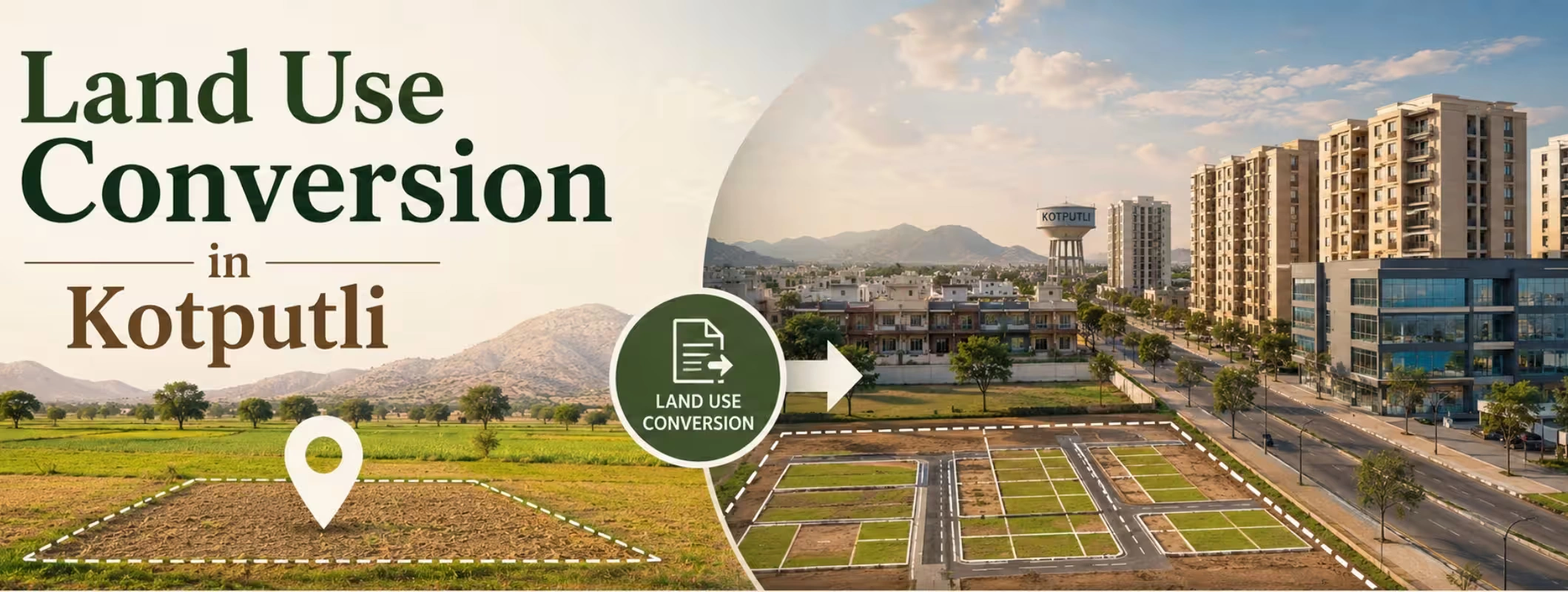
Kotputli is not just a small town located midway between Jaipur and Delhi but has emerged as one of the most popular real estate locations in Rajasthan. The reason for its popularity is that the Delhi-Mumbai Expressway, NH-48, along with increased industrialization in the area has made it attractive for buyers to invest in lands here. However, before buying land and constructing houses or setting up farms or commercial businesses, the buyers must convert their agricultural lands into non-agricultural lands. It is at such times that agricultural land conversion laws of Kotputli help the buyers.
What is Agricultural Land Conversion?
The agricultural conversion of land refers to the official act through which the status of land use, recorded as agricultural in the record, is officially converted into non-agricultural. In India, the revenue records officially record the permitted use of all land parcels. Agricultural land cannot be put to non-agricultural uses like construction of houses or shops without converting the use classification.
The term used for this procedure in Rajasthan is "Bhu Rupantaran". The land is considered fit for the designated purpose once the above-mentioned procedures have been completed by the Tehsildar, who will amend the land records (Jamabandi & Mutation Register). Only then can a buyer go ahead with construction of a permanent structure or obtain bank finance for the said property.
Why Land Conversion Matters for Buyers
Many buyers assume that once they have purchased agricultural land, they can build on it right away. This is a common and costly mistake. Unconverted land:
- Cannot be used for residential or commercial construction legally
- May attract penalties if a structure is built without permission
- Is harder to mortgage or get a home loan against
- Can face demolition or regularisation charges later if the government finds unauthorised construction
This is exactly why understanding the agricultural land conversion rules in Kotputli is essential before you invest, whether you're planning a house, a small business, or a farmhouse plot for weekend living.
Legal Framework Governing Land Conversion in Kotputli
As Kotputli comes under the administrative jurisdiction of Rajasthan, all the laws that operate in the state in respect of land and revenue administration are equally applicable to Kotputli as well.
Key Laws and Rules
Law / Rule | What It Covers |
Rajasthan Land Revenue Act, 1956 (Section 90A) | Grants the District Collector power to allow or refuse conversion of agricultural land |
Rajasthan Land Revenue (Conversion of Agricultural Land for Non-Agricultural Purposes in Rural Areas) Rules, 2007 | Lays down the procedure, charges, and restrictions for converting rural agricultural land |
Rajasthan Land Revenue (Allotment, Conversion & Regularisation of Agricultural Land for Residential, Commercial and Public Utility Purposes in Urban Areas) Rules, 1981 | Applies where land falls within urban or municipal limits |
Rajasthan Enterprises Single Window Enabling and Clearance Rules, 2011 | Applies to larger projects like industrial areas, townships, and tourism units, where a committee-based approval applies |
According to Section 90A of the Rajasthan Land Revenue Act, land designated for agricultural purposes may not be used for any other purpose except agricultural purposes without obtaining prior permission, and the main competent authority who gives such permissions is the District Collector. In most cases of individual purchasers in the rural area of Kotputli, the 2007 rules are followed as they pertain to farmland in the rural area.
Land That Cannot Be Converted
Not every plot qualifies for conversion. According to the rules, certain categories of land are restricted:
- Land under acquisition — no permission will be given for conversion of land which is under acquisition under the Land Acquisition Act, 1894
- Land near highways or railways — if the land falls within the boundary limit of a railway line, state highway, national highway, or any other government-maintained road, such land cannot be converted
- Ecologically sensitive land — near forests, water bodies, or protected zones
- Land involved in ongoing legal disputes
This is particularly relevant in Kotputli, since a large share of the demand here is for plots along or near NH-48 and the Delhi-Mumbai Expressway corridor. Buyers should always check the distance of a plot from the highway boundary before assuming it can be converted easily.
Step-by-Step Land Conversion Process in Rajasthan
The conversion process is largely conducted online through the Rajasthan Single Window Clearance System (SWCS) portal, along with physical verification by revenue officials.
Step 1: Determine Eligibility & Verify Land Records
The owner should verify that he/she is the rightful owner of the land (i.e., khatedari holder) and that there are no disputes regarding the ownership of the land. The owner will also have to determine from the records that the land has not been acquired by anyone or else the land cannot be converted.
Step 2: Create Account on SWCS Portal
To register their application and apply for land conversion, the applicant needs to register on the Rajasthan government's land conversion portal with their Single Sign-On ID (SSOID).
Step 3: Select Correct Application
In the dashboard of the application page, the applicant can select the correct type of application for converting agricultural land to non-agricultural land, either rural or urban.
Step 4: Fill in Application Form & Upload Required Documents
The owner will fill in his/her details, including the owner information, plot information, purpose of conversion, i.e., residential, industrial, or commercial land. The following documents will have to be uploaded:
Copies of Jamabandi and Mutation papers
Khasra map/site plan
Identity and Address proofs
No-objection certificate, if any
Land revenue papers
Step 5: Pay Conversion Charges
Conversion charges are calculated based on land category, location (rural or urban), and intended use (residential, commercial, or industrial). Payment is generally made online through net banking on the portal.
Step 6: Verification and Field Inspection
The application is forwarded to the Tehsildar or the concerned approving authority, who may conduct a field inspection to confirm the land details match the application.
Step 7: Approval and Mutation
Once approved, the Tehsildar issues a conversion order, and the land records are updated through mutation. The applicant can then apply for building plan approval with the local development authority.
Step 8: Track Application Status
Applicants can track their application status anytime through the SWCS portal using their application number.
Conversion Charges and Penalties
The conversion fees will depend upon the type of classification of the land, its location, and the proposed purpose (residential, commercial, industrial, or institutional). Conversion fees for rural lands tend to be cheaper compared to conversion fees of lands found inside urban or municipal areas. It is also necessary to understand that there is indeed a price tag attached to an illegal conversion of land. Anyone who builds on agricultural land or performs non-agricultural activities will need to get the application for regularisation done and will be levied with a penalty fee, traditionally a certain multiple of the conversion fee itself.
Why Kotputli is Seeing a Surge in Land Conversion Demand
Kotputli's transformation from an agricultural town to an emerging real estate hub is being driven by a few clear factors, and understanding them helps in building a solid Kotputli investment guide for yourself.
1. Strategic Highway Connectivity
Kotputli sits directly on NH-48, the key highway connecting Delhi, Gurugram, and Jaipur. This national highway serves as a crucial link between Delhi, Gurgaon, and Jaipur, ensuring seamless connectivity for businesses, daily commuters, and logistics.
2. Delhi-Mumbai Expressway and NH-152D
The Chandigarh–Narnaul Expressway (NH-152D) ends near Kotputli, with extension towards Alwar under planning, while the under-construction Delhi-Mumbai Expressway is expected to significantly reduce travel time and provide alternative access routes to the region, boosting property values.
3. Industrial Growth Along the DMIC
The Rajasthan State Industrial Development and Investment Corporation (RIICO) has established large industrial areas in the Behror-Kotputli belt, attracting manufacturing units across sectors like automobiles, electronics, textiles, and pharmaceuticals, as part of the broader Delhi-Mumbai Industrial Corridor (DMIC).
4. Rising Demand for Farmhouse and Weekend Plots
With Kotputli only a few hours from Delhi and Gurugram, demand for a farmhouse plot for weekend getaways or long-term investment has grown steadily. Many of these plots are agricultural land that buyers plan to convert for personal or commercial use, making it even more important to check conversion feasibility before purchase.
5. Infrastructure and Connectivity Upgrades
The Kundli-Manesar-Palwal (KMP) Expressway, Delhi-Jaipur Expressway, and the upcoming Western Dedicated Freight Corridor are further improving connectivity to the region, adding to its long-term investment appeal.
Things Buyers Should Verify Before They Buy Land in Kotputli
If you're planning to buy land in Kotputli, whether for a home, a farmhouse, or as a long-term investment, keep the following checklist in mind:
- Land classification: Confirm whether the land is agricultural, converted, or under process
- Khatedari status: Ensure the seller has clear, undisputed ownership
- Distance from highway/railway boundary: Some plots near NH-48 or the expressway may face conversion restrictions
- Encumbrance certificate: Check for loans, mortgages, or pending litigation
- Master plan compliance: Confirm the land falls within a zone permitted for your intended use
- Conversion order copy: If the seller claims the land is already converted, ask for the official Tehsildar order and updated mutation record
Many buyers also choose to use a professional property management service to handle documentation, site visits, and follow-ups with local authorities, especially if they are investing from another city.
A Practical Example
Consider a buyer from Gurugram who wants to purchase a two-acre plot near Kotputli to build a farmhouse plot for weekends. The land is currently classified as agricultural. Before finalising the deal, the buyer should:
- Verify the khasra number and ownership in the Jamabandi
- Check whether the land falls near a highway boundary (which could restrict conversion)
- Apply for conversion under the Rural Areas Rules, 2007, specifying "residential/farmhouse" as the purpose
- Pay the applicable conversion charges and wait for the Tehsildar's approval
- Only after mutation is updated should construction begin
Skipping any of these steps could mean the buyer ends up with an illegal structure, difficulty securing a loan, or complications when they later try to sell a plot in Kotputli to another buyer.
Role of Technology and Platforms Like 2Bigha
The land conversion and land ownership verification process would involve multiple trips to the Tehsil office. However, today there are online platforms that are making the process of getting information about the land much easier. Online platforms such as 2Bigha allow buyers and investors to gain insight on the properties, land records and other areas of interest including Kotputli. Such platforms used in conjunction with government websites will allow buyers to make wiser decisions on the land purchase in Kotputli and other areas like farmhouses plots.
Common Mistakes to Avoid
- Assuming conversion is automatic: Buying agricultural land does not mean it's ready for construction.
- Ignoring highway/railway restrictions: Always check boundary distance rules before assuming conversion is possible.
- Skipping the mutation step: Even after a conversion order, records must be updated through mutation to be legally valid.
- Not verifying the seller's claims: Always ask for original documents, not photocopies or verbal assurances.
- Underestimating timelines: Conversion approval can take weeks depending on documentation and field verification, so plan accordingly if you're on a tight construction schedule.
Conclusion
The development of Kotputli town depends largely on its good connectivity via roadways, industrial development, and its location on the Delhi–Mumbai Corridor. The development of the town also attracts many buyers who do not have sufficient knowledge regarding the regulations concerning land use in Kotputli. Familiarity with the process of land-use regulation in Kotputli, including its legal framework, application procedure, fees and limitations, will assist buyers in avoiding any legal issues and making a wise decision about their investments. When you plan to construct a house or arrange for a farmhouse plot in Kotputli or just wish to invest in land in this town, it would be wise to confirm land documentation and land conversion prior to making a decision.
Disclaimer: This article is for informational purposes only and should not be considered investment, legal, financial, or property advice. Real estate regulations, infrastructure plans, market conditions, and government policies may change over time. Readers are advised to verify information with relevant authorities and consult qualified professionals before making any investment or property-related decisions.