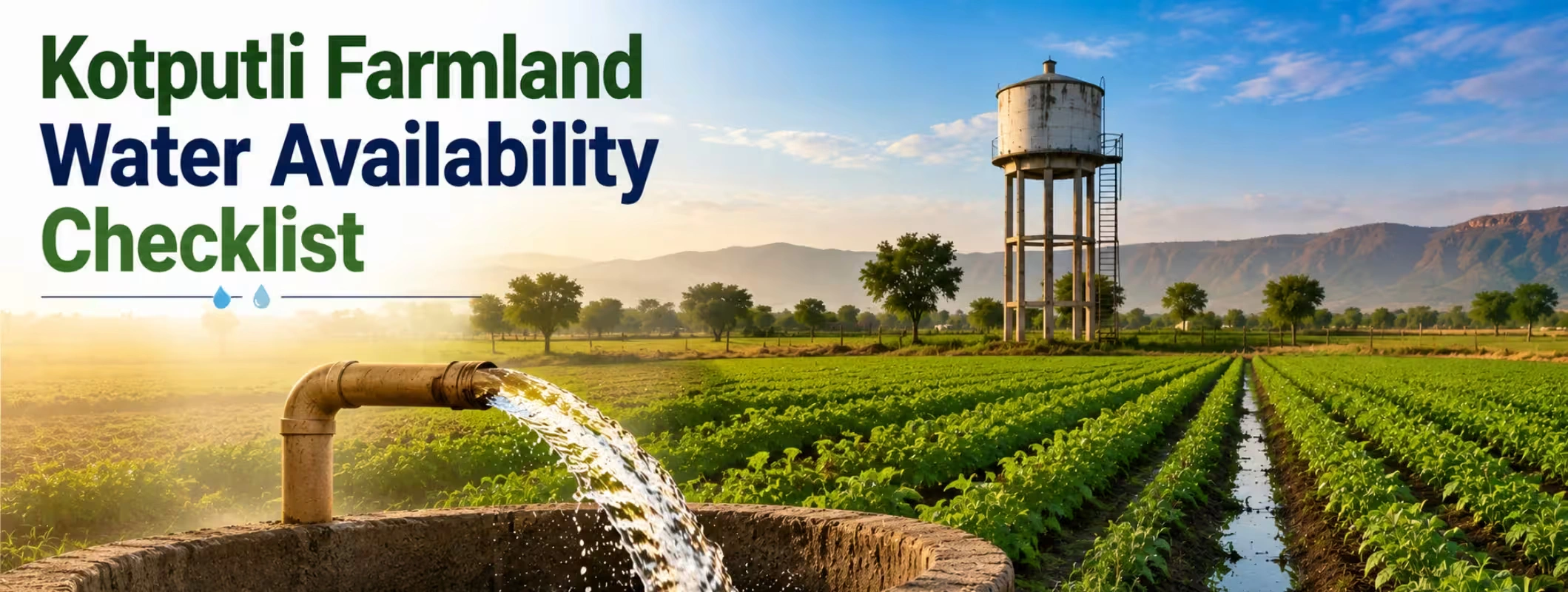
Everyone talks about soil quality, road access, and legal papers when buying farmland. Water barely comes up until it's too late, usually right after the first dry summer, when the borewell that "worked fine" during the site visit suddenly doesn't. Kotputli is located in a part of Rajasthan where groundwater plays a very important role. The state as a whole depends heavily on it, and a large share of its blocks are already classified as over-exploited or critical by groundwater authorities. That doesn't mean farmland here is a bad idea. It means water needs to be checked with the same seriousness as the sale deed, not treated as an afterthought. This checklist walks through what to actually look at before you commit to a plot.
Why Water Deserves More Attention Than It Usually Gets?
A plot can have perfect ownership records, a great road, and still turn out to be a poor investment if there's no reliable water source nearby. Farming without water isn't farming; it's just land sitting idle, waiting for the monsoon. A few reasons this matters more in this region specifically:
- Rajasthan gets a very small share of India's surface water and groundwater compared to its size and population
- Many blocks in various parts of the state are already in the "over-exploited" or "critical" category for groundwater
- Nearby districts like Alwar and parts of Haryana bordering this belt have documented falling water tables over the past two decades.
- Rainfall in this zone is seasonal and uneven, so depending only on monsoon recharge is risky.
None of this is meant to scare anyone off. It's just the reality that should shape how you evaluate a plot before you decide to Buy land in Kotputli.
The Core Water Checklist
Here's what to actually go through, ideally before you pay any advance.
What to Check? | Why It Matters? |
Existing borewell depth and yield | Tells you how deep water currently sits and how much it can supply. |
Groundwater category of the block | Over-exploited zones may restrict new borewell permissions. |
Nearby canal or irrigation source | Reduces dependency on groundwater alone. |
Water quality (TDS, fluoride, salinity) | Affects both crop suitability and drinking use. |
Rainwater harvesting potential | Useful backup, especially on larger plots. |
Neighbouring farm wells | Gives a real-world sense of the water table in that exact area. |
Go through each of these individually. A plot that fails even two or three of them isn't necessarily a bad buy, but it changes what you should be willing to pay. If you're planning to Buy Land in Rajasthan, evaluating these factors carefully can help you avoid costly mistakes and negotiate a fair price.
Borewell Depth Isn't Just a Number
The information provided by someone when saying, “the borewell is at 200 feet” is meaningless by itself. The point is how it differs from what happened five years ago in this village. If a nearby farmer says the water level was 150 feet ten years ago, then this is a much more informative piece of information than any other piece provided by the seller himself. You should interview at least two or three other people from the same community apart from the plot seller.
Groundwater Categorisation Can Affect What You're Allowed to Do
The groundwater blocks in Rajasthan can either be termed as safe, semi-critical, critical, or over-exploited blocks. Blocks categorized as the latter two might have restrictions regarding drilling new borewells and might not even be allowed without any special permission from the concerned authority. It will do you good to double-check the same from the local Central Ground Water Board records or the Jal Shakti office of the district where you plan to invest in agricultural land before assuming that drilling of a new borewell is going to be a piece of cake.
Water Sources Worth Comparing
Not all water sources are equal, and a good buyer usually looks at more than one option rather than betting everything on a single borewell. Whether you plan to Buy Land in India for farming or investment, assessing reliable water availability is one of the most important steps before making a purchase.
- Groundwater/borewell – Most common in this belt, but depth and reliability vary sharply from village to village.
- Canal irrigation – Where available, this is often more stable than groundwater, though coverage is patchy across the region.
- Farm ponds and check dams – Useful for storing monsoon runoff, especially on larger agricultural holdings
- Tanker-supplied water – A short-term fallback, not something to plan a farming operation around long-term
- Rainwater harvesting structures – Increasingly common, and something buyers can actually build themselves post-purchase
If a plot has access to more than one of these, that's a genuinely good sign. If it depends entirely on one ageing borewell, factor that risk into your price negotiation.
Questions to Ask Before You Finalise a Deal
A short conversation with the seller, the local sarpanch, or even a nearby tea stall owner can surface more honest information than any brochure. If you're planning to Buy Farmland in Kotputli, these local insights can reveal issues or opportunities that official documents may not. Worth asking:
- How deep did you have to go for the current borewell, and when was it dug?
- Has the water level changed noticeably in the last five to ten years?
- Is there a canal or government irrigation scheme nearby, even if it doesn't reach this exact plot yet?
- Has anyone in the area faced borewell permission issues recently?
- What does water taste and look like — any known salinity, fluoride, or hardness complaints locally?
If the answers are vague or the person seems reluctant to talk about it, treat that as useful information too.
How Does This Fit Into Land Within 100 KM of Kotputli?
Water availability isn't uniform even within a short driving distance. Land within 100 km of Kotputli spans several tehsils, and each one sits on different soil and aquifer conditions. A plot near a seasonal river or closer to the Aravalli foothills might have noticeably better recharge than one out in a flatter, drier stretch further from any natural water body. This is exactly why a site visit during or right after monsoon season tells you far more than a visit in peak summer. If you can only visit once, ask locals directly how the land behaves in both seasons rather than assuming what you see is the full picture.
Legal and Practical Notes Buyers Often Miss
A few smaller details that don't get enough attention:
- Digging a new borewell may fall under Kotputli agricultural land rules tied to groundwater regulation, not just general land conversion rules; the two are separate approval processes
- Water rights aren't automatically transferred with land in every case; confirm this explicitly in the sale agreement
- Shared wells between multiple farmers can lead to disputes later if usage terms aren't documented
- Government subsidies for farm ponds or drip irrigation are sometimes available, and knowing about these before purchase can shape your budgeting.
None of these are dealbreakers on their own, but skipping them tends to create problems that show up months after the deal is done, not during it.
Buy and Sell Agriculture Land & Farmlands in India – 2Bigha.
Water is one of those things that's genuinely hard to judge from a listing photo, which is part of why buyers end up relying so heavily on local word-of-mouth. 2Bigha was built to reduce exactly this kind of guesswork for anyone looking to buy land online. A few things that help specifically with concerns like water availability:
- Listings come with background checks that go beyond just ownership documents
- You get access to a verified land listing rather than a plot description written entirely by the seller
- The platform covers farmland across multiple regions, so if a particular tehsil near Kotputli looks water-stressed, you can compare it against other options without starting your search from scratch.
- Sellers looking to Sell Land in Kotputli can list with more transparency, which works in favour of serious buyers too.
For anyone serious about farming, and not just holding land as a speculative asset, this kind of upfront clarity matters more than almost anything else in the buying process.
Conclusion
Availability of water is not a priority when it comes to purchasing farmland; however, this turns out to be the reason for any regret that may come about later. Before deciding to purchase any land in India, particularly in an area in which there is groundwater deficiency, such as Rajasthan, ensure that you place your water concerns on the same pedestal as the legality of the land. Talk to people living in the neighbourhood, determine the category of groundwater in the block, consider alternative sources of water, and realize that just because there is an operational borewell now does not mean there will be in five years.
Disclaimer: This article is for informational purposes only and should not be considered investment, legal, financial, or property advice. Real estate regulations, infrastructure plans, market conditions, and government policies may change over time. Readers are advised to verify information with relevant authorities and consult qualified professionals before making any investment or property-related decisions.