Key Takeaways
- Ambala is turning into one of Haryana's most watched land markets in 2026, driven by its position between Delhi, Chandigarh, and the Tricity region.
- The Mohali to Ambala road update is the single biggest trigger for this shift — the Chandigarh-Ambala Greenfield Corridor and the upcoming Ambala-Shamli Expressway are cutting travel time and pulling investor attention toward Ambala City, Ambala Cantt, and the outer belts.
- Demand is splitting into two clear buckets: residential and commercial plot for sale in ambala city listings near the highway corridors, and larger parcels for buyers who want to sell agricultural land in ambala or invest in farm-linked assets.
- Farmland search in Ambala has picked up pace among NRIs, Chandigarh-based investors, and first-generation land buyers looking for appreciation over a 3-5 year horizon.
- Selling property online through verified real estate websites in India has become the default route for both plot owners and farmland sellers, cutting out layers of unreliable local dalals.
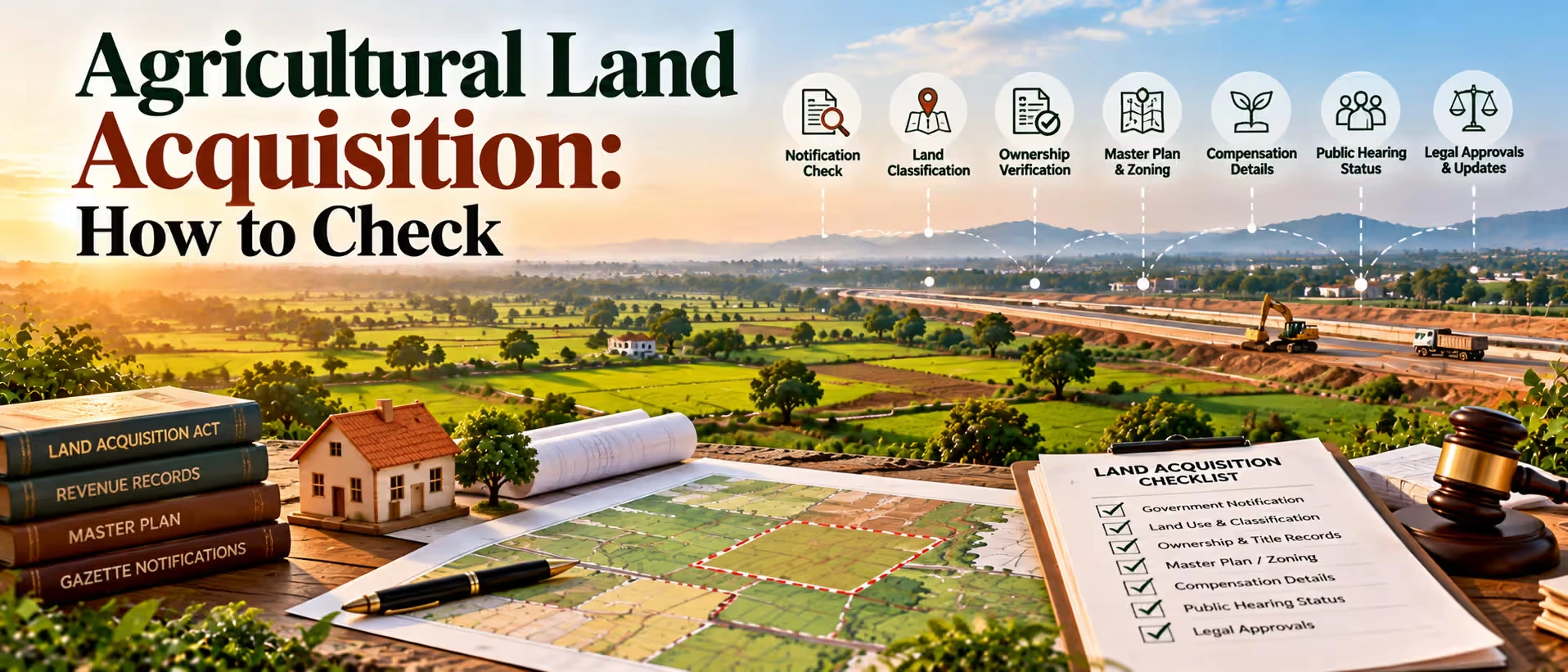
- Before buying agriculture land for sale in Haryana, always verify the jamabandi, mutation record, and land-use zoning — Ambala's revenue records are digitised but still need a local lawyer's eye.
Ambala doesn't get talked about the way Gurugram or even Panchkula does. It's the quieter cousin in Haryana's real estate family — the one that shows up late to the party but ends up being the most interesting person in the room. If you've driven down NH-44 recently, or sat in traffic near Ambala Cantt railway crossing, you already know something is changing here. New signboards for residential colonies, agents standing outside chai stalls with laminated site maps, tractors pulling up to registry offices — it's all happening at once.
This piece breaks down where the actual growth is happening in Ambala, what the road and infrastructure story really looks like heading into 2026 and beyond, and how buyers and sellers — whether you're chasing a plot for sale in ambala city or trying to figure out the right way to sell agricultural land in ambala — can make a decision that doesn't come back to bite you two years later.
Why Ambala Is Suddenly on Every Investor's Radar
Ambala sits at a genuinely rare geographic junction. It's the last major Haryana town before Punjab and Himachal Pradesh begin, it borders the Chandigarh Tricity belt, and it sits directly on the Delhi-Ambala-Amritsar rail and road corridor — one of the busiest movement lines in North India. For decades, this location mattered mostly for defence establishments (Ambala Cantt is home to a major Air Force base) and for its role as a transit town. What's changed is that the transit function itself has become an investment thesis.
When Chandigarh and Mohali property prices climbed out of reach for a large chunk of middle-income buyers, people started looking one ring further out. Zirakpur absorbed the first wave. Now that Zirakpur and Panchkula-Kalka rates have also moved up sharply, the next logical stop on the map is Ambala — and the road projects connecting it to the Tricity are exactly what's making that leap feel realistic instead of speculative.
There's also a simpler, less glamorous reason: Ambala still has room. Unlike Panchkula or Mohali, where usable land within municipal limits is genuinely scarce, Ambala City, Ambala Cantt, and the belt running along the Ambala-Chandigarh and Ambala-Hisar roads still have open plots, agricultural stretches, and semi-developed colonies where prices haven't caught up to the fundamentals yet.
Mohali to Ambala Road Update: The Connectivity Story Driving This Market
If there's one thing every serious buyer should track before putting money into Ambala, it's the highway pipeline. The Mohali to Ambala road update isn't a single project — it's a cluster of interlinked works that, taken together, are compressing the Chandigarh-Ambala drive from a rough 90-minute haul into something closer to 45-50 minutes once fully operational.
Here's the current picture, based on NHAI project updates through early and mid-2026:
- Chandigarh-Ambala Greenfield Corridor (NH-205A): This 61-km, six-lane expressway is the backbone of the whole story. The IT City-Kurali package has already opened to traffic, and it's already saving commuters close to 45 minutes on a stretch that used to mean crawling through Kharar and the congested Mohali Airport Road. The remaining Ambala-side package, running from Devinagar/IT City through to the Ambala end, has been reported at close to 90 percent completion, with NHAI targeting an operational date around October 2026.
- Mohali-Sirhind stretch: A parallel 27-km corridor feeding into the same network is also in its final stages, expected to shave another half hour off regional travel once open.
- Zirakpur-Panchkula bypass and the Ambala-Chandigarh-to-Zirakpur spur: The Centre has cleared funding of over Rs 1,878 crore for the bypass and roughly Rs 1,464 crore for a six-lane greenfield spur connecting NH-205A to the Zirakpur bypass. This is significant because it's designed specifically to pull through-traffic away from city centres — good news for anyone buying land near these junctions, since congestion at the doorstep of a plot usually hurts resale value more than it helps.
- Ambala-Shamli Expressway: A 121-km expressway linking Ambala toward Shamli and eventually Delhi via the Dehradun-Delhi Expressway network is on a fast track, with the Haryana government targeting completion by the end of 2026. This one matters for a different reason — it opens up Ambala's southern approach to Delhi-NCR traffic, not just the Chandigarh side.
- Ambala Ring Road: Still in the works, but state officials have been pushing for faster execution to decongest the town's core, which will matter a lot for anyone eyeing land close to Ambala City's inner belt.
What does this mean practically? Land that sits within a 5-10 km radius of these upcoming corridors — particularly around IT City-side entry points, the Ambala-Chandigarh Highway frontage, and pockets near the future Ring Road alignment — tends to see the steepest price movement once a road actually opens, not while it's still "under construction." That gap between announcement and completion is usually where the smartest entries happen, and where a lot of buyers also get impatient and overpay too early. Timing this well is less about hype and more about tracking real completion percentages rather than press statements.
Growth Areas in Ambala Worth Watching in 2026
Ambala isn't one uniform market. It splits into distinct pockets, each with a different buyer profile and a different pace of appreciation.
| Growth Area | What's Driving It | Best Suited For |
|---|---|---|
| Ambala City (near NH-44 & railway junction) | Established commercial core, upcoming ring road, dense retail and rental demand | Plots, commercial frontage, rental income |
| Ambala Cantt | Institutional presence, established residential colonies, steady resale demand | End-use residential buyers |
| Ambala-Chandigarh Highway belt (Baldev Nagar, Saha side) | Direct exposure to the Greenfield Corridor, rising interest from Tricity investors | Mid-term appreciation plots |
| Naraingarh & Barara outskirts | Large, contiguous agricultural land, lower entry price per acre | Farmland investors, long-horizon buyers |
| Ambala-Yamunanagar stretch | Industrial and warehousing spillover, road widening projects | Commercial and mixed-use land |
A quick, honest observation from tracking listings across the region: the Ambala-Chandigarh Highway belt is where the loudest activity is right now, but it's also where prices have already started running ahead of actual infrastructure delivery. Naraingarh and the outer Barara stretches, by comparison, are still priced closer to their agricultural fundamentals — which is exactly where patient farmland buyers tend to find better entry points.
Buying a Plot for Sale in Ambala City: What Actually Matters
If you're specifically hunting for a plot for sale in ambala city, the checklist looks a little different from a farmland purchase, because you're usually buying into a colony or a development scheme rather than raw revenue land.
A few things that genuinely separate a good plot from a problematic one:
- HUDA/DTCP approval status. Ambala has both approved colonies and a fair number of unauthorised ones. An unapproved plot might look cheaper, but you'll struggle with loans, resale, and building permissions later.
- Road width and frontage. A plot on a 30-40 ft internal road inside an approved colony holds value far better than one squeezed into a narrow lane, even if the base rate looks attractive.
- Distance from the highway vs. distance from noise. Proximity to NH-44 or the Greenfield Corridor helps resale, but a plot too close to a highway junction can suffer from noise and access restrictions. The sweet spot is usually 1-3 km off the main carriageway with a clear approach road.
- Title chain and encumbrance certificate. Always pull a fresh encumbrance certificate covering at least 12-13 years, and cross-check the seller's name against the latest jamabandi.
- Sale deed vs. GPA-based transactions. Ambala still sees a number of General Power of Attorney (GPA) based land transfers, especially in older colonies. These are riskier and harder to resell cleanly — a registered sale deed is always the safer route.
Selling or Buying Agricultural Land in Haryana: The Ambala Angle
There's a quieter but equally important story running alongside the plot market — agricultural land. Ambala district still has a large agricultural base, and interest in this segment has grown from two directions: farmers looking to sell agricultural land in Ambala as urban expansion approaches their fields, and outside investors running a farmland search in Ambala as a way to enter Haryana's land market at a lower per-acre cost than fully developed plots.
A few realities worth understanding if you're looking at agriculture land for sale in Haryana, specifically in the Ambala belt:
- Pricing varies sharply by proximity to road and canal irrigation. Land along the Western Yamuna Canal command area or close to state highways commands a real premium over interior parcels that depend purely on tube-well irrigation.
- Conversion potential (CLU) drives long-term value. Agricultural land close to notified urban expansion zones or highway corridors carries "change of land use" potential, which is exactly why the Ambala-Chandigarh belt and stretches near the upcoming Ambala-Shamli Expressway are seeing more farmland enquiries than the interior villages.
- Section 118 restrictions for non-agriculturists. Haryana law restricts purchase of agricultural land by non-agriculturists in certain cases, so outside buyers often need to structure the purchase carefully — this is a genuine legal nuance many first-time buyers miss.
- Fragmented holdings are common. A lot of agricultural land around Ambala is jointly held across multiple family members. Before any deal, confirm all co-owners are on board and represented in the sale deed, not just the person negotiating.
- Seasonal timing affects price. Sellers are often more open to negotiation post-harvest, when cash flow pressure is lower and they're not mid-cycle on a standing crop.
For a farmer weighing whether to hold or sell, the honest answer depends on location. Land sitting inside the 5-10 km growth radius around the Greenfield Corridor or the Ambala Ring Road alignment has a genuinely strong case for holding a few more years. Land in the deeper interior, away from any announced infrastructure, may see steadier but slower appreciation — selling now versus later becomes more of a personal cash-flow decision than a pure market-timing one.
Selling Property Online: How the Process Has Changed
Ambala's land market used to run almost entirely through local brokers and word-of-mouth. That's shifted meaningfully over the last few years. Selling property online is no longer just an option for big-city sellers — plot owners and even farmland sellers in tier-2 towns like Ambala are increasingly listing directly on real estate websites in India to reach buyers beyond their immediate village or mohalla network.
There are real advantages to this shift:
- Wider buyer reach — an NRI investor or a Chandigarh-based buyer can discover a listing that would never have reached them through a local agent's network.
- Transparent pricing — comparing listed rates across a stretch of road helps both buyers and sellers avoid getting misled on "market rate."
- Fewer middlemen — cutting layers of brokerage commission that used to eat into a seller's final realisation.
This is where a platform like 2Bigha fits naturally into the picture. Built specifically around land and plot transactions rather than generic apartment listings, it works well for exactly the kind of deals Ambala's market is producing right now — highway-facing plots, agricultural parcels, and semi-developed land where buyers need clear documentation, verified ownership details, and direct seller contact rather than a chain of sub-brokers. For someone trying to sell agricultural land in Ambala or list a plot for sale in ambala city, a focused land marketplace like 2Bigha tends to attract buyers who are actually searching for that specific category, rather than casual browsers scrolling through unrelated apartment inventory.
For sellers who'd rather not deal with tenant queries, maintenance coordination, or repeated site visits once a property is listed, opting for a property management service alongside the listing can take a lot of that day-to-day load off, particularly for NRI landowners or absentee sellers managing land from another city.
Future Potential: What Ambala Could Look Like by 2028-2030
It's worth being realistic here rather than promotional. Ambala isn't going to turn into another Gurugram overnight, and anyone selling that story is overselling it. What's more likely, based on the current pipeline, is a steady re-rating of specific corridors:
- Once the Greenfield Corridor and Ambala-Shamli Expressway are both fully operational (realistically by early-to-mid 2027, allowing for the usual execution slippage), the effective commute from Ambala to Chandigarh and even parts of Delhi-NCR shortens enough to make Ambala genuinely viable for people working in the Tricity but priced out of Mohali or Panchkula.
- Land along the Ring Road alignment, once finalised and constructed, is likely to see the kind of appreciation curve that Zirakpur saw a decade ago — slow for years, then a sharp re-rating once the road physically opens.
- Agricultural belts closest to these corridors carry the strongest long-term conversion potential, though buyers should expect this to play out over 5-7 years, not 12-18 months.
- Warehousing and light industrial interest along the Ambala-Yamunanagar stretch is likely to grow in parallel, given the region's existing manufacturing base and improving road access.
Ambala vs Nearby Investment Hubs: A Quick Reality Check
It helps to put Ambala next to the towns investors usually compare it with, because the honest picture is more nuanced than "Ambala is the next big thing."
- Zirakpur already absorbed the first wave of Tricity spillover demand and its rates have climbed well past what most mid-income buyers can justify for a plot today. Ambala is roughly where Zirakpur stood 8-10 years ago, minus the immediate proximity to Chandigarh.
- Panchkula and Kalka benefit from stronger existing infrastructure but have very little raw land left within reasonable municipal limits, which pushes buyers outward toward towns like Ambala anyway.
- Karnal, on the Delhi side of Haryana, is a fair comparison in terms of scale, but Karnal's growth story leans more on NCR proximity, while Ambala's leans on the Chandigarh-Tricity corridor plus its own defence and institutional base. Two different demand engines, similar stage of the growth curve.
- Yamunanagar, right next door, has stronger industrial roots but weaker road connectivity improvements planned compared to what's lined up for Ambala over 2026-2027.
The practical takeaway: Ambala isn't competing to be the "next Gurugram." It's positioning itself as a genuinely liveable, well-connected second-rung town for people priced out of the Tricity core, and as a land-banking option for investors who understand that real returns here will play out over years, not quarters.
Common Mistakes Buyers Make in Ambala's Land Market
A few patterns show up again and again among first-time buyers in this belt, and they're worth flagging honestly:
- Buying purely on the promise of a road, not its actual progress. A highway that's "80% complete" can still take another 12-18 months to open. Buyers who rush in the moment a project is announced often end up waiting far longer than expected for the appreciation to materialise.
- Skipping a physical site visit. Satellite images and broker photos can hide a lot — waterlogging issues, disputed boundary pillars, or a plot that's technically landlocked without a formal approach road. There's no substitute for walking the land yourself, or sending someone trustworthy to do it.
- Ignoring the difference between "on-paper" and "on-ground" possession. Especially with agricultural land bought for future conversion, some parcels look clean on revenue records but have informal encroachments or disputed boundary markers on the actual field. Always cross-check the khasra number against the physical plot with a local patwari present.
- Underestimating registration and stamp duty costs. Haryana's stamp duty and registration charges add a meaningful percentage to the deal value, and buyers who don't factor this in upfront sometimes find their budget stretched thinner than planned.
- Relying on a single broker's word for market rate. Cross-checking listed rates across two or three sources, including online platforms, gives a far more reliable sense of fair pricing than a single agent's quote.
Due Diligence Checklist Before You Buy or Sell in Ambala
| Check | Why It Matters |
|---|---|
| Jamabandi and mutation records (last 12+ years) | Confirms clean title and ownership history |
| Zoning / land-use classification | Determines whether conversion (CLU) is even possible |
| HUDA/DTCP approval (for plots) | Affects loan eligibility, resale, and construction permissions |
| Road width and approach access | Directly impacts long-term resale value |
| Distance to nearest completed/under-construction highway link | Core driver of appreciation timeline |
| Co-owner consent (for agricultural land) | Prevents disputes from undisclosed joint holders |
| Encumbrance certificate | Rules out pending loans or litigation on the land |
Disclaimer: This article is for informational purposes only and should not be considered investment, legal, financial, or property advice. Real estate regulations, infrastructure plans, market conditions, and government policies may change over time. Readers are advised to verify information with relevant authorities and consult qualified professionals before making any investment or property-related decisions.