
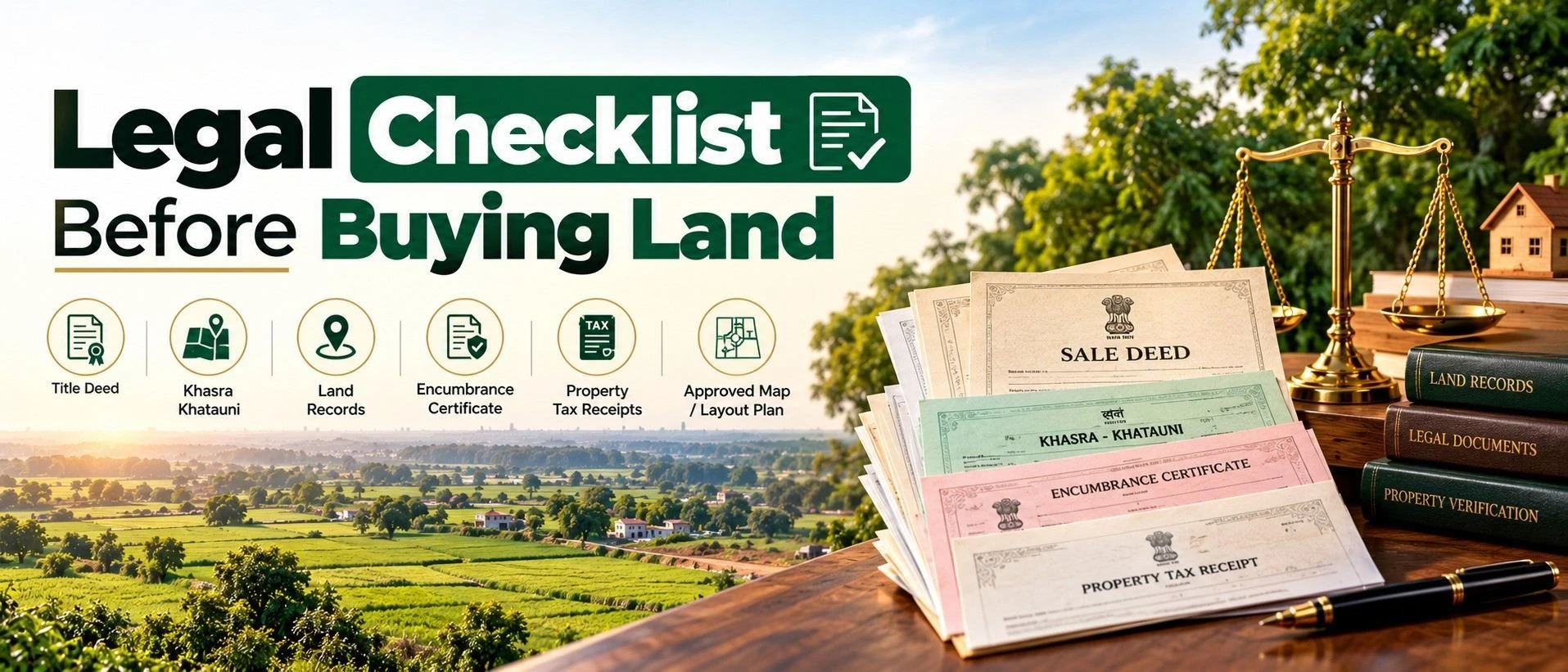
A legal checklist before buying land in Uttar Pradesh is the set of documents and status checks — ownership, boundaries, dues, and disputes — that confirm a plot is safe to purchase before you commit any money.
It matters because skipping even one of these checks can leave you with land that's encumbered, under litigation, or legally impossible to register in your name. This guide walks through each document you need to verify, in the order that makes practical sense, and where to check each one online in UP.
Whether you're buying agricultural land, a residential plot, or inherited family property, this checklist is what a careful buyer — or their lawyer — works through before signing anything.
Section 1 — What is a Legal Checklist Before Buying Land in Uttar Pradesh?
Before working through this checklist for a specific plot, it also helps to compare it against similar listings if you're exploring farm land for sale in Uttar Pradesh more broadly — you can browse a dedicated land map here.
Definition: A legal checklist before buying land is a structured sequence of ownership, boundary, dues, and dispute verifications that together confirm a plot is legally sound and safe to purchase.
This is different from any single document like the Khatauni or Bhu Naksha: those are individual records, while the checklist is the overall process that pulls several of them together — ownership from the Khatauni, boundaries from Bhu Naksha, dispute status from the revenue court system, and dues from tax records — into one coherent picture before you commit.
A buyer needs this specifically because any one document checked in isolation can look fine while still hiding a problem — a clean Khatauni doesn't tell you about a pending court case, and a matching Bhu Naksha doesn't confirm the seller has authority to sell at all.
For inherited or long-held family land in particular, the checklist also needs to account for whether mutation (Varasat) and any necessary partition deed have actually been completed, not just whether the current occupant claims ownership.
State-specific Note: Uttar Pradesh's land record ecosystem is unusually well-integrated for online verification — Khatauni, Bhu Naksha, and dispute status (vaad grast sthiti) are all cross-linked from the same khasra number, so a buyer working through this checklist can do most of the heavy lifting from a single starting point on upbhulekh.gov.in.
Expert Tip: Run the dispute status (vaad grast sthiti) check specifically for the khasra number, not just a general search by the seller's name — litigation is recorded against the specific plot, and a seller with a common name can otherwise make it easy to miss a case attached to that exact parcel.
Section 2 — How to Work Through the Legal Checklist Before Buying Land in UP?
Treat this as a sequence rather than a single application — each step below builds on the last.
Method | Cost | Time | Legally valid for registration? |
|---|---|---|---|
Online (Khatauni, Bhu Naksha, dispute status) | Free | Instant for each check | No — reference/verification only |
Online (certified copies, e-stamping via IGRS UP) | Nominal fees | A few days | Yes, once registered |
Offline (Tehsildar/Sub-Registrar offices) | Nominal fees | A few days to a couple of weeks overall | Yes |
1. Check the Khatauni — Confirm current ownership, land classification, and mutation history on upbhulekh.gov.in.
2. Cross-check the Bhu Naksha — Verify the plot's boundaries and shape match on-site conditions using upbhunaksha.gov.in.
3. Run the dispute status check — Use the linked vaad grast sthiti tool (via vaad.up.nic.in) for the specific khasra number.
4. Verify stamp duty and registration details — Use igrsup.gov.in to understand applicable charges and confirm the registration process before finalising.
1. Visit the Tehsildar's office — Confirm certified copies of the Khatauni and check for any pending mutation.
2. Verify seller's documentation in person — Review the seller's identity proof, legal heir certificate (if applicable), and any partition deed.
3. Check tax/land revenue dues — Confirm there are no outstanding property tax or land revenue amounts tied to the plot.
4. Complete registration at the Sub-Registrar's office — Finalise the sale deed only after every prior check is satisfactorily resolved.
Typical turnaround: A thorough due diligence process typically takes one to a few weeks when done properly, even though individual checks are often instant.
Before you leave the office, check that every single check — ownership, boundary, dispute, and dues — is consistent with what the seller has told you before you sign anything or make any payment.
Section 3 — What Should Be on Your Legal Checklist?
For anyone comparing agricultural land in Uttar Pradesh options, here's the core set of checks worth running before any purchase. You can also browse verified land listings and mapping tools at the 2Bigha homepage: https://2bigha.ai/.
Field | What it means | What to check |
|---|---|---|
Khatauni (ownership record) | Confirms current legal owner and classification | Matches the seller's identity and claimed ownership |
Bhu Naksha (boundary map) | Confirms physical boundaries and shape | Consistent with what's shown to you on-site |
Dispute status (vaad grast) | Reveals any pending litigation on the plot | No unresolved dispute flagged for the khasra |
Mutation/Varasat history | Confirms inheritance or sale mutations are complete | No unmutated gap between the deceased and the seller |
Tax/land revenue dues | Confirms no outstanding financial liability | Clear, with no significant arrears |
Good sign: A plot that passes the full checklist has a Khatauni matching the seller's claimed identity, a Bhu Naksha consistent with ground reality, no dispute flags, complete mutation history, and no outstanding dues.
Section 4 — Common Issues & How to Fix Them
Most buyers who run into trouble after purchase skipped one specific check rather than the process entirely. Before assuming a plot is clean, it's worth confirming each item directly through the Legal Checklist Before Buying Land in Uttar Pradesh official website resources.
Skipping the dispute status check — Buyers sometimes check ownership and boundaries but skip litigation status entirely. Fix: Always run the vaad grast sthiti check for the specific khasra before finalising any deal.
Relying only on the seller's paper documents — Physical copies can be outdated compared to the current online record. Fix: Independently verify every document directly on the official portals rather than trusting paper copies alone.
Unmutated inherited land being sold by one heir — A seller may not have full legal standing if Varasat and any needed partition deed weren't completed. Fix: Confirm complete mutation history and, where multiple heirs exist, get consent from all of them or a registered partition deed.
Boundary shown on-site doesn't match Bhu Naksha — This can indicate an informal, undocumented subdivision or encroachment. Fix: Resolve the discrepancy with the Tehsildar before proceeding — don't rely on verbal reassurance from the seller.
Outstanding land revenue or tax dues not disclosed — Unpaid dues can sometimes carry forward as a liability tied to the property. Fix: Independently confirm dues status rather than relying solely on the seller's claim that everything is clear.
Rushing registration before due diligence is complete — Time pressure from a seller or agent can push buyers to skip steps. Fix: Complete every checklist item first — a genuinely good deal will still be good after a proper verification process.
Section 5 — Recent Changes in 2026
Uttar Pradesh's Stamp and Registration Department rolled out a series of reforms between January and April 2026, including a slot-based appointment system at Sub-Registrar offices and revised, flat fees for family transfer and partition deeds — both relevant to the final registration step of any due diligence checklist. Buyers should confirm current registration procedures on igrsup.gov.in as part of their pre-purchase process.
Section 6 — Why a Legal Checklist Matters for Land Buyers
It catches problems — disputes, unmutated ownership, boundary mismatches — before money changes hands, not after.
It protects you from a purchase that could later be challenged by another heir or claimant.
It confirms the seller actually has legal standing to sell the specific plot.
It reduces the risk of inheriting someone else's unresolved tax or revenue liability.
It supports a smoother home loan or agricultural loan application against the land.
It's the same process a careful lawyer would run — doing it yourself first saves time and legal fees later.
Section 7 — Legal Checklist vs. Encumbrance Certificate
These are sometimes confused because both aim to protect a buyer from hidden problems. An Encumbrance Certificate is one specific document showing registered loans, mortgages, or legal charges against a property over a chosen period. The legal checklist is the broader process that includes the encumbrance check alongside several other verifications — ownership, boundaries, disputes, and dues — that an encumbrance certificate alone doesn't cover.
If you're preparing to sell land in Uttar Pradesh, having a complete set of these checks ready in advance — not just an encumbrance certificate — makes the transaction significantly faster for a serious, careful buyer.
Section 8 — Related Documents
Jamabandi/ROR Guide in Uttar Pradesh
Bhu Naksha Guide in Uttar Pradesh
Property Inheritance Laws in Uttar Pradesh
Partition Deed Process in Uttar Pradesh
