
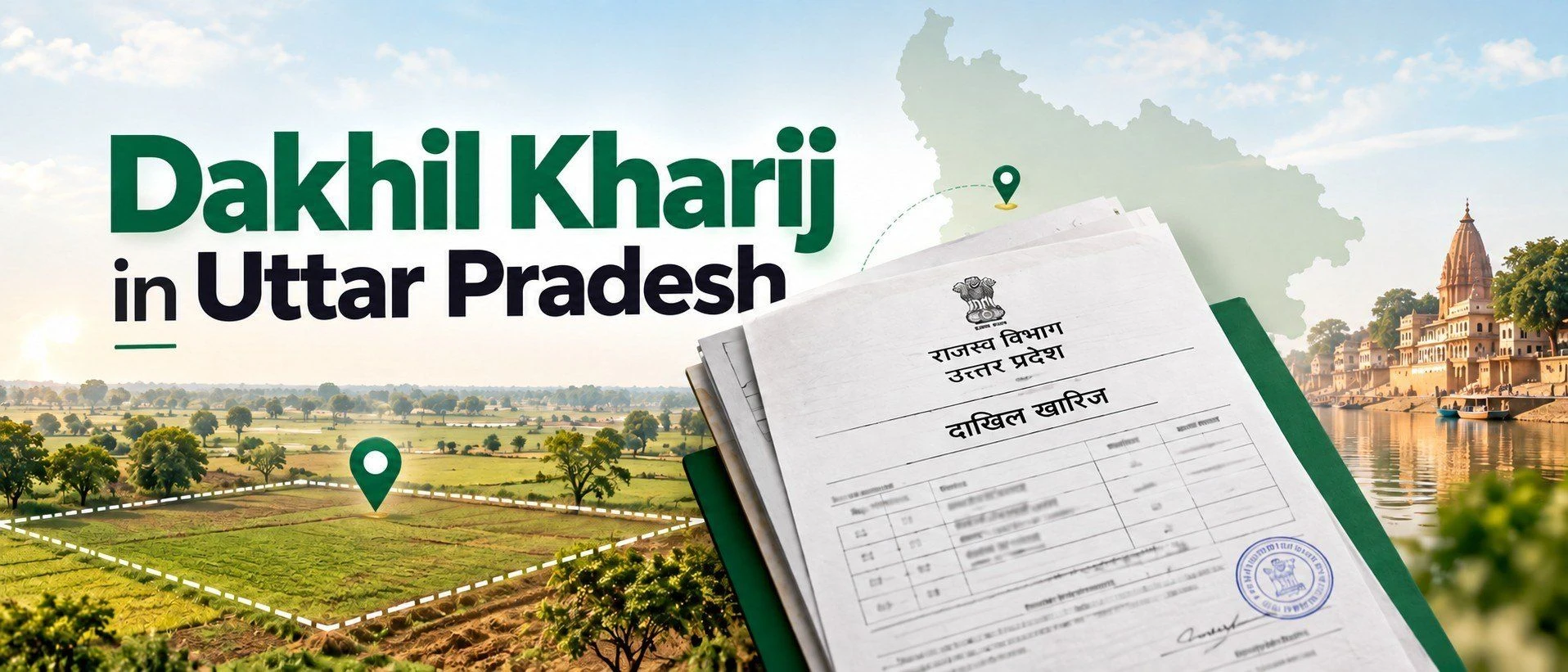
Dakhil Kharij is the Hindi term for property mutation — the process of updating the government's land records to reflect a change in ownership after a sale, inheritance, or gift. It matters because a registered sale deed alone doesn't update the revenue record: until mutation is done, the previous owner's name keeps appearing in the Khatauni, and property tax notices and government correspondence keep reaching them, not you. This guide covers how to apply, how to check dakhil kharij status online, and what the record should look like once it's correct. Whether you're finalizing farm land for sale in uttar pradesh, settling an inheritance, or just confirming a purchase went through properly, this is the record you'll be asked for.
Section 1 — What is Dakhil Kharij in Uttar Pradesh?
Before you get into the paperwork, it's worth confirming the plot itself is what you think it is — you can check listings on the 2Bigha map for Uttar Pradesh alongside land record verification.
Definition: Dakhil kharij is the legal process of updating land revenue records to reflect the new owner's name after a sale, inheritance, gift, or court order.
It proves something different from a sale deed: the deed proves the transaction happened, while mutation proves the government's own records now match that transaction. For agricultural land in Uttar Pradesh, mutation has always been mandatory, since the land title can't legally pass without it. For non-agricultural property, it's now similarly required to have the buyer's name officially recorded. Buyers often assume registration is the final step — it isn't. Skipping mutation means property tax bills and government notices continue going to the seller, and future loan or resale applications can stall when the Khatauni doesn't match the current owner.
State-specific note: In UP, rural mutation is applied for through the UP Bhulekh portal, while urban property outside development authority jurisdiction may need to go through the Lucknow Municipal Corporation or the relevant municipal body instead — the correct office depends on where exactly the property sits.
Expert Tip: File the mutation application 30–45 days after registry, not immediately — this gives the registry record time to reflect in the revenue database first, which avoids the file being flagged for missing cross-reference during Lekhpal verification.
Section 2 — How to Get Dakhil Kharij in Uttar Pradesh?
Applications can be filed online through UP Bhulekh or in person at the Tehsil. Compare the two before choosing:
Method | Cost | Time | Legally valid for registration purposes? |
Online (application submitted, pending) | Mutation fee paid at submission | 30–90 days depending on objections | No — only the approved, updated Khatauni counts |
Online (approved, updated Khatauni downloaded) | Same fee, no extra download charge | Available once approved | Yes |
Offline (Tehsildar office) | Similar fee structure, paid at the office | Similar or occasionally slower due to backlog | Yes, once the updated record is issued |
Visit the UP Bhulekh portal: Go to upbhulekh.gov.in and locate the mutation service.
Select "Apply for Mutation (Dakhil Kharij):" This opens the application form.
Enter owner and property details. Fill in the property owner's name, address, and khasra/survey number.
Upload the required documents: Attach the registered sale deed, ID proof, and any inheritance documents if applicable.
Pay the mutation fee and track status: Note the acknowledgment number and use it to track progress until approval.
Visit the Tehsil office covering the property's location.
Submit the application with documents: Include ID proof, the sale deed, previous registration papers, and property tax receipts.
Attend field verification: A Lekhpal or revenue official typically visits or verifies the record locally.
Collect the updated Khatauni once the Tehsildar approves the mutation.
Offline processing generally runs 30–45 days for straightforward cases, longer if there are objections or missing documents. Before treating the record as final, check that the new owner's name, khasra number, and area all match your sale deed exactly.
Section 3 — What Does a Dakhil Kharij Record Contain?
This same cross-check applies wherever you're transacting — whether it's agricultural land for sale here or a plot in another state, the underlying record fields work the same way.
Field | What it means | What to check |
Owner's name | The person now recorded as titleholder | Should exactly match the buyer's name on the sale deed |
Khasra/khata number | The specific plot covered | Must match the sale deed and prior Khatauni |
Area | The land area recorded | Should match the registered sale deed's area |
Mutation order number | Reference for the approval | Keep this for any future dispute or resale |
Date of mutation | When the record was updated | Confirm it postdates the registration date |
Good sign: the updated Khatauni shows the current owner's name correctly spelled, the khasra number and area matching the sale deed exactly, and no pending objection or "under process" flag against the entry.
Section 4 — Common Issues & How to Fix Them
Name spelling mismatch – Owner's name on the mutation doesn't match ID or sale deed exactly. Fix: file a correction request with supporting ID proof before it causes issues at resale.
Mutation never filed after registration – Buyer assumes registry alone is enough. Fix: file the mutation application separately; it is not automatic.
Application stuck at field verification – Lekhpal visit pending or delayed. Fix: follow up at the Tehsil office directly with your acknowledgment number.
Objection raised by a third party – A dispute or missing NOC halts the process. Fix: resolve the underlying dispute or provide the missing document before resubmitting.
Old owner's name still shows in tax records – Mutation done in revenue records but not reflected in municipal tax rolls. Fix: separately update the municipal property tax record with the mutation order.
Inheritance cases missing documents – Legal heir certificate or succession certificate not attached. Fix: obtain the legal heir certificate first, then file mutation with it attached.
Section 5 — Recent Changes in 2026
Uttar Pradesh continues to expand online land record services through the UP Bhulekh portal as part of the broader Digital India Land Records Modernisation Programme push toward fully online mutation and record access. No major standalone policy change specific to Dakhil Kharij has been confirmed as of August 2026 beyond this ongoing digitization — applicants should still confirm current fees and jurisdiction with their local Tehsil, since these can vary by district.
Section 6 — Why Dakhil Kharij Matters for Land Buyers
A Dakhil Kharij in Uttar Pradesh can involve issues such as name mismatches, delayed field verification, third-party objections, or incomplete inheritance documents. Checking the Dakhil Kharij Uttar Pradesh official website and tracking the application with the acknowledgment number can help identify delays and complete the process correctly.
Confirms the government's own records recognize you as the current owner, not just the sale deed.
Property tax notices and government correspondence stop going to the seller once updated.
Banks generally require an updated Khatauni before approving loans against the property.
Reduces the risk of the previous owner reselling or disputing the same land later.
Needed for future mutation, partition, or inheritance transactions down the line.
Matters at resale — the next buyer's due diligence will check this record too.
Section 7 — Dakhil Kharij vs. Sale Deed
Dakhil Kharij | Sale Deed | |
What it proves | The revenue record reflects the current owner | The transaction of sale legally took place |
Issued by | Tehsildar/Revenue Department via UP Bhulekh | Sub-Registrar's office at registration |
Needed for | Property tax, loans, future mutation | Proving the original transfer of title |
A registered sale deed proves the transaction happened; dakhil kharij proves the government's records caught up with it. Buyers evaluating agricultural land in uttar pradesh should always ask whether the seller's own mutation was completed after their purchase — a seller who's selling land in uttar pradesh with an outdated Khatauni is a sign the paperwork trail has a gap worth closing before you buy.
Section 8 — Related Documents
Legal Heir Certificate in Uttar Pradesh — required for inheritance-based mutation
Bhulekh Records in Uttar Pradesh — checking khasra, khatauni, and bhu naksha
Lagaan Receipt UP — confirming land revenue dues are cleared
Sale Deed verification in Uttar Pradesh — confirming the underlying transaction
Mutation Process in Uttar Pradesh — the step-by-step procedural guide
