
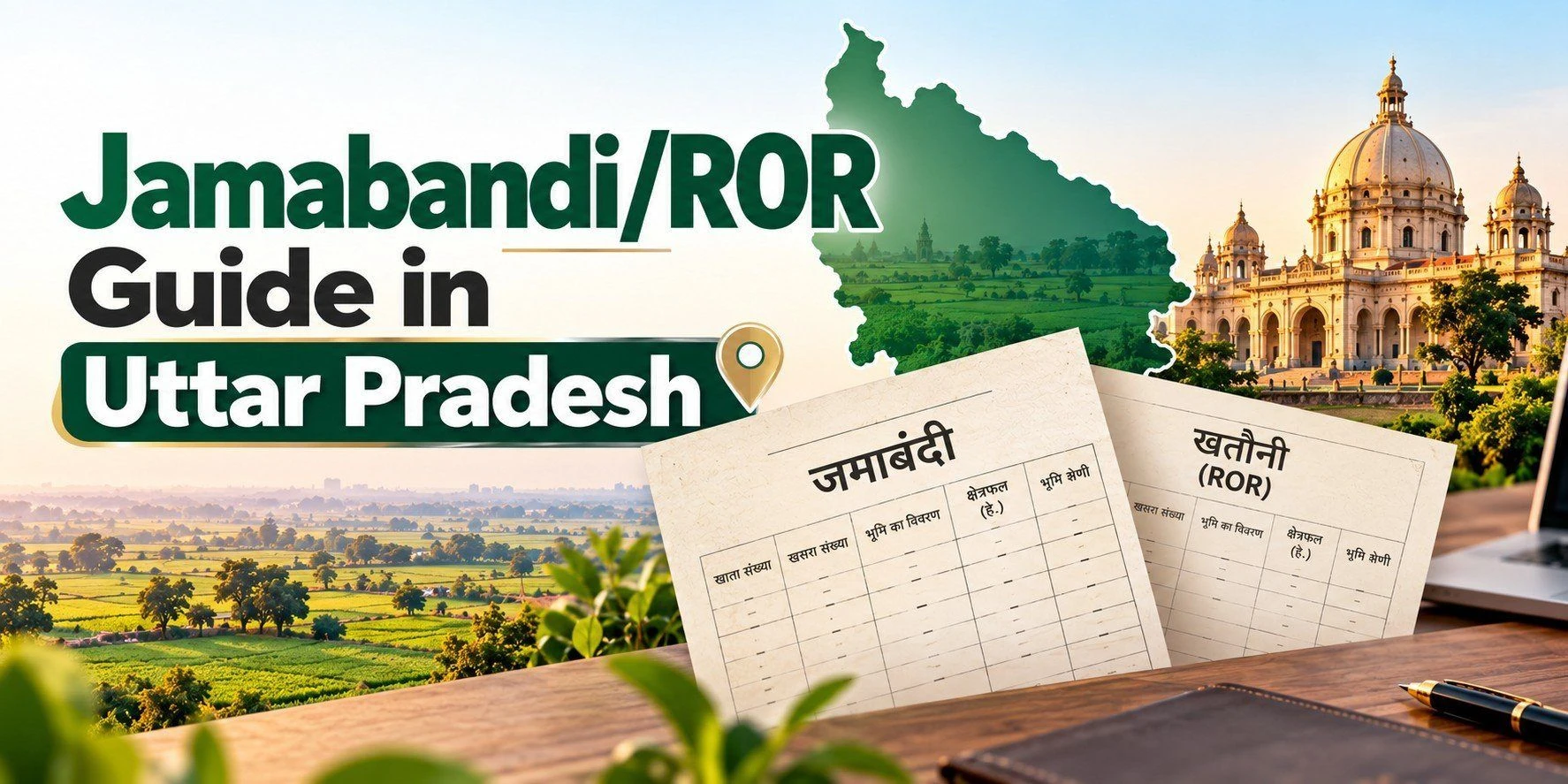
Jamabandi in Uttar Pradesh — locally known as the Khatauni — is the official Record of Rights (ROR) that shows who owns and cultivates a specific piece of land, along with its classification and revenue details.
It matters because it protects a buyer from disputes over ownership and confirms the land's legal status before any money changes hands.
This guide explains what UP's Khatauni contains, how it relates to the term "jamabandi" used elsewhere in India, and how to check it online through Bhulekh. Whether you're buying agricultural land, applying for a crop loan, or settling an inheritance, this is the record you'll be asked for.
Section 1 — What is Jamabandi (Khatauni) in Uttar Pradesh?
Before relying on the record alone, it also helps to see how a plot compares to similar listings if you're exploring farm land for sale in Uttar Pradesh — you can browse a dedicated land map here.
Definition: Jamabandi is the general North Indian term for the Record of Rights; in Uttar Pradesh, this record is specifically called the Khatauni, and it lists a landholder's total holdings, ownership status, and any inheritance or mutation history for each khasra (plot).
The Khatauni is different from the Khasra: a Khasra is the plot-level record showing a specific parcel's number, size, type, boundaries, and crop details, while the Khatauni is the owner-level summary that aggregates all the Khasras held by one person or family — buyers typically need to check both together for a complete picture.
A buyer specifically needs this because it is the primary evidence of current ownership and land classification in UP, and it is what gets updated through mutation (or Varasat, for inheritance) whenever ownership changes.
It's also relied on for agricultural loans, PM-Kisan scheme verification, and confirming whether a plot is under any dispute before finalising a purchase.
State-specific note: Always use the "Real Time Khatauni" option on the Bhulekh portal rather than an older cached version — this reflects the most current mutation and ownership status, which matters if the land has recently changed hands.
Expert Tip: On the Khatauni page, click through to the linked "vaad grast sthiti" (dispute status) check for the specific khasra number — this cross-references vaad.up.nic.in and flags whether the plot is currently under any revenue court litigation, a detail that's easy to miss if you only look at ownership and area figures.
Section 2 — How to Get Jamabandi/Khatauni in Uttar Pradesh?
The Bhulekh portal makes basic verification free and instant for most digitised villages; a certified copy for formal use still requires the Tehsil.
Method | Cost | Time | Legally Valid for Registration? |
Online (unsigned view) | Free | Instant | No — reference only |
Online (digitally signed copy) | Nominal fee | A few days | Yes |
Offline (Tehsildar/Lekhpal office) | Nominal fee | A few days | Yes |
1. Visit the UP Bhulekh portal — Go to upbhulekh.gov.in, the official land records website.
2. Select "View copy of Khatauni" — Click the option to view the Record of Rights copy on the homepage.
3. Choose district, tehsil, and village — Narrow down to the exact location of the plot.
4. Search by khasra, khata, or owner name — Enter the details you have to pull up the Real Time Khatauni for that land.
1. Visit the Tehsildar's office — Carry the khasra/khata number, village details, and ID proof.
2. Request a certified copy — Submit the application and pay the applicable fee.
3. Verification — The Lekhpal or Revenue Inspector may verify the request against local records.
4. Collect the certified copy — Collect the signed and sealed Khatauni once processed.
Typical turnaround: A few days for a certified copy.
Before you leave the office, check that the khasra number, area, and owner name on the Khatauni match your other land documents, and that the mutation history looks consistent with what the seller has told you.
Section 3 — What Does the Khatauni Contain?
For anyone comparing agricultural land in Uttar Pradesh, these are the fields worth checking on any Khatauni. You can also browse verified land listings and mapping tools at the 2Bigha homepage.
Field | What It Means | What to Check |
Khasra number | Unique identifier for each individual plot | Matches your other land documents exactly |
Owner/Khatedar name(s) | Current legally recorded owner(s) | Matches the seller's claimed identity |
Total holding (Rakba) | Area of land recorded under this Khata | Consistent with what's being offered |
Land classification | Type of land (agricultural, irrigated, etc.) | Matches the land's actual current use |
Mutation/dispute history | Recent ownership changes or pending disputes | No unresolved disputes flagged |
Good sign: A reliable Khatauni shows a clear khasra number, an owner name consistent with what the seller claims, and no pending dispute (vaad grast) flag against the land.
Section 4 — Common Issues & How to Fix Them
Most Khatauni problems in UP come down to name mismatches, outdated cached records, or confusing khasra and khata numbers. Before troubleshooting further, it's worth double-checking the Jamabandi/ROR on the Uttar Pradesh official website.
Old cached record instead of Real Time Khatauni — Some search results show an outdated version rather than the current one. Fix: Always use the "Real Time Khatauni" option specifically, which reflects the latest mutation status.
Owner name doesn't match the seller — This can indicate mutation was never completed after a prior sale or inheritance. Fix: Ask the seller to complete pending mutation before proceeding, or investigate the gap thoroughly.
Confusion between khasra and khata numbers — A khasra is plot-level; a khata is owner-level and can cover multiple khasras. Fix: Confirm which number you have and search accordingly — the portal supports both.
Dispute (vaad grast) status not checked — Buyers sometimes skip this cross-check entirely. Fix: Click through to the dispute status link on the Khatauni page before finalising any deal.
Record not available for a specific village — A small number of villages may have incomplete digitisation. Fix: Visit the Tehsildar's office directly for a manual record check.
PDF downloaded from a third-party site, not the official portal — Several look-alike websites mimic Bhulekh's design and branding. Fix: Always use upbhulekh.gov.in directly and verify the URL carefully before trusting any downloaded record.
Section 5 — Recent Changes in 2026
UP Bhulekh continues to expand online services beyond just viewing the Khatauni, including online Varasat (inheritance mutation) filing and integrated dispute status checks via vaad.up.nic.in. No major structural changes to the core Khatauni viewing process have been reported as of August 2026, though buyers should confirm current digitisation status for their specific village directly on the portal.
Section 6 — Why Jamabandi/Khatauni Matters for Land Buyers?
It is the primary official proof of who currently owns and cultivates a plot.
It reveals any pending litigation or dispute registered against the land.
It is required for agricultural loans and government scheme verification like PM-Kisan.
Banks check it before approving any loan against agricultural land.
It confirms land classification, which affects what the land can legally be used for.
It forms the baseline that mutation and Varasat records are checked against after any transaction.
Section 7 — Jamabandi/Khatauni vs. Khasra
These two are frequently confused because both come from UP's Bhulekh land records system. The Khasra is a plot-level record — think of it as the "ID card" of one specific piece of land, showing its number, size, boundaries, and crop details. The Khatauni is the owner-level record, summarising all the Khasras held by one person or family, along with ownership and mutation history.
If you're planning to sell land in Uttar Pradesh, having a current Khatauni that matches the specific Khasra numbers being sold makes a buyer's due diligence considerably faster. You can also explore listing land through https://2bigha.ai/sell.
Aspect | Khatauni (Jamabandi/ROR) | Khasra |
|---|---|---|
Level of record | Owner-level — all holdings of one person | Plot-level — one specific parcel |
What it shows | Ownership, total area, mutation history | Plot number, size, boundaries, crop details |
Best used for | Confirming ownership and title status | Verifying a specific plot's physical details |
Section 8 — Related Documents
Bhu Naksha Guide in Uttar Pradesh — full guide
Property Inheritance Laws in Uttar Pradesh — full guide
Legal Checklist Before Buying Land in Uttar Pradesh — full guide
Patta Rules in Uttar Pradesh — full guide
