
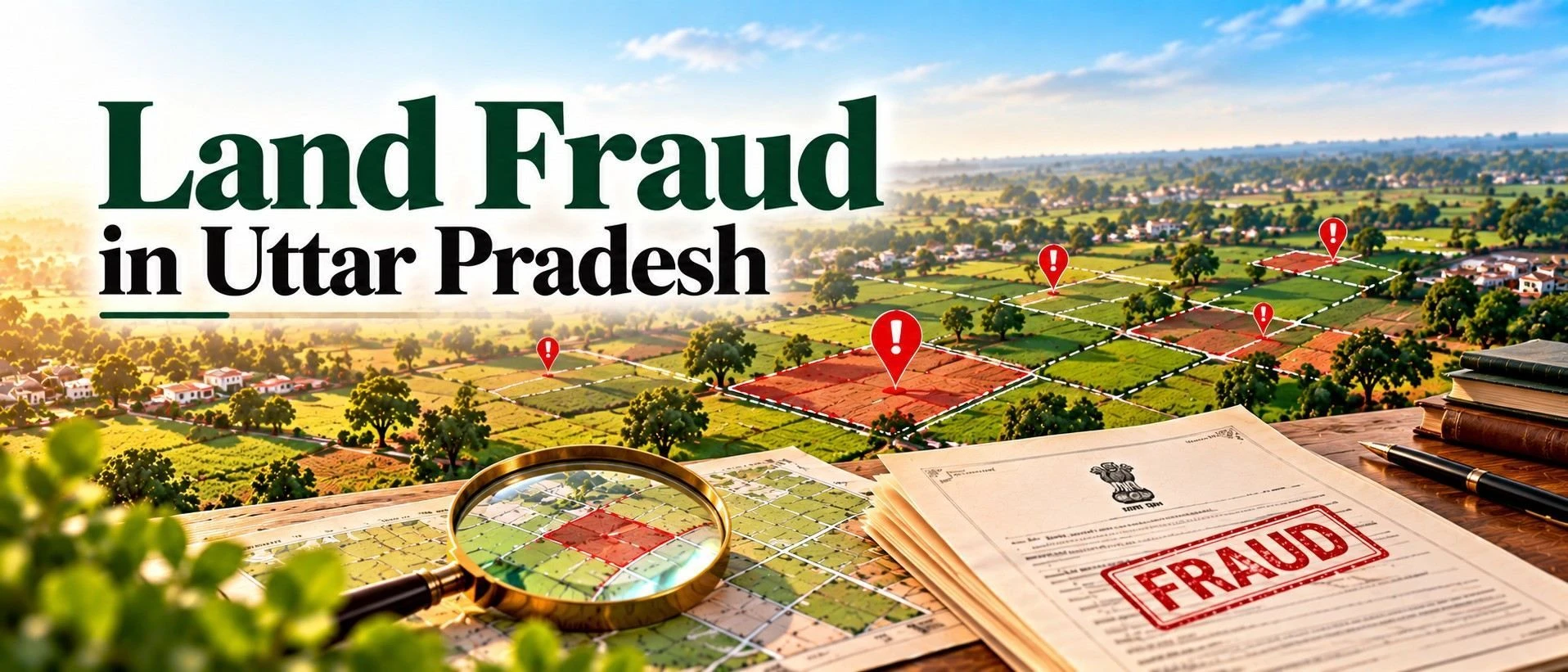
Land fraud in Uttar Pradesh covers a range of schemes — fake sellers, forged registry documents, impersonation using stolen or manipulated Aadhaar data, and selling the same plot to multiple buyers — that have cost genuine buyers crores of rupees in recent cases. It matters because a fraudulent deal can look completely normal on the surface: proper-looking paperwork, a confident seller, even a registered-sounding transaction, right up until the fraud surfaces months or years later. This guide covers the most common fraud patterns in UP, the state's recent anti-fraud reforms, and the checks that catch most schemes before money changes hands. Whether you're evaluating farm land for sale in Uttar Pradesh, buying compensation-linked land near a growth corridor, or simply being cautious about a deal that seems too easy, this is what to watch for.
Section 1 — What Does Land Fraud in Uttar Pradesh Look Like?
Before evaluating any specific deal, it helps to compare it against verified listings — you can browse the 2Bigha map for Uttar Pradesh alongside your own independent checks.
Definition: Land fraud refers to any transaction where forged documents, impersonation, fabricated ownership records, or misrepresentation are used to illegally transfer or sell property, leaving the buyer without valid legal title.
UP has seen several documented patterns. In one case, a gang tampered with over 1,500 Aadhaar registrations — altering names, addresses, and birth dates using fake birth certificates and ration cards — to manipulate biometric data and register property in someone else's name. In another case, fraudsters impersonated a deceased former Chief Minister using a photocopied voter ID to sell his land to an unsuspecting buyer. A more recent case saw a retired employee lose ₹1.47 crore in a Bulandshahr land fraud involving fake sellers and forged documents, tied to land compensation near a growing infrastructure corridor. Buyers need to understand these aren't rare, exotic scams — they follow recognizable patterns that a careful buyer can catch.
State-specific note: Land near major infrastructure projects — where compensation payouts and rapidly rising prices attract organized fraud networks — has been specifically flagged as higher-risk in recent UP cases; extra scrutiny is warranted for such deals.
Expert Tip: If a seller is unusually eager to close quickly, avoids in-person meetings, or resists the buyer independently verifying documents at the Sub-Registrar or Tehsil office, treat that reluctance itself as a red flag — genuine sellers with clean title rarely object to a buyer double-checking.
Section 2 — How to Check for Land Fraud in Uttar Pradesh?
Most fraud indicators can be checked online before you ever meet the seller in person. Compare the available approaches:
Method | Cost | Time | Catches most common fraud patterns? |
Online (IGRSUP + Bhulekh self-check) | Free | Days | Yes, for document forgery, ownership mismatches, and encumbrances |
Online + legal consultation | Legal consultation fee | Days to a week | More reliably, for interpreting unusual transaction patterns |
Offline (Tehsil/SRO in-person verification) | Nominal, if any | 1–2 weeks | Most thorough, especially for compensation-linked or disputed land |
Verify the seller's identity against the registered owner. Cross-check the seller's ID and name exactly against the current owner shown on IGRSUP and Bhulekh — not just what's printed on their papers.
Search the property's full registered document history on IGRSUP. Look for the complete chain of sale, gift, mortgage, and partition transactions, watching for unexplained gaps or unusually frequent transfers.
Verify the e-stamp certificate. Use IGRSUP's e-Stamp Verification tool to confirm the UIN and issue date on any stamp paper are genuine.
Check the Khasra/Khatauni independently. Confirm the plot's classification, area, and recorded owner match what the seller has represented.
Visit the Sub-Registrar Office to request a certified copy of the sale deed and confirm the registration is genuine in person.
Visit the Tehsil office to independently confirm current mutation status and speak with revenue officials if anything seems inconsistent.
Consult a property lawyer, especially for high-value, compensation-linked, or recently subdivided land, before making any payment.
Report suspected fraud to the UP Police Cyber Cell or Economic Offences Wing if you encounter a scheme already in progress.
A proper check typically takes several days to two weeks. Before making any payment — even a token advance — confirm independently, not just from the seller's documents, that the person you're dealing with is the actual registered owner and that the property carries no undisclosed encumbrance.
Section 3 — What Do Genuine Records Look Like?
The same verification discipline applies whether you're checking a specific deal or evaluating agricultural land in uttar pradesh more broadly — treat every claim as something to verify independently, not take on trust.
Field | What it means | What to check |
Seller identity match | Whether the seller is the actual recorded owner | Cross-check ID against IGRSUP/Bhulekh records, not just the seller's own papers |
Document consistency | Whether names and khasra numbers match across all papers | Any mismatch, however small, warrants investigation |
E-stamp authenticity | Whether the stamp paper used is genuine | Verify the UIN through IGRSUP's e-Stamp Verification tool |
Transaction history | Whether the property's chain of ownership makes sense | Watch for unexplained gaps or suspiciously frequent transfers |
Good sign: the seller's identity matches the registered owner exactly across every independent source, the e-stamp verifies as genuine, and the transaction history shows a clean, explainable chain with no unresolved gaps.
Section 4 — Common Fraud Patterns & How to Avoid Them
Land Fraud in Uttar Pradesh can involve owner impersonation, forged identity documents, duplicate sales, fake stamp papers, or pressure to skip verification. Checking the Land Fraud Uttar Pradesh official website and independently verifying ownership, registration history, and e-stamp details can help buyers identify suspicious transactions before making any payment.
Impersonation of the real owner – A fraudster poses as the registered owner using forged or stolen ID. Fix: verify the seller's identity independently against IGRSUP records, not just the documents they present.
Fabricated Aadhaar/biometric data – Manipulated identity documents used to register property in someone else's name. Fix: rely on the mandatory Aadhaar-based biometric authentication now required at registration, and don't skip in-person verification.
Fake sellers on compensation-linked land – Organized networks target land near infrastructure projects with fabricated ownership claims. Fix: apply extra scrutiny and legal review to any deal involving recent compensation payouts or rapidly appreciating corridor land.
Same plot sold to multiple buyers – A seller collects payment from more than one buyer for the same property. Fix: check the full registered transaction history for any conflicting or overlapping claims before paying.
Forged stamp papers – Fake e-stamp certificates used to make a deal appear properly taxed. Fix: independently verify every e-stamp's UIN through IGRSUP before relying on it.
Pressure to skip verification – Seller or broker discourages independent checks, citing urgency. Fix: treat this pressure itself as a warning sign and slow down regardless of the deal's apparent attractiveness.
Section 5 — Recent Changes in 2026
Uttar Pradesh introduced sweeping land registry reforms effective February 1, 2026, making Aadhaar-based biometric authentication (including fingerprint and iris scans) mandatory for all parties in a property registration. The state also rolled out mobile OTP verification and PAN card validation through the NSDL website as standard checks during registration, alongside mandatory village codes and Khatauni number cross-referencing — measures explicitly introduced after authorities found gangs had tampered with over 1,500 Aadhaar registrations to facilitate fraudulent transfers. A large cash payment restriction and a fixed one-hour appointment slot system at Sub-Registrar Offices were also introduced in 2026 as part of the same reform package.
Section 6 — Why Fraud Awareness Matters for Land Buyers
Fraudulent transactions can leave a buyer with no legal claim at all, even after full payment.
Recent UP cases show losses running into crores of rupees for individual victims.
Compensation-linked and infrastructure-corridor land has been specifically targeted by organized fraud networks.
Independent verification catches most schemes before money changes hands — after payment, recovery is far harder.
New 2026 biometric and OTP reforms close some previously exploited loopholes, but buyer vigilance still matters.
Protects not just your money but your ability to get financing and resell cleanly later.
Section 7 — Land Fraud Red Flags vs. Normal Transaction Friction
Genuine Fraud Red Flag | Normal Transaction Friction | |
Seller behavior | Avoids in-person meetings, resists independent verification | Reasonable scheduling delays, standard paperwork requests |
Pricing | Significantly below market with pressure to close fast | Ordinary negotiation within a reasonable market range |
Documentation | Refuses to share original documents or IDs for cross-checking | Standard document exchange through proper channels |
Learning to tell the difference matters, since not every delay or cautious seller is a fraud signal — but a seller actively resisting verification is different from one simply being slow. If you're selling land in uttar pradesh as a genuine owner, cooperating openly with a buyer's verification process is actually in your interest, since it distinguishes you clearly from the fraud patterns buyers are now watching for.
Section 8 — Related Documents
Sale Deed verification in Uttar Pradesh — the core document to independently verify
Property Document Checklist in Uttar Pradesh — the full set of checks to run
Bhulekh Records in Uttar Pradesh — independently confirming ownership and classification
Power of Attorney for Property in Uttar Pradesh — a common vector for POA-based fraud
Legal Checklist Before Buying Land in Uttar Pradesh — comprehensive due-diligence steps
