
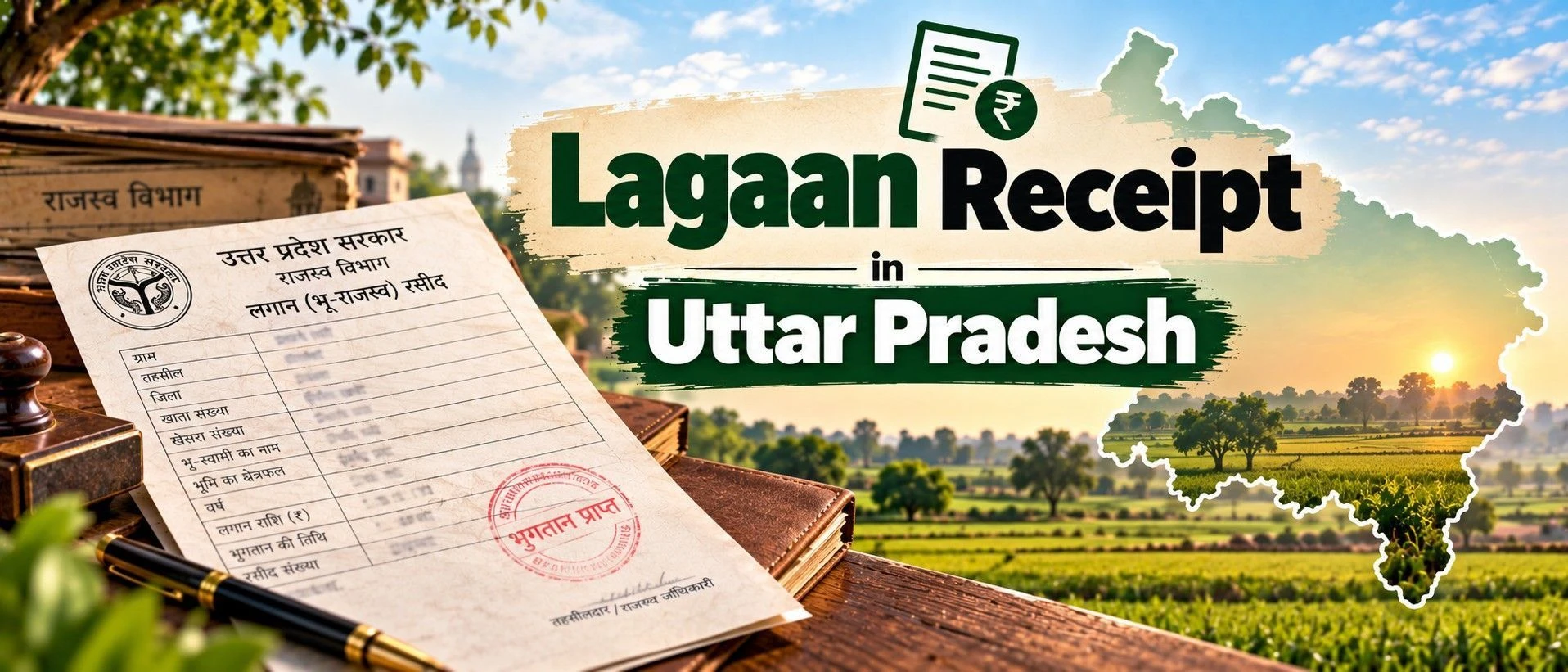
A Lagaan Receipt, also called a Bhu-Rajaswa receipt, is the official acknowledgment issued by the Circle Office or Nagar Palika confirming that the annual land revenue due on a specific plot has been paid. It matters because unpaid dues attach to the land itself, not just the person who owed them — so a buyer who skips this check can inherit someone else's arrears along with the property. This guide covers what the receipt shows, how to check and pay dues online, and what a clean record should look like. Whether you're finalizing agricultural land for sale in uttar pradesh, applying for a crop loan, or settling an inheritance, this is the record you'll be asked for.
Section 1 — What is a Lagaan Receipt in Uttar Pradesh?
If you're comparing land before you check its revenue history, it helps to see it on a map first — you can browse the 2Bigha map for Uttar Pradesh while you shortlist a plot to verify.
Definition: A Lagaan Receipt is an official acknowledgment proving that the annual land revenue owed on a plot has been paid, issued under the UP Land Revenue Act and maintained by the state Revenue Department.
It answers a narrower question than most land documents: not who owns the land, and not what it's zoned for, but whether the government's small annual charge on that land is currently cleared. It's easy to confuse with the Khatauni — the Khatauni is the ownership and land record itself, while the Lagaan Receipt is proof a specific payment obligation tied to that record has been settled. A buyer needs it specifically because unpaid land revenue is a liability attached to the plot, and it doesn't disappear just because ownership changes hands.
State-specific note: In Uttar Pradesh, many small landholders have historically qualified for exemptions or reduced land revenue, so a "clean" record for a small agricultural holding may legitimately show minimal or no dues rather than annual payments — don't assume a near-zero history means something was skipped.
Expert Tip: Ask specifically for a "no dues" or "bakaya rahit" confirmation from the Circle Office, not just the most recent receipt — a single recent receipt can exist even when older arrears remain outstanding on the same khasra.
Section 2 — How to Get a Lagaan Receipt in Uttar Pradesh?
You can check dues and, where applicable, pay online, or visit the Circle Office directly. Compare both routes first:
Method | Cost | Time | Legally valid for registration? |
Online (dues view only, unsigned) | Free to view | Instant | No — a screen view isn't the same as an issued receipt |
Online (receipt downloaded after payment) | Payment amount depends on land size/category | Instant to same-day | Yes |
Offline (Circle Office/Nagar Palika) | Same payment structure, paid at the counter | Same day to about 3 days | Yes |
Visit the UP Bhulekh portal. Go to upbhulekh.gov.in and locate the land revenue/dues section.
Select district, tehsil, and village. Narrow down to the specific location of the plot.
Search by khasra number or owner name. Pull up the specific land record.
Review outstanding dues. Check whether any balance is shown against the record.
Pay online if dues exist, then download the receipt. Save the receipt for your records.
Visit the Circle Office or Nagar Palika covering the plot's location.
Provide the khasra number or owner details to the revenue clerk.
Pay any outstanding amount at the counter. Ask for an itemized breakdown if the amount seems unclear.
Collect the signed and stamped receipt as proof of payment.
Offline processing is typically same-day to about three days, depending on the office. Before treating the transaction as complete, check that the receipt shows the correct khasra number, the current financial year, and no remaining balance noted against the plot.
Section 3 — What Does a Lagaan Receipt Contain?
The same verification habit applies whether you're checking dues here or evaluating farm land for sale in uttar pradesh more broadly — always confirm the plot identifiers match across every document before relying on any single one.
Field | What it means | What to check |
Khasra/khata number | The specific plot the receipt covers | Must match the sale deed and Khatauni exactly |
Financial year | The period the payment covers | Confirm it's current, and check for gaps in prior years |
Amount paid | The land revenue amount cleared | Should be consistent with the land's size and category |
Owner's name | Who paid the revenue | Should match the current or previous recorded owner |
Issuing office | Circle Office or Nagar Palika that issued it | Confirm it matches the plot's jurisdiction |
Good sign: the khasra number matches other documents, the financial year is current with no gaps in recent years, and the office confirms no outstanding balance against the plot when asked directly.
Section 4 — Common Issues & How to Fix Them
A Land Revenue Receipt in Uttar Pradesh can have issues such as missing payment history, Khasra mismatches, outdated owner names, disputed dues, or unavailable online records. Checking the Land Revenue Receipt Uttar Pradesh official website and verifying payment details with the concerned Circle Office can help confirm the receipt before relying on it for a property transaction.
Gap in payment history – Several years show no receipt on file. Fix: request a written dues statement from the Circle Office and clear any confirmed arrears before purchase.
Khasra number mismatch – Receipt references a different plot number than the sale deed. Fix: get this corrected or clarified with the revenue office before relying on the receipt.
Receipt shows previous owner's name only – Common right after a sale, before mutation catches up. Fix: file Dakhil Kharij so future receipts reflect the new owner correctly.
Online portal shows no record found – Sometimes older or recently subdivided plots aren't yet indexed. Fix: check directly at the Circle Office rather than assuming the land has no revenue obligation.
Disputed dues amount – Owner and office disagree on what's owed. Fix: request the calculation basis in writing and escalate to the Tehsildar if unresolved.
Receipt without official stamp/signature – An unstamped printout isn't treated as proof of payment by some offices. Fix: get the physical stamped copy from the Circle Office for anything requiring formal proof.
Section 5 — Recent Changes in 2026
Uttar Pradesh continues to digitize land revenue records through the UP Bhulekh portal, allowing dues checks and record access without visiting the Circle Office in person for most straightforward cases. No major standalone policy change specific to Lagaan Receipts has been confirmed as of August 2026 — readers should still confirm current payment amounts and any district-specific exemptions directly with their local Circle Office, since small landholder exemptions can vary.
Section 6 — Why a Lagaan Receipt Matters for Land Buyers
Confirms the land carries no outstanding revenue liability that could transfer with ownership.
Often required alongside other documents when applying for a crop loan.
Useful supporting evidence in any future ownership or boundary dispute.
Helps confirm the plot's category (agricultural vs. other) matches what's being represented.
Required in some cases for mutation and inheritance-related filings.
Gives a paper trail of continuous, recognized land use over time.
Section 7 — Lagaan Receipt vs. Khatauni
Lagaan Receipt | Khatauni | |
What it proves | Annual land revenue has been paid | Ownership and detailed land record |
Issued by | Circle Office/Nagar Palika | Revenue Department via UP Bhulekh |
Needed for | Confirming no pending dues, crop loans | Proving ownership, mutation, resale |
They cover different obligations — one is a payment record, the other is the land record itself — and a serious buyer checks both rather than assuming a clean Khatauni means dues are also clear. If you're selling property online and want to move faster, having both documents ready upfront avoids a back-and-forth with the buyer's due diligence later.
Section 8 — Related Documents
Dakhil Kharij in Uttar Pradesh — updating ownership after purchase
Bhulekh Records in Uttar Pradesh — checking khasra and khatauni online
Legal Heir Certificate in Uttar Pradesh — needed for inheritance-linked land
Property Tax Rules in Uttar Pradesh — the urban equivalent of land revenue
Jamabandi/ROR Guide in Uttar Pradesh — the broader record-of-rights document
