
 List Your Land
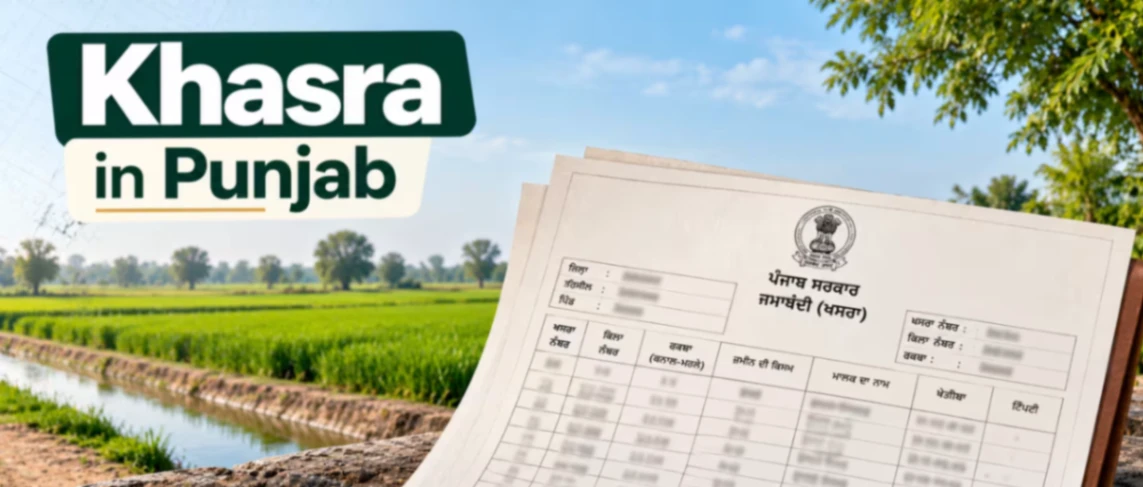
A Khasra number is the unique survey number assigned to each plot of land in Punjab, and it's the identifier every other land record — Jamabandi, Fard, and mutation — is built around.
It matters because without the correct khasra number, you can't reliably pull up a plot's ownership, area, or classification, which means you can't verify what you're actually about to buy.
This guide covers what a khasra number tells you, how to look it up through Punjab's Bhu Abhilekh Naksha system on the Jamabandi portal, and the mistakes buyers make when reading one.
Whether you're evaluating farm land for sale in Punjab India, planning to sell land in Punjab, or simply trying to locate a family plot by its survey number, this guide walks through everything the khasra record can tell you.
Section 1 — What is Khasra Record in Punjab?
Once you've confirmed a khasra number checks out, it's worth comparing it against what's actually listed for farm land for sale in Punjab India nearby. Browse verified listings on 2Bigha's Punjab land map to see how the plot's asking price stacks up.
A khasra number is the specific, permanent identifier assigned to one parcel of land within a village, used to pull up that plot's record in the Jamabandi (Record of Rights).
Think of the khasra number as the address of the land itself, distinct from the address of whoever happens to own it. Every parcel in a Punjab village carries one, and it stays the same even as ownership changes hands through sale, inheritance, or gift — which is exactly why it's the anchor point for looking up a plot's history.
Khasra is often confused with Khatauni and Khewat, which are related but different identifiers within the same Bhu Abhilekh system. The khasra number identifies the physical plot; the Khewat number identifies the ownership account (often shared among joint owners); and the Khatauni identifies who is cultivating or possessing the land, which isn't always the same person as the recorded owner.
For anyone trying to sell land in Punjab or verify a plot before buying, the khasra number is the starting point for every other check — without it, tracking down the correct Jamabandi entry becomes far harder, especially in villages where several families share similar names.
State-specific note: In Punjab, online Jamabandi records only go back to 2002 — if you need to trace a khasra's history further back, that portion of the record exists only on paper at the Tehsil office and requires an in-person request to the Patwari.
Expert Tip: Don't rely on a khasra number from an old family document without cross-checking it on the current Jamabandi. Consolidation and partition activities over the decades have changed khasra numbers in many Punjab villages, so a number from a 1990s paper record may no longer match what the portal shows today — always verify against the current entry before assuming it's still accurate.
Section 2 — How to Get Khasra Record in Punjab?
Looking up a khasra record in Punjab can be done free online, or through a certified request for formal use. Here's how the options compare:
Method | Cost | Time | Legally valid for registration? |
|---|---|---|---|
Online (Jamabandi portal, view only) | Free | Instant | No — reference only |
Online (digitally signed Fard request) | Nominal fee | Minutes to a few days | Yes |
Offline (Patwari / Tehsil office) | Nominal fee for certified copy | A few days to about two weeks | Yes |
1. Go to the Jamabandi portal: Visit jamabandi.punjab.gov.in and select the 'Jamabandi' or 'Fard' option from the homepage.
2. Set your region: Choose the district, tehsil, village, and year, then click 'Set Region' to load records for that area.
3. Search by khasra number: Under Jamabandi, select 'Khasra Number Wise' and enter the specific number to pull up the plot's record.
4. Review the ownership and cultivation details: Check the Khewat (ownership), Khatauni (cultivation), area, and land type shown against that khasra number.
5. Request a digitally signed Fard, if needed: For formal use like a bank loan or registration, use the online request option to obtain a certified copy with a digital signature and QR code.
1. Visit the village Patwari or Tehsil office: Go to the Patwari responsible for the village where the plot is located.
2. Request the Fard for the specific khasra number: Provide the khasra number, or the owner's name if the number is unknown, to locate the record.
3. Pay the nominal certified-copy fee: A small fee applies for an officially certified, signed copy of the Fard.
4. Cross-check against the online Jamabandi: Compare the Patwari's copy with what's shown on jamabandi.punjab.gov.in to confirm both match.
A certified copy from the Tehsil office typically takes a few days to about two weeks, depending on office workload and whether the record needs manual verification.
Before relying on the copy, check that the khasra number, area, and owner's name match your expectations exactly, confirm the Patwari's or Tehsildar's signature is present, and verify the record year is current rather than an older, superseded Jamabandi cycle.
Section 3 — What Does Khasra Record Contain?
A khasra entry packs several distinct pieces of information into one record. For a broader look at how verified listings are screened, see 2Bigha's home page.
Field | What it means | What to check |
|---|---|---|
Khasra number | Uniquely identifies the specific plot within the village | Match it exactly against the sale document and physical boundaries |
Khewat number | Identifies the ownership account, sometimes shared among joint owners | Check whether the land is solely or jointly owned before proceeding |
Khatauni number | Shows who is cultivating or in possession of the land | Confirm this matches the seller — a mismatch can signal a tenancy issue |
Area and land type | The recorded size and classification (agricultural, non-agricultural, etc.) | Cross-check against the physical site and the intended use |
Mutation remarks column | Notes recent ownership changes not yet folded into the main Jamabandi | Read this carefully — the main entry may still show a previous owner |
Good sign: A clean khasra record shows the owner's name matching the seller's identity documents, a Khatauni entry consistent with who's actually farming or holding the land, no unexplained mutation remarks pending, and a record year that's current rather than several cycles old.
Section 4 — Common Issues & How to Fix Them
Most khasra confusion in Punjab comes down to outdated numbers or an unresolved mutation. Cross-check every detail directly on the Khasra Punjab Land official website rather than relying on an old paper copy.
Khasra number changed after consolidation or partition
Older documents sometimes reference a khasra number that no longer matches the current record after a village-level consolidation exercise. Fix: If the portal returns "no record found," ask the Patwari whether the number has changed due to consolidation or partition.
Mutation pending but not yet reflected
Jamabandi is comprehensively updated only every 5 years, so a recent sale or inheritance may still show the previous owner in the main entry. Fix: Check the mutation remarks column and the 'Status of Mutations' section on the portal before assuming the ownership listed is current.
Owner name spelling mismatches
Names entered in Punjabi and English sometimes don't match exactly, or vary across documents from different eras. Fix: Try alternate spellings, or search by khewat or khasra number instead of name if the owner-name search isn't returning results.
Khatauni cultivator differs from the recorded owner
A mismatch between the owner in the Khewat and the cultivator in the Khatauni can indicate a tenancy arrangement the seller hasn't disclosed. Fix: Ask the seller directly about any tenancy on the land, and confirm the Khatauni entry doesn't create a possession complication.
Relying on records older than 2002
The Jamabandi portal only covers digitised records from 2002 onward, so older transaction history isn't visible online. Fix: For pre-2002 history, visit the Tehsil office directly to review the physical register.
Treating an online printout as a certified document
A free online view is useful for reference but isn't accepted for legal or banking purposes without the digital signature. Fix: Request the digitally signed Fard through the portal or Tehsil office whenever the document is needed for a transaction, not just verification.
Section 5 — Recent Changes in 2026
Punjab has digitised 99% of village land records under PLRS, and the Jamabandi portal now offers a WhatsApp-based Fard delivery service and an NRI subscription feature that sends automatic alerts when changes occur on a specific khasra. No further major changes have been reported as of August 2026.
Section 6 — Why Khasra Record Matters for Land Buyers
Confirms you're looking at the correct plot before any negotiation begins
Reveals the actual owner and cultivator, which aren't always the same person
Flags pending mutations that mean the visible ownership record isn't yet current
Required by banks before approving a loan against agricultural land
Prevents costly confusion between plots with similar or changed khasra numbers
Provides the reference point every other Punjab land document builds on
Section 7 — Khasra Record vs. Jamabandi / Fard
Khasra, Jamabandi, and Fard are often used interchangeably in conversation, but they refer to distinct parts of the same record-keeping system.
Aspect | Khasra Record | Jamabandi / Fard |
|---|---|---|
What it is | The unique number identifying a specific plot | The master register (Jamabandi) or certified extract (Fard) of ownership |
Scope | One plot, one number, permanent | A snapshot of ownership, area, and land type at a point in time |
Used to | Locate and reference a specific parcel | Prove ownership for a sale, loan, or legal purpose |
Relationship | The starting search key | The document you retrieve using the khasra number |
Once the khasra and Jamabandi both check out, you're in a strong position whether you're buying or looking to sell land in Punjab and want to move through selling property online with confidence.
Section 8 — Related Documents
Jamabandi Punjab 2026: Complete Guide to Fard & Land Records
Legal Heir Certificate Punjab 2026: Complete Guide
NRI Registered POA Punjab 2026: Complete Guide
Property Tax Punjab 2026: Complete Guide
How to Buy Land in Punjab: Complete 2026 Buyer Checklist
