
 List Your Land
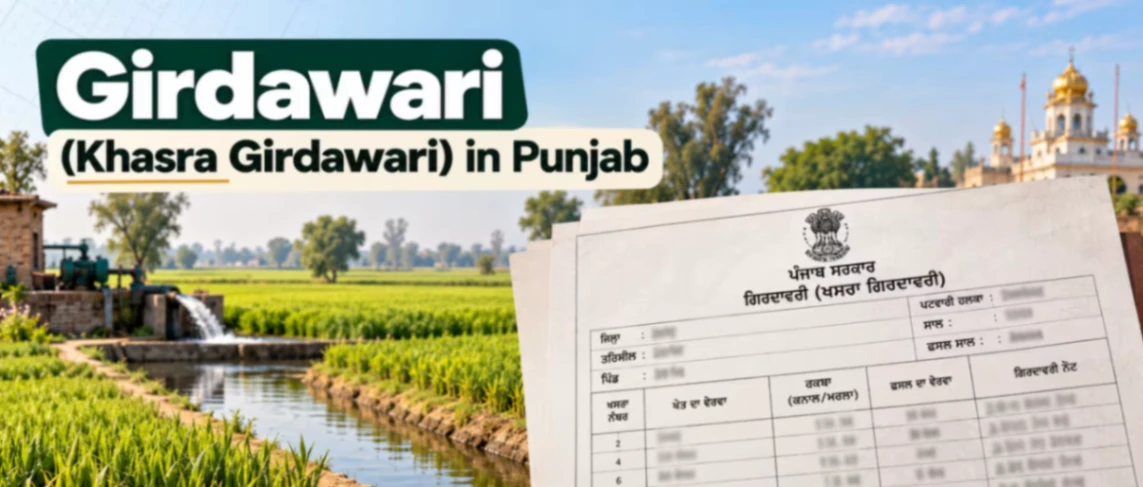
Girdawari is the periodic land inspection or survey conducted by revenue officials in Punjab, recording crop cultivation details, land use, and boundaries for each plot. Also called Khasra Girdawari, it feeds directly into the Jamabandi — the state's official Record of Rights — and matters because it's the government's own field-verified evidence of what's actually growing on, or happening to, a piece of land. This guide covers what Girdawari means in Punjab, how to check and download it online, what a correct entry should contain, and how to resolve the common problems landowners and buyers run into. Whether you're comparing agriculture land for sale in Punjab India, evaluating farm land for sale Punjab India before a purchase, or preparing to sell farmland in Punjab, this is one of the core records every bank and buyer's lawyer will cross-check before a deal closes.
Section 1 — What is Girdawari in Punjab?
Before relying on any single record, it helps to first confirm the plot on a map — on the 2Bigha land map, typing "Punjab" into the search box surfaces parcels across the state you can cross-check before starting your due diligence — view Punjab land parcels on the 2Bigha map.
Definition: Girdawari is the field inspection carried out by the Patwari, recording crop cultivation, land use, and possession details for each Khasra (plot number) in a village, forming the practical, on-ground layer beneath Punjab's Jamabandi land record system.
In the Indian land record system generally, "Khatauni" is an account book, "Khasra Girdawari" is the survey book, and "Shajra" is the village map — Girdawari specifically captures what's actually being cultivated, by whom, and under what terms, at the time of inspection. This is different from the Jamabandi itself, which is the comprehensive Record of Rights showing ownership, area, and revenue details, prepared and formally updated every four to five years. Girdawari entries and mutations are recorded continuously between these updates but are only folded into the main Jamabandi during its next quinquennial cycle. Buyers specifically need to check Girdawari because it reflects current, on-ground cultivation status — useful for confirming who's actually possessing and working the land, which can differ from what an older Jamabandi entry shows.
State-specific note: Punjab's "Easy Jamabandi" portal reform, rolled out by the Revenue Department, bundles Girdawari alongside four other core services — WhatsApp te Jamabandi, Online Intkal Seva, Rapat Entry, and Fard Badar — all accessible without visiting a Patwari in person.
Expert Tip: If you're buying land where a tenant or third party appears to be cultivating it, check the Girdawari specifically for the current season rather than relying on an older Jamabandi entry — cultivation and possession status can shift between the periodic Jamabandi updates, and the Girdawari is the more current field record.
Section 2 — How to Get Girdawari in Punjab?
Here's how the available routes compare for checking Girdawari records.
Method | Cost | Time | Legally valid for verification? |
Online (jamabandi.punjab.gov.in view/download) | Free | Instant | Yes — digitally signed, with QR code |
Certified copy from Patwari (offline) | Nominal, where applicable | A few days | Yes |
WhatsApp te Jamabandi (mobile delivery) | Free | Near-instant | Yes — QR-verifiable |
Visit jamabandi.punjab.gov.in. This is the official PLRS portal for Punjab land records, including Girdawari.
Select district, tehsil, and village. Narrow down to your specific location using the dropdown menus.
Choose the Girdawari/Khasra search option. Search by Khasra number, or by owner/cultivator name if the number isn't known.
View the current entry. Review cultivation details, crop type, and possession status for the selected plot.
Download or print. Save the digitally signed copy, which carries a QR code for third-party verification by banks or legal firms.
Contact the local Patwari. Approach the Patwari responsible for your specific village.
Request a certified Girdawari extract. Provide the Khasra number and relevant details.
Pay the applicable fee, if any. Charges for a certified copy are typically nominal.
Collect the certified extract. Use this for formal verification purposes where required.
Online access is essentially instant, and the digitally signed copy is accepted by banks and legal offices without further attestation. Before relying on any Girdawari entry, check that the Khasra number, village, and season/year match exactly what you're verifying, since older cached entries can sometimes cause confusion if the wrong Jamabandi period is selected.
Section 3 — What Does a Girdawari Entry Contain?
Once you've confirmed current cultivation status, it's worth comparing the plot against other verified listings — the 2Bigha homepage is a good place to check similar options before finalising a purchase.
Field | What it means | What to check |
Khasra number | The specific plot identification number | Matches your sale document and site details |
Crop/land use recorded | What's currently cultivated, or the recorded land use | Consistent with what you observe on-site |
Cultivator/possession details | Who is recorded as cultivating or possessing the land | Matches the seller's claims, or flags a tenant/third party |
Season/period of record | The specific inspection cycle the entry covers | Recent, and clearly dated |
Area | The measured extent of the plot | Matches the Jamabandi and sale deed |
Digital signature/QR code | Verification feature on the downloaded copy | Present, and verifiable by scanning |
Good sign: A clean Girdawari record shows a Khasra number and area matching your other documents, cultivation or possession details consistent with what the seller has told you, and a valid digital signature with QR code for independent verification.
Section 4 — Common Issues & How to Fix Them?
Girdawari-related confusion is common, especially around timing and possession discrepancies. Always cross-check through the Girdawari in Punjab official website rather than relying on an old printed copy.
Girdawari shows a different cultivator than the seller claims – Can indicate an undisclosed tenancy or possession dispute – Fix: raise this directly with the seller and, if unresolved, verify the tenancy terms with the local Patwari before proceeding.
Entry not yet reflected in the online system – Recent field inspections can lag before appearing on the portal – Fix: confirm directly with the Patwari if a recent Girdawari update doesn't yet show online.
Confusion between Girdawari and Jamabandi periods – Buyers sometimes check the wrong cycle – Fix: confirm you're viewing the current season's Girdawari, not an outdated Jamabandi snapshot.
Khasra number mismatch with sale documents – Old deeds sometimes reference outdated survey numbers – Fix: cross-check the current Khasra number with the Patwari before relying on the record.
Portal access issues during peak usage – Occasional slowdowns on jamabandi.punjab.gov.in – Fix: retry during off-peak hours, or request a certified copy directly from the Patwari.
Mutation pending but not yet reflected in Girdawari/Jamabandi – A common gap between the mutation event and record updates given the pendency issues raised by state legislators – Fix: check the Online Intkal Seva mutation status separately, and follow up with the Patwari if there's significant delay.
Section 5 — Recent Changes in 2026
Punjab's Revenue Department continues to expand its "Easy Jamabandi" digital reform, bundling Girdawari access alongside Online Intkal (mutation) Seva, Rapat Entry, Fard Badar, and WhatsApp-based record delivery, with land records for 99% of villages now digitised statewide. No major statewide change to the Girdawari process itself has been confirmed as of August 2026, though state legislators have raised concerns in the Punjab Vidhan Sabha about pendency in related mutation processing at the Patwari level. Buyers should confirm current Girdawari status directly on jamabandi.punjab.gov.in, since it reflects the most recent field inspection available.
Section 6 — Why Girdawari Matters for Land Buyers?
It's the government's current, field-verified record of what's actually being cultivated and by whom.
A mismatch between Girdawari and the seller's claims can reveal an undisclosed tenancy or possession issue.
Banks and buyers commonly cross-check Girdawari alongside the Jamabandi for a complete picture before a loan or purchase.
It helps confirm land classification (agricultural use) relevant for CLU or diversion applications.
A verified, current Girdawari record adds confidence when comparing options for agriculture land for sale in Punjab India.
Digitally signed, QR-verifiable copies make due diligence faster and harder to falsify.
Section 7 — Girdawari vs. Jamabandi
These two are closely related but serve different purposes, and buyers sometimes confuse one for the other.
Aspect | Girdawari | Jamabandi |
What it shows | Current crop cultivation, land use, and possession details | Comprehensive ownership, area, and revenue Record of Rights |
Update frequency | Continuous, updated each cultivation season | Quinquennial (every four to five years), with continuous mutations folded in at each cycle |
Recorded by | Patwari, through field inspection | Compiled from ownership, mutation, and Girdawari data |
Primary use | Verifying current cultivation/possession | Verifying ownership, revenue status, and transaction history |
Girdawari captures what's happening on the land right now; Jamabandi is the broader ownership and revenue record it feeds into. Reviewing both together gives a far more complete picture than either alone. Once your due diligence is complete, you're well positioned for selling property online through 2Bigha's selling platform.
Section 8 — Related Documents
Intkal (Mutation) in Punjab — for updating ownership records reflected across Girdawari and Jamabandi
CLU Certificate in Punjab — relevant where Girdawari confirms agricultural classification before conversion
Building Plan Approval in Punjab — required once land use and ownership are both confirmed
Fard (certified Jamabandi extract) — for formal proof of ownership in transactions
