
 List Your Land
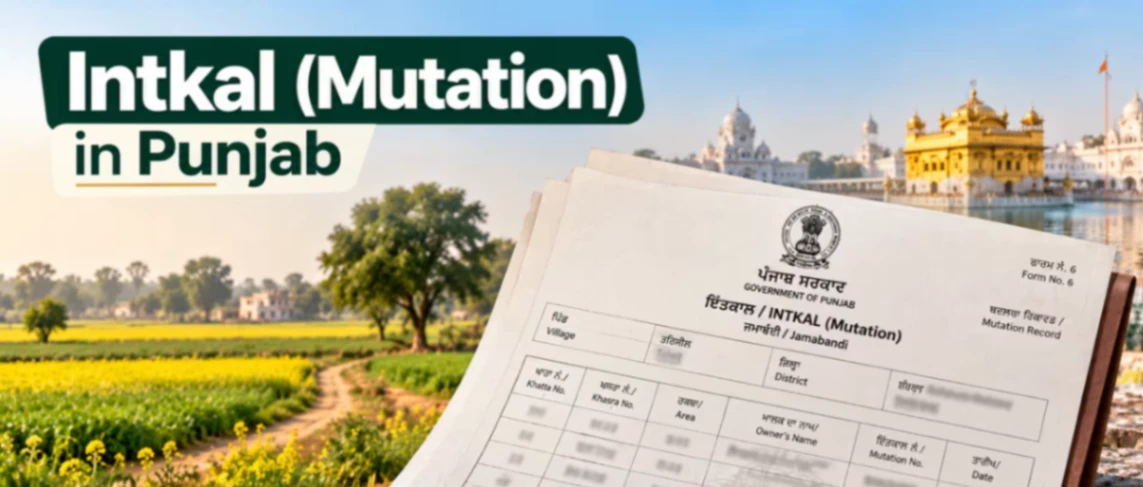
Intkal, the Punjabi/Urdu term for mutation, is the process by which the Punjab Land Records Society (PLRS) updates the Jamabandi — the official Record of Rights — to reflect a change in land ownership following a sale, inheritance, gift, or court order. It matters because a registered sale deed alone doesn't complete a land transaction in the government's eyes — until Intkal is finalized, the Jamabandi still shows the previous owner, and that gap can affect everything from bank loans to future resale. This guide covers Punjab's 2026 automatic mutation system, how to check status online, and what to verify before relying on it. Whether you're evaluating agriculture land for sale in Punjab India, checking a plot in Punjab, or working through how to sell agricultural land in Punjab, this is the record that confirms your ownership is actually reflected where it counts.
Section 1 — What is Intkal (Mutation) in Punjab?
Before checking a specific plot's mutation status, it helps to see the surrounding area — you can browse listings while comparing agriculture land for sale in Punjab India alongside verifying each plot's actual land record.
Definition: Intkal is the process of updating Punjab's Jamabandi — the Record of Rights maintained for every village — to reflect a change in land ownership, ensuring the revenue department's own records match a completed transaction such as a sale, inheritance, gift, or court order.
It's worth being precise about what Intkal does and doesn't establish. The Jamabandi itself is the central legal document showing ownership, possession, land type, area, and cultivation details, and it's formally updated on a five-year cycle, with individual mutation entries recorded as they happen in between. A registered sale deed is the legal act that transfers title; Intkal is the follow-up step that brings the government's own Jamabandi record into line with that transaction. A buyer needs to understand this distinction because a title that's legally transferred but not yet mutated still creates practical friction — banks, courts, and anyone running a land record check rely on the current Jamabandi entry, not just on a private deed sitting in a file.
State-specific note: As of the 2026 update to Punjab's system, registering a property deed now triggers mutation automatically within 30 days — no separate application is needed for sale-based transfers, and applicants receive WhatsApp updates at each stage. Inheritance-based mutation, by contrast, still requires submitting a separate online request, also targeted for completion within 30 days.
Expert Tip: Don't assume "automatic" means "guaranteed" — even with the 2026 auto-mutation trigger for registered deeds, field inquiry and document verification can still cause delays, with some sources citing a realistic 15–45 day window depending on case complexity. Check your mutation status directly on the portal rather than assuming the 30-day figure is a hard guarantee, especially if you need the updated Jamabandi for a time-sensitive bank loan application.
Section 2 — How to Check and Apply for Intkal in Punjab?
Registered-deed mutations now trigger automatically, while inheritance and other cases require a separate online request. Compare the paths:
Method | Cost | Time | Confirms your name is on the current Jamabandi? |
|---|---|---|---|
Automatic mutation (after registered sale deed) | No separate fee | Completed within 30 days of registration | Yes, once confirmed — check status rather than assuming |
Online Intkal request (inheritance, gift, court order) | Free to submit | Targeted 30 days; field inquiry can extend this to 15–45 days | Yes, once processed and reflected in the Jamabandi |
Jamabandi/Fard status check (any case) | Free | Instant | Confirms current entry — shows whether mutation is pending, completed, or needs correction |
Visit jamabandi.punjab.gov.in. This is the established PLRS portal; confirm whether easyjamabandi.punjab.gov.in is also relevant for your specific service, since both currently operate.
Select the relevant service. Choose Jamabandi, Fard, or Mutation status as needed.
Enter your village, Khasra, Khewat, or owner name. These identifiers connect you to the correct land record.
Review the current entry. Check whether the Jamabandi reflects the correct current owner, and whether any mutation entry is pending, completed, or flagged for correction.
Track a specific request. If you've submitted an Intkal application, use "View Fard Request Status" or the equivalent tracker with your Request ID.
Submit your request online at jamabandi.punjab.gov.in, specifying the reason for mutation (inheritance, gift, court order, etc.).
Upload supporting documents. For inheritance, this typically includes a death certificate and heirship proof; other categories require their own relevant documentation.
Track progress via WhatsApp or the portal. You'll receive updates at each stage rather than needing to check manually.
Confirm the updated Jamabandi once processing completes, checking that the new owner's name and details are correctly recorded.
For registered sale deeds, the process is now largely hands-off from the buyer's side, but verifying the outcome remains the buyer's responsibility. Before relying on any mutation status, check the actual Jamabandi entry directly rather than assuming a 30-day window has definitely closed the matter — confirm the current owner's name is correctly and completely reflected.
Section 3 — What Does a Mutated Jamabandi Entry Show?
The same verification habit applies broadly — whether you're checking mutation status here or reviewing farm land for sale Punjab India listed elsewhere, always confirm the Jamabandi reflects reality rather than assuming a sale automatically and instantly updates everything.
Field | What it means | What to check |
|---|---|---|
Owner name (current entry) | Who the Jamabandi currently records as titleholder | Should exactly match the buyer named on the registered sale deed |
Khasra and Khewat numbers | The specific plot and the ownership account it falls under | Must match the sale deed and any other land records exactly |
Mutation status | Pending, completed, or flagged for correction | Only a completed, current entry reflects a finished transfer |
Land type and area | The plot's recorded classification and extent | Should be consistent with what's represented in the sale |
Good sign: the Jamabandi shows your name correctly as current owner, the Khasra and Khewat numbers match your sale deed exactly, the mutation status shows as completed rather than pending, and the land type and area are consistent with your transaction.
Section 4 — Common Issues & How to Fix Them
Most Intkal-related problems in Punjab trace back to assuming the 2026 auto-mutation system is instant and error-free, or confusion between the two currently active portals. Verify anything unclear through the Intkal Mutation Punjab "official website"(jamabandi.punjab.gov.in) rather than relying on informal assurances.
Assuming auto-mutation is instant – Buyer expects the Jamabandi to update the same day as deed registration. Fix: understand the target is 30 days, and check status directly rather than assuming completion.
Mutation delayed beyond the expected window – The Jamabandi still shows the previous owner well past 30 days. Fix: follow up through the portal's status tracker or contact the local revenue office, since field inquiry can extend processing in more complex cases.
Confusion between jamabandi.punjab.gov.in and easyjamabandi.punjab.gov.in – Applicant is unsure which portal to use for a specific service. Fix: check both, since they currently offer overlapping but not necessarily identical features, and confirm which is authoritative for your specific request.
Incomplete documents for inheritance-based mutation – Application stalls due to missing heirship proof or death certificate. Fix: gather all required documents before submitting the online Intkal request to avoid processing delays.
Errors in Khasra, Khewat, or owner name details – A discrepancy prevents the mutation from linking correctly to the right record. Fix: apply for correction (Fard Badar) through the portal or at the local revenue office.
Relying on an unmutated Jamabandi for a bank loan – Financing stalls because the current owner isn't reflected. Fix: confirm mutation is fully completed and reflected before submitting loan documentation.
Section 5 — Recent Changes in 2026
Punjab's 2026 update introduced automatic mutation for registered property deeds — Intkal now completes within 30 days of registration without requiring a separate application, with applicants receiving WhatsApp updates at each stage of the process. The Easy Jamabandi portal (easyjamabandi.punjab.gov.in), introduced in June 2025 under the state government's land governance reform push, added features including Jamabandi copies delivered via WhatsApp with QR-code verification and a paid annual subscription service (₹500 per Khewat) that alerts landowners to any changes in their land records. Punjab has now digitized approximately 99% of village land records statewide, with the remaining villages expected to be completed in the near term. Given that two related portals currently operate, confirm which is most current for your specific need before relying on either exclusively.
Section 6 — Why Intkal Matters for Land Buyers
Confirms your name actually appears in the government's own Record of Rights, not just on a registered deed.
The 2026 auto-mutation trigger reduces manual paperwork for sale-based transfers, but buyers should still verify the outcome directly.
A mutated, current Jamabandi is what banks and courts actually rely on for land-related verification.
Inheritance and gift-based mutations still require a distinct online application, unlike automatic sale-deed mutation.
The optional subscription service offers ongoing monitoring, useful for landowners wanting to be alerted to any future changes.
A stalled or incomplete mutation leaves your ownership legally valid but practically unreflected in the system anyone else will check.
Section 7 — Intkal (Mutation) vs. Jamabandi/Fard
Intkal (Mutation) | Jamabandi / Fard | |
|---|---|---|
What it does | Updates the Record of Rights to reflect a change in ownership | The Record of Rights itself (Jamabandi), or an official extract of it (Fard) |
Issued by | PLRS, triggered automatically for registered deeds or via online request for other cases | PLRS, via jamabandi.punjab.gov.in |
Needed for | Making a change of ownership officially reflected in state records | Proving current ownership, possession, and land details for banks, courts, or registration |
Intkal is the update process; the Jamabandi (and its Fard extract) is the resulting record itself. A buyer needs both to be correct and current, since a completed sale with an outdated Jamabandi entry leaves you unable to produce the document institutions actually ask for. If you're planning to sell agricultural land in Punjab, keeping your own Jamabandi current — with mutation confirmed, not just assumed — makes for a considerably smoother resale process.
Section 8 — Related Documents
Jamabandi/Fard Punjab — the Record of Rights that mutation updates
Encumbrance Certificate — checking for hidden mortgages or legal claims
Legal Heir Certificate — relevant for inheritance-based mutation applications
Property Document Checklist — the fuller set of papers to verify before any purchase
Legal Checklist Before Buying Land — general due-diligence steps applicable across states
