
 List Your Land
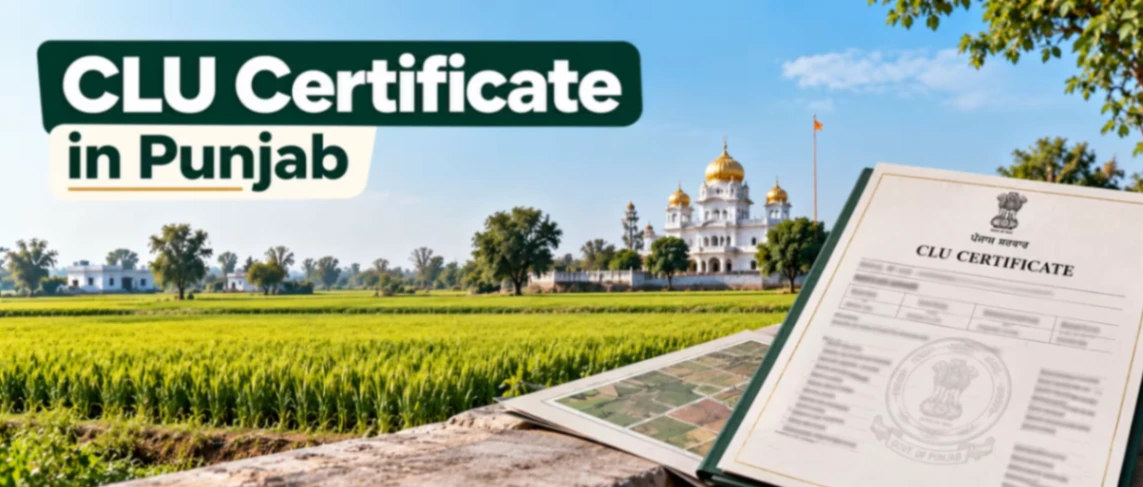
A CLU Certificate — Change of Land Use — is the government's permission to take agricultural land and use it for residential, commercial, or industrial purposes in Punjab. Without it, no colony in Punjab stands on legal ground, no matter how developed it looks or how many plots have already been sold. This guide covers what a CLU Certificate means in Punjab, how to apply for and verify one online, what a valid certificate should contain, and how to protect yourself from the documented risks buyers have faced in this space. Whether you're evaluating land in Punjab before construction, comparing farm land for sale Punjab India that a developer claims is "CLU-approved," or preparing to sell land in Punjab that's already converted, this is the single most important check to run before you commit to any colony or plotted development purchase.
Section 1 — What is a CLU Certificate in Punjab?
Before evaluating any plot marketed as "CLU-approved," it helps to first confirm the site on a map — on the 2Bigha land map, typing "Punjab" into the search box brings up parcels across the state you can cross-check before contacting a developer — view Punjab land parcels on the 2Bigha map.
Definition: A CLU Certificate is the official permission from the competent Punjab authority — PUDA, GMADA, or a regional Development Authority — that converts land recorded as agricultural into land approved for residential, commercial, or industrial use, granted under the Punjab Scheduled Roads and Controlled Areas Restriction of Unregulated Development Act, 1963 and its associated rules.
CLU is different from Building Plan Approval — CLU addresses whether the land itself may be used for a non-agricultural purpose at all, while Building Plan Approval separately governs the specific structure built on land whose use has already been settled. A developer or landowner submits the application through businessfirst.punjab.gov.in, generates a Project Identification Number (PIN), uploads the required documents, and pays the auto-calculated fee. Buyers specifically need to check this before purchasing a plot in any private colony, because a colony without CLU has no legal standing — and unlike a simple paperwork gap, this is a defect that can affect every single plot sold within that development.
State-specific note: Following a late-2025 amendment tightening the process, an applicant must hold full 100% title to the land before a CLU application will even be accepted — a partial-ownership or consent-based application is no longer sufficient on its own.
Expert Tip: Don't accept a developer's claim that CLU is "in process" or "as good as approved" — until the certificate is actually issued, the land remains legally agricultural, and any plots sold or possession handed over before that point carry the same legal risk as the underlying unconverted land.
Section 2 — How to Get a CLU Certificate in Punjab?
Here's how the process works, and what buyers should independently verify before relying on a developer's claim.
Method | Cost | Time | Legally valid basis for a colony? |
Online (businessfirst.punjab.gov.in application) | ₹5,000 first acre + ₹1,000/acre thereafter, plus conversion charges | 23 working days (portal commitment) | Yes, once issued |
Offline (PUDA/GMADA/Development Authority office) | Same fee structure | Similar or longer, depending on office workload | Yes, once issued |
Buyer verification only (checking an existing CLU) | Free | Instant to a few days | Reference — confirm with the issuing authority |
Register on the Business First portal. Go to businessfirst.punjab.gov.in and create an account.
Complete the Common Application Form (CAF). Generate a Project Identification Number (PIN) for your application.
Upload required documents. Attach the Shajra Plan (Patwari-signed), Fard Jamabandi (not older than two months), sale deeds, and non-encumbrance certificate.
Pay the auto-calculated fee. This includes the ₹5,000/₹1,000-per-acre processing fee plus applicable conversion charges.
Track and receive the CLU. The portal issues a QR Code Based Verifiable Approval once processing is complete, with a stated delivery commitment of 23 working days.
Ask the developer for the CLU certificate reference. A legitimate CLU has a specific reference number and QR code.
Confirm with the issuing authority. Contact PUDA, GMADA, or the relevant Development Authority directly to verify the certificate matches the specific plot and developer.
Check the ownership match. Confirm the CLU was granted to the actual, current titleholder of the land — not a different or prior owner.
Given the documented history of fraudulent CLU approvals in Punjab, buyers should treat independent verification as mandatory, not optional. Before relying on any CLU certificate, confirm it covers your specific plot, matches the seller's actual title, and is verifiable directly with the issuing authority — not just presented as a photocopy by the developer.
Section 3 — What Does a CLU Certificate Contain?
Once you've confirmed a colony's CLU is genuine, it's worth comparing the plot against other verified listings — the 2Bigha homepage is a good place to check comparable, cleared options before finalising a purchase.
Field | What it means | What to check |
Site/plot details | The exact land covered by the conversion | Matches the specific plot you're buying |
Approved use | Residential, commercial, or industrial classification | Matches the colony's actual marketed use |
Applicant/titleholder name | The person or entity the CLU was granted to | Matches the current, actual landowner or developer |
Conversion charges paid | Fees paid for the land use change | Receipts consistent with the amount on the certificate |
QR Code Based Verifiable Approval | Digital verification feature on the certificate | Scans and confirms authenticity with the issuing authority |
Issuing authority and date | PUDA, GMADA, or Development Authority, with issue date | Present, traceable, and recent |
Good sign: A genuine CLU certificate shows a site description matching your specific plot, an applicant name matching the actual current titleholder, and a QR code that independently verifies with the issuing authority.
Section 4 — Common Issues & How to Fix Them?
CLU-related fraud has been a documented, serious problem in Punjab, making independent verification essential. Always confirm status through the CLU Certificate in Punjab official website or directly with PUDA/GMADA rather than relying on a developer's paperwork alone.
Developer claims CLU based on fake consent letters – A documented scam pattern where developers obtained approvals using consent from landowners they had no genuine agreement with, leading to ED arrests of promoters – Fix: independently verify that the CLU applicant actually held valid title or consent, not just a claimed agreement.
CLU shown as "in process" but not yet issued – Land remains legally agricultural until the certificate is actually granted – Fix: never treat a pending application as equivalent to an issued CLU; wait for the actual certificate with its verifiable reference.
Partial land title used for a CLU application – No longer accepted since the late-2025 amendment requiring full 100% title – Fix: confirm the applicant held complete title at the time of application, especially for older CLUs granted before this rule.
CLU doesn't match the specific plot being sold – Some developers market plots beyond the actual CLU-covered area – Fix: cross-check the CLU's site description against your specific plot's location and boundaries.
Fard Jamabandi or Shajra Plan discrepancies – Ownership documents inconsistent with the CLU application – Fix: request current, verified copies of both directly from PLRS/the Patwari rather than relying on developer-supplied copies.
Colony construction proceeding without a granted CLU – Buyers sometimes assume ongoing construction implies legal approval – Fix: treat active construction as no substitute for a verified, issued CLU certificate.
Section 5 — Recent Changes in 2026
Following the exposure of a significant CLU fraud scheme in Punjab — where developers secured approvals using fabricated consent letters from landowners who had no real agreement with them, resulting in Enforcement Directorate action against promoters — the state tightened its process in late 2025 to require applicants to hold full 100% title to the land before a CLU application is accepted. No further major statewide changes to the CLU fee structure or the 23-working-day processing commitment have been confirmed as of August 2026. Given this history, buyers should treat independent verification of any CLU certificate as essential, not a formality, and confirm current requirements directly with PUDA, GMADA, or the relevant Development Authority.
Section 6 — Why a CLU Certificate Matters for Land Buyers?
Without it, a colony has no legal standing — regardless of how developed or actively marketed it appears.
The documented CLU fraud cases in Punjab show real financial risk for buyers who don't verify independently.
Banks typically require a genuine, verified CLU before financing a plot purchase in a private colony.
A verified CLU protects buyers from later demolition or regularisation costs tied to an unauthorised colony.
Understanding the 100% title requirement helps buyers spot red flags in how a colony's land was assembled.
A confirmed CLU adds real, verifiable value when a plot is eventually listed for selling property online.
Section 7 — CLU Certificate vs. Building Plan Approval
These two are often confused because both are needed before development can legally proceed.
Aspect | CLU Certificate | Building Plan Approval |
What it addresses | Whether agricultural land can legally be used for a non-agricultural purpose | Whether a specific building design meets bye-laws (floors, setbacks, FAR) |
Issued by | PUDA, GMADA, or regional Development Authority | ULB (via e-Naksha), PUDA/Development Authority, or Panchayat |
Applies to | Land still classified as agricultural | Land already zoned for the intended use |
Sequence | Typically required first | Follows once CLU is granted, where applicable |
CLU addresses whether the land's use can change at all; Building Plan Approval then governs what's actually built once that's settled. Buyers should confirm both exist and genuinely match the specific plot before purchasing in any colony. Once a parcel's conversion status is fully verified, it can responsibly be listed through 2Bigha's selling platform.
Section 8 — Related Documents
Building Plan Approval in Punjab — required after CLU is granted, before construction
Girdawari (Land Record) in Punjab — for confirming current classification and cultivation status
Intkal (Mutation) in Punjab — for verifying the actual, current recorded titleholder
Punjab Scheduled Roads and Controlled Areas Restriction of Unregulated Development Act, 1963 — the governing legislation
