
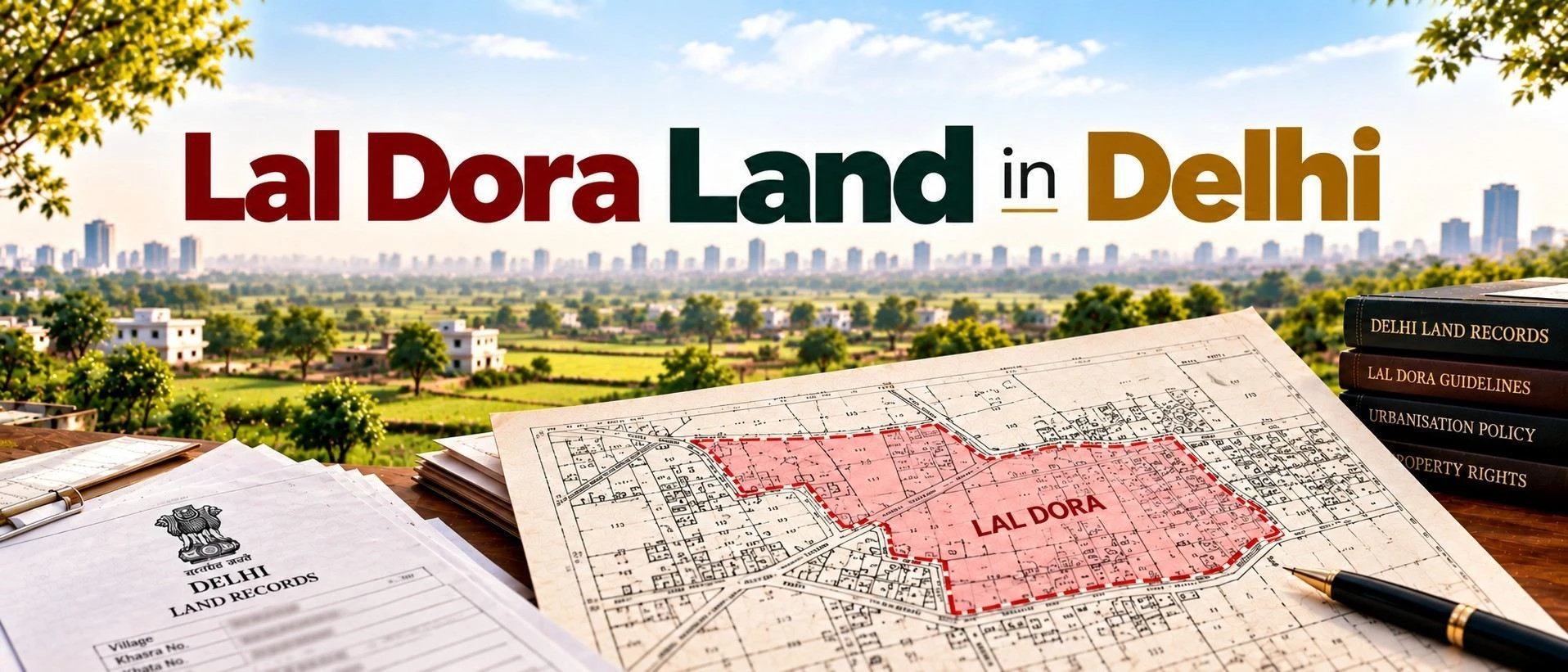
the LalLal Dora land is a legacy land classification unique to Delhi, marking the village abadi (habitation) area on old revenue maps with a red boundary line, distinguishing it from surrounding agricultural land. It matters because properties inside this red line have historically sat outside municipal building codes and formal registration systems, which means a buyer can end up holding a property with unclear title, no proper mutation, and real trouble getting a bank loan against it. This guide covers what the Lal Dora status means for a property, how regularisation and ownership verification work today, and how to fix the issues that most often come up. Whether you're buying a plot in an urban village, applying for a loan, or planning to sell inherited property, this is the status you'll need to check first.
Section 1 — What is Lal Dora Land in Delhi?
Before evaluating a plot with Lal Dora status, it helps to compare what else is on the market — browse plots in Delhi NCR on the 2Bigha map to see location and status side by side.
Definition: Lal Dora land refers to the village abadi areas of Delhi, first demarcated in 1908 with a red line on revenue maps to separate residential habitation zones from surrounding agricultural fields, and historically exempted from municipal building bye-laws and land revenue.
It's often confused with regular freehold residential property, but the two differ significantly in legal standing — Lal Dora properties are typically held through informal instruments like General Power of Attorney (GPA), Will, or Agreement to Sell rather than a registered sale deed, because these transactions historically weren't recorded at the Sub-Registrar's office. A buyer needs to understand this specifically because a property held only through GPA or unregistered documents carries weaker transfer rights, and clear ownership generally requires obtaining a Lal Dora Certificate and, where eligible, converting the property to freehold through a formal regularisation scheme.
State-specific note: Delhi currently has around 360 villages falling under Lal Dora classification, and residents in several of these are now receiving formal property cards under the SVAMITVA Scheme — a joint initiative between the Delhi government and the Survey of India — which is a separate track from PM-UDAY and worth checking for eligibility as well.
Expert Tip: Before assuming a Lal Dora property can simply be registered like any other plot, confirm whether it falls within an "extended Lal Dora" boundary or the original 1908-era abadi — extended Lal Dora areas were consolidated later and are generally easier to map and process for regularisation, while original abadi land can involve more complex historical records.
Section 2 — How to Verify or Regularise Lal Dora Land in Delhi?
Comparison of routes:
Method | Cost | Time | Legally valid for registration? |
|---|---|---|---|
Lal Dora Certificate (SDM office) | Nominal fee | A few days to a few weeks | Proves abadi status; not the same as freehold title |
PM-UDAY freehold conversion (online, DDA portal) | Free registration; minor charges if using a facilitation agent | Several weeks to months, depending on GIS survey and verification | Yes, once the conveyance deed is executed |
Offline (SDM/Tehsildar office for records check) | Nominal fee | A few days | For verification purposes |
Register on the PM-UDAY portal at pmuday.ncog.gov.in, filling in applicant details, property details, email, and mobile number.
Check eligibility using the UC Locator (via the portal or the PM-UDAY mobile app) to confirm your property falls within one of Delhi's listed unauthorised colonies eligible under the scheme.
Fill Part-2 of the application and upload the required documents, including your existing ownership proof — GPA, Will, Fard/Mutation, or Agreement to Sell.
Request the GIS Survey, after which the assigned agency visits the property within a few days and issues a GIS ID.
Enter the GIS ID and submit Part-3, after which your application moves to the concerned authority for review, witness details, and eventual execution of the Conveyance Deed with the Sub-Registrar.
Visit the local SDM or Tehsildar office covering the village where the property is located.
Request the Lal Dora Certificate, providing property details and any existing documents you hold.
Submit the application with the required fee, and the office verifies the property's abadi status before issuing the certificate.
This offline verification usually takes a few days to a few weeks, depending on the office's workload and whether the property's historical records need cross-checking. Before treating any Lal Dora property as clear, check whether it has a valid Lal Dora Certificate and confirm the chain of GPA/Will documents is consistent, and verify whether the colony qualifies for PM-UDAY or SVAMITVA-based regularisation.
Section 3 — What Does Lal Dora Documentation Contain?
For a broader look at verified land listings, including regularised and Lal Dora-status properties, visit 2Bigha.
Field | What it means | What to check |
|---|---|---|
Lal Dora Certificate details | Confirms the property falls within the village abadi boundary | Issued by SDM office, matches the property's actual location |
GPA/Will/Agreement chain | Historical ownership transfer documents | Consistent, unbroken chain from original owner to seller |
GIS ID (if PM-UDAY applied) | Confirms the property has been surveyed under the scheme | Matches the application and property location |
Fard/Mutation record | Revenue department's land record | Reflects current possession/ownership accurately |
Conveyance Deed (post-regularisation) | Final legal proof of freehold ownership | Registered with the Sub-Registrar's office |
Good sign: A property with a clear, unbroken GPA/Will/Agreement chain, a valid Lal Dora Certificate, and — ideally — a completed PM-UDAY conveyance deed or SVAMITVA property card offers the strongest legal footing.
Section 4 — Common Issues & How to Fix Them?
Most Lal Dora land issues in Delhi trace back to informal transfer history rather than the land itself being ineligible for regularisation. Confirm eligibility and status directly on the Lal Dora Land Delhi official website before finalising any transaction.
Property held only through GPA, not a registered deed – Weak legal transfer rights since GPA-based transactions aren't registered with the Sub-Registrar. Fix: Pursue formal regularisation through PM-UDAY to convert holding into a registered Conveyance Deed.
Boundary delineation incomplete – Some unauthorised colonies still lack finalised boundary maps. Fix: Check the colony's current delineation status with GNCTD/DDA before assuming eligibility.
No GIS ID issued within expected timeframe – Survey delays can stall the PM-UDAY application. Fix: Contact the assigned GIS agency directly if the ID isn't received within about 7 days, using the contact details provided at registration.
Break in the ownership document chain – Missing or inconsistent GPA/Will links between past owners. Fix: Gather all available historical documents and consult the SDM office on how to establish continuity, possibly through affidavits.
Colony not on the PM-UDAY eligible list – Not all Lal Dora or unauthorised colonies qualify. Fix: Check the PM-UDAY Unauthorised Colonies list on the portal before proceeding with an application.
Confusing Lal Dora Certificate with freehold title – Buyers assume the certificate alone proves clear ownership. Fix: Understand that the certificate confirms abadi status only; freehold conversion through PM-UDAY or SVAMITVA is a separate, additional step.
Section 5 — Recent Changes in 2026
Residents of 31 villages across Delhi are now receiving formal ownership rights through property cards under the SVAMITVA Scheme, following an administrative agreement between the Delhi government and the Survey of India, with special authorisation from the Ministry of Panchayati Raj enabling this integration despite Delhi not operating under a traditional gram panchayat framework. No further major changes have been reported as of August 2026 beyond this ongoing SVAMITVA rollout alongside PM-UDAY.
Section 6 — Why Lal Dora Land Matters for Land Buyers?
Properties held only through GPA or informal documents carry significantly weaker legal transfer rights.
Regularisation through PM-UDAY or SVAMITVA is often needed before a property can be sold with a clear, registered title.
Banks generally hesitate to finance purchases where ownership isn't backed by a registered deed.
Lal Dora areas historically fall outside standard municipal building bye-laws, which affects construction and resale planning.
Understanding a property's regularisation status protects buyers from inheriting someone else's unresolved title issues.
A completed PM-UDAY conveyance or SVAMITVA property card substantially increases a property's resale value and loan eligibility.
Section 7 — Lal Dora Certificate vs. Freehold Conveyance Deed (PM-UDAY)
Aspect | Lal Dora Certificate | Freehold Conveyance Deed (PM-UDAY) |
|---|---|---|
Issued by | SDM/Revenue Department | DDA, after GIS survey and verification |
What it confirms | Property falls within the village abadi (Lal Dora) boundary | Full freehold ownership, registered with the Sub-Registrar |
Legal weight | Supporting document for abadi status | Primary legal proof of ownership |
If your Lal Dora property has completed regularisation and you're ready to reach buyers, you can list it to sell agricultural land in Delhi through 2Bigha.
Section 8 — Related Documents
Legal Heir Certificate Delhi
Encumbrance Certificate
Khata/Fard-Mutation Records
Building Plan Approval Guides
