Key Takeaways
- The Ministry of Rural Development approved 96 road works in Tripura on June 24, 2026.
- The projects carry an estimated cost of ₹211.71 crore and cover 163.872 kilometres.
- The roads were approved under Batch-I of the Pradhan Mantri Gram Sadak Yojana-IV for the 2026–27 financial year.
- The projects aim to provide first-time all-weather road connectivity to 96 rural habitations.
- Better roads can improve access to schools, healthcare facilities, local markets and government services.
- Agricultural and residential land may attract more interest when accessibility improves, but road approval does not guarantee an increase in land value.
- The government has not yet included a village-wise, district-wise or road-wise project list in its public announcement.
- Buyers should wait for official alignments and tender details before purchasing land based on road-development claims.
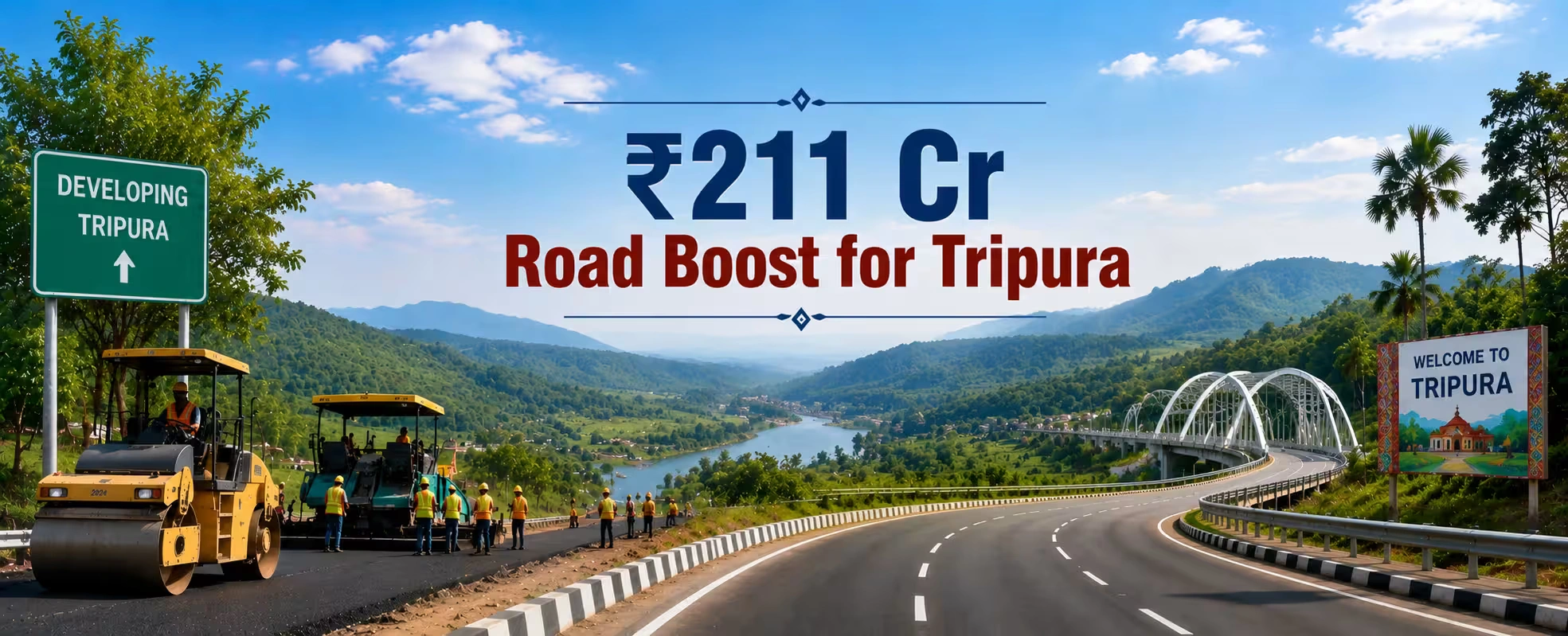
Tripura has received a significant rural infrastructure boost. The Union Ministry of Rural Development has approved 96 road works covering 163.872 kilometres at an estimated cost of ₹211.71 crore.
The ₹211 crore road projects in Tripura form part of Batch-I of PMGSY-IV for the 2026–27 financial year. Once completed, these roads are expected to provide year-round connectivity to 96 habitations that do not currently have reliable all-season road access.
For people living in remote settlements, this is more than a road-construction announcement. A dependable road can influence how quickly an ambulance arrives, whether students attend school during the monsoon, how farmers transport produce and how easily residents reach markets, banks and government offices.
The development may also influence rural land demand. However, rural property buyers must separate genuine infrastructure-led opportunities from short-term speculation. A sanctioned road does not automatically give every nearby plot direct access or guarantee rapid price appreciation.
Tripura’s ₹211 Crore Road Approval at a Glance
| Project detail | Officially announced information |
| Scheme | Pradhan Mantri Gram Sadak Yojana-IV |
| Approval batch | Batch-I |
| Financial year | 2026–27 |
| Estimated investment | ₹211.71 crore |
| Number of road works | 96 |
| Total road length | 163.872 km |
| Habitations expected to benefit | 96 |
| Main objective | First-time all-weather rural road connectivity |
| Approval announced | June 24, 2026 |
| District-wise list | Not included in the initial public announcement |
| Completion deadline | Not specified in the initial announcement |
These Tripura road projects 2026 are part of a wider effort to connect eligible rural habitations that remain outside the dependable road network.
Are 96 Villages or 96 Habitations Being Connected?
Many news headlines describe the beneficiaries as 96 villages. The Ministry of Rural Development’s official announcement, however, uses the word “habitations.”
The difference matters.
A village is an officially recognised revenue or administrative unit. A habitation is a cluster of people living within a village or rural area. One revenue village may contain more than one habitation, hamlet or settlement.
Therefore, it is more accurate to say that:
- The government approved 96 road works.
- These works will serve 96 habitations.
- The 96 habitations may not necessarily represent 96 separate revenue villages.
This distinction does not reduce the importance of the approval. It simply prevents readers and land buyers from assuming that a complete list of 96 separate villages has already been announced.
What Are the New Road Projects in Tripura?
The newly approved works are rural connectivity roads under PMGSY-IV. They are not national highways, urban flyovers or large expressways.
The scheme focuses on eligible rural habitations that still need reliable road access. Under the national PMGSY-IV framework, the government plans to connect qualifying unconnected habitations through all-season roads and construct or upgrade bridges wherever required along approved alignments.
The PMGSY-IV Tripura projects represent the first batch approved for the state for the 2026–27 financial year.
The initial announcement confirms the overall cost, number of works, total length and beneficiary habitations. It does not publicly identify:
- The names of all roads
- The names of all 96 habitations
- The district-wise distribution
- The length of each individual road
- The contractor for each work
- Tender dates
- Construction start dates
- Project-wise completion schedules
Residents and investors should wait for detailed sanction documents, tender notices or departmental project lists before assuming that a particular locality is included.
Also Read: Buy Agricultural Land in Tripura: Rules, Eligibility & Documents
What Does All-Weather Connectivity Actually Mean?
An all-weather road is designed to remain usable across normal seasonal conditions, including periods of heavy rainfall. It generally offers more dependable access than an unpaved track or seasonal route.
However, all-weather does not mean disruption-proof.
Road performance still depends on:
- Construction quality
- Drainage design
- Slope protection
- Culverts and bridges
- Regular maintenance
- Local rainfall intensity
- Erosion and landslide risks
- Control of overloaded vehicles
This matters in Tripura, where hilly terrain, high rainfall and drainage conditions can place considerable pressure on rural roads.
Good pavement without adequate side drains may deteriorate quickly. Similarly, a completed road can lose much of its value if damaged culverts, blocked drains or unstable slopes remain unattended.
The long-term success of Tripura rural road development will therefore depend not only on building roads but also on maintaining them properly.
Why These Road Projects Matter for Rural Tripura
Better access to schools
In poorly connected settlements, students may have to walk long distances before reaching a motorable road. During heavy rain, an unpaved route can become muddy, slippery or inaccessible.
A reliable road can make school transport more practical and reduce seasonal interruptions. It can also help teachers, educational materials and administrative staff reach remote institutions more consistently.
The benefit will not appear automatically, though. Communities may still need affordable transport services after road construction. A road creates access, but buses, shared vehicles and local transport determine how people use it.
Faster access to healthcare
Healthcare is one of the strongest reasons to improve rural connectivity in Tripura.
Consider a pregnant woman, an accident victim or an elderly patient living several kilometres from the nearest motorable route. Even when an ambulance is available, the lack of road access can delay treatment.
An all-season road can help ambulances and private vehicles reach settlements more quickly. It can also make it easier for health workers, vaccination teams and medicine suppliers to serve rural populations.
Easier movement of agricultural produce
For a farmer, poor connectivity can directly affect income.
Perishable produce loses value when transport takes too long. Small farmers may also depend on local intermediaries because they cannot move goods directly to a larger market.
A dependable road can help farmers:
- Transport produce more quickly
- Reduce handling damage
- Access more buyers
- Reach storage and processing facilities
- Bring fertiliser, equipment and other inputs to the farm
- Make more frequent trips to rural markets
A road alone cannot solve every agricultural problem. Farmers still need market information, storage, fair pricing and affordable transport. Yet connectivity removes one of the biggest physical barriers.
Stronger village-level commerce
Road access can support small shops, repair services, collection centres, transport businesses and other local activities.
A settlement that once received supplies only occasionally may attract more regular movement after a road becomes operational. This can encourage small-scale commercial activity around established habitation centres and market junctions.
That is how village infrastructure development can gradually support a wider local economy.
Improved access to government services
Residents of remote settlements frequently travel to block offices, banks, schools, health centres and administrative facilities.
Better connectivity can reduce the time and cost involved in these journeys. It can also make it easier for government personnel to deliver public services in rural areas.
How PMGSY-IV Fits into Tripura’s Existing Road Development
The new approval does not stand alone.
According to the Ministry of Rural Development, 1,594 road works covering 6,284 kilometres and 66 bridges had already been sanctioned in Tripura under different stages of PMGSY. The total approved investment across these works stands at ₹4,479 crore.
The latest 96 projects expand this rural network further.
At the national level, PMGSY-IV runs from the 2024–25 to 2028–29 financial years. The scheme has a total outlay of ₹70,125 crore and aims to provide 62,500 kilometres of roads to 25,000 eligible unconnected habitations.
The framework gives lower population thresholds to the Northeast and hill states so that smaller remote communities can also qualify. This makes the programme especially relevant to Northeast India infrastructure, where difficult terrain and dispersed settlements can raise the cost of last-mile connectivity.
How Could the New Roads Affect Tripura’s Rural Economy?
Road development can alter a village economy in stages.
During construction, projects may create temporary demand for labour, transport, materials, food and basic services. Once the roads become operational, the larger benefits can come through improved movement of people, farm produce and goods.
The potential outcomes include:
- Lower travel time
- More regular transport services
- Improved access to larger markets
- Better reach for healthcare and education
- Higher customer movement for local shops
- Greater viability for collection and distribution points
- Improved access for emergency and public-service vehicles
These changes can support economic development in Tripura, but outcomes will differ from one habitation to another.
A road connecting a productive agricultural cluster to a major market may create a stronger economic effect than a short road serving a small settlement with limited commercial activity. The connecting road’s condition, distance to the nearest town and availability of transport will also matter.
Will These Projects Increase Land Prices in Tripura?
Improved road access can increase buyer interest, but it does not guarantee an immediate or uniform price rise.
The impact of new roads on Tripura land prices will depend on several local factors:
- Exact road alignment
- Distance from the plot
- Direct and legal road access
- Width and classification of the connecting road
- Distance to a market or town
- Existing settlement activity
- Land category and permitted use
- Quality of the completed road
- Flooding and drainage conditions
- Availability of power and water
- Clarity of title
- Local restrictions on land transfer
- Future commercial or residential demand
A plot that gains direct access to a completed public road may become easier to use and resell. A plot located two kilometres away without a legal approach road may see little change.
Similarly, a narrow agricultural parcel beside a rural road does not automatically become commercial property. Land-use rules, setbacks, development permission and local demand still apply.
Approval Does Not Equal Immediate Property Appreciation
Infrastructure announcements often create rumours in rural land markets.
A broker may say:
- “The new road will pass directly beside this land.”
- “The rate will double when construction starts.”
- “Buy now before outsiders enter the market.”
- “The government has already marked the alignment.”
- “This agricultural land will become commercial.”
Do not rely on these statements without official documents.
Road projects usually move through several stages:
| Stage | What it means for a land buyer |
| Government approval | Budget and project scope receive approval |
| Detailed planning | Alignment, design and technical details are prepared |
| Tendering | Contractors bid for the work |
| Contract award | A contractor receives the work order |
| Construction | Physical work begins on the approved alignment |
| Completion | The road becomes usable, subject to inspection |
| Usage and maintenance | Actual economic impact becomes clearer over time |
The speculative risk is highest immediately after an announcement, when detailed local information remains limited.
The strongest evidence of an infrastructure-led land opportunity is not a WhatsApp message or broker’s promise. It is a combination of official alignment, visible work, legal access, completed connectivity and genuine local demand.
Which Types of Land Could Benefit Most?
Agricultural land with better market access
Farm plots may benefit when a new road connects them more efficiently to a collection point, local haat, processing unit or larger market.
People looking for agricultural land for sale in Tripura should assess whether the road genuinely lowers transport difficulty. A road that ends before reaching the farm may offer less value than expected.
Land near established village centres
Plots near an existing habitation, school, market or junction may experience stronger demand than isolated roadside land. Daily activity creates more practical use than road frontage alone.
Land suitable for small rural businesses
Subject to permissions and land classification, improved connectivity may support shops, storage facilities, repair services, collection points or small service businesses.
Residential plots near growing settlements
Where a road improves access to a town, block headquarters or employment centre, residential demand may increase gradually. The buyer must still check water, power, drainage and development permissions.
Land connected to tourism routes
Some rural locations may attract visitors when accessibility improves. However, buyers should not assume that every road-connected scenic location will become a tourism hotspot. Demand, amenities, environmental permissions and local planning remain important.
Which Land May Not Benefit Much?
Road announcements do not improve every property equally.
Be cautious about:
- Land without a recorded approach road
- Plots reached only through another person’s property
- Low-lying or flood-prone land
- Land affected by road widening
- Disputed plots
- Forest or government land
- Land with unclear boundaries
- Land under restricted ownership or transfer categories
- Agricultural land marketed as immediately commercial
- Property far from the actual project alignment
- Land near a proposed road that has not entered tendering or construction
A buyer considering property near upcoming road projects in Tripura should verify both the Jami Tripura Land Records, land record and the road record.
Will Dhalai, Gomati or North Tripura Receive These Roads?
The Ministry’s initial announcement does not provide the district-wise list.
Residents searching for road projects in Dhalai, rural roads in Gomati Tripura or road connectivity in North Tripura should not treat a state-level approval as proof that a specific road in their area has been sanctioned.
The same caution applies to West Tripura, South Tripura, Khowai, Sepahijala and Unakoti.
A locality should be considered part of the package only after its name or road appears in an official:
- Sanction list
- Detailed project report
- Tender notice
- Work order
- PMGSY project dashboard
- Departmental announcement
- Construction board displayed at the site
Until such information becomes available, district-level claims remain unconfirmed.
A Practical Land-Buyer Checklist
Before you buy land in developing areas of Tripura, complete the following checks.
Verify the project
- Confirm that the road appears in an official project or tender list.
- Check the exact start and end points.
- Identify the approved alignment.
- Ask whether the project is sanctioned, tendered, awarded or under construction.
- Check whether a bridge or culvert forms part of the connectivity.
- Visit the site during or after rainfall where possible.
- Do not rely only on a broker’s marked Google Map.
Verify the land
- Obtain the latest Record of Rights or Khatian.
- Match the seller’s name with the land record.
- Verify the plot number and total area.
- Examine the registered title documents.
- Check mutation records.
- Confirm physical possession.
- Conduct boundary identification or measurement.
- Search for mortgages, disputes and acquisition notices.
- Verify whether the land has legal road access.
- Check whether the proposed road will take any part of the land.
Verify permitted use
- Confirm the current land classification.
- Check whether conversion or change-of-land-use permission is required.
- Do not assume road frontage changes agricultural land into commercial land.
- Check local building, setback and development requirements.
- For a plotted or developer-led project, verify applicable RERA registration.
Check special transfer restrictions
Tripura has specific legal protections governing certain land transfers, particularly land belonging to members of Scheduled Tribes.
Depending on the parties and property, a transaction may require special compliance or prior permission. A registered deed should not be prepared until a local property lawyer has examined the land category, seller’s status and applicable restrictions.
Evaluate the investment realistically
- Compare actual registered and local transaction rates.
- Speak to residents, not only agents.
- Estimate how the road will change travel time.
- Check the distance to the nearest market, school and health centre.
- Study existing demand rather than relying on future promises.
- Keep enough time for legal verification.
- Avoid paying a large token amount before completing due diligence.
What Should Existing Landowners Do?
Landowners near an approved road should not rush to sell merely because enquiries increase.
First, establish what the road genuinely changes.
Ask:
- Does the road give the land direct access?
- Will part of the land be needed for construction or widening?
- Has the boundary been measured?
- Is the land title updated?
- Does the seller hold the entire plot or only a share?
- Can the land be legally used for the buyer’s proposed purpose?
- Has the local market experienced real transactions at higher rates?
A better road can strengthen a property’s usability, but asking prices and completed sale prices are not the same.
Owners planning to sell land near Tripura road projects should organise land records, title documents, tax receipts, mutation details and boundary information. Proper documentation attracts more serious buyers than unsupported appreciation claims.
What Should Investors Monitor Next?
The approval is the beginning of the project cycle, not the end.
Investors and residents should now watch for:
- Publication of the 96 road names
- District- and block-wise project distribution
- Tender invitations
- Contract awards
- Work commencement
- Alignment markings
- Bridge and drainage provisions
- Construction milestones
- Quality inspections
- Final completion and maintenance arrangements
The most meaningful real-estate impact usually appears after people begin using the road regularly. Actual travel patterns, local transport services and commercial activity provide better evidence than an approval announcement alone.
When Will the Tripura Road Projects Be Completed?
The Ministry’s June 24, 2026 announcement does not specify a completion date for the full package or individual road works.
A media report indicates that construction is expected to move forward after administrative and tendering procedures, but no common deadline has been publicly confirmed.
Project timelines may vary because each road can involve different terrain, drainage structures, clearances, tender responses and weather conditions.
Anyone asking when Tripura road projects will be completed should track the individual tender and work order rather than expecting all 96 roads to finish on one date.
Construction Quality Will Decide the Long-Term Benefit
The real test of the package will be the condition of these roads several monsoons after completion.
PMGSY-IV allows the use of modern construction practices and materials, including cold-mix technology, panelled cement concrete, cell-filled concrete, full-depth reclamation and selected waste materials where technically suitable.
Technology alone will not guarantee durability. Engineers and contractors must adapt the design to local soil, slope, rainfall and drainage conditions.
For Tripura, the most important construction issues may include:
- Cross drainage
- Side drains
- Stable embankments
- Slope protection
- Culvert capacity
- Erosion control
- Safe shoulders
- Maintenance after heavy rain
Poor drainage can damage an otherwise well-built road. Quality control must therefore focus on the complete road system rather than only the visible paved surface.
How 2Bigha Can Help Buyers Explore Land Opportunities
Improved connectivity can bring previously overlooked rural areas into the consideration set of land buyers.
2Bigha helps users explore land opportunities and compare locations before contacting sellers. Buyers can use the platform to discover options, but they should still verify road alignment, title, access, land category and local transfer rules independently.
Landowners who live outside Tripura or cannot regularly inspect their property may also explore 2Bigha’s subscription plan and property management service.
Technology can simplify land discovery and oversight. It cannot replace official records, site visits and professional legal verification.
Final Verdict: A Major Connectivity Boost, but Investors Must Stay Grounded
The Tripura road projects represent an important step towards connecting rural habitations that still lack dependable year-round access.
The scale is meaningful: 96 road works, 163.872 kilometres and an estimated investment of ₹211.71 crore. For affected communities, the roads can improve access to education, healthcare, markets and public services.
The projects may also create new interest in rural and agricultural land. Yet buyers should not treat the approval as a shortcut to guaranteed returns.
The sensible strategy is to:
- Wait for the official road list
- Confirm the exact alignment
- Track tender and construction progress
- Verify the property title
- Check legal access and land use
- Study genuine local demand
- Avoid buying on rumours
Road connectivity can improve land utility. Only clear ownership, lawful use, practical access and real demand can turn that utility into a sound property investment.
Disclaimer: This article is for informational purposes only and should not be considered investment, legal, financial, or property advice. Real estate regulations, infrastructure plans, market conditions, and government policies may change over time. Readers are advised to verify information with relevant authorities and consult qualified professionals before making any investment or property-related decisions.