There is a pattern that repeats itself every single time a new expressway gets built in India. Before the project is announced, the land sitting on either side is quiet. Farmers are working their fields. Prices have not moved in years. Nobody outside the local village even knows the name of these places. Then one day, something changes. A government notification comes out. A survey team shows up on the road. Word spreads that an expressway is coming. And within weeks, sometimes days, the same land that nobody cared about becomes the topic of conversations in cities far away.
This story has played out along the Yamuna Expressway, the Dwarka Expressway, the Delhi-Mumbai Expressway, the Purvanchal Expressway, and many others. It will continue to repeat across new growth corridors. For anyone planning to Buy Land in India, understanding how infrastructure, government planning, and market demand influence land prices leads to smarter investment decisions than simply following the crowd.
What the Land Looks Like Before an Expressway?
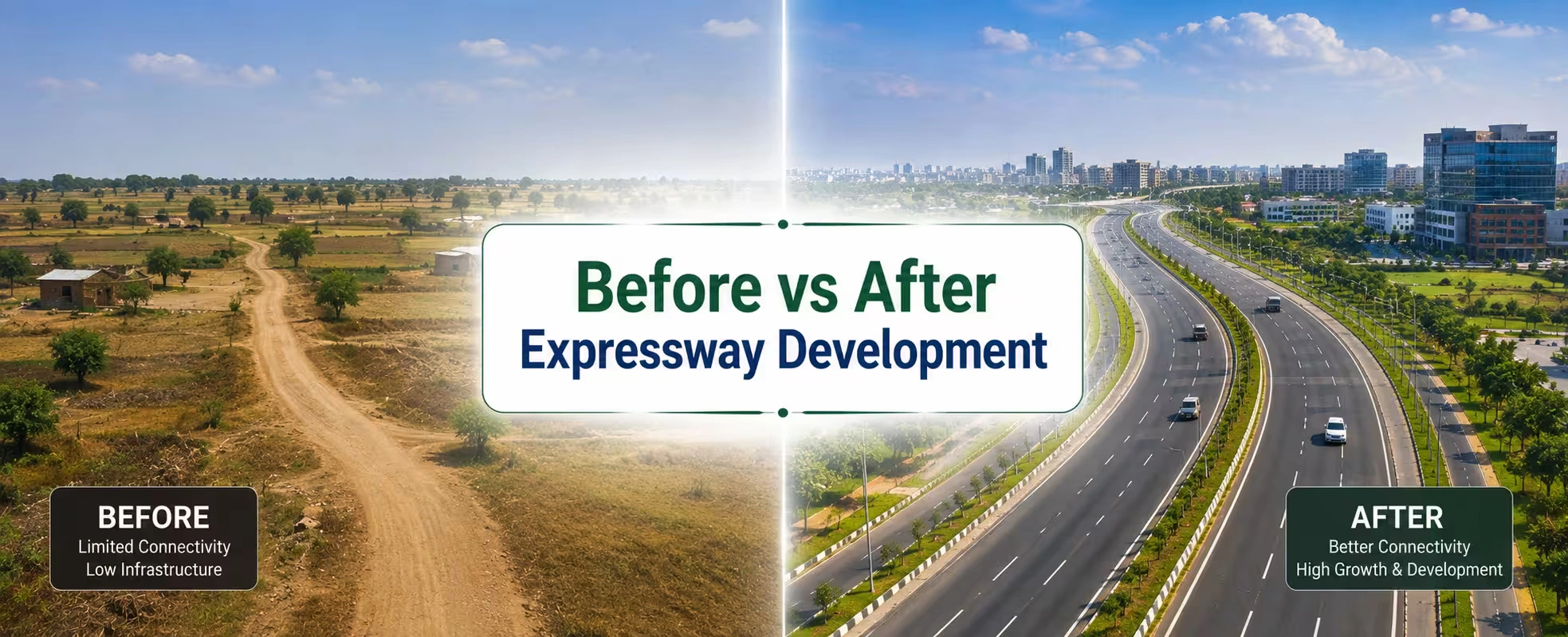
Before any expressway comes, the land along its future path has a very specific character. Most of it is agricultural. Families have been farming the same plots for generations. Prices reflect what the land can grow, not what it could become. In many cases, those prices have barely shifted in ten years.
The buyers in this market are almost entirely local. One farmer buying his neighbor's plot. A small local investor picking up a few bighas. The occasional person from a nearby town looking for something cheap. Nobody from any major city is paying attention. Roads are usually kaccha or barely paved. Electricity is inconsistent. The nearest decent hospital or school might be an hour away. That is the baseline; that is what the land is before anything happens.
The Announcement Phase: This Is When It Starts?
The first real shift does not happen when the expressway opens. It happens the moment the announcement is made. By the time that news hits newspapers, a certain amount of land along the route has already quietly changed hands. People with government connections know early. Local officials know. Big investors with the right contacts know. This is a documented pattern across every major corridor India has built.
| Factor | Before Announcement | After Announcement |
| Land price | Flat, based on farm value | Starts rising within weeks |
| Who is buying | Local farmers only | Outside investors arrive |
| Transaction volume | Slow and low | Sudden spike in deals |
| Seller behavior | Open to negotiation | Starts holding out for more |
| Media attention | None | Local and regional coverage |
This phase also brings confusion. Some land along the proposed route gets acquired by the government for the expressway itself. Farmers in the direct path deal with acquisition notices and compensation discussions. Farmers just outside that zone suddenly find their land in demand.
The Construction Phase: Where the Real Opportunity Sits
Once construction starts, two things happen at the same time. Living near the site becomes genuinely difficult. Dust, noise, heavy machinery, broken access roads. Some farmers find their field access blocked for months. This phase is hard for people who actually live there.
At the same time, smart investors are quietly buying land. They are not buying for next year. They are buying because they can already see what the finished expressway will do to land values, and they are picking it up at prices that still carry the construction-phase discount. This is historically where the best deals happen in any expressway corridor. Not before the announcement, when prices are at the bottom, but almost nobody has information. Not after the opening, when prices have already run. During construction, when the opportunity is clear, but the disruption keeps most buyers away.
What Actually Changes After the Expressway Opens?
When an expressway opens, the changes do not come gradually. They arrive in waves.
Connectivity changes overnight. A town that took two and a half hours from the city now takes forty-five minutes. That single change rewrites the land use math entirely. What was too far for a commuter is suddenly manageable. What was too remote for a warehouse is now perfectly placed.
Industrial and logistics interest arrives first. Warehousing, cold storage, light manufacturing- these sectors move fast after a new expressway opens. They need large flat land parcels with easy truck access. Expressway-adjacent agricultural land fits that description exactly. This is the first wave of commercial demand that hits any new corridor.
Residential development follows. Workers come in for industrial zones. Housing demand follows workers. Developers start acquiring agricultural land for conversion. Plotted developments appear. Apartment projects get announced. How fast this happens depends on how close the expressway brings the area to a major city.
Prices move in stages, not all at once. Land closest to interchanges and exits moves first and fastest. Land five kilometers from an interchange moves more slowly. Land with no direct connecting road to the expressway may barely move at all, even if it technically sits close to the route.
The Factors That Actually Determine How Much Land Prices Move
Not every expressway creates the same opportunity. These are the specific factors that decide how much, and how fast, land prices change.
Distance from the interchange, not the expressway. An interchange is where vehicles actually get on and off. Land one kilometer from an interchange is dramatically more valuable than land one kilometer from the expressway itself but ten kilometers from the nearest exit. Many buyers miss this and end up with land that benefits very little.
Which cities sit at both ends. The Yamuna Expressway created massive appreciation because it linked to Greater Noida and Agra, both large urban centers. An expressway connecting two small towns with limited economic activity creates far less land demand. The bigger the city at one or both ends, the stronger the land price story.
Government industrial and zoning decisions. If the state government designates land near the expressway for an industrial cluster or special economic zone, demand rises sharply and fast. If no such designation comes, appreciation is slower and depends only on organic residential growth.
Land use classification and conversion rules. Almost all land near a new expressway starts as agricultural. Converting it to residential, commercial, or industrial use needs state government approval. States with clear and faster conversion processes see faster market development. States where conversion is slow or uncertain see appreciation lag, even when the expressway itself is excellent.
Water and utility availability. An expressway brings roads. It does not automatically bring water lines, sewage, gas, or reliable electricity. Areas where utilities can be extended easily develop faster. Areas where utility extension is difficult or expensive develop slower regardless of how good the expressway is.
Population density along the corridor. A corridor passing through dense, populated towns generates faster demand. More people means more immediate housing need, more retail activity, and faster infrastructure follow-through from local government.
| Factor | Strong Price Impact | Weak Price Impact |
| Interchange distance | Within 2 km | Beyond 8 km |
| City at corridor ends | Large metro or city | Small towns only |
| Industrial policy | SEZ or cluster designated | No specific plan |
| Conversion process | Fast and clear | Slow and uncertain |
| Utility availability | Easy to extend | Expensive or blocked |
| Developer activity | Large developers present | Only small local buyers |
What Farmers Actually Experience, The Side Nobody Talks About?
The expressway land story is usually told from the investor's point of view, but the farmer's experience is often very different. For farmers whose land falls within the acquisition zone, the process can be slow and complex. Although compensation improved after the 2013 Land Acquisition Act, it does not always reflect the long-term livelihood farming provides. For those planning to Sell Land in India, understanding acquisition policies, compensation rules, and market trends is essential before making a decision.
For farmers sitting just outside the acquisition zone, the experience can be very good if they hold on. Most do not. They sell early, at prices that look good compared to what they were offered before, but that are a fraction of what the land will be worth five years after the expressway opens.
This repeats across every corridor. The original landowners often benefit less than the investors who bought during construction. A big reason is the information gap. Farmers know farming. They do not always have access to the same market data that investors and developers work with. Direct buyer-seller platforms narrow this gap, but it has not disappeared.
Real Corridor Examples From India
Yamuna Expressway Land along this corridor was selling at very low rates per square meter in the early planning stages. After it opened in 2012, prices in several pockets multiplied significantly. The Jewar interchange, now the site of Noida International Airport, saw the most dramatic long-term appreciation of any point along the route.
Dwarka Expressway: One of the most delayed expressway projects in the country, nearly fifteen years from planning to operation. Buyers who entered during construction and held through the delays were eventually rewarded. Buyers who expected quick returns suffered years of stagnation and some sold at losses before the appreciation finally came.
Delhi-Mumbai Expressway Land near this corridor, particularly in Haryana districts like Nuh and Sohna, and in Rajasthan near Alwar, has already seen rising inquiry volumes even before the full expressway is operational. Investors who watched the Yamuna and Dwarka stories play out are moving earlier here.
Purvanchal Expressway: Connected districts in eastern Uttar Pradesh that had almost no investment activity before. Agricultural land near expressway towns in that corridor saw meaningful price movement as industrial and warehousing interest followed the improved connectivity.
The Mistakes Most Buyers Make
Buying close to the expressway but far from an interchange. Already said, but worth repeating because it is the single most common mistake in this category of investment. Assuming the timeline will be short. Expressway construction in India almost always runs longer than the announced date. Buyers expecting two-year appreciation and then being forced to sell during construction often break even or lose money.
Not checking land use classification. Buying agricultural land assuming conversion will be easy, and then finding it is blocked by environmental orders or policy restrictions, is a lesson many buyers have learned the hard way near forest zones and Aravalli-adjacent corridors.
Ignoring due diligence because the location feels exciting. An expressway does not clear a title dispute. It does not remove an encumbrance. It does not resolve a boundary conflict. All the standard legal checks still apply, and arguably matter more in high-demand corridors because higher prices attract more fraudulent activity. Buying land with no physical road access to the expressway. Land locked behind other plots with no access road is worth far less than its map location suggests, regardless of how close it sits to the route.
Find Verified Land Near Expressway Corridors on 2Bigha.ai.
When you are looking to buy land in India near an expressway corridor, the verification process matters more than usual. Higher demand means more listings, but also more misinformation and more fraud. 2Bigha is a platform built specifically for agricultural land and farmland transactions across India. Verified listings, direct buyer-seller connections, and real market data, all in one place. Whether you are looking for farmland for sale in India near a major corridor, a plot for sale in India at a fair price, or you want to sell land in India to genuine buyers without broker interference, 2Bigha is built for exactly this.
| What 2Bigha Offers? | Why It Matters Here? |
| Verified listings only | Less fraud risk in high-demand corridors |
| Real price trend data | Know if a corridor is already overpriced |
| Pan-India land coverage | Compare multiple corridors before deciding |
| Direct buyer-seller connect | No broker inflating numbers or hiding facts |
| Agricultural land expertise | Guidance specific to your land type and location |
Visit 2bigha.ai to explore verified land listings across India's expressway corridors.
Conclusion
Expressways change land. That is the simple truth behind every infrastructure project India has built in the last thirty years. What changes is not just the price. It is who wants the land, what they plan to use it for, and how fast that demand grows. The pattern is consistent across every corridor, but the timing, the magnitude, and the specific pockets that actually benefit are different each time. Buying land near an expressway at the right point in the cycle, in the right location, with clean documentation- that combination has created real wealth for a lot of people in this country. Getting any one of those three things wrong is how the same opportunity becomes an expensive lesson.
Do the research. Check how far the land sits from the nearest interchange. Verify the land use classification before assuming anything. Run full legal due diligence. And when you are looking for Farmland for Sale in India or a plot for sale in India near a new corridor, work with a platform that verifies what it lists.