Key Takeaways
UP Bhulekh Sonbhadra helps buyers, sellers, farmers, investors, and families check land records online before making any property decision in Sonbhadra district.
You can use the UP Bhulekh portal to check khatauni details, khasra/gata number, landholder name, village record, sale status, litigation status, and other basic land information.
For a safer land purchase, never depend only on verbal promises, broker details, or listing photos. Always verify Sonbhadra land records, plot boundaries, ownership details, and revenue entries before payment.
UP Bhulekh is useful for initial verification, but final legal checking should include certified records, registry documents, mutation status, physical site inspection, and local revenue-office confirmation.
For buyers searching for land for sale in Sonbhadra, agricultural land, plots, or farmland, digital verification can reduce risk, improve negotiation confidence, and help avoid disputed land.
Introduction: Why Land Record Verification Matters in Sonbhadra
Purchasing land in India cannot be compared with purchasing ordinary products. There is much information about such property, such as previous owner, revenue documents, boundaries, mutations, road accessibility, usage, family issues, and possible ongoing legal disputes. In the case of Sonbhadra District, one should consider that the land there can be agricultural land, village land, land close to the forest, influenced by mining, rural area, and local development area.
This is precisely the reason why the UP Bhulekh Sonbhadra service has become an important starting point for those who need to get any information on the land through the Internet. The UP Bhulekh website will allow you to view all the necessary records regardless of whether you are a local agriculturist, NRI relative, buyer, seller, land owner, or ancestral land checker.
In simple words, UP Bhulekh helps you check “what the land record says.” It does not replace legal due diligence, but it gives you a strong first layer of verification.
For example, if someone is offering a plot near Robertsganj, Dudhi, Obra, Ghorawal, or Renukoot, you should not only ask for the registry copy. You should also check whether the owner’s name appears in the khatauni, whether the khasra/gata number matches the land being shown, whether the plot has any sale or dispute status, and whether the village record matches the location. This is where check Sonbhadra land record online becomes a practical step, not just a technical process.
What Is UP Bhulekh Sonbhadra?
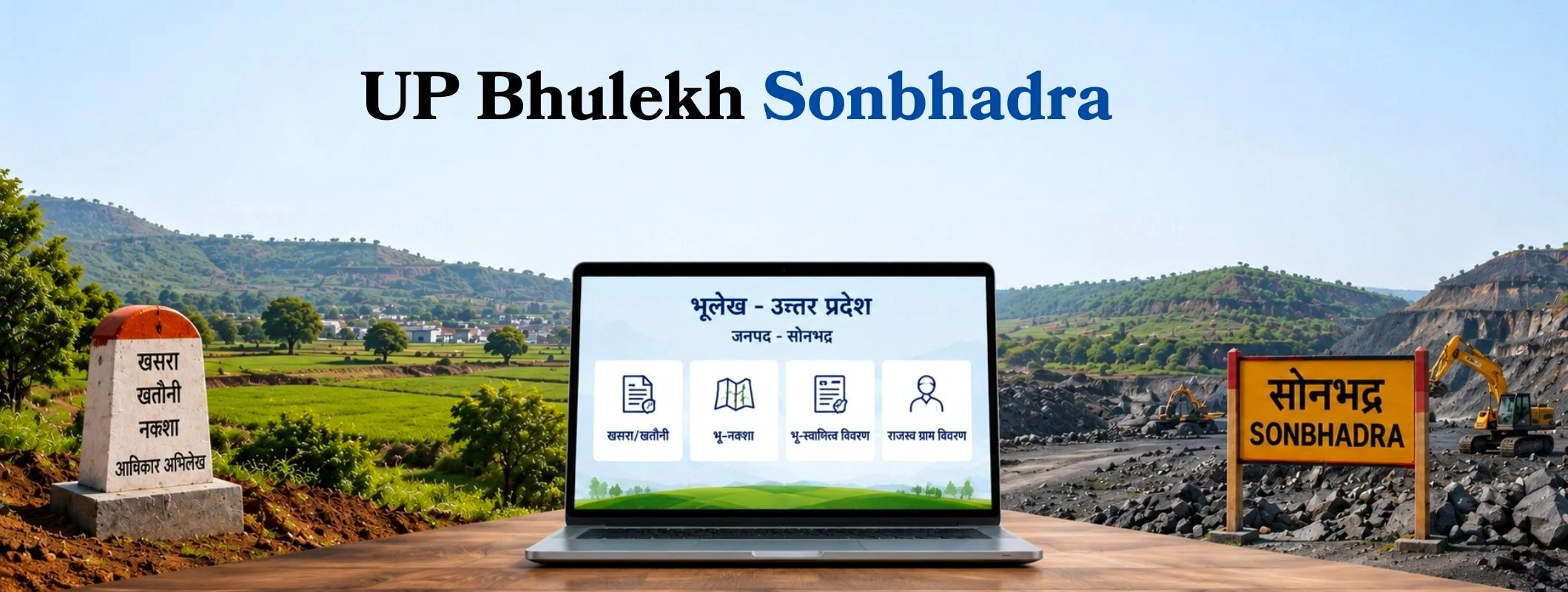
UP Bhulekh Sonbhadra refers to the online land record system through which users can access land-related information for villages and revenue areas within Sonbhadra district of Uttar Pradesh.
The word “Bhulekh” generally means land records. In Uttar Pradesh, the UP Bhulekh portal allows people to view khatauni, khasra/gata details, landholder information, revenue village data, and plot-related status. For Sonbhadra, this is especially useful because many land parcels are located in rural or semi-rural areas where proper record checking is necessary before buying, selling, inheriting, leasing, or managing land.
When you search for Sonbhadra land records, you are usually trying to confirm one or more of these details:
- Who is recorded as the landholder?
- What is the khasra or gata number?
- Which village and tehsil does the land fall under?
- What is the land area as per revenue records?
- Is the plot recorded as agricultural, residential, government, forest, or another land type?
- Has the land been sold recently?
- Is there any litigation or dispute status attached to the plot?
- Does the land map match the actual plot shown on-site?
These questions matter because many land issues start from small mismatches. A seller may show one plot but provide documents for another. A family member may claim ownership even when mutation is pending. A broker may show approximate boundaries without checking the official land map Sonbhadra record. UP Bhulekh helps reduce these risks at the early stage.
Why Sonbhadra Land Records Need Careful Verification
Sonbhadra is not a small urban property market where most deals are apartment-based. It is a large district with villages, agricultural land, natural resources, industrial belts, power projects, forest-side regions, and land parcels spread across different tehsils. This makes land verification more sensitive.
Sonbhadra is also strategically located because it borders multiple states, which increases movement, trade, and land interest in different pockets. Buyers often look for agricultural land, rural plots, farmhouse-type land, or future-growth locations. But where land demand increases, documentation mistakes and unclear claims can also increase.
That is why verify plot details Sonbhadra should be treated as a mandatory step before any deal.
A buyer may like a plot because it is near a road, village settlement, water body, industrial zone, or future development corridor. But attractive location is not enough. The buyer must confirm whether the land is legally transferable, whether the recorded owner has the right to sell, whether the boundaries match, and whether there are restrictions on use.
A good land-buying decision in Sonbhadra should combine three things:
- Online record checking through UP Bhulekh
- Physical land inspection
- Legal and revenue-office verification
Only after these three steps should a buyer move toward token payment, agreement, or registry.
What Details Can You Check on UP Bhulekh for Sonbhadra?
The UP Bhulekh portal allows users to access important land record information. For Sonbhadra, buyers and landowners commonly use it to check:
1. Khatauni Details
Khatauni is one of the most important land records in Uttar Pradesh. It shows details of landholding, landholder name, khasra/gata number, area, and related revenue entries. If you are checking UP Bhulekh Sonbhadra khasra khatauni, this is usually the main record you want to view.
A khatauni helps you confirm whether the person claiming ownership is actually recorded in the revenue record. However, you should remember that khatauni is part of revenue documentation. For final legal clarity, compare it with registry papers, mutation records, family settlement documents, and other legal records.
2. Khasra or Gata Number
The khasra or gata number works like an identity number for a land parcel in village revenue records. If you know the khasra number Sonbhadra, you can search land details more accurately.
Many land searches fail because people only know the owner’s name or village name. In rural land deals, names may repeat within the same village. A khasra/gata number reduces confusion and helps identify the correct parcel.
3. Landholder Name
You can check the landholder name as recorded in the revenue entry. This is helpful when you want to verify the plot owner name Sonbhadra before making a buying decision.
If the seller’s name and landholder name do not match, do not panic immediately, but do not ignore it either. There may be valid reasons such as inheritance, mutation pending, joint ownership, or family partition. Still, you should ask for supporting documents and get the record checked properly.
4. Revenue Village Details
Every rural land parcel is linked to a revenue village. You need the correct district, tehsil, village, and sometimes pargana details to access records. Village land record Sonbhadra checking becomes easier when you know the exact village name and not just the nearby town or local landmark.
For example, a seller may say the land is “near Robertsganj,” but the actual revenue village may be different. Always ask for the village name as per land record, not just the market name or local identity.
5. Sale Status of Plot
UP Bhulekh allows users to check whether a land parcel has a sale-related status. This can be helpful before finalising a transaction because it may show if the plot or gata has already been involved in a sale entry.
This is especially useful when you are evaluating property for sale in Sonbhadra and want to avoid duplicate sale risk or unclear transactions.
6. Litigation or Dispute Status
A clean-looking plot can still have a legal dispute. UP Bhulekh provides an option to check whether a plot is linked with a dispute or litigation status. This is not the only legal check you should do, but it is a useful first filter.
Before buying verified land in Sonbhadra, buyers should also check revenue court cases, civil court records where applicable, local objections, family claims, and physical possession.
7. Bhu Naksha and Plot Boundary Reference
The UP Bhu Naksha portal helps users view village maps, plot outlines, and gata-wise map references. For Sonbhadra, Sonbhadra bhulekh naksha can help you understand the approximate location and surrounding plots.
However, map verification should not replace on-ground measurement. If there is a mismatch between map, khatauni, and physical boundary, take help from a local lekhpal, revenue official, surveyor, or legal expert.
UP Bhulekh vs Bhu Naksha vs Physical Verification
The table below explains how each verification method helps in a land transaction.
| Verification Method | What It Helps You Check | Best Used For | Limitation |
| UP Bhulekh | Khatauni, landholder name, khasra/gata number, village record, sale/litigation status | Initial record verification | Does not replace legal title checking |
| UP Bhu Naksha | Plot map, village map, boundary reference, nearby gata numbers | Understanding plot location and layout | Map boundaries may need physical confirmation |
| Registry Documents | Legal sale deed and transaction history | Ownership transfer review | Must be checked with mutation and revenue records |
| Mutation Record | Whether ownership change is updated in revenue records | Confirming updated landholder entry | Pending mutation can create confusion |
| Physical Site Visit | Actual possession, approach road, boundary, encroachment, local issues | Final ground reality check | Needs local knowledge and measurement support |
| Legal Due Diligence | Title chain, disputes, inheritance, restrictions, court cases | Safe purchase decision | Requires professional review |
This comparison shows one important point: UP land records Sonbhadra online are very useful, but they are only one part of safe land buying. A serious buyer should combine online data with document review and ground verification.
How to Check Sonbhadra Land Records Online on UP Bhulekh
If you want to check land records in Sonbhadra, keep your basic details ready before opening the portal. You may need the district name, tehsil, village, khasra/gata number, khata number, or landholder name.
Here is a practical step-by-step process.
Step 1: Visit the UP Bhulekh Portal
Open the official UP Bhulekh portal and choose the relevant land record service. For most users, the main requirement is to check khatauni or land record copy.
Search carefully. Many unofficial websites use similar names, but land buyers should always rely on the official UP land record portal for primary checking.
Step 2: Select District as Sonbhadra
Choose Sonbhadra as the district. This step is important because Uttar Pradesh has many districts, and similar village names can exist in different districts.
Once you select Sonbhadra, the portal will ask you to choose the tehsil.
Step 3: Select the Correct Tehsil
Sonbhadra includes important tehsil areas such as Robertsganj, Dudhi, Ghorawal, and Obra. Choose the tehsil correctly.
For example, if you are checking bhulekh Dudhi Sonbhadra, make sure you select Dudhi tehsil and then the correct revenue village. Similarly, for bhulekh Robertsganj, choose the correct tehsil before moving ahead.
Step 4: Select the Revenue Village
Now choose the village where the land is located. This is where many users make mistakes. The village name used locally may not always match the official revenue village name.
Ask the seller for the exact revenue village name from the khatauni or registry document. This will make the search easier and more accurate.
Step 5: Search by Khasra/Gata, Khata Number, or Name
You can search the record using available details. The most reliable option is usually the khasra/gata number because it identifies the land parcel more specifically.
If you search by name, be careful. Many people in one village may have similar names. Always match the father’s name, land area, khata number, and khasra/gata details before assuming the record is correct.
This step is useful for anyone looking for land record by khasra number Sonbhadra or trying to check land details before buying.
Step 6: Review the Khatauni Details
After opening the record, check the landholder name, gata number, land area, land type, and other available entries.
For buyers, this is the most important part. If the seller’s details, land area, or gata number do not match the document given to you, ask for clarification before moving forward.
Step 7: Download or Save the Record for Review
You may take a print or save the available record for discussion with a lawyer, family member, property consultant, or revenue expert. For legal use, check whether a certified copy is required.
Do not treat a screenshot as final proof of ownership. Use it as a reference for further checking.
How to Check Sonbhadra Bhu Naksha Online
The Bhu Naksha portal helps you check the map-side view of a land parcel. This is useful when you want to understand the plot’s rough position, adjoining plots, and village map layout.
To check Sonbhadra bhulekh naksha, follow this approach:
- Open the official UP Bhu Naksha portal.
- Select Uttar Pradesh, Sonbhadra district, tehsil, and village.
- Enter or select the relevant gata/khasra number.
- View the plot outline on the village map.
- Compare the map with khatauni details and site visit observations.
Bhu Naksha is very helpful, but it should be used with caution. The map gives a digital reference. It does not always solve boundary disputes, encroachment issues, or exact measurement problems on its own.
For example, if a seller shows you a field boundary on-site and says “this entire area is included,” do not rely only on visual judgement. Check the map, khatauni area, nearby gata numbers, and physical measurement. If needed, request proper demarcation through the relevant revenue process.
What Is Khatauni and Why Is It Important?
Khatauni is a landholding record used in Uttar Pradesh. It shows who is recorded as the landholder and what land parcels are linked with that holding.
For a buyer, online khatauni Sonbhadra helps answer one basic question: “Does the land record support the seller’s claim?”
A khatauni may include:
- Khata number
- Landholder name
- Father’s or family reference
- Khasra/gata number
- Area of land
- Land category or type
- Revenue village details
- Related entries or remarks
This is why people often search for check khatauni Sonbhadra before buying or selling rural land. It helps reduce confusion and gives a documented starting point.
However, khatauni alone is not the full title report. For a safe transaction, compare it with the registered sale deed, mutation status, inheritance records, family consent documents, court-case status, and physical possession.
What Is Khasra or Gata Number in Sonbhadra Land Records?
A khasra or gata number is the plot identification number used in village land records. Think of it as the official reference number for a land parcel.
When someone says they have agricultural land in a village, ask for the khasra/gata number. Without this number, verification becomes weak.
For example, if you are reviewing agricultural land for sale in Sonbhadra, the seller should be able to provide:
- District
- Tehsil
- Village
- Khata number
- Khasra/gata number
- Land area
- Owner details
- Registry or title documents
Once you have the khasra/gata number, you can check whether the same land appears in the UP Bhulekh record and whether the map location matches.
This step is very important for Sonbhadra land ownership check before buying because it protects you from wrong-plot claims, boundary confusion, and unclear ownership.
Common Mistakes People Make While Checking UP Bhulekh Sonbhadra
Many people open the portal, search one name, see a familiar entry, and assume everything is correct. That is risky. Land records need careful reading.
Here are common mistakes to avoid.
Mistake 1: Searching by Name Only
Names can repeat in the same village. A record may show the same or similar name, but it may not be the seller’s land. Always match khata number, khasra/gata number, father’s name, village, and land area.
Mistake 2: Ignoring Joint Ownership
Many rural land parcels are jointly owned by family members. If only one person is selling, check whether all legal owners have agreed. A missing family consent can create disputes later.
Mistake 3: Not Checking Mutation
Registry and mutation are different. A buyer may have a sale deed, but if mutation is not updated, revenue records may still show the old landholder. Always check whether ownership changes are updated in the record.
Mistake 4: Not Comparing Map and Site
A plot may look clear on-site, but the map may show a different shape, approach, or nearby gata numbers. Always compare Bhu Naksha with physical boundaries.
Mistake 5: Ignoring Litigation Status
Before buying land, check whether the land has any dispute or case-related indication. Also ask a legal expert to check court and revenue records where needed.
Mistake 6: Trusting Only Broker Information
A broker may know the local market, but land records must be verified independently. Do not make payment only because someone says “record clear hai.” See the record yourself.
Land Buying Checklist for Sonbhadra Buyers
Use this checklist before buying farmland for sale in Sonbhadra, residential plots, village land, or agricultural land.
| Checklist Point | Why It Matters |
| Check UP Bhulekh khatauni | Confirms revenue landholder details |
| Verify khasra/gata number | Confirms correct plot identity |
| Match village and tehsil | Avoids wrong-location confusion |
| Check Bhu Naksha | Helps review map and boundaries |
| Confirm physical possession | Ensures seller controls the land |
| Review registry documents | Checks legal transfer history |
| Check mutation status | Confirms revenue record update |
| Verify sale/litigation status | Reduces dispute risk |
| Check land-use type | Helps avoid wrong-use purchase |
| Confirm road access | Important for future use and resale |
| Take local legal advice | Protects against hidden risks |
This checklist is useful for anyone planning to buy land in Sonbhadra or compare multiple land options before finalising a deal.
How Sellers Can Use UP Bhulekh Before Listing Land
UP Bhulekh is not only useful for buyers. Sellers can also use it before listing land.
If you want to sell land in Sonbhadra, you should first check whether your land record is updated. Many sellers face delays because the khatauni still shows an old owner, mutation is pending, family shares are unclear, or the plot map does not match the actual boundary.
Before listing your land, prepare these details:
- Updated khatauni copy
- Khasra/gata number
- Registry document
- Mutation status
- Bhu Naksha reference
- Land area details
- Road access details
- Clear photographs and location information
- Family consent, if jointly owned
When your documents are clear, buyers feel more confident. Your land also becomes easier to present on real estate platforms because serious buyers ask for verification before negotiation.
2Bigha helps landowners and buyers approach land discovery with better structure. If you are planning to list or manage land, its subscription plan and property management service can support more organised land visibility and ongoing property care.
Why UP Bhulekh Matters for Agricultural Land in Sonbhadra
Sonbhadra has strong rural land relevance. Many buyers search for agricultural land, farm plots, and village land for long-term holding. But agricultural land has special considerations.
Before buying agricultural land, check whether:
- The land is recorded as agricultural land
- The seller is the recorded landholder
- There are co-owners or family claims
- The land is free from disputes
- The plot has proper access
- There are any land-use restrictions
- The land falls near forest, mining, industrial, or restricted zones
- Conversion is required for non-agricultural use
If someone is offering agricultural land for sale in Sonbhadra, do not judge only by price per bigha or road distance. A cheaper plot with unclear records can become expensive later.
Similarly, do not assume that every agricultural land can be used for farmhouse, commercial activity, warehouse, or plotting. Land use depends on local laws, permissions, and revenue classification.
Can UP Bhulekh Help in Property Verification?
Yes, UP Bhulekh is helpful for property verification Sonbhadra, especially at the first stage. It helps you check whether the land details given by the seller are matching the official revenue record.
But property verification should not stop there.
A practical verification process should include:
- Check khatauni on UP Bhulekh.
- Check the plot map on Bhu Naksha.
- Match khasra/gata number with registry documents.
- Confirm mutation status.
- Check whether the land has any dispute or sale status.
- Visit the land physically.
- Speak with local revenue officials or a legal advisor.
- Confirm road access, possession, and boundary.
- Avoid cash-heavy informal payments.
- Complete transaction through proper legal documentation.
For high-value land deals, it is better to spend time on due diligence than lose money later in disputes.
How Buyers Can Use Online Records During Negotiation
Online land records are not only for safety. They also help in negotiation.
If the seller claims the land is larger than what appears in the record, you can ask for clarification. If the land is jointly owned, you can ask whether all owners will sign. If the map shows limited access, you can negotiate accordingly. If mutation is pending, you can request completion before payment.
This gives buyers more control.
For example, suppose you are reviewing plot for sale in Sonbhadra near a growing local road belt. The seller says the land is ideal for future appreciation. That may be true, but you should still check:
- Is the recorded area the same as claimed?
- Is the seller’s name in the khatauni?
- Is the plot reachable by legal road access?
- Is there any dispute status?
- Is the land actually suitable for your intended use?
A buyer who checks records properly negotiates from facts, not assumptions.
Why Digital Land Verification Is Important for NRIs and Outstation Buyers
Many families from Sonbhadra now live in cities such as Varanasi, Lucknow, Delhi NCR, Mumbai, Pune, Bengaluru, or outside India. They may still own ancestral land or want to invest in rural property. For such users, UP land records Sonbhadra online are very useful.
Digital records allow outstation users to check basic details before sending someone to the village or tehsil. They can verify whether the family land is still recorded correctly, whether mutation is pending, or whether any unexpected change appears in the record.
However, remote checking has limits. If you are not physically present, appoint a trusted person for site inspection and document collection. For inherited land, check succession, family settlement, and mutation carefully.
2Bigha can be useful for users who want a more organised way to explore and manage land-related opportunities. Its subscription plan and property management service can support buyers and owners who want better visibility and structured property support.
Local Areas Where People Commonly Search Land Records in Sonbhadra
Land record searches in Sonbhadra are often linked with tehsil and local belt names. Some users search for:
- bhulekh Robertsganj
- bhulekh Obra Sonbhadra
- bhulekh Dudhi Sonbhadra
- bhulekh Ghorawal Sonbhadra
- bhulekh Renukoot Sonbhadra
These searches usually happen when users know the broader local area but need the exact revenue village. For accurate record checking, always move from district to tehsil to village to khasra/gata number.
Local names can be different from official revenue names. A land parcel may be marketed as “near Renukoot” or “close to Obra,” but the revenue village may fall under a different official entry. That is why document-level details matter.
UP Bhulekh Sonbhadra for Land Buyers: Practical Example
Let us take a simple example.
A buyer finds a 2-bigha agricultural plot near a village in Sonbhadra. The seller says the land is clear, road-touch, and ready for registry. The price looks attractive. Before paying token money, the buyer should ask for the khasra/gata number and village name.
Then the buyer should check Sonbhadra plot details online through UP Bhulekh. If the khatauni shows the same seller name and same land area, the first step looks positive. Next, the buyer should check Bhu Naksha to see the plot’s approximate position and nearby gata numbers.
After that, the buyer should visit the site. During the visit, the buyer should check boundary, access road, neighbouring land, current possession, cultivation, and any local dispute. Then a legal expert should compare the registry documents, ownership chain, mutation status, and any case history.
Only after all these checks should the buyer move ahead.
This process may feel lengthy, but it protects your money.
UP Bhulekh Sonbhadra for Sellers: How to Build Buyer Trust
If you are selling land, updated records help you attract serious buyers. Buyers are more confident when you can share basic record details clearly.
Before listing land, check:
- Is your name updated in khatauni?
- Is mutation completed?
- Are all co-owners ready to sell?
- Does the land area match the record?
- Is the plot free from known disputes?
- Does Bhu Naksha match the land being shown?
- Are documents clean and readable?
A seller who provides clear details can reduce negotiation delays. It also improves trust on land discovery platforms and during buyer discussions.
If you want to list land professionally, provide location details, land type, record status, access details, and ownership clarity. Buyers searching for verified land in Sonbhadra are more likely to respond when the listing looks transparent.
Things UP Bhulekh Cannot Fully Confirm
UP Bhulekh is powerful, but it cannot confirm everything. Buyers should understand its limits.
UP Bhulekh may not fully confirm:
- Actual physical possession
- Boundary encroachment
- Family-level informal disputes
- Unregistered agreements
- Oral sale arrangements
- Exact road width
- Soil quality
- Water availability
- Future zoning changes
- Local objections
- Complete legal title chain
That is why online land verification UP should be treated as the first step, not the final answer.
If the transaction value is high, take legal advice. If the land will be used for farming, farmhouse, warehousing, plotting, or commercial use, confirm land-use rules before purchase.
Documents to Ask Before Buying Land in Sonbhadra
Before buying land, ask the seller for these documents:
- Latest khatauni copy
- Khasra/gata details
- Registry or sale deed
- Mutation record
- Bhu Naksha reference
- Identity proof of seller
- Family consent documents, if applicable
- No-objection documents, where required
- Court-case or dispute declaration
- Tax or revenue payment records, if available
You should also check whether the land belongs to a restricted category or needs special permission for transfer. Some land transactions in Uttar Pradesh may require additional legal caution depending on land type, seller category, and buyer profile.
UP Bhulekh Sonbhadra and Real Estate Platforms: How Both Work Together
Real estate platforms help buyers discover land options. Government land record portals help buyers verify official details. Both have different roles.
A land listing may show photos, location, price, area, seller information, and nearby facilities. But the listing itself is not proof of title. Before buying any land, buyers should check Sonbhadra revenue land records and match them with seller documents.
This is where a platform-first and record-first approach works well. You can discover land opportunities through a platform like 2Bigha, shortlist suitable options, then verify records through UP Bhulekh and Bhu Naksha before moving ahead.
For land buyers and owners who want more organised support, 2Bigha’s subscription plan and property management service can add value by helping users handle land discovery and property care with better structure.
Is Online Khatauni Enough for Buying Land?
No. Online khatauni is important, but it is not enough by itself.
A khatauni can show the recorded landholder and land details, but a safe land purchase needs a wider title check. You should compare khatauni with registry, mutation, family ownership, land-use status, and physical possession.
For example, if the khatauni shows the seller’s father’s name but the seller says he inherited the land, ask whether succession and mutation are completed. If not, the seller may still need proper documentation before selling.
Similarly, if the land is jointly held, all co-owners may need to participate in the sale. A buyer who ignores this may face objections after registry.
How to Read Sonbhadra Land Records Carefully
When you open a land record, do not only look at the name. Read the full details.
Check these points:
- District: Sonbhadra
- Tehsil: Correct tehsil
- Village: Correct revenue village
- Khata number: Matches seller document
- Khasra/gata number: Matches land parcel
- Landholder name: Matches seller or ownership chain
- Area: Matches what is being sold
- Remarks: Check if any note appears
- Land type: Agricultural, government, forest, residential, or other category
- Sale/litigation status: Check available status
If you are unsure how to interpret the record, take help from someone who understands UP revenue records. A small misunderstanding can create a big issue in land transactions.
Safety Tips Before Paying Token Money
Token payment is common in land deals, but it should not be done casually.
Before paying token money for land for sale in Sonbhadra, follow these safety tips:
- Verify land record online first.
- Ask for seller ID and ownership documents.
- Match khasra/gata number with the land shown.
- Visit the plot physically.
- Check if all owners are ready to sell.
- Avoid large cash payments.
- Take a written receipt for any amount paid.
- Mention refund terms if documents fail verification.
- Do not sign blank papers.
- Get a lawyer to review the agreement.
A genuine seller should not object to basic verification. If someone pressures you to pay immediately without checking records, treat it as a warning sign.
When Should You Visit the Tehsil Office?
Online portals are helpful, but some cases still need tehsil-level confirmation.
Visit or consult the tehsil office when:
- Mutation is pending or unclear
- Land area does not match documents
- Seller name does not match khatauni
- Bhu Naksha and site boundary differ
- There is a dispute or litigation indication
- Land category is unclear
- Family ownership is complicated
- You need certified copies
- You need demarcation
- You are buying high-value land
For Sonbhadra, tehsil-level checks are especially useful because many properties are village-based and may involve local land history.
Future of Digital Land Records in Sonbhadra
Digital land records are changing how people buy and sell land in Uttar Pradesh. Earlier, buyers depended mostly on local agents, photocopies, and repeated visits to government offices. Now, portals like UP Bhulekh and Bhu Naksha allow users to check many details online before taking the next step.
This improves transparency, saves time, and helps serious buyers ask better questions.
However, digital access does not remove the need for human judgement. Land is still a ground reality asset. Roads, possession, boundaries, neighbours, water access, and local disputes cannot be fully understood from a screen.
The best approach is simple: use digital records for early filtering, use physical inspection for ground reality, and use legal review for final safety.
Final Thoughts
UP Bhulekh Sonbhadra is one of the most useful tools for anyone dealing with land in Sonbhadra district. It helps you check khatauni, khasra/gata details, landholder information, village records, and plot status online. For buyers, it reduces the risk of wrong information. For sellers, it improves transparency. For families, it helps track ancestral land records more easily.
But land buying still needs caution. Do not buy land only because the price is attractive or the location looks promising. Always verify the record, match the documents, check the map, inspect the site, and take legal advice before payment.
If you are exploring land opportunities in Sonbhadra, start with UP Bhulekh Sonbhadra khasra khatauni, review the plot map, and then move step by step. A clear record today can save you from a costly dispute tomorrow.
2Bigha supports smarter land discovery for buyers and sellers who want a more organised way to explore land opportunities. Along with government record verification, its subscription plan and property management service can help users manage land decisions with better confidence.