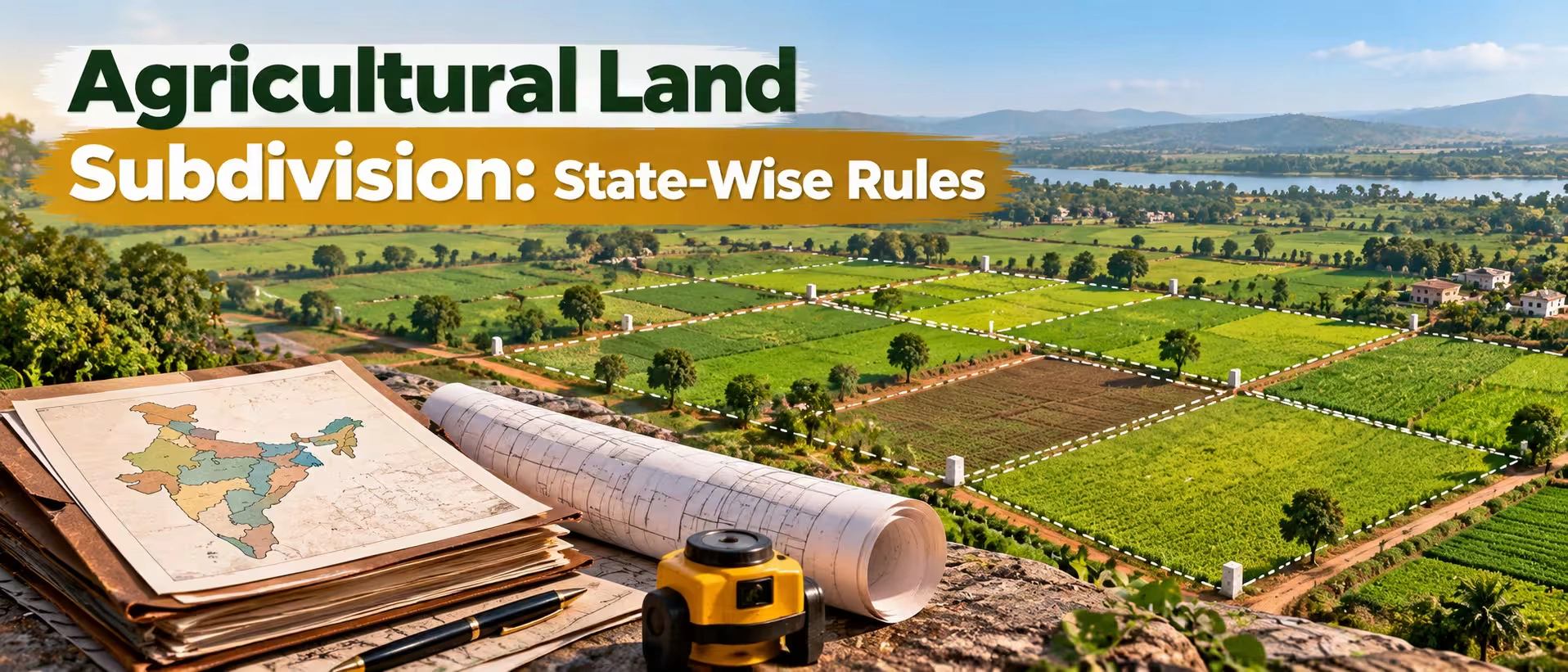
Any owner of land that is cultivated would, at some point in time, want to break it into smaller pieces of land that may serve different purposes. Whether or not one should go ahead and do it depends on the state, the area of the new land, and its future use. In any state, there is a law governing the minimum area that the farm plot should occupy. Besides, there are laws that specify whether the farm parcel could be converted into land for residential purposes. This guide first gives you the reasoning behind it and then proceeds state-wise. If you are browsing agriculture land for sale in a new district, the buyer-side checks later in the article will help you too.
Can Agricultural Land Be Divided? The Short Answer
Most states allow division of lands within certain restrictions. These are:
- Partitioning lands for agricultural purposes, or dividing them among heirs, is normally allowed provided that all the parcels remain at or above the minimum parcel size notified by the state.
- Fragmentation is restricted in states where there is a fragmentation law, except in cases where an exemption is allowed, such as lands within municipal limits or a planned layout.
- Converting the parcels to residential or commercial land use requires changing the land use and layout planning, regardless of the parcel sizes.
- Registration of a sale deed alone does not make the partition lawful. Courts and revenue departments have often had to deal with registered deeds which were found to be in violation.
Three Tests Every Division Has to Pass
Think of any division as passing through three separate checks. Clearing one does not clear the others, and this is where most disputes begin.
| Test | What it checks | Who usually decides |
|---|---|---|
| Fragmentation | Whether every piece meets the notified minimum area (called the standard area) | Revenue department |
| Land use | Whether the land can move from agricultural to non-agricultural use | Collector or development authority |
| Layout | Whether roads, open space and access are planned for the plots | Town planning or development authority |
The standard area is not one national number. Each state notifies it, often separately for irrigated land, dry land and horticultural land, and sometimes village by village. That is why a plot that is perfectly fine in one district can be a "fragment" in the next.
Also Read: Top 15 Places to Buy Plots in Chennai
State-Wise Rules at a Glance
The table below covers the states where buyers and sellers ask this question most often. It is a starting point for your search, and you should still confirm the notified standard area for your own village with the local tehsil or revenue office.
| State | Main law | What it means for dividing land |
| Gujarat | Gujarat Prevention of Fragmentation and Consolidation of Holdings Act, 1947, amended in 2026 | A uniform minimum of 10 gunthas (1,012 sq m) now applies in rural areas, and urban areas are exempted |
| Maharashtra | Maharashtra Prevention of Fragmentation and Consolidation of Holdings Act, 1947 | Standard areas are notified by local area, with 2025 relaxations for municipal and planned zones and a regularisation drive for old small-plot deals |
| Rajasthan | Rajasthan Holdings (Consolidation and Prevention of Fragmentation) Act, 1954 | In notified areas, no transfer or partition can create a plot smaller than the standard area |
| Punjab and Haryana | East Punjab Holdings (Consolidation and Prevention of Fragmentation) Act, 1948 and later amendments | Fragmentation is prohibited in notified areas, and fragments are recorded as such in the record of rights |
| Karnataka | Karnataka Prevention of Fragmentation and Consolidation of Holdings Act, 1966 | A schedule lists the minimum area by class of land, and transfer or partition that creates a fragment is barred |
| Himachal Pradesh | Himachal Pradesh Holdings (Consolidation and Prevention of Fragmentation) Act, 1971 | Same standard area logic, applied to notified areas |
| Uttar Pradesh | Uttar Pradesh Revenue Code, 2006 | Rules work through transfer restrictions; for example, a Scheduled Caste bhumidhar generally must retain at least 1.26 hectares after a transfer, and there is a cap on how much a buyer can hold |
| Other states | Similar acts or revenue code sections | Look up the standard area notified for your village before planning any split |
Gujarat: the 10 guntha rule
The latest and most recent case of how rapidly things can change is that of Gujarat. An ordinance was introduced in July 2026, which was then made law by the amendment bill in September 2026. This new law has set a standard area size of 10 gunthas of rural land. This replaces the previous system where there were different area sizes depending on whether the land is irrigated, dry, or horticultural. There have also been certain provisions for regularizing earlier offences.
Maharashtra: relief for small plots, with conditions
The Act of Maharashtra of 1947 has been a problem for many years, as people have purchased gunthas (plots) which were not eligible for recording in land records. In 2025, the government announced that plots up to one guntha created before 1 January 2025 will be recognised, and the revenue department then issued a free regularisation process for transactions from 1965 until October 2024. Some reports on the amendment have indicated that fragmentation restrictions no longer apply within the municipal corporation/council limits and also within the area of some planning authorities. Outside these zones, however, due diligence is required, as the restriction applies here.
Steps to Divide Agricultural Land the Right Way
- Land type and ownership should be verified. Get the updated land record (7/12 extract, Jamabandi, Khatauni, or the corresponding document in your state) and ensure that your land's area, owners, and category are correct.
- The standard minimum area for your village and your category of land is known. Approach the Tehsil or Revenue Office and find out the notified standard minimum area. Note the answer because you need it in the future.
- Decide the purpose. A family partition for farming is handled differently from a plan to sell plots, and mixing the two in one application is a common cause of rejection.
- Apply for land use conversion if plots are the goal. Most states call this NA permission, conversion, or change of land use, and it usually involves fees and a no-objection process.
- Get the layout or subdivision approved. The planning authority checks approach road width, open space, and drainage before it approves individual plots.
- Register and then mutate. After the sale or partition deed is registered, apply for mutation so the new pieces appear in the revenue record under the right names.
Common Mistakes That Make a Split Invalid
- Selling off a portion using a notarized agreement or power of attorney without proper registration of the deed and mutation of title.
- Assuming that the same size of plot will be acceptable in your location if it is fine in an adjoining location.
- Avoiding the process of conversion, as “all the buyer wants to do is erect a farmhouse.”
- Partitioning land with no proper road access, thus making both approval and reselling impossible.
- Neglecting co-owners or heirs without their consent.
What Buyers Should Check Before Buying a Divided Plot?
If you are purchasing agricultural land that has been split, then you have to deal with the issues faced due to the split itself. Some precautions can help avoid many risks:
- You should request the parent land document and the document of the new plot, and see if the plot has been recorded separately with its own number.
- Check if the plot size complies with the minimum standard area of the state, or if there is an exemption or regularization order.
- Ensure that the land use is agricultural unless there is a conversion order.
- See the access road on the ground and the village map, as plots without legal access are difficult to sell.
Buyers usually start with a search such as land for sale near me, and then proceed with selecting the plot based on the cost factor alone. But a cheaper plot with defects in the split will eventually end up costing you more in legal fees and delays. Get the documents checked by a lawyer or tehsil clerk before paying any token amount.
What Sellers Should Do Before Splitting and Listing?
In case one intends to sell the property in pieces, the process of obtaining the legal documentation must be done first before advertising. This is because buyers and financiers both require the records to be clear. Therefore, once all the necessary documentation has been obtained, one can then advertise the property through the Internet. The advantages that come with doing this include that one can upload the record, photos, and demarcation details to potential buyers from other cities, especially since the plot being sold is part of a bigger parcel of land.
How 2Bigha Helps With Agricultural Land Plots?
2Bigha is a land marketplace focused on agricultural land and farmland across India, with listings that go through background verification before they are shown. For buyers, a farm search on the platform lets you filter by state, district, and budget, and the land report gives you a summary of the documents and records behind a listing so you are not relying only on what a seller tells you. If you prefer to look at farmlands near me-style results, you can narrow by distance to a city or highway and then book a visit. For sellers, listing on 2Bigha puts your plot in front of people who are specifically looking for agricultural land, and the verification step builds trust with buyers who are wary of disputed splits. You can start from the 2Bigha website whether you want to buy, sell, or just compare prices in a district.
Disclaimer: This article is for informational purposes only and should not be considered investment, legal, financial, or property advice. Real estate regulations, infrastructure plans, market conditions, and government policies may change over time. Readers are advised to verify information with relevant authorities and consult qualified professionals before making any investment or property-related decisions.