List Your Land
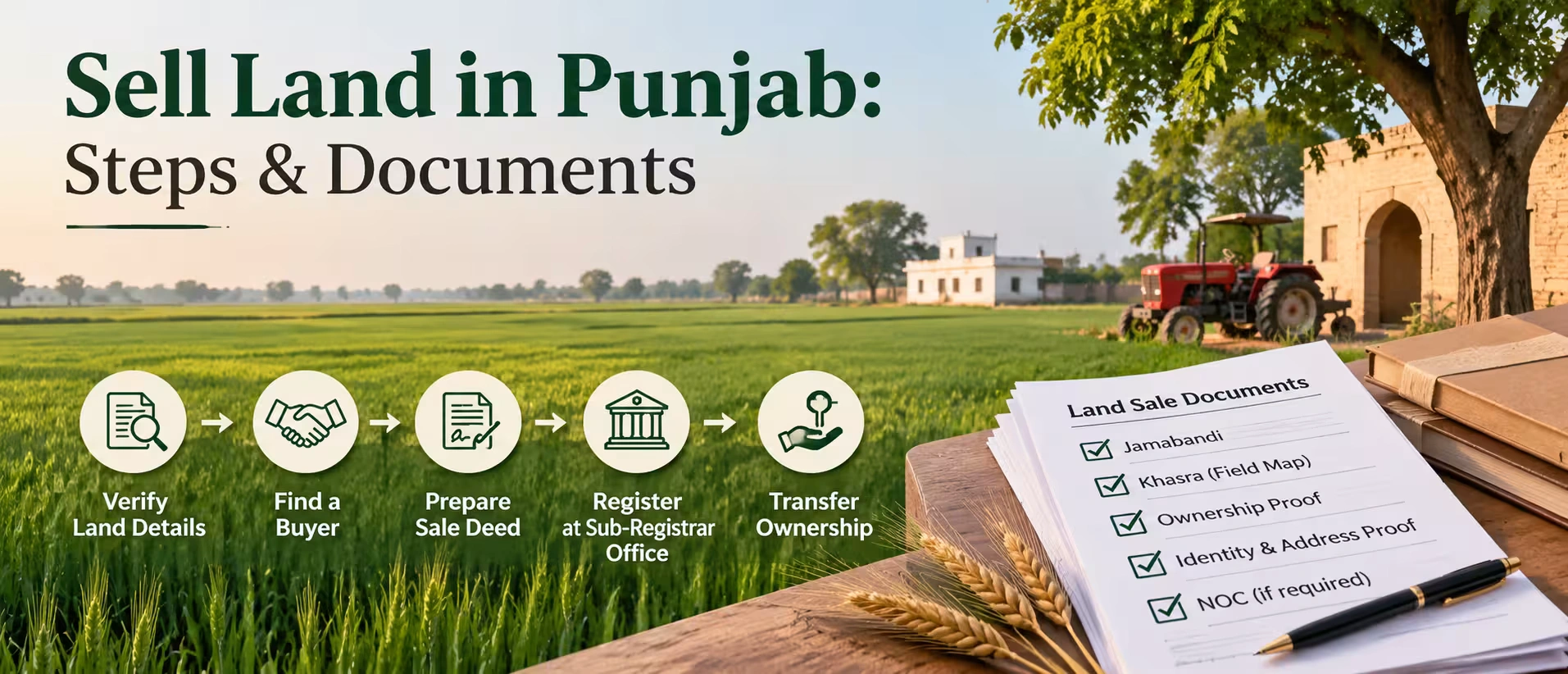
Most people who own land in Punjab get their first enquiry through a relative, a village contact, or a local dealer, and the talks often stop when the buyer asks for a clean Jamabandi, a Fard copy, or proof that the Intkal is not pending. Land with ready papers and a sensible price usually finds a buyer within a few weeks, while land with unclear records can stay unsold for months even in a good market. This guide goes through the steps in the order a seller should follow, from checking records to registering the sale deed, along with notes on tax, stamp duty, and listing your land online.
Why Sell Land in Punjab Now?
Many families have plots of land that are now rented out at low rents to tenants. This is because many of the sons/daughters are working in Chandigarh, Ludhiana, Canada, and Australia, so their land is let out to tenants. It can make financial sense to sell the land, as you can use the money to purchase a property, pay for your children's education, or buy a smaller plot in an area that is closer to a city. The income from the lease can be low. In October 2024, Punjab increased the collector rates in some areas significantly. As a result, buyers are looking at registered land values much more carefully now.
Know What Type of Land You Are Selling
The way a buyer will react to your plot depends on whether it is farmland, residential, or commercial. Farmland within villages will be in Killas and Kanals, whereas plots within towns/colonies will be in Marlas, Gaj, or Square Yards. The documents needed will also differ. If we look at online listings for agri land for sale in Punjab, we can see how they are listed. Each listing includes the village name, size of land, road access, and whether it is irrigated. Below are some key points to remember:
- 1 Killa = 1Acre and there are 8 Kanal in a Killa
- 1 Kanal = 20 Marla
- If the land is listed as Shamlat Deh, it means it is village common land. This usually can’t be sold by a private owner.
- Land within unapproved colonies can be more difficult to sell, as many buyers and banks avoid this type of land.
Also Read: Building Plan Approval in Punjab: Complete Guide & How to Check It Online 2026
Check Your Records Before You Sell Land in Punjab
The Punjab Revenue records are available on the PLRS portal. Registration, encumbrances, and stamp duty are handled through the IGRS Punjab system. Most checks can be performed via your phone. Download the most recent Jamabandi and Fard to ensure that your name, khewat, khasra number, and area are as you expect. It is also important to check for any typos or incorrect shares, as this can easily be corrected prior to selling the property. Things to check:
- Have they actually recorded the previous Intkal (mutation), e.g., in the case of a family member passing away?
- Are there any Girdawari details? This will show who is growing the crop and what was planted.
- Is there any red in the Jamabandi? This usually indicates there is a bank loan against the land.
- Is the land owned jointly by brothers or cousins? All owners must sign and agree. A Tatima may be required to split the land.
Set a Price That Matches the Market
Price per killa can differ a lot even between two villages on the same road, so it is better to collect real numbers than to rely on what a neighbour said at a wedding. Ask for the rates of the last two or three registered sales near your khasra, speak to a couple of local dealers, and compare with the asking prices of agriculture land for sale in Punjab, India on listing sites. The collector rate is only a floor, and stamp duty is calculated on whichever is higher, the actual sale price or the collector rate, so a buyer will keep that in mind while bargaining.
| What buyers look at | Why it affects your price |
| Road access | Land on a link road or highway gets more interest than land reached by a field path |
| Distance from city or highway | Closer land attracts plot buyers and investors, not only farmers |
| Water source | Canal water, a working tubewell, and the water table depth all matter to a farming buyer |
| Soil and crop history | Regular paddy and wheat yields show the land is productive |
| Size and shape | A single, regular piece sells faster than a narrow or split one |
| Clear title | Any dispute or pending Intkal lowers the offer or stops the sale |
How to Sell Land in Punjab Online With 2Bigha?
Listing online lets buyers from other districts and other states see your land, which a village dealer cannot offer, and it keeps the first round of enquiries on your own phone instead of passing through a chain of middlemen. On 2Bigha, the steps are these:
- Keep photos of the land, a Fard copy, and your ID ready.
- Create a seller account and enter the village, tehsil, area in killa or kanal, asking price, and road access. If the form feels long, you can also share the details over WhatsApp, and the listing will be created for you.
- Add clear daylight photos that show the road, the boundary, and the water source.
- Reply to calls yourself and share only scanned copies of the papers, never the originals.
- Once a price is agreed, sign a written agreement to sell with the token amount and move on to registration.
The Silver plan is free, while Gold costs ₹999 and Platinum ₹1,499 for three months, and both paid plans add featured listings and a social media post. A free listing is enough to begin with, and a paid plan is worth considering only if the land gets no response after a few weeks.
Documents Buyers Will Ask For
Buyers who reply to a farm land for sale Punjab India advertisement almost always ask for papers on the first or second call, so scan them once and keep them in a folder on your phone.
| Document | Where to get it | Why the buyer wants it |
| Jamabandi and Fard | PLRS portal | Shows owner name, khewat, khasra, and area |
| Cadastral map (Shajra Nasab) | PLRS portal | Confirms the boundaries on paper match the field |
| Girdawari | PLRS portal | Shows who is in possession and what is grown |
| Encumbrance Certificate | IGRS Punjab | Shows any mortgage or other claim |
| Earlier sale deed or Intkal | Sub-Registrar office or Patwari | Proves how you became the owner |
| Aadhaar and PAN of all owners | Your own copies | Needed for the deed and the buyer's tax filing |
| Death and legal heir certificate | Local authority | Needed when the land came by inheritance |
Tax, Stamp Duty and Charges When You Sell Land in Punjab
The amount varies according to the type of land. Confirm the following with your chartered accountant.
- Stamp duty and registration charges: Usually the buyer will bear this cost. Visit the IGRS Punjab portal to check the current rates and the rate of your local collector.
- Capital Gains: Generally, agricultural lands in rural areas are not classed as Capital Assets, but any land in or near towns and all plots may be subject to Capital Gains Tax. If you have held the land for more than 24 months, it will be long-term capital gains.
- Reinvestment relief: If you have used the land for farming and purchase another agricultural land within the required period, you may be able to get some or all of the gain exempted.
- TDS: 1% TDS will be taken off by the buyer if the sale price is ₹50 lakh or above. This does not apply to agricultural land in rural areas.
- Other small costs: Deed writer, Lawyer fee, E-stamp papers, and certified copies.
Sale Deed, Registration and Intkal Mutation
The deed is written on e-stamp paper, and both parties go to the Sub-Registrar office that covers the land along with two witnesses. A seller with a Plot for Sale in Hoshiarpur, Punjab, for example, registers it at the Sub-Registrar office of the tehsil where the plot falls, so confirm the correct office before you fix a date.
- Read the draft thoroughly and confirm the khasra number, area, description of boundary, and price.
- Expect to be photographed, have impressions of your thumb taken, and provide identification.
- Request payment through bank transfer/demand draft. Keep a record of it, as cash payments in large amounts may invite problems with income tax.
- Once you have registered the Intkal, it will go to the revenue office. Your role as a seller comes to an end once the Buyer's name appears on the Jamabandi.
Common Mistakes When You Sell Land in Punjab
- Pre-Intkal sales. If a share has been inherited but is in the seller’s previous owner’s name, then the buyer’s lawyer will discover this and cause delays.
- All Co-owners must sign. If any of them hasn’t signed, then a deal that has been registered could be revoked.
- Original documents given to dealer. Only provide scanned copies until the sale is registered.
- Token with no written contract. If there is no written contract, then there’s nothing to hold the buyer to if they disappear.
- Emotional pricing. You can feel an old family plot is worth more than market value. If the price isn’t right, then good buyers may not be interested.
- Don’t forget to check if there is an acquisition or Shamlat Deh. These can cause problems and invalidate the sale, so make sure to check both.
Selling From Abroad or to Buyers in Other States
Many Punjab landowners now live in Canada, the UK, Australia, or the US, and an NRI who holds inherited or earlier-bought agricultural land can sell it, as long as the buyer is an Indian citizen living in India. If you cannot travel, you can give a registered Power of Attorney to a trusted family member, because a notarised-only POA is not valid at any Sub-Registrar office in Punjab. Online listing helps you sell land India wide, so a buyer from Delhi, Haryana, or Himachal can see your plot without calling a local dealer, but that buyer should still visit the land and verify the papers in person before paying anything.
Conclusion
Once you’ve taken care of any problems with the records, you’ll find selling your property quite easy. Set the price according to actual sales in your area. You will need to take some good quality photos and scan your documents to advertise your land. Remember to be aware of the stamp duty, capital gains, and registration process so that you’re not caught out when you get to the Sub-Registrar office. If you want to sell outside your village, it’s easy to start by advertising for free on 2Bigha.
Disclaimer: This article is for informational purposes only and should not be considered investment, legal, financial, or property advice. Real estate regulations, infrastructure plans, market conditions, and government policies may change over time. Readers are advised to verify information with relevant authorities and consult qualified professionals before making any investment or property-related decisions.