List Your Land
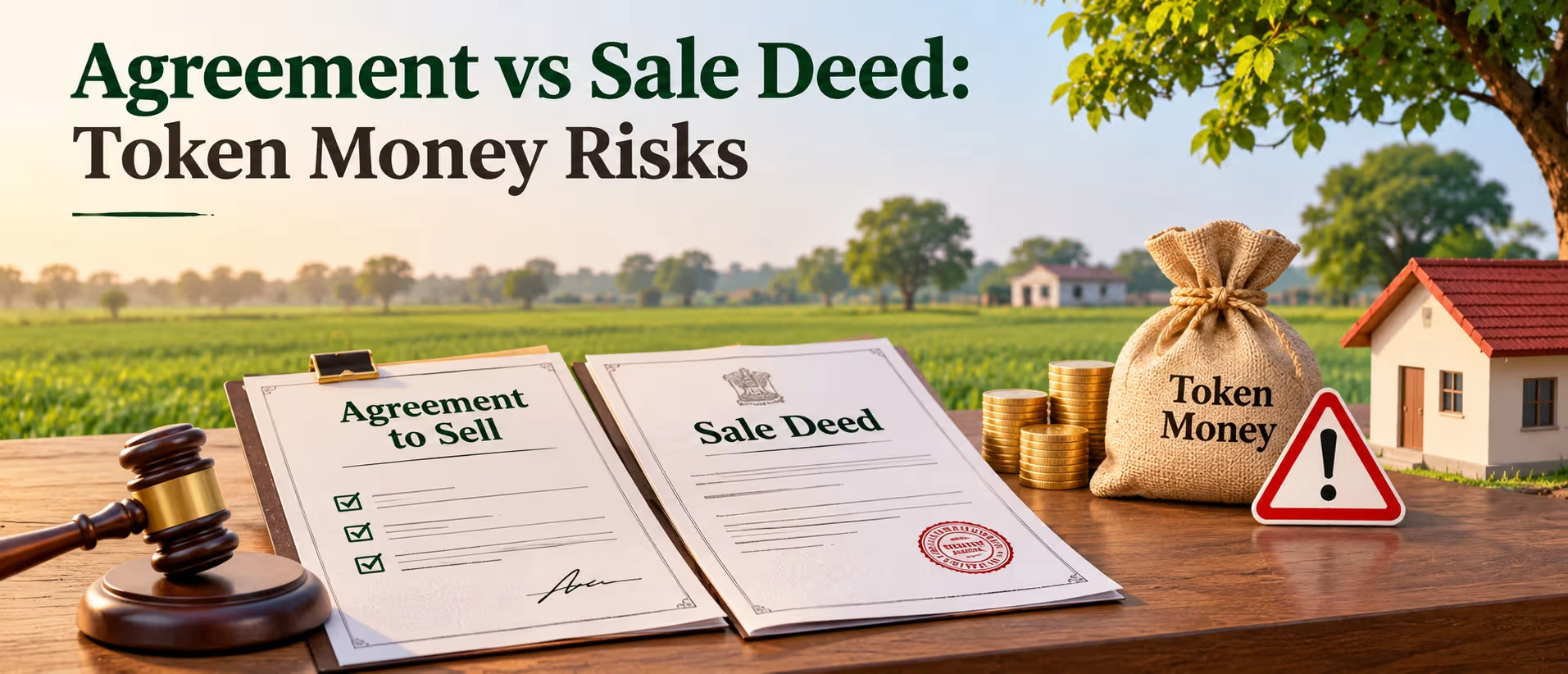
Most land deals in India begin with a token amount handed to the seller and a paper signed on stamp paper, and many buyers who start a farmland search assume that this first paper already makes the land theirs, which is not how the law works. The agreement to sell is a contract that promises a transfer at a later date, while the sale deed is the registered document that actually moves ownership, and the gap between the two decides whether your token money is safe, refundable, or lost. This blog explains what each document does, when a token can be forfeited, how stamp duty works when possession is given early (especially in Telangana and Andhra Pradesh), and which checks to run before you pay anything.
The Short Answer: Agreement to Sell vs Sale Deed
A contract of sale will contain details such as what the price is, what token will be used to pay for it, and how the sale will be completed over a certain period of time. It legally binds the two parties to complete the sale; however, it does not grant any interest to the buyer. There is no interest given to the buyer until a sale deed has been signed, stamped, and registered as stated in section 54 of the Transfer of Property Act. Until this has been done, the seller will still be the legal owner.
What an Agreement to Sell Does and Whether It Is Valid?
It is a valid contract, and it is useful when the buyer needs time to arrange the balance payment, wait for a loan sanction, or give the seller time to clear dues or correct a mutation entry, which happens often when someone is looking at agriculture land for sale, and the records need some fixing first. A well-drafted agreement names both parties, describes the land by survey number, extent and boundaries, states the full price and the token, fixes a date for the sale deed, says who bears which charges, and explains what happens to the token if either side backs out.
Does an Agreement Need Registration, and What Have the Courts Said?
The agreement may not need to be registered. However, registering the agreement may provide certain protections:
- You can sue for specific performance based on the unregistered agreement (s.49 (proviso) of the Registration Act, 1908)
- If you wish to benefit from the protection provided by part performance under section 53A of the Transfer of Property Act by taking possession, the agreement must be registered under s.17(1A).
- There are amendments in Andhra Pradesh and Telangana regarding registration of sale agreements. You should therefore check with the Sub-Registrar when signing the agreement.
- In Suraj Lamp and Industries v. State of Haryana [2011], the Supreme Court held that title would not be provided by an agreement to sell, general power of attorney and/or will. This has been confirmed in further judgments.
However, you will have the right to ask the court to order specific performance. This means ordering the seller to complete the sale. To do this, you must show you have always been willing and able to pay the remaining purchase price.
What a Sale Deed Does and What It Should Contain?
A Sale Deed is an instrument whereby the ownership of a property is transferred from the Seller to the Buyer. A Sale Deed for a property valued at ₹100 or more must be put in writing and registered under the Registration Act, 1908. In Telangana, a Sale Deed for agricultural land has to be registered after securing a registration slot on Bhu Bharathi. If you have booked farmland near me using a portal and have reached the documentation stage, make sure that all the below information is mentioned in the draft Sale Deed:
- Name, Address & Identity details of the Buyer & Seller
- Survey/Plot No., Area, Boundaries & Location of Land
- Sale Amount, Payment History & Receipt of Full Amount
- Title Deed History of the Seller with a declaration that the Land is clear of any dues and charges.
- Declaration by the Seller to protect the Buyer's Title should anyone challenge it.
- Handing over of Possession & Original Documents.
Agreement to Sell vs Sale Deed: Side by Side
| Point | Agreement to sell | Sale deed |
| What it is | A promise to sell in the future | The document that completes the sale |
| Does title pass? | No | Yes, on registration |
| Registration | Not always compulsory, but needed for Section 53A protection | Compulsory for property of ₹100 or more |
| Token or advance | Recorded in the agreement | Full price shown as paid |
| Main remedy if the other side defaults | Specific performance or refund | Rights of an owner |
| Stamp duty | Lower, unless possession is given | Full sale rate |
| Possession | May be handed over, but this does not make you the owner | Handed over to the new owner |
What Happens to Your Token Money?
A token payment gives you a basis to claim a refund or file a suit if the seller defaults, but it does not protect the land itself. Whether you choose a Gift Deed vs. Sale Deed, or pay a token for land for sale near me, a title problem can still arise. In such cases, you can only pursue the seller for a refund or seek enforcement of the contract.
Earnest money and advance
The term used in the receipt does not matter much. It has been decided by the Supreme Court that money stated to be an advance may be treated as earnest money if it was paid as a guarantee to enforce the contract. If there is a clear provision for forfeiture of earnest money, and the amount is reasonable, then it can be forfeited if the buyer is in default. If the amount is part payment of the price, then it can generally be recovered. In Kailash Nath Associates v. DDA (2015), the Court held that under Section 74 of the Contract Act, only a reasonable amount can be retained. However, if you are suing for specific performance, then you must claim for refund under the same suit as per Section 22 of the Specific Relief Act.
Cash payments
Section 269SS of the Income-tax Act, 1961 does not allow anyone to accept ₹20,000 or more in cash as an advance for the transfer of immovable property, and a seller who does so faces a penalty equal to the amount received, whether or not the sale is completed. The Income-tax Act, 2025 renumbers these sections, so confirm the current provision, and in any case pay the token by bank transfer or cheque and keep the proof.
Risks of Stopping at the Agreement
At this stage, the seller is still free to sell the land to someone else. However, according to Section 19(b) of the Specific Relief Act, if the subsequent purchaser pays honestly and has no knowledge of your agreement, then he will be allowed to retain possession of the land. You will only have a claim against the seller. Furthermore, there is a time bar as well. Any suit for specific performance must be filed within 3 years from the date of completion of sale (Limitation Act, 1963). Possession, power of attorney, or a will cannot be used as a substitute for a registered sale deed.
Stamp Duty in Telangana and Andhra Pradesh When Possession Is Given
In both states, an agreement under which the buyer takes possession can be charged stamp duty as if it were a sale. The Andhra Pradesh High Court has read the Explanation to Article 47-A of the state stamp schedule to mean that an agreement to sell followed by, or evidencing, delivery of possession is chargeable as a sale, and Telangana kept the same schedule after 2014. A lot of deals now begin with selling property online and a WhatsApp chat, so the buyer often pays the token and enters the land before anyone reads the stamp rules, and this is the point where an unexpected bill can appear.
- An agreement without possession carries much lower duty than a sale deed
- Duty on a sale deed is charged on the higher of the agreed price and the official market value
- The state stamp duty calculators give a fair estimate of the total cost
- Rates change, so confirm the current figure with the Sub-Registrar
Checks to Run Before You Pay Token Money
- Confirm the name of the seller in the Pattadar Passbook (Telangana) or the respective land record of your state.
- Get an Encumbrance Certificate for at least 30 years.
- Telangana: Check the survey number against the black list of properties. Andhra Pradesh: Check against the Meebhoomi 22A list and obtain EC from IGRS AP.
- Mention the token amount, the purpose of the token amount, forfeiture, and refund terms in the agreement.
- Make payment via banker's cheque or bank transfer. Never make cash payments.
- After registration, you can apply for mutation through Bhu Bharathi/Meebhoomi.
How 2Bigha Helps Before You Pay a Token?
The seller puts their land up for sale on 2Bigha. The buyer reaches out to the seller directly and asks about the Fard, survey details, and the seller’s ID. Sellers (land sellers) can put their land up for sale for free under the Silver plan. If they don’t want to complete the form, then they can share the details via WhatsApp. Buyers can view the 2Bigha Land Report page to see what details are included in a report. However, it is still important to have a Lawyer review the agreement and sale deed.
Conclusion
Payment of a token amount gets you nothing but an agreement and a right. Your title will only pass once the sale deed has been registered. Always ensure there is clarity around the terms of your agreement, that payment can be traced, and all checks are in place prior to payment. If your transaction relates to possession, then ensure you know the stamp duty implications. Don’t let the agreement sit for too long, as this is where most problems occur.
Disclaimer: This article is for informational purposes only and should not be considered investment, legal, financial, or property advice. Real estate regulations, infrastructure plans, market conditions, and government policies may change over time. Readers are advised to verify information with relevant authorities and consult qualified professionals before making any investment or property-related decisions.