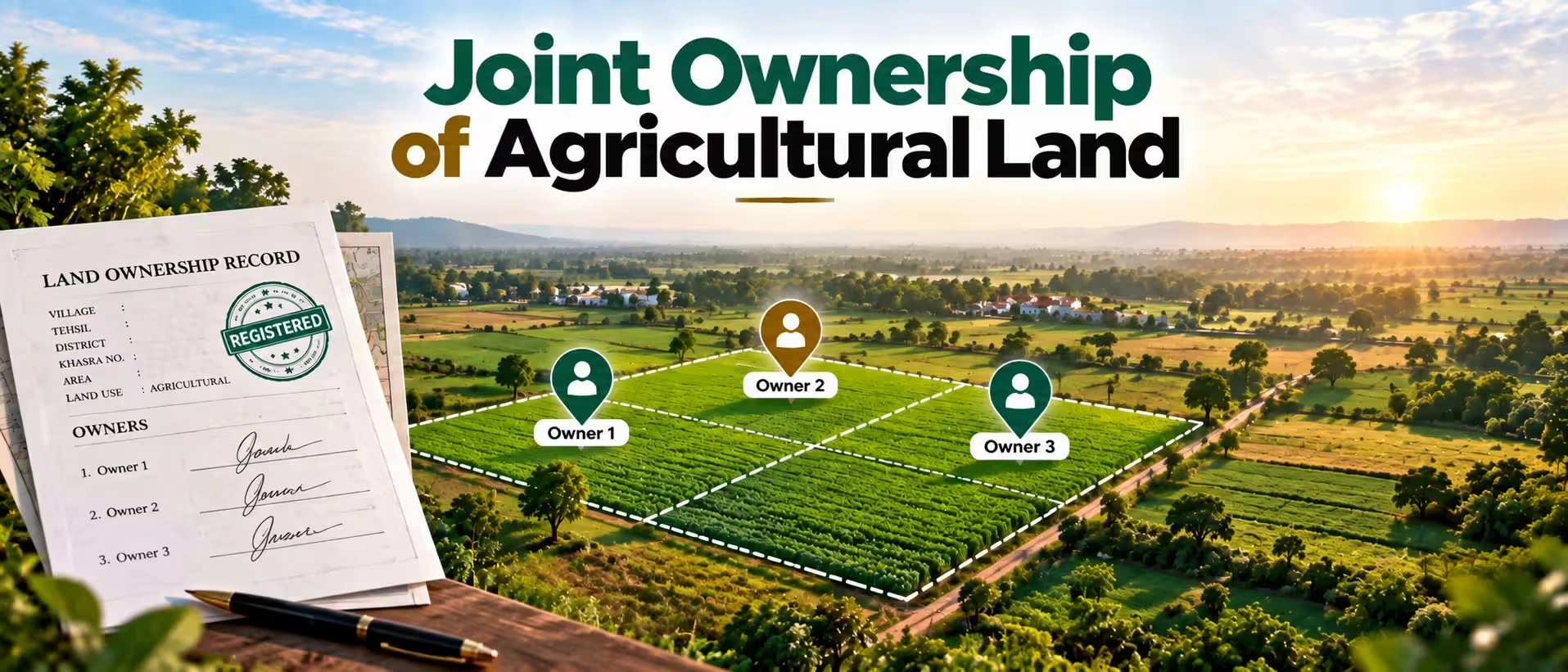
Joint ownership seems to be an easy concept. People own the piece of land together, they pay for it together, and they all gain from it. However, joint ownership is one of the most frequent causes of conflicts in land transactions in India, and in most cases, they occur not due to malicious intentions but because the participants never take a moment to discuss what to do in case something goes wrong, because somebody wants to sell their share, somebody dies, or they just don't agree anymore.
If you have been thinking about purchasing land with your brother, sister, cousin, or business partner, or even simply with your friend who would help you to save money on the purchase, it would be better to find out more about how joint ownership really works. This is not intended to discourage you from doing that since joint ownership may sometimes be an effective and convenient way of accessing the lands.
What Joint Ownership Actually Means?
Legally speaking, agricultural land co-ownership is an arrangement whereby multiple parties own the same land together at once, either with or without a known proportion. In most states within India, co-ownership can be categorized into one of two different types of arrangements.
- Tenancy in Common – each co-owner has a defined and unequal proportion of the property which may be freely sold, mortgaged, or inherited.
- Joint Tenancy – co-owners have equal shares in the property, and the usual way is that the share goes to the living co-owners and not the descendants (depending on the jurisdiction and wording of the deed).
Tenancy in common is what most agricultural land in India defaults to when purchased unless otherwise stated in the deed.
Why do people Choose Joint Ownership?
There are genuinely good reasons this arrangement is common, especially for people browsing farmlands near me listings without the budget to buy solo.
- Splitting the cost makes larger, more productive parcels accessible to buyers who couldn't afford them individually
- Shared farming operations become easier when multiple family members have a formal stake
- It's a common way to keep ancestral land within a family across generations
- Pooling resources for organic farmland conversion, which often requires upfront investment in soil transition, certification, and infrastructure, becomes more realistic when the cost is shared
That last point matters more than people expect. Converting conventional land to certified organic status isn't cheap or fast, and a lot of would-be organic farmers only make the jump because they're sharing the financial load with a co-owner.
Where Joint Ownership Tends to Go Wrong?
Here's the part most people skip past during the excitement of a purchase, and it's the part that actually decides whether the arrangement works long-term.
| Common Friction Point | Why It Happens | How It's Usually Prevented |
|---|---|---|
| One owner wants to sell, others don't | No exit clause defined upfront | Written co-ownership agreement with buyout terms |
| Unequal financial contribution | Verbal-only agreements on who pays what | Documented contribution ratio tied to ownership share |
| Disagreement on land use (farming vs leasing vs holding) | No decision-making process agreed in advance | Majority-vote or unanimous-consent clause in the agreement |
| Inheritance disputes after an owner's death | Deed doesn't clarify succession | Explicit succession terms, ideally reviewed by a lawyer |
| One owner unilaterally lists the land for sale | Lack of clarity on individual selling rights | Right-of-first-refusal clause among co-owners |
Almost every serious co-ownership dispute traces back to one of these five rows. None of them require exotic legal solutions, they just require the conversation happening before the money changes hands, not after.
The Legal Groundwork Before You Buy Together
A few steps make joint ownership far more durable, and none of them are particularly expensive relative to the size of a land purchase.
- Get a written co-ownership agreement, separate from the sale deed, that spells out contribution ratios, decision-making rules, and exit terms.
- Clarify the share split on the deed itself — vague or equal-by-default splits cause more arguments later than clearly stated percentages.
- Agree on a dispute resolution mechanism upfront, whether that's mediation, arbitration, or a defined buyout formula.
- Decide how future costs are split — property tax, maintenance, irrigation, and any conversion costs like moving toward organic farmland should be addressed before they come up as a surprise bill.
- Confirm succession terms so that if one co-owner passes away, their share transfers according to a clear, agreed process rather than defaulting to whatever the general inheritance law says.
None of this is about distrust. It's closer to a prenup for land; the people who need it least are usually the ones who benefit most from having it in writing, because it removes ambiguity before ambiguity has a chance to become a fight.
Selling a Jointly Owned Plot
This is where things get genuinely complicated, and it's worth understanding before you're the one trying to exit. Generally, a co-owner can sell their individual share without the consent of the other owners, unless the ownership agreement specifically restricts this. But selling an undivided share of agricultural land is a hard sell in practice; most buyers don't want to become co-owners with strangers, so the market for partial shares is thin. This is exactly why a right-of-first-refusal clause matters: it gives existing co-owners the option to buy out the exiting owner before the share goes to the open market.
If all co-owners agree to sell the full parcel together, the process looks like any standard land sale, just with every owner needing to sign off on the transaction. Increasingly, co-owners are turning to selling property online through verified platforms rather than relying purely on local brokers, mainly because a listing on a proper platform reaches a wider, more serious buyer pool and keeps documentation organized in one place, which matters even more when multiple names are on the title and everyone needs visibility into the process.
What Should Buyers Check Before Purchasing Jointly Owned Land?
When you are the one purchasing the agricultural land that is currently owned by more than one person, the best case study here would be inherited property; this is where a little caution will take you a long way.
- Make sure that all the owners who have been listed as owners have really agreed to the sale, and not only the one you are working with.
- Find out if the share that is being sold is properly demarcated or is just an undivided share of the whole piece of land.
- Look into the mutation and revenue record documents to ascertain the accuracy of the ownership structure.
- Ask if there is any owner with an existing loan or mortgage over their share.
- Always make sure that you get written confirmation from all concerned rather than one family member confirming for all.
This is one of the most common cases of people ending up in litigation after a while.
Finding the Right Land, Jointly or Otherwise
Whether you're searching for plots for sale near me to split with a partner or scouting land independently, the fundamentals of due diligence don't change just because more than one name is going on the deed; if anything, they matter more, because the process needs to satisfy every buyer's questions, not just one person's comfort level.
This is where platforms like 2Bigha make the process considerably less stressful. Every listing comes with background verification and documented ownership history, which is particularly valuable for co-buyers who want a shared, transparent starting point rather than relying on one person's due diligence and everyone else's trust. For anyone actively involved in land selling and looking to reach genuine buyers rather than time-wasters, listing through a verified platform also tends to move faster than word-of-mouth or informal broker networks.
Disclaimer: This article is for informational purposes only and should not be considered investment, legal, financial, or property advice. Real estate regulations, infrastructure plans, market conditions, and government policies may change over time. Readers are advised to verify information with relevant authorities and consult qualified professionals before making any investment or property-related decisions.