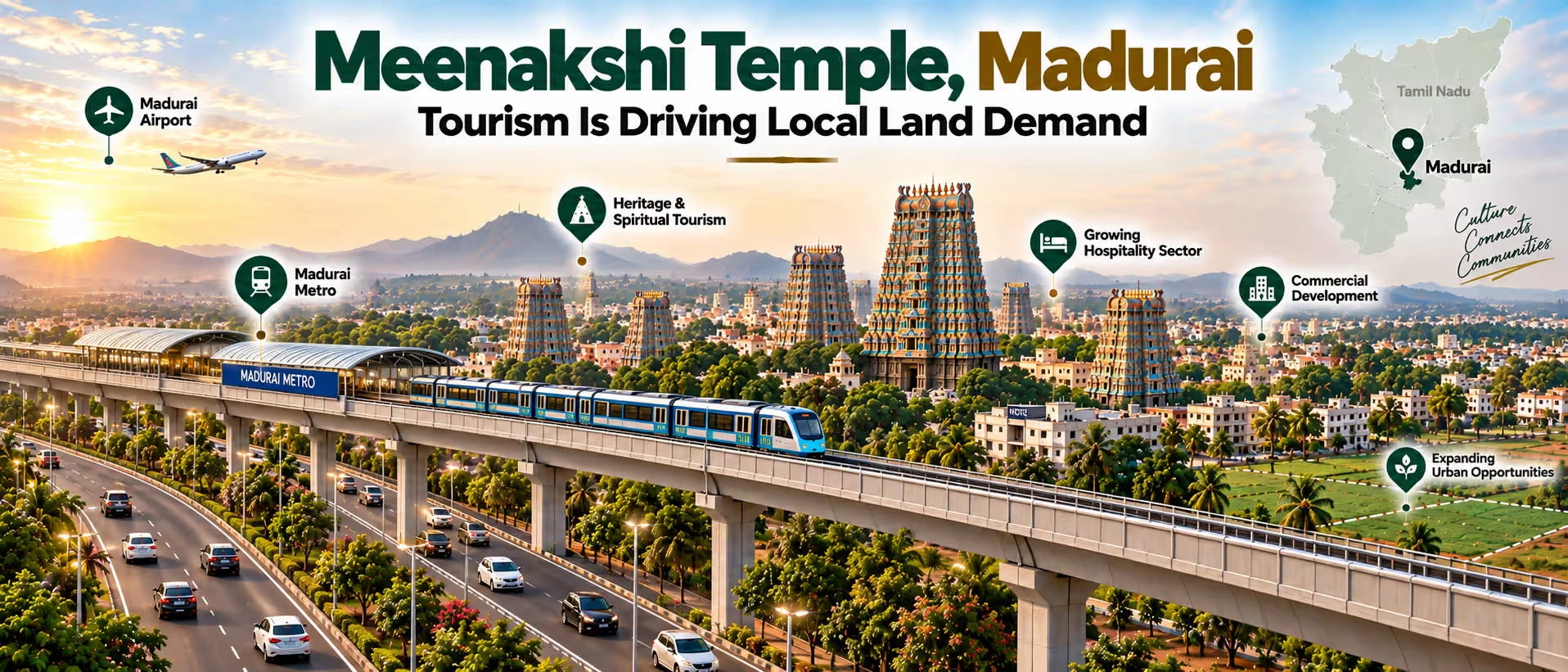
Madurai doesn't need an introduction if you've grown up in Tamil Nadu. The moment someone says "Madurai," the image that comes to mind is the twelve towering gopurams of the Meenakshi Amman Temple, lit up gold against the evening sky. But over the last few years, something else has been happening quietly around this 2,500-year-old temple town — its land market has started moving in ways that long-time residents haven't seen before.
Pilgrims are still coming in the same numbers, sometimes more. But now they're not just visiting — some are investing. Hoteliers are scouting plots near the temple. Homestay owners are converting old houses into guest accommodations. And families that have held onto ancestral land for generations are suddenly getting serious offers. If you've been thinking about buy land in Madurai, or you're already sitting on a plot and wondering whether it's the right time to sell, this piece breaks down exactly what's driving the shift — and what it means for you.
Key Takeaways
- Meenakshi Temple draws lakhs of pilgrims and tourists every month, and this steady footfall is pushing up demand for land in and around Madurai city.
- Areas close to the temple, Madurai Junction, and the airport corridor are seeing the fastest appreciation, while peripheral zones offer better entry prices for long-term investors.
- Commercial land for sale in Madurai is attracting hospitality, retail, and hostel developers who want proximity to the temple economy.
- Farm land for sale in Madurai near the outskirts is drawing interest from buyers who want agri-income plus long-term appreciation as the city expands outward.
- Verifying title, DTCP/CMDA approval, and land-use classification is non-negotiable before you commit money — Madurai's growth has also attracted its share of disputed and layout-irregular parcels.
- Digital property websites like 2Bigha make it easier to compare verified listings, track price trends, and connect with genuine sellers instead of relying only on local agents.
Why Meenakshi Temple Still Shapes Madurai's Economy
Most temple towns in India see tourism ebb and flow with the season. Madurai is different. The Meenakshi Amman Temple pulls in visitors almost every single day of the year — locals say the temple complex sees thousands of devotees even on an ordinary Tuesday, and that number multiplies several times over during festivals like Chithirai and the Meenakshi Thirukalyanam. This isn't seasonal tourism. It's a daily economic engine that has run, uninterrupted, for generations.
What's changed recently is the scale of the surrounding ecosystem. Madurai has grown into a genuine hospitality and trading hub — cotton handloom, the GI-tagged Madurai Malli jasmine trade, an emerging IT presence around TIDEL Park, and an expanding airport with better connectivity to other Indian cities. Temple tourism sits at the centre of it, but it's no longer the only reason people are looking at land here. It's the reason the city's core stays busy, and the busyness is what's now spilling outward into new demand for residential plots, commercial frontage, and even agricultural land on the fringes.
Ask any local broker near Town Hall Road or West Masi Street, and they'll tell you the same thing: enquiries have gone up, and a good number of them are coming from outside Madurai — Chennai-based investors, NRIs with family roots in the region, and hospitality operators scouting for their next property.
How Tourism Footfall Translates Into Land Demand
It helps to understand the actual mechanism here, because it's not just "more tourists equals more demand" in a vague sense. There's a fairly direct chain of cause and effect:
More visitors need more rooms: Budget hotels, mid-range business hotels, and homestays have all expanded near the temple in the past decade. Every new property needs land — and land close to the temple, within walking distance or a short auto ride, commands a premium that keeps climbing.
More footfall means more retail and food business: Sungudi saree shops, jasmine flower vendors, South Indian filter coffee joints, and souvenir stores all want frontage on the busy streets radiating out from the temple. This has made commercial land for sale in Madurai — particularly in areas like Simmakkal, North Chitrai Street, and the stretch near Periyar Bus Stand — genuinely scarce and expensive.
Improved connectivity widens the catchment: Madurai International Airport now connects to more cities, and highway upgrades have shortened travel time from Trichy, Dindigul, and Tirunelveli. This has pulled land demand outward from the temple core into peripheral zones like Melur Road, Alagar Kovil Road, and areas near Tirupparankundram — places that were purely residential or agricultural a decade ago.
Migration and settlement follow business: As hospitality, textile trading, and logistics jobs grow, more people are choosing to settle in Madurai rather than just pass through. That steady, less glamorous demand — people wanting a plot to build a home on — is arguably a bigger long-term driver of land purchase in Madurai than the tourism headlines suggest.
Which Areas Are Actually Seeing Price Movement
Not every part of Madurai is appreciated at the same pace, and it's worth being specific rather than painting the whole city with one brush.
Near the temple core (Town Hall Road, Chitrai Streets, West Masi Street): Land here is already dense and expensive, and what's available tends to be small, older plots with existing structures. Buyers here are usually commercial operators — hotel chains, retail brands — not first-time residential buyers. Prices in this belt have historically moved up steadily because supply simply cannot expand; the temple and its surrounding heritage zone limit new construction.
Mid-ring residential pockets (KK Nagar, Anna Nagar, Goripalayam, SS Colony): These established residential areas have seen consistent demand from families wanting to stay close to the city centre while avoiding the congestion right around the temple. Good civic infrastructure and schools keep this segment attractive for end-users, not just investors.
Growth corridors (Melur Road, Vilangudi, Thirupparankundram, Airport Road): This is where a lot of the newer activity is concentrated. Layouts here are more affordable, DTCP approvals are becoming more common as developers formalise projects, and buyers are betting on the city's outward expansion. If you're looking to buy land in Madurai as a mid-term investment rather than an immediate build, this belt deserves a serious look.
Outer agricultural belts (Usilampatti Road, Melur, parts of Sholavandan): Here you'll find genuine farm land for sale in Madurai, often still under cultivation, with owners who've held it for two or three generations. Some of this land is being eyed for future residential layouts as the city's footprint grows, but a good portion is also attracting buyers who simply want productive agricultural land with the option to convert later.
Quick Comparison: Where To Look Based On Your Goal
| Your Goal | Best Zones to Explore | What to Expect |
|---|---|---|
| Quick commercial returns (hospitality, retail) | Town Hall Road, Simmakkal, West Masi Street | High entry cost, limited fresh inventory, strong footfall |
| Residential end-use, close to city | KK Nagar, Anna Nagar, Goripalayam | Moderate pricing, established infrastructure |
| Mid-term investment, growth potential | Melur Road, Airport Road, Thirupparankundram | Lower entry price, appreciation tied to infrastructure rollout |
| Agricultural income + long-term appreciation | Usilampatti Road, Sholavandan, Melur outskirts | Lowest entry cost, longer holding period, conversion potential |
What Buyers Should Actually Check Before Closing a Deal
Land purchase in Madurai — or anywhere in Tamil Nadu, really — isn't complicated once you know what to look for, but skipping these steps is exactly how disputes happen.
Title verification, going back at least 30 years: Ask for the parent document and trace ownership through the encumbrance certificate (EC). Madurai has seen a fair share of ancestral land with multiple legal heirs, and an unclear title can tie you up in court for years.
Patta and chitta records: Confirm the land is correctly classified — agricultural land carries different regulations than residential or commercial plots, and converting land use isn't automatic. If you're eyeing farm land for sale in Madurai with future development plans, check the conversion process with the local Tahsildar office before you assume it's straightforward.
DTCP or local body approval for layouts: Any plotted development should carry proper approval. Unapproved layouts might look cheaper upfront, but you'll struggle to get bank loans, building permissions, or resale value later.
Physical boundary verification: Get a survey done rather than relying on verbal boundary descriptions. Encroachment and boundary disputes are common enough in fast-growing corridors that this step genuinely saves money.
Local body tax receipts and pending dues: Property tax arrears or unpaid dues can become your problem the moment ownership transfers, so this is worth confirming before final payment.
Zoning and Master Plan alignment: Madurai's development authority periodically updates land-use zoning, especially in the growth corridors. Knowing whether a plot falls in a residential, commercial, or mixed-use zone tells you what you can legally build.
Selling Land in Madurai: What's Working Right Now
If you're on the other side of this — someone who wants to sell land in Madurai — the current tourism-driven demand actually works in your favour, provided you position the sale correctly.
Commercial buyers, particularly hospitality operators, are actively looking for plots within a two-to-three kilometre radius of the temple. If your land falls in that zone, even a modest-sized plot can attract serious commercial interest. Highlight footfall proximity, road width, and existing approvals — these matter more to commercial buyers than aesthetic factors.
For residential or agricultural sellers further out, timing and documentation matter more than location alone. Sellers who keep their EC, patta, and tax receipts updated and ready tend to close deals faster and at better prices, simply because buyers today are more cautious and want a clean paper trail before committing.
It also helps to list on more than one channel. Word-of-mouth and local brokers still play a role in Madurai's market, but pairing that with listings on established property websites widens your buyer pool considerably — especially for reaching NRI buyers or investors based outside Tamil Nadu who won't discover your land through a local broker alone.
Where Platforms Like 2Bigha Fit In
This is where digital platforms have genuinely changed the experience for both buyers and sellers in Tier-2 markets like Madurai. 2Bigha focuses specifically on land and plot transactions, which matters because generic property portals often bury land listings under apartment and villa inventory. On a platform built around land, you can filter by plot size, land-use classification, and locality — useful when you're comparing, say, a commercial land for sale in Madurai listing near the temple against a residential plot in KK Nagar.
For sellers, listing on 2Bigha means your land gets visibility beyond your immediate network — reaching investors from Chennai, Bengaluru, or even NRI buyers who are actively searching to buy land in Tamil Nadu but don't have local contacts to rely on. For buyers, it means access to more verified information upfront — reducing the number of dead-end site visits that often eat up weekends when land-hunting the traditional way.
If you eventually decide to hold the land as an investment rather than build on it immediately, it's also worth asking whether the platform or a local firm offers a property management service — someone to handle basic upkeep, tax payments, and periodic site checks so your investment doesn't sit neglected while you're based elsewhere. This is a small detail that a lot of outstation buyers overlook until it becomes a problem.
What This Means If You're Deciding Right Now
If you've been sitting on the fence about Madurai, here's a straightforward way to think about it. The temple isn't going anywhere, and neither is the steady stream of pilgrims and tourists that keeps the local economy active through every season. That baseline demand gives Madurai's land market a stability that purely speculative markets don't have.
What you're really deciding is which segment fits your goals — quick commercial upside near the temple core, steady residential value in the mid-ring, or a longer-term bet on the growth corridors and agricultural belts. Each comes with a different entry price, a different holding period, and a different level of documentation diligence required. None of them is automatically the "right" choice; it depends on your budget, your timeline, and how hands-on you want to be with the property afterward.
What doesn't change, regardless of which segment you choose, is the need for careful verification. Madurai's growth has been genuine, but growth also attracts opportunistic sellers and unapproved layouts. Do the paperwork properly, use a platform that gives you verified listings, and you'll be buying into one of Tamil Nadu's most resilient real estate stories rather than into a risk you didn't see coming.
Disclaimer: This article is for general informational purposes only and does not constitute legal, financial, or investment advice. Real estate prices, regulations, and land-use classifications in Madurai and Tamil Nadu can change over time. Please verify all details independently and consult a qualified legal or real estate professional before making any land purchase or sale decision.