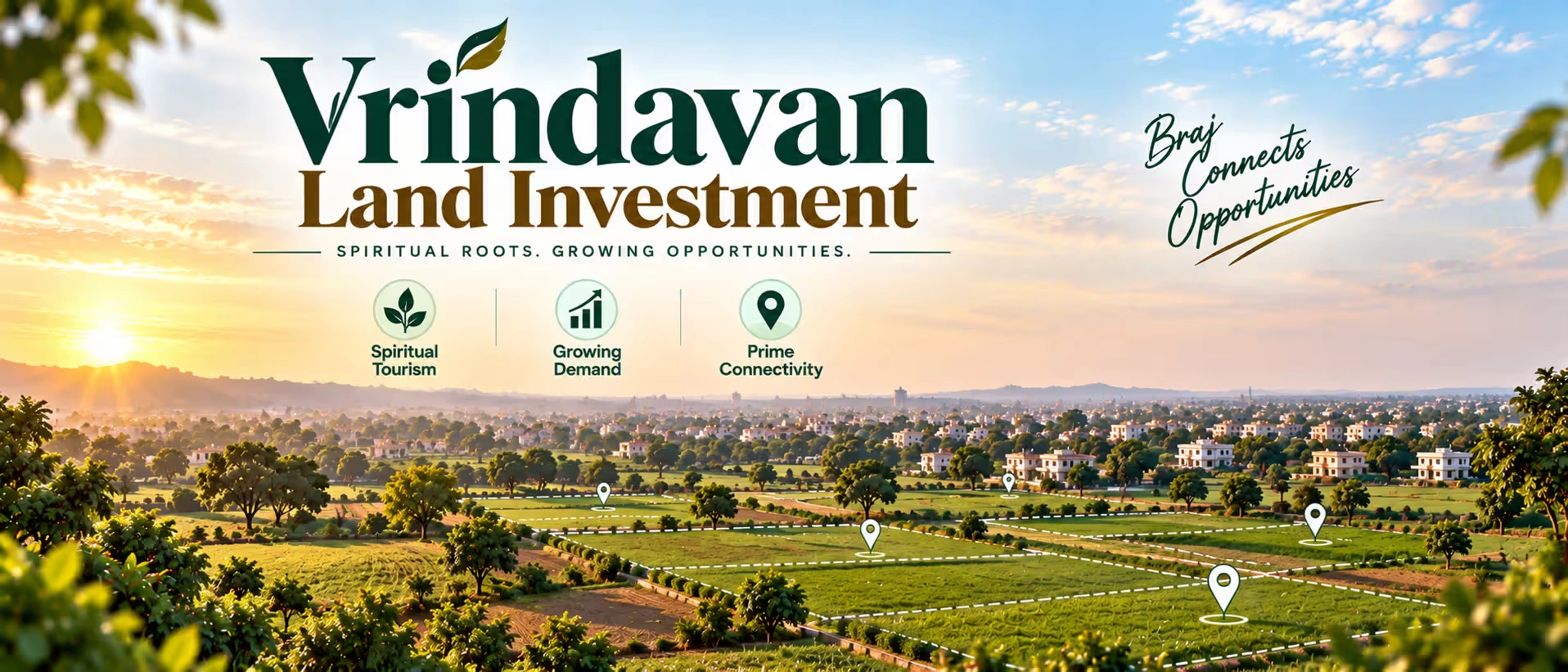
What has attracted people to Vrindavan all along? Devotion – the temples, the ghats on the river Yamuna, the eternal chanting of kirtan through its streets. However, over the past few years, an additional reason has subtly crept into the picture: people are no longer coming and going; they are choosing to settle down here, build a holiday home, or plan their retirement here. It has brought in an entirely new valuation of property in and around Vrindavan. For those who have kept a close eye on this property market or intend to do so, it becomes essential to understand not just its current rate per sq.
Why Vrindavan, and Why Now?
Some factors are combining together here at the same time, which contributes to the significance of the shift.
- Spiritual tourism is on the rise. Vrindavan and Mathura have a constant inflow of tourists throughout the year, not limited to big religious holidays such as Janmashtami.
- Retirees seek meaning, not solitude. An increasing number of retirees, particularly from Delhi-NCR, opt for religious towns as opposed to regular holiday towns, hill stations, or beach resorts.
- Connectivity is real. Improved connectivity to Delhi-NCR has turned Vrindavan into an alternative weekend and retirement destination instead of just a destination for pilgrimage.
- Second-home culture has extended beyond conventional suburbs. The NCR buyers, who used to look only at Gurgaon-Alwar or Delhi-Dehradun corridors, are increasingly considering religious towns as valid alternatives for their second homes.
Who's Actually Buying Land in Vrindavan Right Now?
| Buyer Type | What They're Looking For | Typical Land Preference |
|---|---|---|
| Retirees | A peaceful, spiritually meaningful place to settle long-term | Small residential plots close to temple areas |
| Second-home buyers (NCR-based) | A getaway property for weekends and festivals | Plots on the town's outskirts with easy road access |
| Long-term investors | Land appreciation tied to rising tourism and religious infrastructure | Larger parcels, sometimes still agricultural |
| NRIs with family ties to the region | A home base for periodic visits, often tied to family tradition | Residential or mixed-use plots near established colonies |
| Ashram and trust-linked buyers | Land for religious or community institutional use | Larger contiguous parcels |
This mix matters because it means demand isn't coming from one narrow segment. When multiple buyer types are active in the same market at once, land tends to hold value more steadily than in places driven by a single trend.
What's Driving Retirement Demand Specifically?
Buying for retirement in India would previously be associated with places such as Rishikesh, Haridwar, and hill stations such as Dehradun. Vrindavan is also becoming part of this dialogue; however, it should be appreciated why.
- Daily religious living is made easy, rather than occasional. Being close to the temples allows retired people to visit the temples each day, instead of arranging visits.
- A pre-existing community is already present. Vrindavan already has a well-established population of older individuals and religious establishments.
- The cost of living is still reasonably inexpensive. Living costs in Vrindavan compare favorably against other metropolitan retirement destinations.
- Healthcare facilities have improved, bridging the gap that used to exist.
What Second-Home Buyers Are Actually Looking For?
Second-home demand runs on a slightly different logic than retirement demand, even though both are pushing the same market upward. For landowners considering whether to sell agricultural land in Vrindavan, understanding who is driving that demand can make a significant difference.
- Proximity to the town center, but not necessarily inside the busiest lanes
- Realistic construction potential; buyers want to build, not just hold undeveloped land indefinitely
- Reasonable distance from Delhi-NCR for weekend accessibility
- Some assurance of appreciation, since most second-home buyers view the purchase as part investment, part lifestyle choice
This is where a plot for sale in Vrindavan on the town's edges tends to draw more interest than something deep inside the older, denser core; buyers want walkable access to temples without dealing with the congestion that comes with it daily.
The Agricultural Land Angle
Not all the activity here is about residential plots. A fair amount of land around Vrindavan is still classified as agricultural, and that land is caught in an interesting position right now.
- Some of it is being slowly absorbed into second-home and residential development as the town expands outward.
- Some remains genuinely productive farmland, still valuable for agricultural use on its own terms.
- Buyers looking specifically to buy farmland in Vrindavan are often doing so with an eye on future conversion potential, not just current agricultural yield.
This is something that you should be aware of if you are a landowner of agricultural lands surrounding the town and have been contemplating what you can do. Landowners who want to sell agricultural land in Vrindavan will find that there are buyers who will be interested not only in the current uses but also in the potential future developments of the land.
What to Verify Before You Buy?
Land close to religious settlements comes with its own set of due diligence factors, a few of which are not usually considered when buying regular suburban land.
- Land trust or temple lands. There may be some land in and around Vrindavan that is claimed by religious trusts. Make sure that there is no ambiguity about the title of the land.
- Classification of the land. Is the land classified as agricultural land, residential land, or limited-use land?
- Access roads. There are certain plots on the outskirts that look like an ideal choice, but the access road for such plots may not have been maintained properly.
- Floodplains. Being located next to the Yamuna River, it makes sense to find out whether a particular land plot is part of the floodplains
- Registration and encumbrances. As always, the ownership of land is more important than its price.
Quick Comparison: Vrindavan vs. Other NCR-Adjacent Second-Home Markets
| Factor | Vrindavan | Typical Hill/Getaway Alternatives |
|---|---|---|
| Primary draw | Spiritual significance, daily religious life | Scenery, cooler climate |
| Buyer profile | Retirees, devout families, second-home buyers | Weekend tourists, lifestyle buyers |
| Distance from Delhi-NCR | Moderate, road/rail accessible | Often longer, hill-road dependent |
| Land type available | Mixed, residential, agricultural, institutional | Mostly residential/estate land |
| Long-term demand driver | Religious tourism, aging population choices | Tourism seasonality |
How does 2Bigha help you move in this market?
Vrindavan's land market runs on a mix of long-standing family holdings, trust-linked parcels, and newer development-focused plots, which means documentation quality varies a lot from one listing to the next. 2Bigha's verified listings cut through that by confirming title history and land classification upfront, so whether you're comparing a plot in Vrindavan for a retirement home or scouting farmland with conversion potential, you're working from facts rather than a broker's assurances. The same goes if you're selling. Listing through a verified platform puts your land in front of genuine second-home and retirement buyers actively searching this market, rather than relying purely on local word-of-mouth.
Disclaimer: This article is for informational purposes only and should not be considered investment, legal, financial, or property advice. Real estate regulations, infrastructure plans, market conditions, and government policies may change over time. Readers are advised to verify information with relevant authorities and consult qualified professionals before making any investment or property-related decisions.