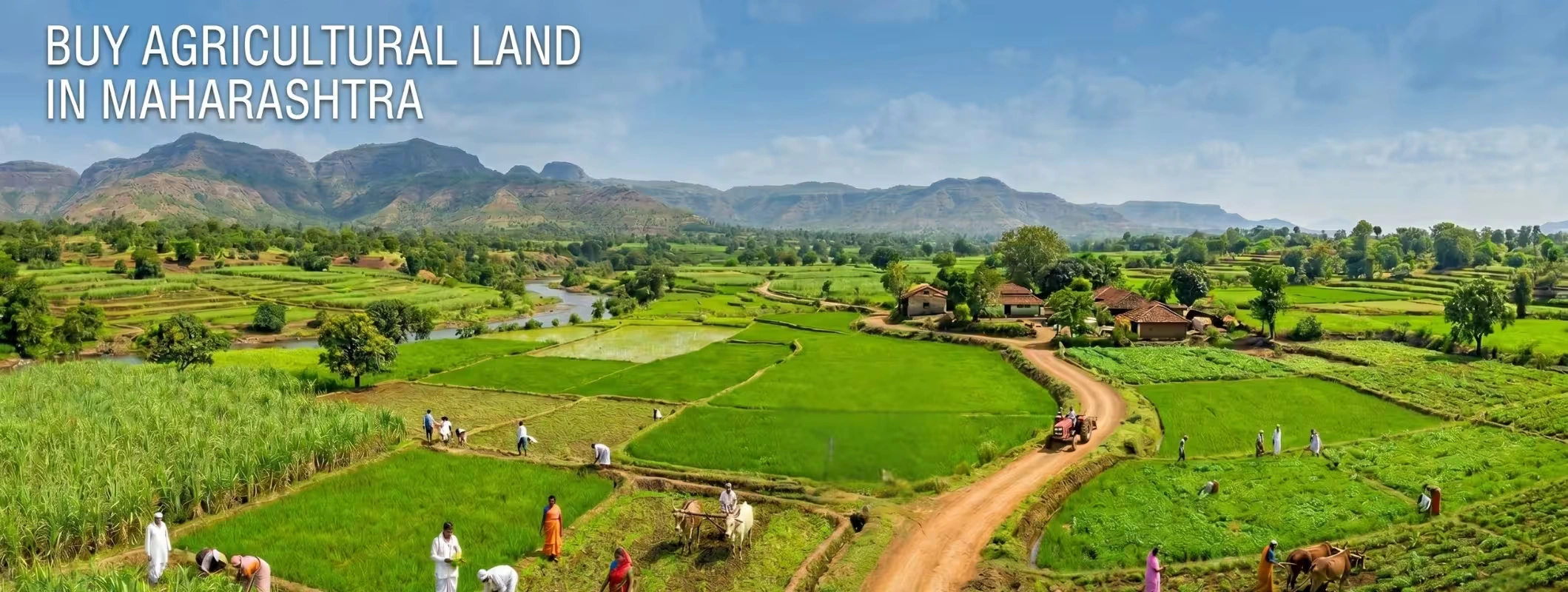
Buying agricultural land in Maharashtra looks simple from the outside. It is not. The real issue is not just finding agricultural land for sale in Maharashtra. The real issue is whether you are legally eligible to buy it, whether the land itself is transferable, and whether the use you have in mind actually matches the law, the regional tenancy rules, and the local planning framework. In Maharashtra, one careless deal can trap a buyer in years of title, mutation, zoning, or transfer disputes.
Key Takeaways
- In most cases, raw agricultural land cannot be validly transferred to a non-agriculturist unless the deal fits a statutory exception or the competent authority grants permission under the applicable regional law.
- Maharashtra does not run on one single tenancy rule everywhere. The Bombay area, Vidarbha region, and Hyderabad area of Maharashtra are tied to different tenancy laws.
- Under the main Maharashtra Tenancy Act and the Vidarbha Act, an “agriculturist” is defined as a person who cultivates land personally.
- If the land falls inside certain municipal or planning limits, or is allocated for residential, commercial, industrial, or other non-agricultural use in the relevant plan, the transfer position can change materially.
- Maharashtra separately regulates change of use under the Maharashtra Land Revenue Code, so buying agricultural land and legally using it for something else are two different questions.
- Ceiling rules still matter. The ceiling area is district, taluka, and land-class specific, and the law bars holding land beyond the permitted ceiling.
- Before paying even a token amount, a serious buyer should verify the 7/12 extract, 8A extract, property card, Index II/title search options, survey map, and mutation path through the official Maharashtra portals.
Can you Buy Agricultural Land in Maharashtra
Yes, but only if the transaction fits the law. For an ordinary buyer, the clean answer is this: if you are not an agriculturist, you should not assume you can directly buy raw farmland in Maharashtra just because a broker says so. The default legal position across the main regional tenancy laws is restrictive, and the burden is on the buyer to prove eligibility, permission, or a valid exception.
That is why “how to buy farm land in Maharashtra” is really a legal due diligence question before it becomes a price negotiation question. A cheap plot with a broken transfer chain, tribal restriction, ceiling problem, or non-compliant land use can become a bad investment very fast.
Why does the Answer Change across Maharashtra
A lot of buyers miss this point. Maharashtra is region-sensitive for agricultural land law. One official state law itself identifies the relevant tenancy framework as follows: the Bombay area follows the Maharashtra Tenancy and Agricultural Lands Act, the Vidarbha region follows the Maharashtra Tenancy and Agricultural Lands (Vidarbha Region) Act, and the Hyderabad area follows the Hyderabad Tenancy and Agricultural Lands Act, 1950.
That means a land purchase in Pune, a land purchase in Nagpur, and a land purchase in parts of Marathwada may sit under different transfer provisions, exceptions, and practical compliance paths. So when someone asks about Maharashtra land purchase rules for non-farmers, the right answer is never one-line and statewide without checking region, tenure, and land use.
Who is Treated as an Agriculturist
Under the main Maharashtra Tenancy Act, an agriculturist means a person who cultivates land personally. The Vidarbha regional law uses the same core definition. This sounds simple, but in practice it matters because the legal validity of the transfer often turns on whether the buyer truly fits that category or instead needs permission or another statutory route.
So if your plan is purely passive farmland investment in Maharashtra, weekend ownership, or future appreciation without actual agricultural status or a lawful exception, that is exactly where buyers start entering risky territory.
When can a Non-Farmer Still Buy
1. With permission under the applicable regional law
In the Bombay area, Vidarbha, and Hyderabad area laws, the default bar on transfer to non-agriculturists is paired with a proviso that allows the Collector or authorised officer to grant permission, subject to prescribed conditions. That means the law is restrictive, but not absolutely closed in every case.
2. If the land falls into a planning-based non-agricultural exception
Under the main Maharashtra Tenancy Act, section 63(1C) carves out land within municipal limits, municipal council limits, special planning authority or new town authority limits, and also land allocated to residential, commercial, industrial, or other non-agricultural use in the relevant draft or final regional plan or town planning scheme. The Hyderabad area law contains a similar carve-out in section 47(3A), again subject to time-bound use conditions.
This is where many people get confused. A land parcel may still be recorded as agricultural in revenue records, but if its planning status and statutory exception route place it in a lawful non-agricultural transfer category, the legal analysis changes. That does not mean every roadside plot can be safely bought as “future NA.” It means the planning documents, tenure conditions, and timeline for permitted use must be checked properly.
3. For bona fide industrial use
Both the main Maharashtra Tenancy Act and the Vidarbha regional Act allow transfer to a person who is or is not an agriculturist for bona fide industrial use in specified situations, and the Maharashtra Land Revenue Code separately provides that, in defined cases, no permission is required for bona fide industrial use of land. These provisions are not meant for casual farmhouse buying or speculative rural land parking. They are structured exceptions with time limits, conditions, and consequences if the intended use is not implemented.
Also Read: Bhulekh Mahabhumi 2026: How to Check Land Records Online in Maharashtra
Legal Criteria Every Buyer should Check Before Paying Token Money
- Your own eligibility: First confirm whether you are buying as an agriculturist, with permission, or under a specific statutory exception. Never start with site visits and price bargaining before this step.
- The land’s exact legal category: Check whether the parcel is Occupant Class I, Occupant Class II, tribal land, new tenure land, or otherwise subject to transfer limits. Occupant Class II and restricted tenure issues can trigger nazarana, reclassification, or separate sanctions. Tribal occupancy transfer is heavily restricted under section 36A of the Maharashtra Land Revenue Code.
- Ceiling compliance: Maharashtra’s ceiling law prohibits holding agricultural land in excess of the ceiling area, and that ceiling depends on district, taluka, and class of land. Buyers who ignore this point can step into an invalid or challenge-prone position.
- Use and zoning: Section 42 of the Maharashtra Land Revenue Code says land used for agriculture cannot be used for non-agricultural purposes without permission, subject to the code’s specific exceptions and deemed-conversion provisions. So if your real intent is residence, plotting, warehousing, tourism, or another non-farm purpose, you must check the proper legal route before purchase.
- Title and record trail: Maharashtra’s official portals themselves direct citizens to verify land records and registration data through the 7/12 extract, 8A extract, property card, Index II, free or paid e-search, map viewing, and mutation services. A buyer who checks only one paper is not doing real due diligence.
- Registration readiness: At the registration stage, the state’s official checklist calls for the stamped original document, proof of payment where applicable, identity cards of parties, identifiers’ IDs, category-specific papers, and Power of Attorney papers when relevant.
Documents Required to Buy Land in Maharashtra
For a farmland purchase, think in two layers: mandatory registration papers and smart due diligence papers.
1. Mandatory registration papers
The official registration checklist includes the original properly stamped document, proof of stamp duty and registration fee payment if paid electronically, ID proofs of all parties, IDs of identifying persons, category-specific papers, Power of Attorney papers where relevant, PDE details where used, and e-Step receipt where applicable.
2. Smart due diligence papers you should insist on before deal closure
A careful buyer should also review the land records and search tools the Maharashtra government itself makes available: the 7/12 extract, 8A extract, property card, Index II, free or paid title search options, survey map, and the mutation pathway. If you are buying as a non-agriculturist under a special route, then the applicable permission order or statutory exception documents become essential, not optional. If the land is being bought for non-agricultural or industrial use, relevant planning, conversion, and land-use compliance papers must also be checked.
Step-by-step Legal Process to buy Farmland in Maharashtra
Start with eligibility, not emotion. Then verify the land records, seller title chain, mutation status, encumbrance search, and planning position. After that, draft the correct deed, pay the applicable stamp duty and registration fee, complete the registration at the Sub-Registrar office, and follow through on mutation so the record trail is updated. Maharashtra’s official portals split this journey into title verification, land records, map access, pre-registration activities, registration, and post-registration mutation.
In plain words, the legal process to buy agricultural land in Maharashtra is not “find land, pay token, sign agreement.” It is “verify legality, then verify title, then verify use, then register, then mutate.” That sequence protects the buyer.
A Practical Word for Buyers and Sellers
If you want to buy agricultural land in Maharashtra or sell agricultural land in Maharashtra, stop treating documentation like a formality. In this market, paperwork is the asset. The 7/12 extract, title search, mutation trail, use permission, and transfer eligibility are not side issues. They decide whether the deal stands or falls.
For people exploring farmland investment Maharashtra opportunities, 2Bigha can be positioned as a smarter starting point: shortlist opportunities, compare locations, and keep your subscription workflow focused on document-first screening instead of broker-first pitching. That saves time and cuts noise before you spend money on site visits.
Conclusion
Buying farmland in Maharashtra is possible, but it is never just a market question. It is a legal eligibility question, a land-use question, a title question, and a compliance question. The safest mindset is simple: do not buy because the land looks right; buy because the law, record trail, and intended use all line up cleanly. That is how serious buyers avoid future disputes and make better rural land decisions.
FAQs - Buy Agricultural Land in Maharashtra
1. Can a non-farmer buy agricultural land in Maharashtra?
Usually not as a default rule for raw agricultural land. The regional tenancy laws generally bar transfer to a non-agriculturist unless permission is granted or a specific statutory exception applies.
2. Are Maharashtra agricultural land rules the same in every district?
No. Maharashtra’s legal framework is region-sensitive, with separate relevant tenancy laws for the Bombay area, Vidarbha region, and Hyderabad area.
3. What is the safest first document to check before buying?
Start with the official land and registration records the state itself surfaces: 7/12 extract, 8A extract, property card, Index II or title search, survey map, and mutation status or process.
4. Is the 7/12 extract alone enough to prove a clear title?
No. It is important, but a prudent buyer should not stop there. Maharashtra’s official systems also point buyers to property card, Index II, free or paid search, map, and mutation-related services.
5. Can land inside municipal or planning limits be transferred to a non-agriculturist?
In certain cases, yes. The main Maharashtra Tenancy Act and the Hyderabad area law both carve out land within specific municipal or planning jurisdictions, and land allocated to non-agricultural use in the relevant planning documents, subject to conditions and time-bound use requirements.
6. Can a non-agriculturist buy agricultural land for industrial use?
In defined situations, yes. The tenancy laws provide a bona fide industrial use exception, and the Maharashtra Land Revenue Code also recognises cases where permission is not required for bona fide industrial use of land.
7. Do I need separate approval to use agricultural land for non-agricultural purposes?
Often yes, unless your case falls under a specific exception or deemed-conversion route under the Maharashtra Land Revenue Code. Section 42 lays down the basic rule, while sections like 42B, 42D, and 44A create special paths in certain situations.
8. What if the land is tribal land?
Then the deal needs much more caution. Section 36A restricts the transfer of a tribal occupancy to a non-tribal and requires prior sanction, with additional protections in Scheduled Areas.
9. Do ceiling laws still matter when buying farmland in Maharashtra?
Yes. Maharashtra’s ceiling law continues to regulate how much agricultural land a person or family unit may hold, and the ceiling depends on district, taluka, and land class.
10. What documents are officially needed at the time of registration?
The official checklist includes the original stamped document, fee payment proof where applicable, IDs of parties, IDs of identifying persons, category-specific papers, POA documents where relevant, and PDE or appointment details if those systems were used.
11. What happens after registration?
Registration is not the last step. Maharashtra’s official property workflow separately points to post-registration mutation services, which means buyers should follow through on the revenue record update process after the deed is registered.
12. Is this topic important for both buyers and sellers?
Absolutely. A seller who wants to sell farmland in Maharashtra and a buyer who wants to purchase farmland in Maharashtra both need the same thing: a lawful transfer path, clean records, and correct use classification.
This guide is informational and should be checked against the exact district, tenure, and land-use facts of your case before execution of any deed.